
ClimateX and the JERICA Prize: What Early Support Makes Possible
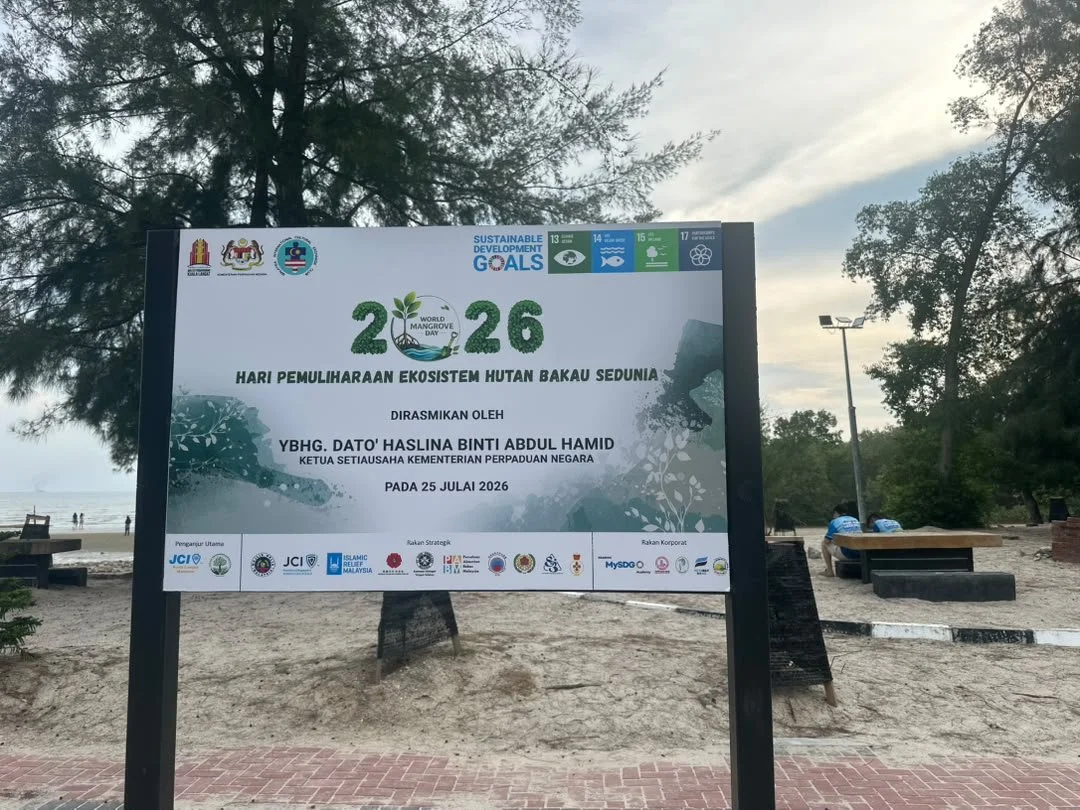
World Mangrove Day 2026 signboard at the planting site in Malaysia, 25 July 2026. Photo courtesy of Ho Wei Liang (Liam), ClimateX.
Why We Back Ideas Before They Are Proven
Most of the funding conversations I have been part of start after something has been proven. There is a pilot with results, or a prototype that works, or a team that has been at it long enough to look like a safe bet.
I understand why. But it means a lot of good ideas run out of the road in the stretch between a strong pitch and a first field test, and in my experience, the idea itself is rarely the reason. What is missing is someone willing to put a modest amount of money and a fair amount of trust behind it before the evidence exists.
ClimateX is one of the ideas we decided to back at that stage. It is a youth-led project that uses drones and AI to monitor mangroves, and it was one of five teams to receive the 2025 JERICA Prize through Moonshot Pirates’ Shape the Future Challenge. A year on, I want to share where it has got to, what the support did in practice, and what I think it says about how early backing works.
Moonshot Pirates and the JERICA Prize
Moonshot Pirates is a free, global impact accelerator for people aged 15 to 24. It has been running since 2019, and in that time, more than 15,000 young people from over 160 countries have taken part. The whole point of the programme is that a good idea should not depend on where you were born, what your family can afford, or how close you live to the places where ideas usually get funded.
My colleague and JERICA Co-CEO Jules Harrison-Annear was a mentor on the programme for two years and a judge in the 2025 challenge. Being that close to it showed us something the final pitch and focus on one ‘winner’ can obscure. Some of the strongest thinking, and some of the most committed people, were on teams that did not make the final.
So in 2025 we set up the JERICA Prize. We chose five teams from across the whole programme, and we deliberately did not limit ourselves to the finalists. We focused on teams that brought us hope.
Each team received mentorship and masterclasses, access to a global network of people who could help, and USD 1,000 to spend on whatever their project needed most.
The amount is small on purpose. What interests me is what happens when a young founder is trusted to decide where the money goes.
Catalyst Kits: What’s in the Name
The JERICA Prize launched the programme we call Catalyst Kits. It supports young people with system-changing ideas by giving them a collegial community, structured learning and mentoring, and seed funding.
We chose the name carefully. Kits are young beavers. They learn from their parents how to build and maintain dams, and a family of beavers can change an entire landscape. Young impact entrepreneurs can be catalysts for system change in a similar way, if they get the time and support to build and maintain the ecosystems their ideas need.
I will be candid about the context they are working in. Many of the people who currently hold power, design the guardrails and receive capital are also the people who designed, and now maintain, the dominant systems we all live within. Understandably, they find it hard to see the value in alternatives. Catalyst Kits exists to help emerging impact leaders think critically about how they want to lead, do business, and affect the world, so that they can take an active part in creating systems that do better for people and for the planet.
At JERICA, we tend to think in generations. Change starts now, but the ripples of that change into fairer and more regenerative global systems will take a long time to spread. That is why backing a young team’s mangrove project feels to us like a long-term position. It is certainly not charity.
The Problem ClimateX Is Working On
Mangroves are one of the most useful ecosystems on the planet, and they are disappearing quickly. ClimateX’s own research puts global loss at somewhere between 35 and 50 percent since the 1980s, mostly because of shrimp aquaculture, urban expansion and deforestation.
It is easy to underestimate what goes with them. A mangrove forest stores carbon at three to four times the rate of a tropical rainforest. A hundred metres of it reduces the energy of incoming waves by around 60 percent, which for the villages behind it can be the difference between a bad storm and a disaster. Around 70 percent of tropical fish species use mangroves as nurseries. So when a forest is cleared, the carbon it held is released, the coast is left exposed and, over time, the fishing gets worse.
The good news is that restoration is happening. There are planting days and volunteer groups and community organisations doing patient work along coastlines. What is usually missing is what comes after the planting: reliable information about whether the seedlings survived, how the forest is actually growing, and where the next effort should go. Without that, decisions get made on guesswork, and the people who paid for the planting find it very hard to see what their money achieved.
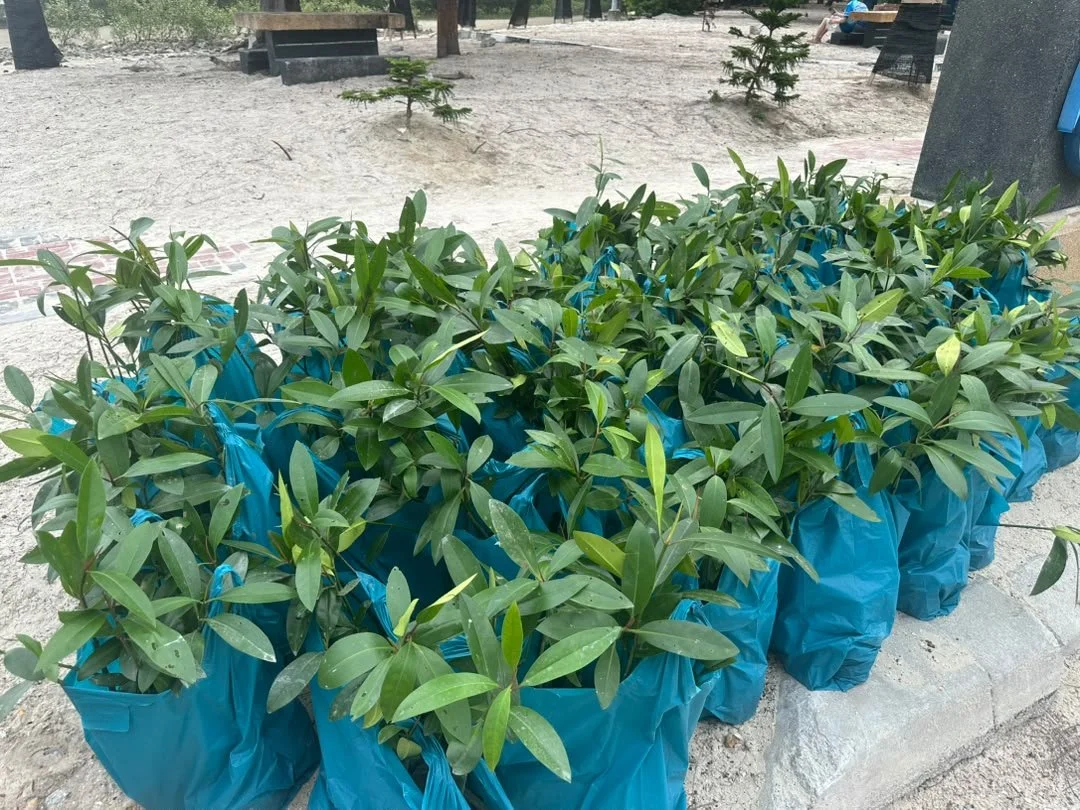
Mangrove seedlings ready for planting on World Mangrove Day, 25 July 2026. Photo courtesy of Ho Wei Liang (Liam), ClimateX.
How Drone- and AI-Based Mangrove Monitoring Works
ClimateX’s answer is to make that information cheap enough for a community to collect.
The approach uses two sources of imagery. Satellite data from the Sentinel-2 programme gives broad, regular coverage of a coastline. Drones fly much lower and capture far finer detail of individual restoration sites. An AI model that has been trained to recognise mangrove cover reads both, and produces maps showing where mangroves are, how dense they are, and roughly how much biomass they hold.
If you do that again and again over the same sites, you get something communities rarely have access to: a clear data-based picture of change over time. You can see which plots are thriving and which are failing, and you can put your effort and your next round of funding where it will make the most difference.
The team’s longer-term design goes further than this. There is a mobile application, Mangrove Guardian, for registering sites, delivering training, and tracking progress. There is a model in which verified restoration generates carbon credits, with 70 percent of the revenue going back to the communities that did the work. Those are ambitions for later phases, and I think it is right to treat them that way. What matters now is the foundation underneath all of it. Can this monitoring approach work in the field, on a real coastline, alongside the people doing the planting?
That is the question Liam is testing.
Where ClimateX Is Now: Liam’s Update
Ho Wei Liang, who goes by Liam, is the member of the ClimateX team carrying the project forward. He has agreed to let us share his name, this update, and the photos in this blog post.
Liam has secured around €3,000 in initial funding from Europe. That sits alongside the support he has had from JERICA, which has included mentoring, introductions, and non-equity seed capital to help develop a working prototype.
He is now working with a Malaysian community partner that has a great deal of experience in mangrove planting. On 25 July 2026, World Mangrove Day, he joined one of their planting activities with around 100 volunteers. The partner has since invited him to keep contributing over the long term on the technology side.
To my mind, that invitation is the most important line in the whole update. Technology that arrives from outside tends to just be tolerated by the people on the ground. Technology they have asked for tends to get used.
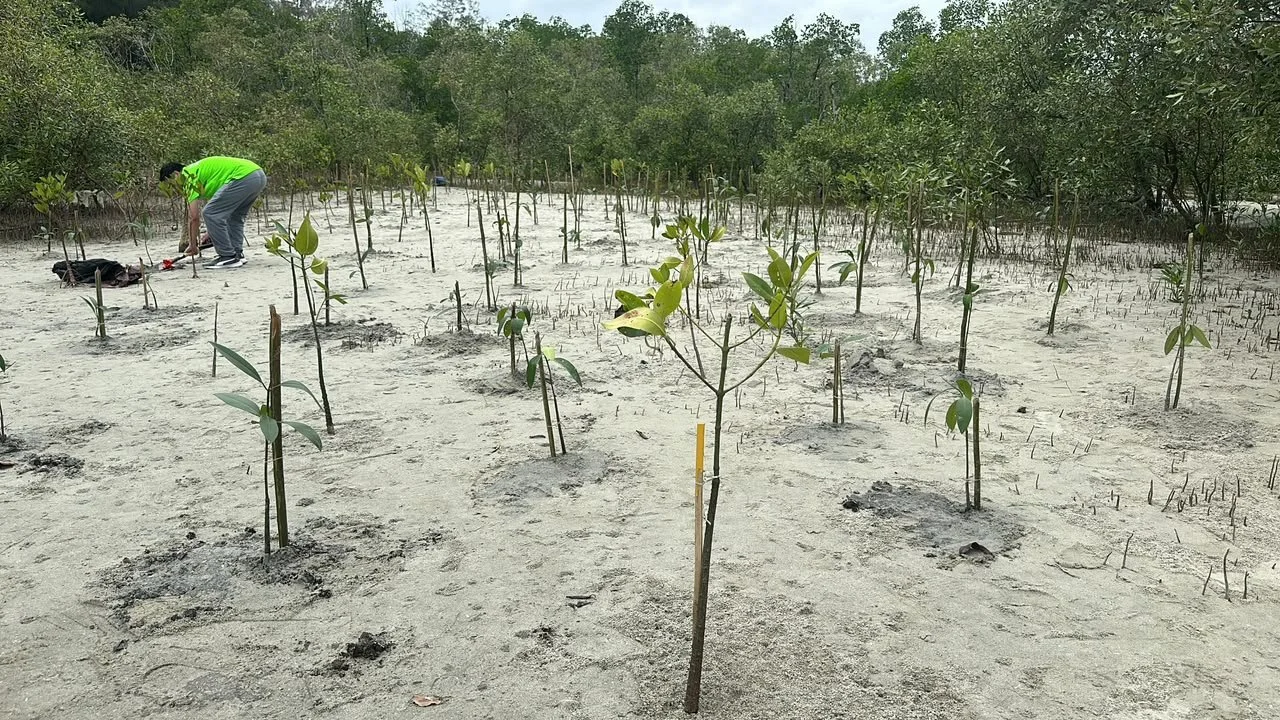
Newly planted mangrove saplings, staked and marked, at the restoration site, 25 July 2026. Photo courtesy of Ho Wei Liang (Liam), ClimateX.
His focus now is field testing, which means taking the drone- and AI-based approach out of the pitch deck and onto an actual restoration site. Together with the local partner, he plans to collect testing data and use it to prepare a proposal for government support in Malaysia.
There are real constraints, and I would rather share them than skate over them. The most immediate one is hardware. Liam is exploring affordable, reliable drone and IoT options, and he is investigating whether equipment can be borrowed from a university or research centre. The original team has also become less active as its members focus on their studies and university commitments, so for now, it is Liam alone who is moving the project forward.
There is one more part of the journey worth sharing, because nobody warns a first-time founder about it. ClimateX began as a team name for a closed competition, chosen quickly and never meant to outlive the pitch. As the concept has developed, Liam has been considering a new name, CarbonX, that better reflects what he is now building. A quick search shows that both names are already used by established companies in other markets, so before anything is confirmed, we are working through the trademark and branding checks with him, as we do with other Catalyst Kits participants. To any company that shares one of those names: please take this as a young person finding his way into entrepreneurship and trying to do the right thing. As anyone who has started a business will know, there is nothing unusual about choosing a name and then discovering it is already out there. Doing the checking now, with patience, is part of what the programme is for.
I do not see these challenges as signs of weakness. Most early-stage projects go through moments like this. What decides whether impact projects survive is often whether one person keeps showing up and if the relationships around that person stick and evolve. On both counts, ClimateX is in a stronger position than it was a year ago.
What a Small Amount of Early Support Can Do
I have heard people say that what would be considered in some circles as a small amount does not change much, and in purely financial terms, they are right.
But everything is contextual. Look at what has gathered around it over the past year. A mentoring relationship. Introductions. A small amount of capital that a young founder could direct without asking anyone’s permission. The ability to access tools and services that seemed unattainable for them. And a signal to other people with the potential to support that someone has already looked closely at this project and said yes.
When capital supports a founder instead of controlling them, the early decisions stay with the people closest to the work. Trust builds, and the next yes gets a little easier to win. That is the mechanism, as far as I can tell, and it is the reason we structured the prize as non-equity seed funding with mentoring alongside it. There are no strings attached.
The Kind of Leadership We Look For
There is one more thing this story shows, and it is the view of leadership we hold at JERICA.
Liam has not gotten this far by pitching harder. He got here by turning up to a planting day, by listening to a community partner who knows that coastline far better than any dataset does, by being clear about what he needs, and by staying with the work when the team around him thinned out.
That is what ethical leadership - integrity, clarity and care - looks like in practice, together with the kind of collaboration that outlasts a funding cycle. There is nothing performative in any of it, and it is exactly what makes a project like this worth backing.
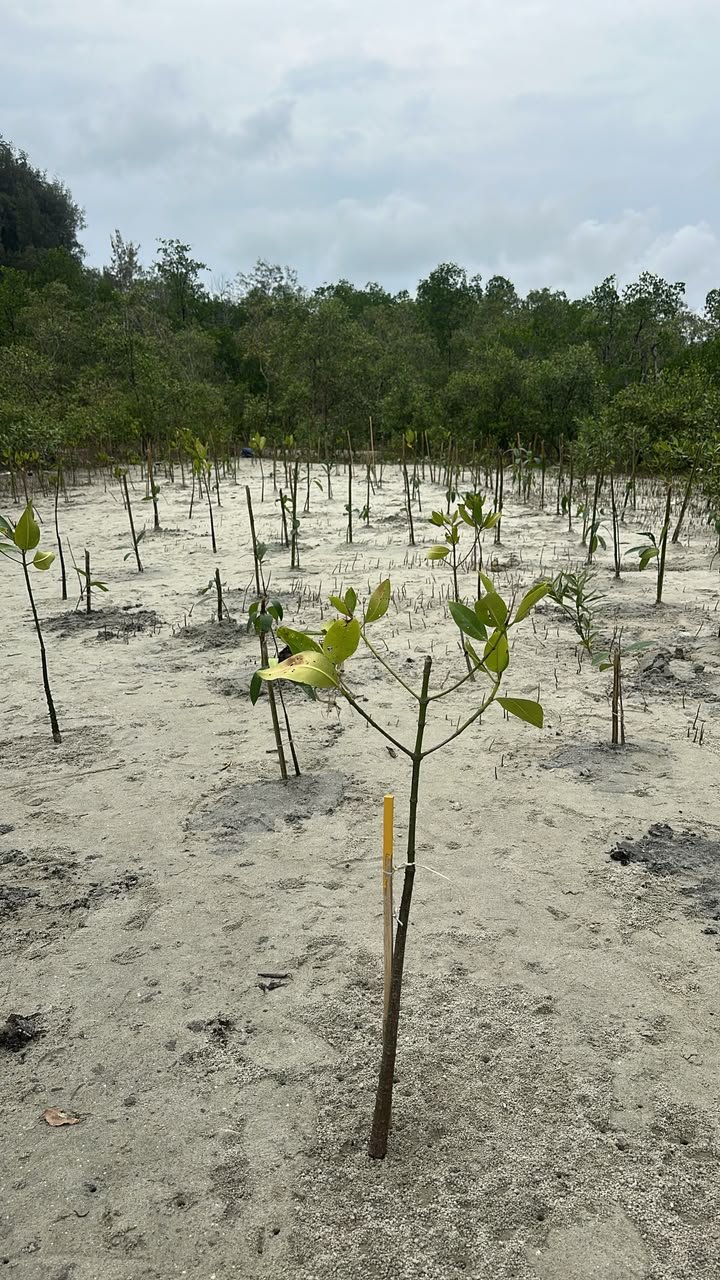
A staked mangrove sapling at the planting site. The next step for ClimateX is measuring how plots like this one grow over time. Photo courtesy of Ho Wei Liang (Liam), ClimateX.
Walking Beside the Next Generation of Changemakers
Our partnerships, with organisations like Moonshot Pirates, are a long-term commitment to young people with system-changing ideas. ClimateX is one of five teams we backed in 2025, and we will keep sharing their progress as it happens.
If you work in mangrove restoration or environmental monitoring, or you have access to drone or IoT equipment that could support a field test in Malaysia, we would be glad to make the introduction. Book a call with me here.
You can read more about our partnerships with organisations such as Moonshot Pirates, The Earthshot Prize, Conscious Marketing Movement, and beyond. Or connect with Jules or me on LinkedIn.
The next move is yours.
FAQ on ClimateX and the JERICA Prize
-
ClimateX is a youth-led project that was presented in Moonshot Pirates’ 2025 Shape the Future Challenge. It is developing a drone- and AI-based way of monitoring mangroves, so that communities restoring them have useful environmental data and can make better decisions about where to plant and how to care for what they have planted.
-
Drones and Sentinel-2 satellite imagery capture pictures of a coastline. An AI model that has been trained to recognise mangrove cover reads those images and produces maps of where mangroves are, how dense they are, and roughly how much biomass they hold. Done repeatedly over time, this shows which restoration plots are doing well and which need attention.
-
The JERICA Prize took place in 2025. It recognised five outstanding teams from across the Moonshot Pirates’ challenge programme, and was open to all participant teams whether they won the final pitch or not. Each team received mentorship and masterclasses, access to a global network of support and collaboration, and USD 1,000 in non-equity funding to invest in what matters most to their project.
-
Catalyst Kits is JERICA’s programme for young people with system-changing ideas. Ideas that bring and sustain hope. It gives them a collegial community, structured learning and mentoring, and access to seed funding. The name comes from beaver kits, which learn from their parents how to build and maintain the dams that reshape their surroundings.
-
Moonshot Pirates is a free, global impact accelerator for young people aged 15 to 24. Since 2019, more than 15,000 participants from over 160 countries have taken part, with the help of more than 500 mentors and 30 local chapters. Its mission is to make youth-led problem-solving accessible regardless of geography, financial means, or proximity to established hubs.
-
The most useful support right now is practical. Liam needs access to affordable, reliable drone or IoT hardware, connections to universities or research centres in Malaysia that lend equipment, and people with experience in mangrove restoration or environmental monitoring. If that sounds like you, get in touch with JERICA, and we will make the introduction. Book a call here.