
Building the Africa We Want: Why I Said Yes to Nairobi in November 2026
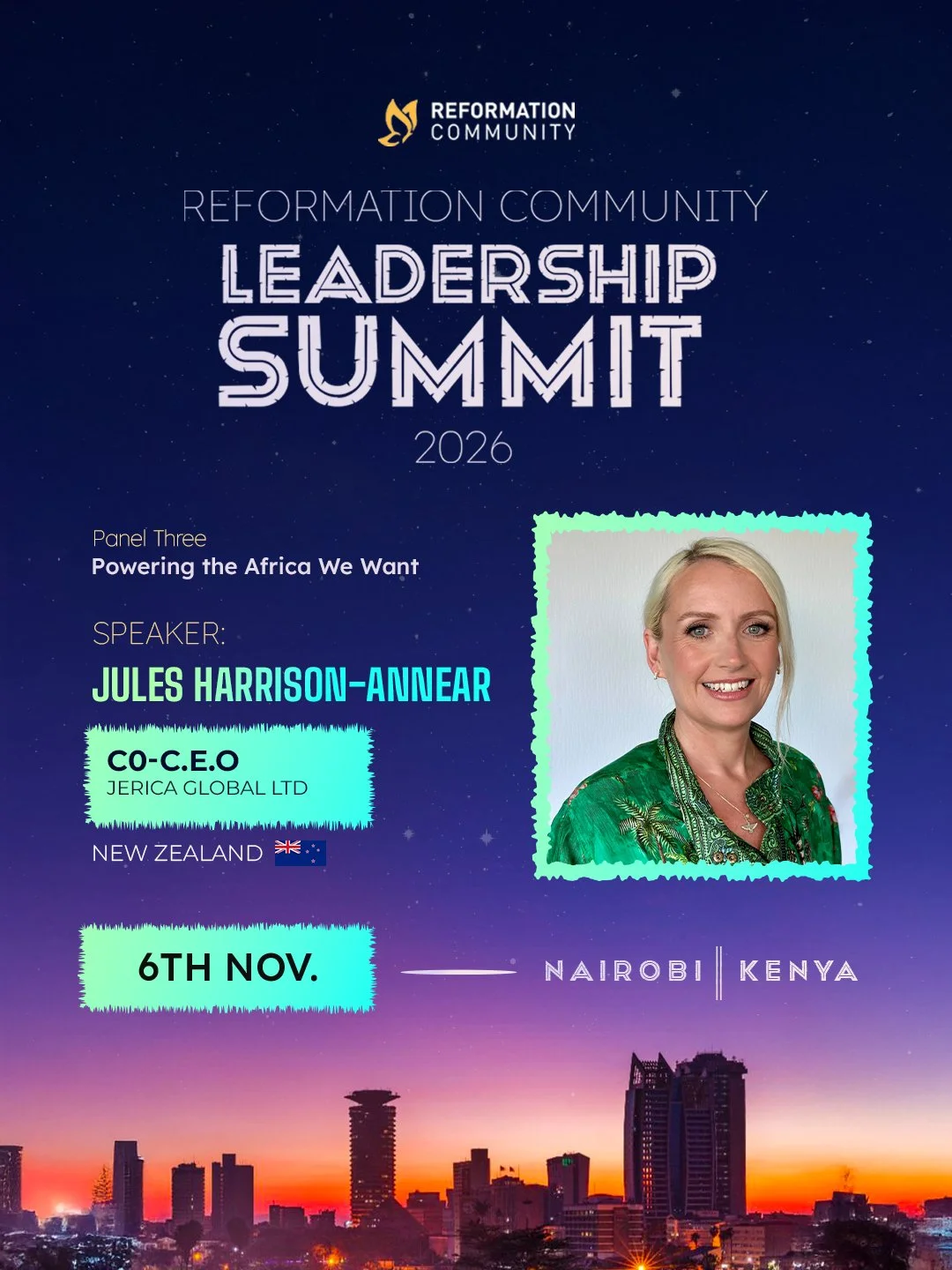
Speaker announcement for Panel Three, Powering the Africa We Want. Image: Reformation Community.
A Summit That Asks Harder Questions
On 6 November, I will be in Nairobi, speaking at the Reformation Community Leadership Summit 2026. JERICA Global is an official partner of the summit, and I have been asked to join Panel Three, Powering the Africa We Want, on climate resilience, the green economy, and a just transition.
I want to share why I said yes, because it was not an automatic decision. I am invited to a fair number of conferences, and most of them cover the same ground in Europe as they do in New Zealand.
This one is different.
The theme is Building the Africa We Want. Put simply, Africa already has its plans for the future. The African Union’s Agenda 2063 and the UN Sustainable Development Goals set out where the continent wants to go, and Kenya has gone further than most by devolving power to 47 county governments so that decisions are made closer to the people they affect. The gap the summit is interested in is follow-through: how a signed commitment turns into something a young person living and leading into the future can actually feel. And with more than 60 percent of Africa’s population under 25, the organisers’ view is that the generation who will live with the results should be the ones closing that gap.
What drew me in is where the summit chooses to position itself. It brings intergenerational thinking, civil society and the environment into the same room and treats them as one ethical conversation. In my experience, that intersection is where the boldest ideas live, and it is also where the complexities of supporting these ideas to fruition aren’t always giving a clear platform. I wanted to be involved in discussions that bring together complex issues on purpose and without apology.
Who Is in the Room
Reformation Community is a Pan-African, youth-led organisation. It was founded in 2016, is headquartered in Accra, Ghana, and works through university chapters and member communities in ten African countries. The summit is its flagship annual gathering.
This year it expects more than 500 delegates in Nairobi and over 3,000 joining online: students, young professionals, entrepreneurs, civil society and community leaders, policymakers and development practitioners. Reformation Community founder Ewura Ama Jenkins believes, as I do, that young people are not a constituency to be planned for. They are the people who will design, decide and carry out the plans - and the status quo approach is not sufficient for the world they will need to navigate and thrive within.
The summit itself is deliberately practically-focused. One keynote, three panels, ten Solution Labs, and the finals of the Enda Social Venture Challenge, where finalist teams pitch to a judging panel for a USD 2,000 prize. The panels are built around real tensions that young people are living, and every session is meant to support people to move from listening to building.
Panel Three: Powering the Africa We Want
My panel takes on the green transition, and as with most ethical issues, we aren’t at an easy version of a story.
Kenya, like many places in Africa and beyond, holds two truths at once. For Kenya, most of its electricity already comes from geothermal, wind, and hydro. Nairobi hosted Africa’s first continental climate summit. At the same time, prolonged drought has pushed pastoralist and farming communities to the edge. A common harsh reality of climate breakdown is that the people least responsible for the crisis are carrying the heaviest cost.
So the questions the panel will start with are pointed ones, relevant well beyond Kenya or Africa. They are leadership questions, and they are worth asking in any work you lead.
How do we make the transition just for everyone, and not only profitable for investors?
What do carbon markets and climate finance actually deliver to the communities living the crisis?
Where are the real jobs in the green economy, and what stops young people from getting them?
These are the types of questions I ponder in my own work. At JERICA we talk often about moving from extraction to regeneration, and it is an easy thing to say. It is much harder to answer when someone asks who benefits, who decides, and what is left behind when the money moves on.
I don’t expect a panel to settle any of that in forty-five minutes.
What I hope for is the same thing I look for in every room I facilitate: that people leave with a clearer sense of what they stand for, and with one decision they are willing to make differently because of it. In my experience, change rarely starts with a big plan, although having a long-term vision of where you want to get to is helpful.
It starts with each of us having clarity on what matters to us, and with the confidence to use the agency we have to make the next decision with as much care and impact as possible.
Solution Lab 2: Climate Resilience and the Green Economy
In the afternoon, JERICA will lead one of the ten Solution Labs: Lab 2, Whose Place, Whose Plan - Local Agency in Climate Resilience and Adaptation, with a focus on ethical decision-making.
A Solution Lab is a facilitated working session that takes a single, defined challenge and moves it from problem to plan. This can involve root-cause analysis, stakeholder mapping, and developing a practical solution aligned with Agenda 2063. The main focus is for participants to work collectively to develop a six-to-twelve-month action plan: who they need to partner with, what they need to make it happen, and how they will know whether it is working. Delegates choose one lab and stay with it for the full session.
Whose place, whose plan — 75 minutes, one real local climate adaptation challenge, and eight plans that did not exist earlier that morning. Participants will bring what they already know about the places they are from, work together, and leave with a plan, a slogan, and one thing they can start to do on Monday without anyone's permission.
The strongest outputs feed into the pitching finals.
This is the part of the day I am most looking forward to. Facilitating sessions where people get the support to practise ethical decision-making in real time, on real problems, is the work I love most at JERICA. And taking a group from an idea to a plan they can actually carry out is what I do with our Catalyst Kits cohorts. So the lab format is familiar ground.
It is also where intelligence and unique perspectives tend to surface, mix together, and create a little magic.
Panels are interesting because you get to hear different perspectives and see how they meet, challenge, and build on one another. But working sessions are where you find out what people are actually dreaming about and, hopefully, help them take the next step towards making it happen.
If you would like reflections and practical resources on ethical leadership and systems change, you are welcome to join our monthly newsletter or listen to our podcast.
JERICA Global is an official partner of the Reformation Community Leadership Summit 2026. Image: Reformation Community.
Why This Matters to Me, and to JERICA
I grew up in Zambia, Malawi, South Africa, and the UK. My commitment to equity and regeneration is personal before it is professional, and I have never lost the sense that the resilience which communities have is a thing worth building around.
It is also why I recognise this context. At JERICA we run a programme called Catalyst Kits, for young people with system-changing dreams. Ideas and ideals that bring and sustain hope. We give them a collegial community, structured learning and mentoring, and support. The name comes from beaver kits, which learn from their parents how to build and maintain the dams that reshape their surroundings.
Through Catalyst Kits, I mentor young climate entrepreneurs across Africa, Asia, Europe, and Latin America. The summit is asking its delegates to do the very thing our kits do: take an idea seriously enough to turn it into a plan, then find the inner strength, build the relationships and source the means to carry it out. That is what the Solution Labs are for, and what is recognised in the pitching finals.
It is part of a pattern for me. I have mentored and judged with Moonshot Pirates, a global accelerator for young people, and I nominate and evaluate climate solutions for The Earthshot Prize. Each of those has taught me something similar: accelerators are good at teaching a pitch deck and how to find traditional funding arrangements. Far fewer teach a young founder how to lead themselves through all of it. How to hold on to your purpose when the pressure arrives. How to decide well when there is no clean answer.
That gap is what JERICA’s ethical leadership work is about, and it is part of why Nairobi matters to us. We are developing a wider set of programmes on ethical leadership, and I want to spend time with the people who are already doing this work, to learn from them and share what I know.
So if you work with young founders through an accelerator, impact programme, university innovation lab or social entrepreneurship course, or you lead a foundation or network supporting young people across African countries, I would love to talk!
I hope to leave Nairobi with a more honest understanding of what these organisations need: where ethical leadership already lives in their work, where it is missing, and what we might build together next. I am going there to listen at least as much as to speak.
I will arrive a couple of days before the summit, before and after I’ll have some time to meet with people from a number of local and pan-African organisations operating within the same ecosystem of impact-focused work as JERICA. Leadership can’t just stay inside a conference; it has to carry through to the relationships that sustain us, the lives we impact and the realities we work within.
Reformation Community Leadership Summit 2026, Nairobi, Kenya, 6 November. Image: Reformation Community.
Join Me in Nairobi or Online
If you work in climate resilience, youth leadership, or the green economy, I would especially love to connect - whether you are attending the summit or are based in Nairobi. The Reformation Community Leadership Summit is open to attend in person in Nairobi or online. You can find registration details here.
Join me for Panel Three or Solution Lab 2, introduce yourself afterwards, or connect with me on LinkedIn before the event so we can arrange a time.
The next move is yours.
FAQ on the Reformation Community Leadership Summit 2026
-
It is the flagship annual gathering of the Reformation Community, a Pan-African, youth-led organisation founded in 2016 and headquartered in Accra, Ghana. The 2026 summit brings young leaders together for a keynote, three panels, ten Solution Labs, the finals of the Enda Social Venture Challenge and an award ceremony, under the theme Building the Africa We Want.
-
Summit day is Friday 6 November 2026 in Nairobi, Kenya, with the option to join in person or online. It sits within a wider delegate programme from 4 to 10 November that includes a community outreach at Nyumbani Children’s Home on 7 November.
-
Jules joins Panel Three, Powering the Africa We Want, which looks at climate resilience, the green economy and a just transition. The panel asks where the real jobs in the green economy are, what carbon markets and climate finance deliver to communities living the crisis, and how the transition can be made just for pastoralists and farmers as well as investors.
-
A Solution Lab is a facilitated working session that takes one defined challenge from problem to plan, ending with a six-to-twelve-month action plan. Ten labs run in parallel on the afternoon of 6 November. JERICA leads Lab 2, Climate Resilience and the Green Economy.
-
Catalyst Kits is JERICA’s programme for young people with system-changing ideas. Ideas that bring and sustain hope. It gives them a collegial community, structured learning and mentoring, and access to seed funding. The name comes from beaver kits, which learn from their parents how to build and maintain the dams that reshape their surroundings. We are currently preparing for 2 cohorts in 2027, working with partners to identify participants and those who want to sponsor and support the cohorts and the learning and leadership they develop over time, together.
-
You can join in person in Nairobi or online. Registration and delegate packages are on the Reformation Community summit page. If you would like to meet Jules in Nairobi, connect with her on LinkedIn.