
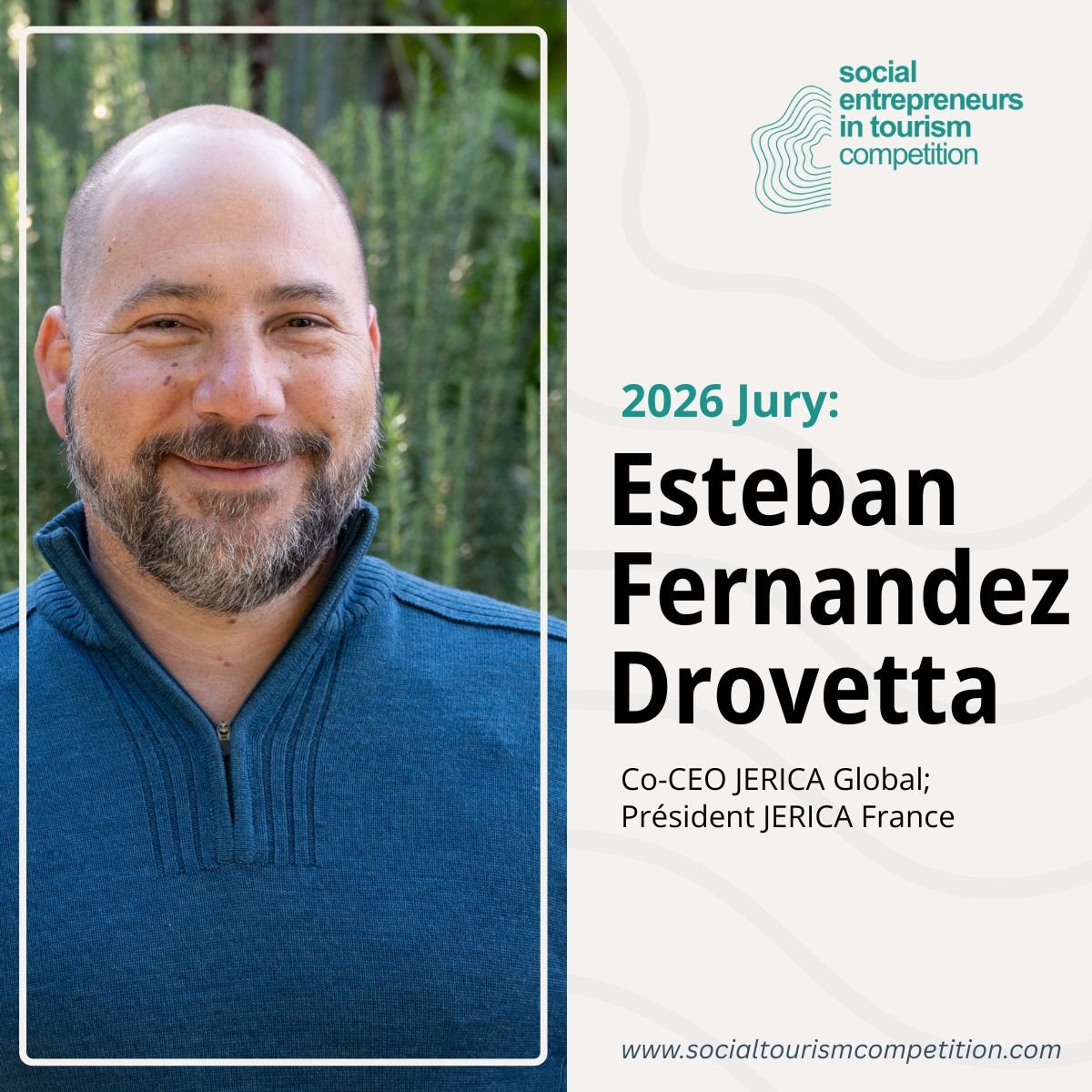
Esteban Fernandez Drovetta, Co-CEO of JERICA Global, on the 2026 SET Competition jury. Image: Social Entrepreneurs in Tourism Competition.
Why I Said Yes to the Jury
Earlier this year I joined the jury of the 2026 Social Entrepreneurs in Tourism Competition, the first worldwide competition for social innovation and entrepreneurship in tourism. This year the competition received 238 applications. After an eligibility review, 201 of them went to the jury, and between the end of July and early September each one was read independently by at least two of us. On 10 September, ten finalists were announced, five in the Launch Track and five in the Growth Track. They are now in a month of mentorship, and on 23 November 2026 they will pitch at the final.
I want to share what that experience was like, because it had a lasting impact on me.
I said yes for a simple reason: the competition sees the world the way I do. Social enterprises and impact businesses have an important role to play in the economies that are coming, and tourism is one of the places where that role is most visible. I have worked in tourism since early in my career, and it sits close to what we are building at JERICA. I hoped that what I have learned as an entrepreneur, an impact investor and a changemaker might be useful to people whose ideas are trying to make things better for people and planet, and that I could offer something that was both grounded and hopeful.
An idea becoming an innovation needs support and encouragement along the way. The SET Competition gives these initiatives a window in which to be noticed, recognised and valued. That is not a small thing when you are building something new.
A Record Year, and a Movement Growing
This was a record year. Those 238 applications came from 74 countries, a 20.8 percent increase on 2025 and the most in the competition’s history. Since it was founded in 2019 by Professor Dr. Claudia Brözel of the Eberswalde University for Sustainable Development, the competition has drawn more than 600 applications from over 60 countries, and it is backed by partners including Amadeus, ITB Berlin, Lufthansa City Center and Travel Massive.
Those numbers tell you something about the people applying. Behind each application is a founder or a team who has looked at tourism in their own place and decided it could work differently: that it could protect an ecosystem instead of wearing it down, that it could create fair jobs where there were only seasonal ones, and that it could put real value back into the community that hosts the visitors. There are enough of them now that I would call it a movement.
What Stood Out
Reading the applications, I was asked to look at holistic impact, clarity of purpose, passion, how well the initiative fits into the wider social entrepreneurship landscape, and how deeply the founders understood both the people and the ecosystem their work sits inside. Those are the things I tend to look for anyway.
Some applications surprised me. A few presented very interesting reframings of challenges I thought I understood, or of solutions I assumed were settled. Others described their initiative with a connection between all the parts of its ecosystem that was really well thought through, so that the guide, the homestay, the artisan, the conservation work and the revenue all belonged to one system.
Two trends stood out, and both are hopeful.
The first is disability inclusion. More applicants are designing for visitors and workers who have too often been an afterthought in tourism, and they are doing it inside the business model, where it belongs.
The second is local and Indigenous destinations. More initiatives are led by, or built around, the communities who hold the knowledge of a place, with tourism designed so that this knowledge stays local and the revenue reaches the people who carry it.
Both of these are gaining momentum in the industry and in policymaking at the same time. It means the initiatives choosing this path are standing in the right place for the shift that is coming.
Across the finalists, you can see the shape of it: community ownership of tourism assets, livelihoods for guides, artisans and women’s cooperatives, conservation of wetlands and forests funded by the visitors who come to see them, traditional knowledge treated as something to be respected and paid for, and, in one case, small tourism creators proposing to own their own digital booking tools together instead of depending on platforms that take more than they give.impact as possible.
The Hard Part of Judging
The hardest part of being a juror is giving each initiative an analysis that is fair and truthful, so that they leave the process knowing whether they are on the right path for impact as a social enterprise, whatever the score says about the idea itself. A generous score does nobody a favour if it leaves someone building in the wrong direction.
My own background is in leadership, entrepreneurship, impact, strategy and systemic design, and it shapes how I read an application. I look for systemic change that may take years to show a result, which pulls me away from traditional metrics and towards wellbeing economics, the social and environmental implications of what is being proposed, and the intergenerational value it might create. I evaluated every application on its own merits and in its own context. But within SET, I also read each one against what it means to be a social enterprise or an impact business.
If you are ever asked to sit on a jury like this, my advice is to read every application as though it were the first one you opened. Each one comes from its own context and deserves your full attention. The deadlines give you time to return the effort the applicants put in, so use it.
JERICA Global is an official partner of the Reformation Community Leadership Summit 2026. Image: Reformation Community.
Tourism as Catalyst Enterprise in Practice
There is a reason this competition matters so much to us at JERICA, and it goes beyond the sector.
We talk about catalyst enterprises: businesses designed to create positive, lasting change far beyond their own commercial success.
A catalyst enterprise earns its living, but its purpose reaches further. From the outset, it is built to challenge assumptions, demonstrate new possibilities, and shift the practices and systems around it. It then uses its position to set wider change in motion: in the micro-enterprises that emerge alongside it, the skills and capabilities people develop, the land and natural systems that recover, and the community that gains a stronger voice in shaping its own future. Its success is measured as much by what it enables to grow and change around it as by what the enterprise itself becomes.
Tourism brings together nearly everything JERICA cares about in one place. Cultural sovereignty: who decides how a place, its customs and its stories are shared with visitors. Environmental regeneration: whether the coast, the forest or the wetland is better off because people came. Social inclusion: who gets to work in tourism, and who gets to travel. Economic participation: where the money goes once the visitor has paid.
The finalists I read this year are catalyst enterprises in practice. In each of them, the social purpose is the business model itself. That is what made them stand out, and it is what makes them worth supporting.
Where This Meets Cécile and Catalyst Projects
There is an additional reason why JERICA committed to the SET Competition. Cécile is JERICA’s flagship tourism model within our Catalyst Projects, and it was designed from the start to have a positive impact while being run, without apology, as a business.
Cécile was never meant to be a hotel with a sustainability policy. Each site is designed as a catalyst enterprise: a financially self-sustaining anchor that generates revenue through inclusive hospitality while creating the conditions for a wider ecosystem to form around it. Universal accessibility is designed in from the start, because 16 percent of the world’s population lives with a diagnosed disability and the industry has largely failed to serve them. Community consent and participation are an ongoing condition of operating. And each site is built to shift from JERICA-led to community-led over a fifteen-year arc that is written into its legal structure.
So when I read an application from a community-owned eco-tourism network, or a women-led trekking company, or a destination that keeps academic knowledge local and sends tourism revenue directly to homestay families, I recognise it. These founders are working on the same questions we are: ethical business practice, dignity in the visitor experience and in tourism jobs, and a community’s right to decide how it welcomes people into its place, its culture and its customs.
Catalyst Projects exist to turn those values into practical action. The distinction between a project and an enterprise is a simple one. A catalyst enterprise is an operating entity, like a Cécile site once it is open to guests. A catalyst project does not have to be a registered or operating business. It can be the work that prepares the ground: the economic development case we are building for Kadavu, for example, or Cécile as it stands today, before the first site opens. Some catalyst projects end with an enterprise. Others never will, and still carry the same principles and practices into the place where they run. Catalyst Projects is where JERICA invests time, reputation, and capital in projects, initiatives, and enterprises that do more than avoid harm. The SET finalists are doing that already, with far fewer resources than they deserve.
Tourism Is Not Automatically Good
I want to be careful here, because tourism has a long record of doing harm. It has displaced communities, hollowed out neighbourhoods, put pressure on water and land, and turned culture into a product sold by people who did not create it.
Tourism is only a force for good when it is built around dignity, fairness, care for the environment and meaningful local decision-making. Those conditions are the design itself. What gives me hope is that 238 founders in 74 countries have understood that, and are building from it.
What I learned this year, and did not expect, is how expansive the view of business in tourism has become. The strongest applications integrated technology, digital tools, local ownership, impact alignment, and value creation for the community in ways that could compound the outcomes they are aiming for. I think that is where the sector is heading, if enough people choose it.
That compounding of impact happens through collaboration, through alignment, and through connecting with others who see the world in a similar way.
Join Us on 23 November 2026
The ten finalists will pitch at the Final Pitch Contest and Award Ceremony on 23 November 2026. The event will be livestreamed, so you can watch the final pitches and awards ceremony online and discover the inspiring initiatives shaping the future of tourism. I also encourage you to explore the finalists and my fellow jury members, who I am sure share the hope for the future that I have seen during this process.
It has been a pleasure to be part of SET 2026, and I hope I contributed something meaningful to the applicants, whatever their result. For me, it was a way to recognise the effort that every entrepreneur and leader puts in, daily, to make the world a little better.
If you are building tourism that gives back, or funding it, I would be glad to hear from you. You can read more about our partnerships, or connect with me on LinkedIn.
The next move is yours.
FAQ on the SET Competition and Catalyst Enterprises
-
The SET Competition is the first worldwide competition focused on social innovation and entrepreneurship in tourism. Founded in 2019 by Professor Dr. Claudia Brözel of the Eberswalde University for Sustainable Development, it has received more than 600 applications from over 60 countries. Each year ten finalists receive mentorship and pitch at a final, with winners in the Launch and Growth Tracks receiving exposure and financial, marketing and business support from industry partners.
-
The 2026 edition received a record 238 applications from 74 countries. Of those, 201 went to jury evaluation between 27 July and 10 September, each reviewed independently by at least two jurors. Ten finalists were announced on 10 September, followed by a mentorship phase and the Final Pitch Contest and Award Ceremony on 23 November.
-
Esteban Fernandez Drovetta, Co-CEO of JERICA Global, is a member of the 2026 SET Competition jury. He evaluated applications for holistic impact, clarity of purpose, passion, fit within the social entrepreneurship landscape, and understanding of the people and ecosystem each initiative is embedded in.
-
A catalyst enterprise is an operating business or social impact organisation designed to create positive, lasting change beyond its own commercial success. It sustains itself financially and uses that position to set off change around it: new micro-enterprises, skills, environmental recovery and greater community agency. A Cécile site, once open to guests, is a catalyst enterprise.
-
A catalyst project is the work that brings the same principles and practices to a place, whether or not it ends in a business. It does not need to be a registered or operating entity. Cécile, before its first site opens, is a catalyst project; so is the economic development case JERICA is building for Kadavu, which will not produce an enterprise but will transform the conditions around one. JERICA’s Catalyst Projects is the programme through which it invests in both.
-
Cécile is JERICA’s flagship tourism model within Catalyst Projects: inclusive ecotourism designed so that financial return, community wealth and environmental regeneration are one system. Each site is a catalyst enterprise, with universal accessibility built in from the start, ongoing community participation, and a planned transition to community-led ownership over fifteen years. The first sites JERICA is working on are in France and Fiji.
-
Visit the SET Competition website for the finalists, the jury, and details of the 23 November final.