
Baking, Running and Seeing Behind the Façade — with Enver Samuel
Humans at Work Podcast | Episode 1
Host: Jules Harrison-Annear | Guest: Enver Samuel
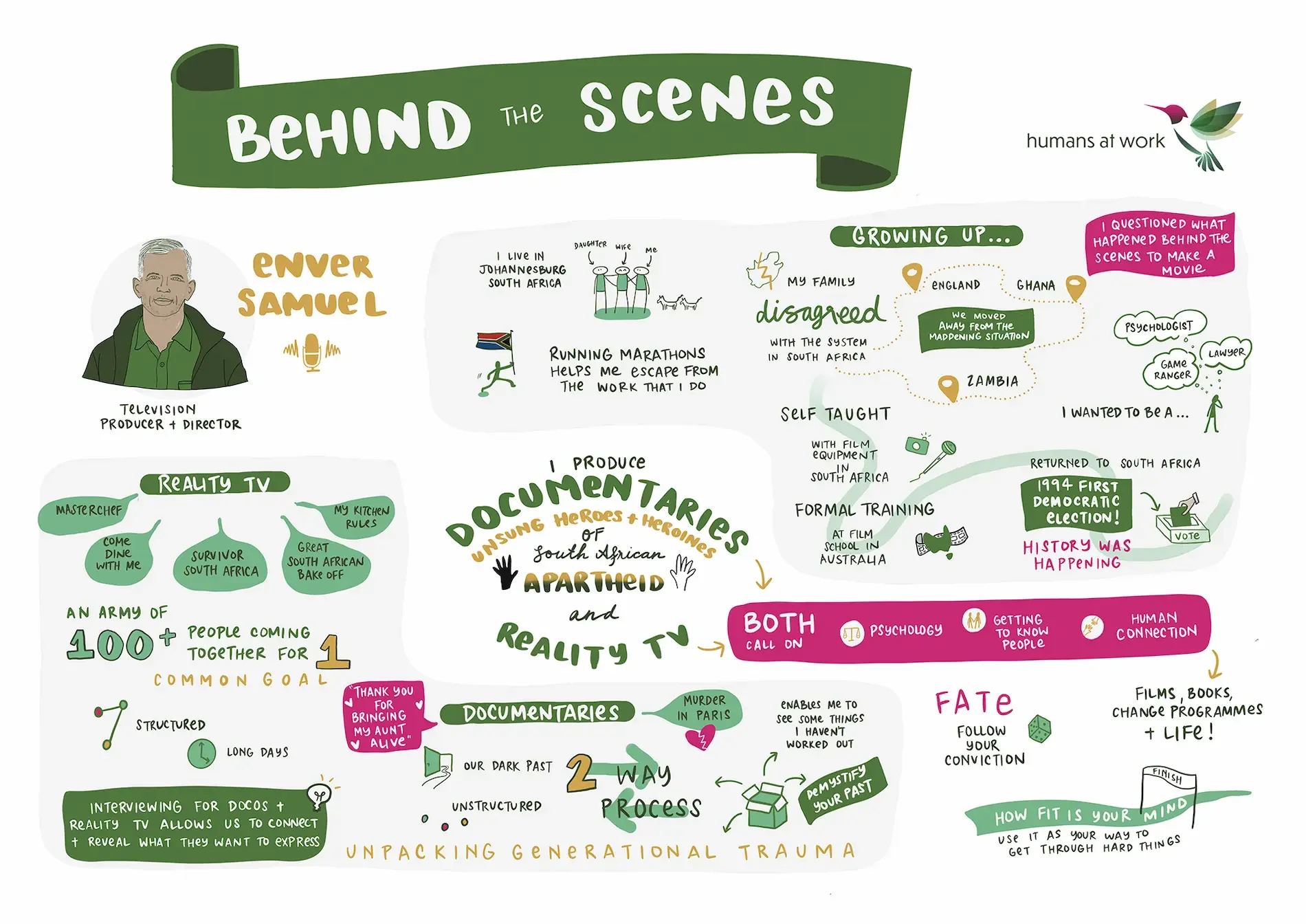
Jules: Kia ora, welcome to Humans at Work. I'm Jules, your host. Thanks for joining me and our latest guest, and thanks for taking some time in your day to indulge your curiosity about other people and their humanness. If your thirst is unquenched after this, check out jericaglobal.com.
Let's begin!
Today I'm talking to Enver Samuel. Rather than introduce Enver, I'm going to get him to introduce himself, tell us where he's sitting right now, what his current job is, and what pushes him to run marathons. Over to you, Enver.
Enver: Hi, my name is Enver Samuel. I'm actually sitting in my home in Johannesburg, South Africa. The suburb is called Little Falls and it has that name because not too far from us is a really beautiful hundred-metre waterfall, and it reflects everything best of South Africa — beautiful mountain and waterfall in the background.
I'm a television producer and director. I have been doing this for a long time. I started in around 1994 producing and directing television content for our national broadcaster, the South African Broadcasting Corporation — SABC — amongst others. Of late I've been concentrating on making social impact documentaries for the last seven years, documentaries that resonate with South Africa's history during apartheid and chronicle and highlight the roles of unsung heroes and heroines of the South African struggle against apartheid.
I think, to keep sane, I run marathons because it allows me the time to forget about some of the hard issues that I deal with in my documentaries. The running gives me a sense of freedom and a sense of escaping from the work I do.
Jules: I admire marathon runners — I couldn't do it myself, I'm not really a runner, I'm more of a wanderer. But that sense of having something that allows your mind to drift and takes you away from things. Do you run every day? Do you have times when you just slob out for months, or are you really disciplined?
Enver: I'm a mixed bag because working in television is not a 9 to 5 Monday to Friday job — it's dealing with deadlines. I find that a lot of the times I miss out on the running that most of my friends and colleagues are able to do because they work 9 to 5 jobs and have weekends free. Whereas I'm out of the country or in a different province most of the time, so I generally try to squeeze it in wherever I can. My running shoes are always in my suitcase. I could be running at night because there wasn't a chance to do it in the day — all odd hours. But I'm not fanatical about recording mileage or doing a minimum of three or four runs a week. Sometimes I go with a few weeks missed here and there.
Jules: You're flying off to Singapore, I understand, to run a marathon.
Enver: Yes, I leave tomorrow for Singapore to do the Singapore Marathon on Sunday and I'm looking forward to it. It's my first international marathon and I hope it's going to be the first of many. I've got the Sydney Marathon on my radar for next year. I think it's going to be fun — I'm going to make sure that I have something to identify me as being from South Africa with our flag, which you can't miss. I think it's going to be a nice, interesting challenge.
Jules: Have you been to Singapore before?
Enver: Yes, in fact I think this is my fourth visit. Previous ones were on my way back from Survivor shoots in Malaysia, the Philippines, and Samoa. That was the route back and I got off then and went to explore.
Jules: You'll know about the humidity. I've been to Singapore once for a couple of days — I've felt heat but I'm not sure I've ever felt humidity quite like Singapore.
Enver: That would explain the crazy start time. I think the start is at 4:30am.
Jules: That makes complete sense! I wish you good luck. If it's going to be televised or on YouTube, I'll have a look and see if I can see you dripping with sweat but running with your flag.
Enver: Look out for the flag!
Jules: I will. Is that the one you're taking?
Enver: No, I'm taking a much bigger one!
Jules: I think that's going to be amazing. Are you going on your own or do you travel with a cohort?
Enver: This is like a little bit of a holiday, too, so I'm travelling with my wife Karen and my daughter Kiara.
Jules: I was going to ask who makes up your family — who's in the house?
Enver: We have a lovely daughter, Kiara, who is 21 and she works with animals in the Animal Care Centre — predominantly dogs, but they have donkeys and cats and turtles. My partner Karen and I have been together since the mid-eighties.
Jules: I'm not going to ask you exact dates, I don't want to get you into trouble! If your daughter works with animals, especially dogs, do you have a lot of dogs at home?
Enver: We have two Labradors — a white and a black one. The golden one's name is Baloo and the female — the black one — is Midnight.
Jules: Baloo as in Disney?
Enver: Yes.
Jules: I think I just heard one of them in the background saying hello.
Enver: They're barking, yeah.
Jules: Tell me a little about what life was like for you as a child. What kind of kid were you?
Enver: We had an interesting life — interesting to a certain extent because it came with its challenges of growing up in an apartheid state, whose central thesis was to keep people of different races apart. My father didn't agree with the system and we left South Africa at a very young age. I have no recollection of it, but I was probably two or three years old when we left South Africa to go to England and live in exile. We ended up in England, then Ghana, and then Zambia for the majority of the time.
That was the childhood of travelling and being away from your homeland. The memories from Zambia — I have the bigger memories from there because I was older — were pleasant memories of being with children from all over the world because the community we stayed in was a community of teachers from all over the world helping out with the educational system in Zambia. My father was in education. I remember it being very pleasant and very outdoors, far away from the maddening situation in South Africa. But a lot of it is a vague memory.
Jules: I was in Zambia too, of course, where our parents' paths crossed. I remember vague memories of a very outdoorsy life that was very chilled. Obviously, I was a lot younger! What was the decision to move back to South Africa?
Enver: You'd have to ask my father that primary question, but I think the indications were that South Africa was on a path where it wasn't going to look back — it would look forward. The future was that South Africa now had to change and change was coming, so rather be there if things are going to happen for the positive.
Jules: As a kid were you into technology? Were you interested in movies, or did you fall into it?
Enver: In Zambia, totally no technology, as I can recall. I was a master climber of trees. Sometimes when Karen and Kiara see me climb up a tree in the garden they say, "Where did you learn this? How did you do this?" In Zambia, that was our entertainment — climbing the highest, tallest tree. That type of very, very outdoor life, far from technology and what kids do today with all these modern games.
I do recall that I had a love for movies and going to see them every week. Watching film and somehow having a connection to them — not on a superficial level of just watching, but somehow — I don't know why even today — I was able to see more than what I was just seeing. I was questioning in my mind how this was done, how that was done, what I could do to improve it. I seemed to have that from a very young age.
Jules: What was the first movie or film that you shot?
Enver: Let me say, I think the first film that I saw that resonated with me or stuck with me was Jaws! That's so vivid in my memory still today. The first means of actually making something came very much later, and I went the other route in that I started with photography long before I got into anything audio-visual. I think photography was the foundation because, essentially, photography is still images, and if you put them all together then you got film. It was a nice medium to practise in terms of composition, framing and that type of thing, which held me in good stead later when I decided to jump into the audio-visual medium.
And that has its birth with your mother, ironically. Your mother was working for the British Council and she got posted to South Africa, to Johannesburg. This equipment came from the UK — a camera and sound recording — and it ended up at the place where I was, which was the SACHED Trust, the South African Council for Higher Education, where your mother had been posted to. I seemed to take an interest in the equipment that was laying there, I guess waiting for someone to start fiddling with it. Before I knew it, between your Mum and I, we were making audio-visual material, going to Soweto, to schools in Soweto, making these educational little videos. That's where it all started.
Jules: I do remember that. I remember going to SACHED and it would've been videotaped then — the old VHS or something like that. I remember my Mum saying, "Enver's been making a video." I can actually picture myself in the office hearing that conversation, which is amazing. I remember her being tickled about it, really excited and really proud. But hearing that story about suddenly there's this equipment there, nobody knows how to use it and you seeing the opportunity — it was almost like it was meant to be.
Enver: Yes, on the ground, hands-on experience. Again, it was in a beautiful time in South Africa because we were all trying to do our bit in terms of helping with the situation that existed, and with this it was education. We were welcomed at the schools and we did training for the schools to learn how to make their own videos, so it was a really rewarding time. Through the British Council I was able to get the opportunity to go to England and then take what I'd learnt into a more formal setting and enhance and improve my skills in that medium. I was lucky to get that opportunity because that then solidified what I was interested in.
Jules: What you were meant to do. From the SACHED Trust to the Great South African Bake Off!
Enver: There was a period where I got a scholarship to study film and television in Australia. I left the SACHED Trust in 1989 and the scholarship in Australia ran from 1990 to 1992. That really was like the cherry on top of the cake in terms of completing the experience because it was a really, really good course with a very strong component of learning. When I got back to South Africa around '93, I worked in the industry and it was a very upward trajectory. Based on the skills I got in Australia, I didn't hassle for work — I hit the ground running, worked for a production company for three years. We were doing cutting-edge work.
You must remember 1993 and 1994 is a historic time in South Africa's history — we're talking about the first democratic elections. So for someone working in this field, it was a dizzy, exciting time. A lot of people in Australia at the time, the friends that I'd met, said, "Why are you going back to South Africa? Are you crazy?" I said, "There was not even a second thought — I had to go back to South Africa because history was happening and I couldn't miss out on that." The first chance to vote as an equal citizen — why would you not want to go back?
After working for that production company, I realised quickly that I was doing all the work for the company and I thought, why don't I just set out on my own, take the giant leap to become a self-employed independent producer/director. From 1996 I've been doing that, and not one year without work or looking for work. Somewhere along this time as a producer/director I got into reality TV, and I've worked in all the big reality TV formats — The Great South African Bake Off, Survivor South Africa, MasterChef, Come Dine with Me, My Kitchen Rules. Which is a strange juxtaposition — hard-core documentary with a strong social impact focus on one side, and really classical reality on the other. Reality is all about observation, and I think I bring my observational skills from documentary to reality. It's an interesting combination and I like working in both spheres.
Jules: I'm really fascinated about that link because some of the documentaries that you do, they're really hard. It must take a lot of resilience to keep going and they take a long time. Then on the flip side, reality TV looks easy when you're watching it sitting on your couch, but in order to produce it, it's a lot of work — long hours, lots of pressure.
The subject matter is either food, it seems, or trying to find food if you're on Survivor. So I can imagine that there's a pressure valve in being able to switch between something that's quite deep and dark and hard to something else where you're still using all of your skills but it's a little bit more light-hearted. You might end up eating a bug or whatever, but you're not talking about life and death. Not really.
Enver: Exactly. I think that combination is also probably another thing that keeps me sane besides the running — the fact that I'm not doing hard-core work continuously for a year. I'm able to do that hard-core work but then stop doing it for a while and move on to something softer and light-hearted with the reality shows. One is not caught up in that dark void with some of the content that I do.
I think it's a good combination for keeping one's sanity, while also not being on the high horse and saying, "I'm this producer/director that does serious stuff and I must be taken seriously." Some of my colleagues look at me strangely when I tell them I'm going off to do a Bachelorette or a Survivor, but each to their own. Sometimes the documentaries I do, funding is extremely hard to come by, so this lighter-hearted work pays a lot of my bills. I think I've found a model that works for me and I'm happy with it. It keeps me balanced from going over into the really dark side.
Jules: Because you work for yourself, you don't need to create any excuses. The choices about the business you take on are yours and yours alone. Running my own business, one of the benefits is that you make a decision and it's yours. It might go well, it might not go well, but there's nobody else in that picture.
The flip side of that is you're the only one who can make that decision, and if it goes wrong, you're the only one who can get yourself out of that hole. It's one of those things in life where there's always benefits and negatives, and a lot of it depends on how much you invest in it. I would say — if you get to go on baking shows and you get to eat the baking, then why would you not do that!
Tell me though, do you get to eat the baking?
Enver: Yes, a lot of times on the cooking shows we get to eat, because sometimes follow-up questions are based on the taste, so there are some positive perks to being on these shows! Then you have to do a lot of running after that.
Jules: I was going to say — that's why you do the marathon running, so that when you're eating all the pastries you can run it off!
What's the work mode like for you on a TV show versus a documentary? I would imagine that a TV show is fairly scheduled — they've got a start, they've got an end, they've got a date they want it ready by. Whereas when you're making a documentary and it's yours, yes, you've got collaborators but really, you are driving that schedule. Is one your preference or do you find you can slip into each one fairly seamlessly?
Enver: You're exactly right. Doing a Survivor, for example, we are over a hundred crew — so you're like a little army on the move. You work strictly to deadlines, there's a call sheet, you're starting at this time, everything by the hour, very detailed.
What I like about that is how a unit of more than a hundred different people from different backgrounds and different experiences come together with one common goal — to make a product that will get broadcast to a high standard. These big format shows have very specific guidelines on the look and feel, so you have to meet that criteria. South African crew are known for their reputation of working extremely hard and being very competent.
It's nice to be part of a little army where there's one common goal. There are extremely long hours — some of the Survivors I've worked on were 16 to 18 hours a day. But it's a nice feeling when every single person from the lowest common denominator to the top are all seen as one, because everyone's job is so critical in achieving the end goal.
That's what I like about it. But also, reality is quite a social experiment — as a content producer you are the one doing the content, and that observational position of seeing how these contestants are formulated to be personalities in the show is quite fascinating. I find the character developments of participants in reality shows highly interesting. There's a lot of psychology to it. We do have psychologists on board to ensure that the participants are well looked after.
From that point of view, if you ask me what jobs I would have liked to have done — one, from the Zambia and Ghana experience, would be to have been a game ranger. And the other two would be a psychologist or a lawyer. I think that's what fascinates me about reality — the psychology involved in it.
Then on the other hand, documentary filmmaking is a very laboured and much less structured process because you are dealing with stories that aren't straightforward — they deal a lot with trauma, our dark past in South Africa, the history of apartheid. In particular, some of the documentaries I've been working on recently are looking at transgenerational trauma — how the trauma that affected your mother or your father who was killed by the security police, for example, and how you, thirty years later as the child, have dealt with that.
I can't go and tell a family that I'm running to a schedule — a lot of the time it's a stop/start process. A lot of people break down. It's not something you can put to a schedule.
Even in reality, a lot of the content is based on the interview with the contestants, and that — for me — is my favourite part. That's why the crossover to documentary works for me, because the interview is the best part of my job. When you get to be one-on-one and you get to know that person and sometimes get them to drop their guard and forget the camera and just have that conversation between the two of you — letting that reveal what the person is trying to express in the most unobtrusive way. It's a technique that you develop over the years.
Jules: Do you find that when you're having those conversations and you're hearing from people — because you've got some of that history yourself, you left your home, you travelled as a family and then went back, and there was always that low grind of trauma in the background — do you find that when you're talking to people, you're able to work through some of that for yourself as well?
Enver: Yeah, the big thing when you're doing the one-on-one, sitting across from the person you're interviewing, it links back to this whole idea of connections. How do you connect with that person? I think sometimes I'm able to really connect and it becomes a two-way process — it's not just one-way because I'm in the driving seat. I think a lot of times I connect with the person on the opposite end of the chair in a way that also enables me to see some of the things that I haven't worked out for myself.
Jules: I reflect on that because I have a little bit of that myself. The older you get, in theory the wiser you are — I don't think that's actually true — but I think you get a little bit more reflective and you recognise in yourself the things that maybe aren't from the present but are from something in the past.
I grew up as a travelling kid and my parents were in education. They went to where education was most needed, including Zambia, Malawi, and South Africa. In South Africa I was a white, blonde kid so I could do what I wanted, pretty much, and I didn't have all of that fear. But I absorbed it because my parents were friends and colleagues with a whole lot of people who were feeling that every day. I have an irrational fear of the Police that I know comes from living in South Africa during apartheid and seeing what the Police could get away with.
When I was in my twenties and living in the UK, I actually did some voluntary work with the Police to try and get through my fears and to understand how the institution of the Police actually works. I worked with cold case detectives to try and help them see things differently. Part of it for me was giving back, but part of it was also — I've got to demystify the Police. I tried to get that connection with individual Police officers and understand what processes they used in order to do their job, so that I would be able to put myself into a slightly different frame of reference when I think about Police as an institution.
I'm interested in how you have found an outlet in both worlds — in the baking/surviving world, and in the serious work of opening up and bringing to the surface things which were really damaging. If they go on being unspoken about, they continue to damage because they're not recognised and not acknowledged.
Enver: Exactly. There's another factor — the reward. Not reward in financial terms but reward in terms of fulfilment in the heart, in the being of a person's psyche.
For example, when I finished the documentary A Murder in Paris — which is about the assassination of an ANC chief representative in France in 1988, Dulcie September — when it came time to show the documentary to the family before the broadcast, I showed it to her nieces and nephews. The niece, who are all adults today, said, "Thank you for bringing my aunt alive." That, for me, is one of the other and bigger reasons why I do these types of documentaries.
Jules: I feel the emotion of you saying that and it's not even my documentary and I wasn't even there. That must've been an amazing moment for you and for her.
Enver: Yes.
Jules: You said earlier that it took four years to make that documentary. How do you motivate yourself to keep going over four years — that's quite a long time.
Enver: I started work on it in late 2017. You get grit into the story and the research, and what that uncovers keeps uncovering — one door opens and leads to another door. To give a persona and a personality beyond what existed in the past — for me, the slow-working approach to this is part of the journey. For any independent producer/director, it's par for the course. I'll work on it for a couple of months, then stop and go and do some paid work, but at the same time while I'm doing that paid work I'm also still thinking about the documentary and formulating different ideas and different approaches to how I can better tell the story.
It did coincide with COVID, so there was that full stop because we were all in limbo. But that period when we were really confined to our homes for about six months was actually the best period for me — I was able to go back to ground zero with the documentary and look at it from a fresh perspective. I'm literally constantly travelling, constantly working, so that period of COVID allowed me to work on the documentary for six months entirely at home, and it worked out in the end that I had that time to focus just on it.
I must tell you — I was in Switzerland in 2017 and I bumped into Dulcie's brother-in-law by complete chance. He was at a documentary festival I was attending and he asked me, "Why don't you do a documentary on Dulcie September?" That was complete fate. That meeting between the two of us wasn't planned and that's how it all started.
Jules: It was meant to be. As soon as he said that, did you have that lightbulb moment, or did it take a bit of convincing?
Enver: He said that in the midst of a festival, but I had the conviction to follow up. He gave me the address and contact numbers for Dulcie's nephew and niece in Cape Town. There was something inside of me that said this story's worth doing, this story's worth following up. Once I'd made that connection with the family in Cape Town, I knew there was no turning back and that this story had to be told.
Jules: Can I delve into your decision-making practice? Are you more of an intuitive decision-maker, or would you say you balance the analytical side with the intuition? It sounds like in that case, it went into your psyche and once you'd made that connection, nothing would've swayed you — no analytics, no data, COVID didn't sway you. That's a real deep-down conviction.
Enver: It definitely is. Once I set myself that goal, there's no turning back. I think inherently in that is the fact that there's something going on inside of you that is telling you this is worth doing. Something inside of me said, follow this to the end, follow this, it needs to be done, it needs to be told. That's something that goes on in your psyche — something I don't know how to put into words in terms of following your conviction. To a certain extent, it's happening again now with the series that I'm working on that's looking at victims from the Truth and Reconciliation Commission in South Africa. There's just something within me telling me to stick to this and make sure you tell these stories.
Jules: Do you think I can draw a bit of a link? You know when you were talking earlier about as a kid you loved going to the movies, but you wanted to see what was behind them, and that led you into making them. To me, it sounds as though that's been a constant through your life — you want to understand what sits behind the person, what sits behind the story, to try and make sense of that.
The medium is a documentary or a production of something, but there's a similarity there around not being satisfied with the surface but wanting to understand somebody's psyche.
Enver: I think it goes back to that psychology element — in a different world, that's an area I would have liked to focus on. In the reality shows, the contestants see us — the people doing the content — as their psychologist to a certain extent. We are their gatekeepers to keeping sane in many, many circumstances, especially the Survivors and the ones that push you to the limits. We are their priests — they confess to us, basically — and we have to keep that balance between whether they're going over the edge or not. It's quite tricky.
When you delve into it further, there are a lot of psychological aspects in terms of what contestants expose themselves to. From the beginning they enter into these things with the conception that being on television is going to be great, and then they realise that suddenly they're exposing themselves to national television and things are not working out. It's not to be taken lightly when you're dealing with people's feelings.
Jules: How do you say goodbye? If you've been on an island somewhere and you've done these long days and you've got your crew there who you're working with, your colleagues — but you've also got, presumably, some sort of connection with the contestants — and then at the end of the shoot you all go to the airport and fly off. How does that actually work? How do you finish that?
Enver: Working under those conditions brings everyone together very closely. There's a strong bond, a strong connection — not just for the crew but also the contestants. There are a lot of friends for life, let's hook up when we get back, social media connections and that type of thing. I think in the real world you move on to another project, they move on to their lives or to the real reality, and there's just the rare exception where I've seen that we've taken a relationship further. It does happen, but it doesn't happen often.
Jules: That's interesting. One of the things I do in my other profession is managing change programmes, and it sounds a little bit like Survivor. You've got a crew of people — a little army — they've got technical expertise or they're there to help manage the programme or do the communications. You have this really intense period of time with a schedule, something big to do, under pressure, a whole melting pot of things.
Then you've got the people going through the change. You've got executives who are driving the change but actually need you to help them build and design what that story looks like. Then you have the contestants — the people whose organisation or team is being changed, it's being done to them.
There are layers and layers of psychology and this real intensity. You come together, you do a programme — in our case it might be six months, long hours, weekend work. You get to the endpoint and everybody says, "That was really intense and I'd love to work with you again," and then you slope off and go away and think, gosh, that was great but I actually want a bit of peace.
It's really interesting to me that your description of going off to an island and filming Survivor actually sounds very much like my experience of running a big change programme. You wouldn't think those two things are alike, but there are a lot of similarities. At the heart of it, it's human connection and people going through a stressful situation — how do you manoeuvre through that situation to get to the end point while caring for the individuals who are somehow caught up in it?
Enver: Exactly. You hit the nail on the head with the whole aspect of human beings caught together in one place with one common goal. You might have friction, you might have obstacles, but in the end you overcome — and it's very much like your classical film. In film we talk about the three-act structure. In the ideal world, at the end of that third act there's resolution and there's a happy ending.
For me, this coming together of different people, different crew, working for the common goal with contestants also from different walks of life — when it all comes together and it gels, it's a beautiful thing. Life is not just about happy endings, but in that given time and that given moment when it works, it's a beautiful thing to see, especially when it works out positively.
Jules: I'm imagining that a marathon is like a three-act cycle — you start off and you're all enthusiastic and you think you're going to sail through. In the middle bit is the grind where you think, oh my goodness, I've still got two thirds of this to go, my feet hurt, everything hurts. Then the final thing is, I can see the finishing line, I've just got to keep going. That's my imagined view of what a marathon is like.
Enver: Exactly. There's the stage where you say, why the hell did I do this? Why am I doing this? Why am I here? That's when it's mind over matter. Many times in my work I cross that bridge of the marathon in terms of the doubts, but the resolution to finish always wins. When I'm facing the hardest, most difficult times with my work, I say to myself, you've done a marathon — what is this? Mentally, what is this?
I've done Comrades, and Comrades is two marathons in one day — that's 89 kilometres, an up run and a down run, because you have to do both. One is Durban to Pietermaritzburg, and Pietermaritzburg to Durban. For me, that is the defining moment in terms of my mental status — you can do this, and you can overcome anything. You come to the end of the marathon at 42 kilometres and realise you've got to run another marathon!
At some point, with people like myself who are not trained athletes, you've got to deal with a lot. It's not how physically fit you are, because invariably for me I wouldn't be physically fit — it's how fit is my mind to tackle it. It becomes a mind issue, and how strong your mind can be to get you over that finishing line.
A lot of times on Survivor we face tropical storms. We don't live like the contestants because we go back to our hotel, but the working hours and the physical hardship — in times of self-doubt I go back and say, do it. You ran the Comrades twice — what is this? It's nothing. I use that to focus and say, you can overcome that obstacle.
Jules: I can't even think about running the Comrades, but the idea of having something where you've proved yourself to yourself, and you have that sense of pride that can just be a defence against any self-doubt — that's a really valuable thing. It doesn't have to be a marathon. It just has to be something that you know you've tried your best, you've pushed yourself, you've broken through your own barrier, and you can go back to that repeatedly when the world — the storms, the bugs, the miles or kilometres — are pushing against you. If you've got that inner kernel of something, it gives you that extra defence against what the world throws at you.
I wanted to ask — people who are close to you, what are three words they would use to describe you?
Enver: I'm not sure, you'd probably have to ask them. I guess people when I meet them in different productions will say, he listens. I'm not over the top in terms of making myself heard, I don't need my voice to be the most vocal. I tend to listen a lot. I'm the quiet one.
Jules: The quiet one who's very stubborn, very resilient, and who's watching everybody and looking behind the scenes to see what makes them tick.
Enver: Exactly.
Jules: Sounds amazing. I love it.
That's our time. I feel like we could carry on talking and I certainly would delve much more into Bake Off because I'm a massive fan. I couldn't do it myself, but I think the concept of putting yourself out there on a TV show — whatever it's about, even if it's something quite light-hearted — it's people putting themselves out there and trying something different. I find that really, really fascinating and a really brave thing for people to do.
Obviously, the documentaries that you make are really, really powerful. They grab you by the heart and then they lead your head down a path, and that's an amazing, magical skill that you've got. I want to say thank you very much for giving me your time and walking us through how you do things and what your life is like. It's been really, really fascinating and I do appreciate it.
Enver: Thank you for making the time and for making the connection after how many years.
Jules: Thank you so much for listening, and thanks, as always, to the generosity of our delightful guests. The stories of how others have faced up to their challenges can help give all of us courage to keep going with our own. For more great episodes, blogs and learning packages, go to JERICA Global
Humans at Work Podcast