
Star Wars, Christmas Ninjas and Rewarding Kindness — with Vince Warnock
Humans at Work Podcast | Episode 2
Host: Jules Harrison-Annear | Guest: Vince Warnock
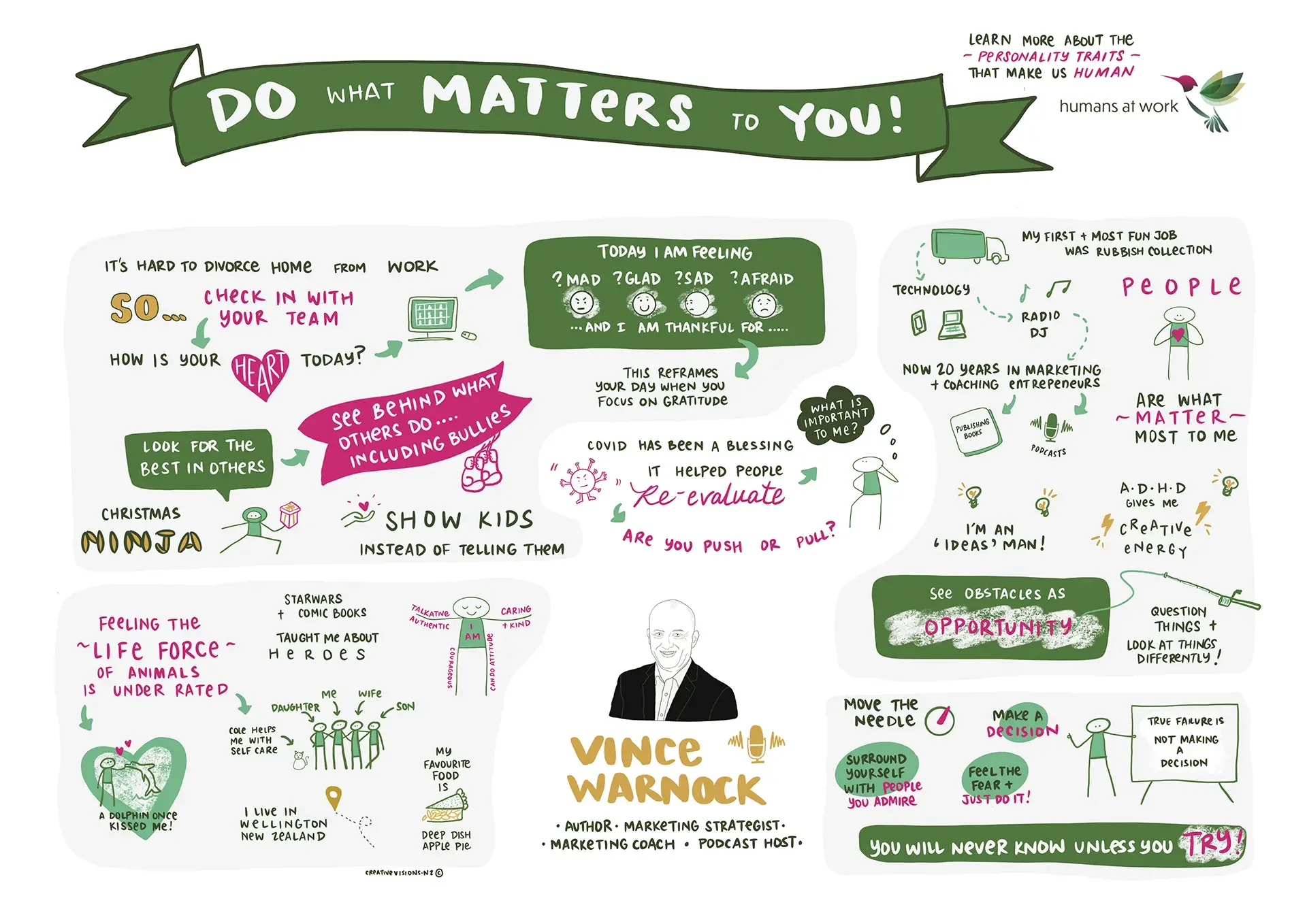
Jules: Kia ora, welcome to Humans at Work. I'm Jules, your host. Thanks for joining me and our latest guest, and thanks for taking some time in your day to indulge your curiosity about other people and their humanness. If your thirst is unquenched after this, check out jericaglobal.com. Let's begin.
Today I'm talking to Vince Warnock. Rather than introduce Vince, I'm going to ask him to introduce himself, tell us where he's sitting, what his current job is and what his favourite thing is to eat. Over to you, Vince.
Vince: First of all when you say "quirks" I feel like you're just talking directly to me then — I'm full of quirks.
Everyone, I'm Vince Warnock. I am sitting in Wellington, New Zealand, actually in Churton Park in the home office, trying desperately to keep warm, not succeeding. My job is a mixture of things, actually. Previously I have had a number of different start-ups, worked in the Government sector — that was an accident — and also worked as the chief marketing officer at Cigna Insurance. But now I'm getting to do all the stuff that I enjoy, all the stuff that makes me fulfilled.
I'm the host of two podcasts — Chasing the Insights, which is my entrepreneurial podcast, and NTF Ninjas, a podcast to train people in the web three space. I also run a publishing company and I'm a marketing and visibility coach, so I help a lot of entrepreneurs to position themselves as thought leaders and to be seen. I'm pretty sure that's it — there's a whole pile of things, I've got fingers in so many pies, basically I'm just having a lot of fun right now.
Favourite thing to eat is probably food — I eat way too much, honestly. I am half Italian, so I do enjoy really good Italian food, but also deep dish apple pie with ice cream on top, heated up. Oh, my goodness — I go gaga for it.
Jules: Wow, do you know what? I wasn't expecting that in terms of apple pie.
Vince: Really?
Jules: I don't know what I was expecting, maybe something spicy, but I get it.
Vince: I think the reason is, I love spicy foods honestly, I'm a huge fan of spicy and savoury in general. But I think the reason to pick a deep-dish apple pie is because I normally do have savoury foods. I don't eat sugar anymore, cut that out of my diet, so therefore the thing I pine for is the thing I can't have — which is just basically sugar with some pastry and some apples.
Jules: What's not to like? Are you a cinnamon person?
Vince: Yeah, totally, always cinnamon.
Jules: Good, cos we might've had to re-evaluate our relationship. I'm a huge cinnamon fan — I can't live without cinnamon, actually. I think it's one of those things that most everything is enhanced with cinnamon in it.
Vince: I would agree with that 100%.
Jules: Churton Park, which for those of you who don't know, is a distant suburb of Wellington. But I see that you've gone to a galaxy far, far away in your office design. Talk to us a little bit about your friends behind us.
Vince: When I first got into corporate life, a lot of people told me I need to grow up and that I was not to be childish, cos I'm a giant nerd. I still vividly remember when I saw Star Wars the first time. I was eight years old, sitting in the cinema, and that thing had a profound effect on my life. I remember at the end — this is when Star Wars first came out by the way, so I'm aging myself majorly here — but I remember turning around and every single kid in that cinema, the credits had finished, the lights were on, there was nothing on the screen and not one of us would get up. We were all holding on to the edge of the chairs just going, "I don't want to leave cos if I leave this is over and I don't want it to be over." That was the effect it had on me.
I grew up with comic books. Comic books were my safety net. I actually grew up in a really abusive household, grew up surrounded by poverty, so for me, if I could get my hands on a comic book, I would read about these people who basically had all the same problems I did. In a lot of cases, they were in terrible relationships or they were trying to get money or trying to succeed at school — I'm thinking Spiderman here — constantly failing at it but at the same time they had to save the world. For me, that made my problems seem a lot less. It was a way of putting some perspective on it, and also I felt safe with these people. That was my childhood.
Then I got to corporate life and everyone's like, "You can't be into comic books, that's for kids. You can't be into Star Wars. What are you? You gotta grow up now, you gotta be an adult, you gotta do adult things." And for years I denied who I was. I tried to be someone that wasn't me, and then at one point I just got tired of it and just accepted the fact that I'm a giant nerd and I should just enjoy the things I enjoy.
I'm a really passionate person. I'm passionate about Star Wars — that's why all the different stuff behind me, even the Boba Fett helmet. I've done cosplay many a times at Armageddon, which is like our comic con. This is, by the way, only a small portion of my Star Wars memorabilia. The rest of it's in storage because my wife said, "You're not putting that in the living room, no. You can put it in your office, I don't care, but it's not going in the main areas of the house." So a lot of it's in storage. My background is Star Wars, it's comic books, and it's a lot of whiskey — although those whiskey bottles get less and less every day, for some strange reason.
Jules: Surprising! If you had to pick a character as your favourite, who would it be?
Vince: When I was a kid, I was Luke Skywalker for many years. But weirdly, my first ever girlfriend was Princess Leia — she just wasn't real and didn't know about it! She was just this amazing, powerful woman who didn't need rescuing, didn't need a man. Everything about her was just exactly what women should be portrayed like on screen. I thought it was amazing. Especially having five sisters, I was like to all of them, "You've gotta watch Star Wars, stop watching the Disney Princess crap, go and see this, this is a real woman, this is amazing." They didn't buy into it, but anyway.
I was Luke Skywalker for years, then I graduated to Han Solo. But I'm going to pick a random character — I'm going to pick Wedge Antilles. He is a character who was in all of the original trilogy as a background character, led Rogue Squadron, and in the expanded universe books he led all these raids on the Empire bases. I just love that aspect of it.
Jules: You mentioned your wife. Who else makes up your family?
Vince: My wife Leanne — we've actually been married 27 years now. Weirdly it feels like we've been married forever and at the same time just a year, it's crazy. We also have two kids who are grown now. My daughter Oriana, she is 25 now, and my son Jarvis is still with us here at home. He's 19, studying software engineering at Vic Uni and doing very, very well there.
Jules: Any pets?
Vince: Yes, Cole our cat. He is the most gorgeous — honestly, anyone who tells me that cats don't have a personality and they don't care has just never seen a cat before.
In fact, there's a story I share quite a bit. I suck at self-care, I'm really bad at it. I work from home, I'm constantly online, and with ADHD and the hyper focus part of that, there will be days where I suddenly at 3 o'clock in the afternoon, I get up and I'm like, why am I so dizzy? Why do I feel so bad? Then I realise I've been going since 3am — I haven't taken a break, haven't had any food, any water, haven't gone to the bathroom. It's not healthy, so I'm trying to get better at that.
One morning I remember waking up and I was having one of those days that we all have — one of those days where I'm like, I can't face the day, I'm overwhelmed, I'm just feeling terrible. My mental health was suffering big time that morning. I sat in front of the computer and realised I can't do this — I have to go and sit on the couch in the lounge. Everyone else is still asleep, and Cole came up and stood next to me on the chair, then tried to push me over. I realised he was trying to make me lie down. I lay down on the couch, put a little pillow under my head, and he stretched right out and put his head underneath my chin, his paws came up on either side, and he just started purring. I could feel every stress start to melt away. The two of us just fell asleep and I slept for about another two hours, which is very rare for me. He knew I was having a rough day and he knew I just needed some help. Anyone speaks bad about cats, come at me.
Jules: He just walked behind you on the screen as well! There are studies that if you have a pet and you interact with it and stroke it, you'll live 10 years longer — and probably feel 10 years younger, actually.
Vince: Exactly. I love it. I love animals in general.
Weird tangential story, but you get used to this — I'm full of stories. When our daughter was really young, we took her up to Napier to the sea park. They had the dolphins and I remember standing there going, "Holy crap, these things are beautiful." The trainer was telling us how they form this bond over many years and it takes a while for them to trust. While he's giving this big spiel about how amazing he is because these dolphins want to kiss him, I just looked over the edge at one of these dolphins and went, "You are so freakin' cool." And next thing you know it came up on its tail and gave me a kiss. I've never forgotten that — I could not stop smiling for about a month.
Jules: That's adorable. They do say that dolphins have been known to rescue and comfort people.
Vince: I think the dolphin looked at me and said, "You're definitely non-threatening." I think they just feel your emotion — and I think that's the thing with animals. When they know you respect them, when they know that you love them, when they know you are just in awe of them.
Actually, if you ever get the chance, do the cheetah exhibit at Wellington Zoo. We used to go there and be able to pat these cheetahs — it is the most amazing thing ever. You've got this weird mix of emotion. Part of you is going, "Wow, I'm so in awe," because they purr really loudly, louder than any animal you've ever come across. And you're sitting there going, "This is so freaking amazing, it's just like a cat, I wanna hug it." Then the other part of you is going, "And it could tear my face off."
I took my son there for our combined birthday, and two of us are sitting there patting it, and then one of the cheetahs just turned around, went right up, put his head underneath our hands and got us to pat his head. The guy that worked there said, "Go for it, just keep patting, be very, very gentle." I almost cried. I was so overwhelmed by the whole experience.
Jules: I've done that too, at Wellington Zoo with those two cheetahs. I had the same mix of emotions of wonderment — especially when you've watched them on screens all your life — but actually being there and touching them and feeling the life force and that power they have is a really humbling experience.
Vince: It really was.
Jules: On the other hand you're still going, "Oh, my God, you're so cute," when in fact you know that cute is not how you would describe a cheetah.
Vince: Exactly — you're cute but you're awesome but you're deadly, but you're cute. Kind of describes my wife, really. Cute but deadly but awesome.
Jules: I was going to ask — if somebody close to you was to use three words to describe you, what words would they use?
Vince: Oh, my goodness. Talkative definitely, caring would definitely be there as well, and genuine.
I wear my heart on my sleeve all the time. I don't have room to not do that anymore, to be honest. I spent many a year in corporate life trying to pretend to be something that I'm not, but now I just want to be me and I want to help people and I genuinely care.
Something that we did as a family 15 years ago was this whole family tradition called the Christmas Ninja. We tried to tell my son about Santa Claus and he just looked at us and went, "Nah." He was four. He said, "That's a stretch, Dad." I went, okay, he's never going to fall for this, so we told him the truth — "Santa's not real, it's just something that parents and Coca Cola make up so that kids behave." He turned around and said — and this is a four-year-old mind — "If you're gonna make up stories, make them interesting and put Ninjas in them." We just thought, best thing to ever come out of a four-year-old's mouth.
The other thing was I realised how much I really did not like the whole concept of telling kids, "Behave and you'll get rewarded." As a society we do this as well — we say to people, if you do as you're told, if you behave yourself, you do what your parents, your teachers, your employers, your leaders tell you, you will get rewarded for that. I thought, I want so much more for my kids. So much more for us as well.
We wrote the Christmas Ninja story, which basically combines all the Christmas traditions — baby Jesus, wise men coming down, Christmas Ninja following them, then has to defend baby Jesus from Santa and his evil Ninja elf clan, defeats them, Santa gets banished to the North Pole with the elves, then his penance once a year is to go and deliver presents to the kids. Then the Christmas Ninja is on this mission to find people that demonstrate the traits that make us awesome, that make humanity awesome — and that's honour, respect, courage, compassion, and self-sacrifice. When this Ninja finds these people, they deem them worthy, bestow upon them a gift, and they become a Ninja themselves.
It started our family tradition. Every year we each had to pick a person we deemed worthy of those traits for whatever reason, and then we get them a gift. At Christmas time we're allowed to open one of our gifts each, and we have to jump in the car and go and deliver this anonymous present from the Christmas Ninja — it's got the full story in there — and we've got to do that without getting seen. We have so much fun, honestly. It's one of the highlights of our Christmas tradition.
The other thing I realised over the last 15 years is, it did something really quite profound in all of us. It actually trained us to see people differently. When you're constantly and consistently looking for the best in other people, when you're telling your brain, "I want to see what makes people great so that I can recognise that and reward it," that actually reprogrammes your whole reticular activating system.
Basically, you've got this front part of your brain that says, "There's all this information bombarding me at every single minute of the day, every five senses — when you're walking down the street you see every colour, every car, every person, every building, every tree, everything." All this information coming in, and that's just one of your senses.
Your brain has to make sense of all that and go, "Which of this information is useful for my survival or my thriving?" When you go to your brain and you say, "I want to see the good parts of people, I want to see the good in others," your brain goes, "That's now relevant information for me, so I will pass that through the reticular activating system into your prefrontal cortex."
All of a sudden we realised that we were seeing the potential and the good in everyone — not just the people that we like, not just the people we surround ourselves with. Sometimes the people that irritate us, the people we disagree with. But when you're training your brain to see the good in others, you start to see it in them as well. When you realise that, you just have to accept it and go, "I'm just going to have to wear my heart on my sleeve, I'm just going to have to believe the best in others and do what I can to try and impact them." That's my long-winded way of saying, authentic and caring — but I think it outworks for a lot of the work that I do as well.
Jules: They definitely resonate for me. Some people may or may not know that we used to work together years and years ago in the BC era — the before children era, for me at least. I was thinking this morning about how I would describe you from when we worked together. I definitely had "kind" first — to whoever, even if they were being a little bit bolshy or disrespectful to you.
Vince: We have many stories, yes!
Jules: We have many, many stories. "Can do" — I don't think I've ever heard you say no to somebody who had a genuine request. But I can remember you going in at the weekend to do something that wasn't your job, so that on a Monday everybody else in the organisation could work. And certainly, from all of your side hustles plus your main hustles, "I got that, I can do that, I can do that."
The third thing was courageous. You have never shied away from anything. Hard childhood, challenges throughout your career, but if I think about everything that you have done, you've never gone, "That's a bit scary, I don't think I'll do that." You've just gone for it. Some things work out, some things don't, but you learn from it. Those were my three words for you.
Vince: You're going to make me cry, Jules.
That means a lot. One of the things I realised early on, particularly in marriage and when we had our kids for the first time, is that's a lot of pressure for me. When I look at that I'm like, I'm bringing kids into this world, I have no idea what I'm doing. Seriously, I'm a kid myself and I'm trying to raise kids — this is crazy. The thing that I realised is, I want to create an environment for Leanne and the kids where they feel like they can thrive, they feel like they can achieve anything that they want to achieve.
Two things were really important to me when the kids were growing up. One was that they don't judge people based on their actions or perceptions, but they actually try and look behind that and find out what's going on in other people's lives. Because you have no idea most of the time — we just judge people very quickly, we have no idea the struggles that they go through. If you understand that, it really does help you to relate to people.
The other thing was, never be reliant on an income from someone, never be reliant on somebody else for your own success. Create your own wealth, create your own success.
To do that, to create that kind of environment for them, you can't just say, "Go out and start your own company." You actually have to do it yourself. You've got to show them that this can be done, that you can fail and bounce back, that you can make mistakes and recover from that, that you can try something really risky and succeed. It doesn't mean I don't feel the fear — oh, my goodness, I'm petrified all the time! But the key thing is, if you've got the right motivation, you can just do it anyway.
I always get really annoyed at Nike with that whole "just do it." That should be just a universal saying for everybody. Just do it, because it doesn't matter how scared you are — what's on the other side of that is either success or learning. It's not really anything that's catastrophic.
Jules: Feel the fear but do it anyway.
Vince: That's the one, yeah.
Jules: I think that resonates a lot around the Humans at Work concept. Until you actually sit down with different people and ask about who they are behind the scenes, behind the professional persona, you have no idea. And if you listen to people's stories, a hundred per cent of the time you will find something interesting that brings you to a common area. Even if you have a whole lot of differing views — and most people do, cos we're all very opinionated — there'll always be something that you can go, "I understand that, I can put myself in your shoes."
Vince: Actually, apologising to kids is really important as well. A lot of parents really shy away from it — they feel like if they apologise, they're admitting failure and their kids won't respect them. Actually, your kids respect you a lot more.
I still remember turning round to my kids one day and saying, "The way I behaved before — I was really stressed, I was really anxious about something going on at work, I shouldn't have reacted that way. I didn't need to take that out on you guys." They were like, "Dad, it wasn't that big a deal." I said, "It was to me, because that's not me." Just being able to have an open conversation with them.
That whole seeing behind what people do and trying to understand other people is absolutely critical. I think we need more of that in the world right now, because there's so much divide. There's politics and views on vaccinations, all sorts of things going around the world, and as a result people don't talk to each other anymore — they just form an opinion.
For me, I had the fortune and misfortune of learning this the hard way. As I said, I grew up in an abusive household. Up until the age of 10, my safe place was at school — that was the place where I felt I could let my guard down, I could just learn. I love learning. But when I got to age 11, I discovered something else. I went to intermediate school and I had a bully. This is a guy who made my life hell for two years. And now I had a bully at home and a bully at school — I had no safe space. My life was horrible for two years.
This is going to sound so lame, but every day I just kept dreaming that aliens would come down and pick me up and say, "Turns out you're not from this planet, turns out there's a whole galaxy that you need to save, you're the chosen one." That was what I kept dreaming about because I just wanted out of this situation.
Then I found the good news — when we were at the end of the last year of intermediate, he went to a different college from me. I went to Mana, he went to Porirua College. I got to college and decided I was sick of being a victim, so I threw myself into learning how to defend myself. Martial arts — I trained every single day, did a mixture of styles from Thai to traditional boxing to Chinese. Enough that I could defend myself, not enough to be like Bruce Lee.
Then this amazing thing happened. When I was at seventh form — so I was 17 — he got transferred to our school. And I'm thinking, I've seen enough eighties movies to know how this plays out. The underdog finally comes out on top. This is going to be glorious.
He walked past me one day and I called out his name and yelled some expletives. He turned round, did what he normally does, struts over and took a swing at me. Nope. Took another swing at me. Nope. I'm like, oh man, this is going to be so sweet. Took another swing at me — and then bam, I laid him out. And he's on the ground, laying there, he's unconscious, and I felt terrible.
I'm like, this is not how I'm supposed to feel. I was supposed to feel like the victor here. Why do I feel so bad? Next thing you know I'm in the principal's office. He pulled me aside and said, "First of all, do you know why he got transferred to this school?" And I'm a 17-year-old trying to be cool so I'm like, "I don't care." He goes, "You should care."
He explained the situation that this boy had lived in. He said this kid had grown up in abuse. His father was incredibly abusive towards him, his sister and his mother through their entire childhood, to the point where the father beat the mother so badly in front of the two kids that she actually lost her life and passed away. The father went to jail for manslaughter and the kids were placed with their aunty and uncle — which is why they now came to my school.
I just stood there looking at the principal and said, "I didn't know that." And he goes, "No, I wouldn't have expected you to know that. But of all the people that could possibly have understood what he had gone through, I thought you might've been the one."
I had this horrible feeling in the pit of my stomach. I realised I had no idea what this guy's life was like. I'd never even made an attempt to know. The other thing I realised — I wasn't the hero of this story. I was the villain of the story. I was the one who had the opportunity to at least try to reach out to him. It may not have succeeded, but it could've. And I didn't. Instead, I chose to do exactly what he had grown up with — re-enacting basically what he'd been surrounded with his whole life. That was a massive eye opener for me.
Jules: It was quite a hard way to learn that lesson, but it was an important one.
Vince: It was quite a hard way to learn that lesson, but it was an important lesson. It made me realise that I really do need to make an effort to understand why people behave the way that they do. Honestly, that's the easiest way to learn to be kind to others — try and put yourself in their shoes for a moment. If you can understand their world, even for a little bit — even if you disagree with them, that's fine — just understand where they're coming from, understand their insecurities, their pains, their triggers, their scars. It will just make the world a better place.
Jules: If I put that in a work context, there's something about responsibility as a leader — but certainly as a participant in the work environment — to try not to bring all that stuff to the work environment either. The people around you don't know what's going on in your life, but they certainly don't expect or deserve to be a scapegoat for it.
There's a fine line, though. Because you want to be yourself at work. You don't want to hide or cover all the cracks, you don't want to say, "Everything's amazing," when actually you're close to breaking point.
Vince: That's the other thing to remember — we can do our best to separate work from our home life. But at some point you're going to face a trigger at work. For me, one of the things I really can't stand is people talking down to others. I grew up in that environment, I was surrounded by people undervaluing who you were. I don't want to be surrounded by people that talk down to others, so I find I accidentally react to those situations quite a lot, particularly if another employee is being bullied or spoken down to rudely.
The other thing, particularly if you've got your own startup — at Common Ledger, one of my previous companies, we realised you can't fully separate work and personal life. We were in a high-growth tech startup — a lot of stress, a lot of anxiety. We knew that was going to bring up some triggers from our own pasts.
One of the things we implemented was a concept called How is Your Heart. It was based on an Indonesian word — and it was a daily check in. We'd do this thing daily, and the idea was you could say, "I am feeling…" You check in and you say, "Hi, I'm Vince," and everyone goes, "Hi, Vince," which is really cheesy but trust me, it's important.
Then you go, "Today I am feeling…" and you could use any of these terms — "I'm mad," "I'm glad," "I'm sad," or "I'm afraid." You could choose not to check in, or you could use one, you could use all four — whatever you were feeling. But it gave you the chance to talk about your life.
A good example was one of our co-founders. He was a highly volatile person at the best of times, but he checked in one morning and said, "I'm really sad because I found out last night that my Mum is dying of cancer and it's very aggressive and she doesn't have long." Knowing that — as co-founders, as the rest of the team — didn't mean we were going to pander to that all day. But it meant we could understand the context of where he was coming from. We could understand that maybe if there's a high stress situation, maybe he's going to react poorly, so let's keep that in mind and show him some grace if he does.
The other thing we always did at the end was you had to say, "And I am thankful for…" and you had to declare something you were thankful for. It didn't have to be anything to do with work. Early on when we did it, everyone was coming up with really random things like, "I'm thankful for pens cos I get to write," or "I'm thankful for the sun because it means I don't freeze." It started to get really quite powerful — from people looking at what they are grateful for in life, it reframes your day. Highly encourage it, particularly for startups.
Jules: That's the kind of thing certainly I employed during the pandemic, when everybody was working from home. You had at least a daily catch-up that was not about work — it was actually about, how is your life going? And people could say, "The kids have gone crazy, the dog's been barking, I have to go to the supermarket today, which is a two-hour process with gloves and masks and hand sanitiser." That's my context for the day.
Vince: I'm so used to being on a Zoom call with one of my team members and suddenly you see them mute themselves and you can see them mouthing the shouting words in the background, trying to tell their kids to get out of the room.
Lockdown was a very interesting thing for me and the whole pandemic, because in reality it didn't terribly change much for me externally — I'd left Cigna pre-COVID and I work from home. The challenge was the mental side, because I'm a high extrovert. I need to be around people and I didn't even realise. I thought, hey, I work from home so that's my routine. What I didn't realise is I would often just drive into town, go and sit at a café and just work away surrounded by people. I thought that was me being alone but in actual fact it was me desperately needing to be around others.
My wife thought it was hilarious when we came out of lockdown and could go back to the gym. I was refreshing the page, messaging the owner going, "Come on, when are the classes going to be on there? I need to get there." We finally got to the gym and Leanne was cracking up laughing. She's a high introvert. She goes, "Do you realise what you're doing?" We were standing outside the door and she said I was like a puppy, bouncing up and down going, "People, people." Every time someone came past I was the first to yell hi and wave at them.
I had no idea the actual emotional and mental toll that not being able to be around others had actually had on me. In all honesty, I think the pandemic has actually been a bit of a blessing to the world in some ways. I know a lot of people would argue with me on that, but I think it's made people re-evaluate what's important to them.
A lot of entrepreneurs get stuck in corporate roles because it's secure — you've got a job that pays you a salary, you don't have to take any risks. The reality is, when the pandemic hit, people realised those secure jobs we thought we had are not actually that secure. A lot of people had that security blanket pulled out from under them, so it forced them to go, "What's important to me? Is it important to have that security, or is it important that I can actually control my own destiny?" I think that's been a hidden blessing from the whole thing.
Jules: Yeah, I would agree. It forced me to acknowledge the things I actually like — because I actually liked a lot of the lockdown. I work from home a lot, I'm perfectly comfortable on video or in my own head, or I quite like the old-fashioned phone calls with no video.
Vince: That's just crazy!
Jules: I know we've had that conversation before on the phone! I think what it did for me was allow me to say, "I really like that — so why should I apologise for that, and how can I recreate my life, my work life in particular, where there's more of that and less of the stuff that I don't like?" But I did miss sitting in a café with ambient noise around me and seeing other people and that people-watching aspect.
Vince: My son made a really interesting observation. In New Zealand during lockdown, we got our one walk a day. You'd walk along and you'd see a couple coming towards you on the other side of the road, and we'd interact with them and say, "Hi." My son noticed that every time we came across another person, Leanne would say "Hi," he would say "Hi," but I'd be there jumping up and down going, "Hi!" And every time there was a couple coming toward us, nine times out of ten they were a mix of an introvert and an extrovert. You could tell, because the introvert is always civil and always says hi, but there's always one there that's desperately looking at you going, "Make eye contact, make eye contact, I need to see another human being, please say hi to me." He made the observation and I'm going, "That's so true," and he goes, "Yeah, but Dad — you're that extrovert. You're the one bouncing up and down."
Jules: Nobody would ever know that.
Vince: Yeah, sure!
Jules: Just going on into your career — what was your first ever job?
Vince: First ever job, straight out of school, was rubbish collection. I worked at a commercial rubbish company. I was the offsider who used to drive in the truck and winch the big wheelie bins up into the truck. Then I got the dream job — I was the guy running alongside the truck throwing the rubbish bags up and over. I can tell you now, that was actually one of the most fun jobs I've ever had. I got so fit, I've never been that fit ever again. It was amazing.
Then I went to CIT and studied electronics engineering, got bored very quickly with that, so changed to electronics, computer and software engineering. My first job out of that was working at a little family-run business called Confirm Scientific, which used to make plant growth chambers — like incubators for plants — and sell those around the world. I used to run the electronics department. I worked with a really smart guy, we'd design the stuff and then I'd build it as a prototype, test it, and when it worked, we'd put it into manufacturing. I literally worked in a lab with a lab coat, which was hilarious because back then I actually had hair — really long hair down my back and a long goatee. In that lab coat, I looked like a scientific Jesus.
I moved from there and just transitioned. One of the things I realised was, I thought technology was the thing I was super passionate about, and I am — I love technology — but the more I got into working life, I realised people were way more important to me. I took a management role at EFTPOS New Zealand and more and more realised that the people side was what I loved.
I ended up working in radio. I worked at More FM as an on-air announcer for a number of years. That was my dream job, ever since I was seven. I built my first crystal radio set when I was seven, without even a schematic — anyone who knows electronics knows that's pretty impressive. Just based on that though, I could only get one station — that was poor design. I used to listen to these DJs and go, "Wait a minute, there's a job out there that pays you to play music, to hang out with cool people and to interact with the public. This is obviously the dream job." What I didn't realise was the pay was definitely not dream. That job lasted me a few years alongside a day job, and then I had to give it up because moving into marketing and digital overtook my life and I realised I could make a lot more money in that.
Now I've been in marketing about 20-plus years and gone in and out of entrepreneurship, start-ups, back into corporate, and accidentally into Government where we met. It's been a crazy journey. I have absolutely no regrets. Every job I've had has taught me something new, added some new skill or experience that I can take to do what I do now.
Jules: If I think about what you do now — you get to talk on podcasts and video, using a big mic, similar to what you would've used when you were doing radio announcing, and you get to interview a whole range of different people and people listen to you. You've kind of come full circle.
Vince: Yeah, I've combined all the different things now. I look at last year — I was running a group accelerator programme for businesses, doing a lot of one-to-one coaching with high-profile entrepreneurs around the world, and obviously I had the podcast. I was also helping clients publish their books and become authors. And the more I got into that, I got to the end of the year and thought, what were the things that lit me up? What were the things that really made me happy?
There were two things. One was a lot of the technology stuff I was studying cos it was just fascinating. But the other one was, every single time one of my clients was holding up that book they'd just got published and they had that cheesy grin on their face — that look of, "Oh, my goodness, I did it, I accomplished this." That was such a fulfilling feeling and I want more of that. So this year I've totally changed things up. Every year I try to keep open to what other opportunities are there, what other ways I can add value to people.
Jules: You're a bit of an ideas factory. Do you think that's something that really gives you the oomph in terms of being an entrepreneur? There has to be something that takes people from full-time, safe, secure employment to working for themselves. A lot of people want to do it, but they need that extra thing. Is it a push or a pull for you?
Vince: Mostly on the pull side. I actually think it's a trait of ADHD. A lot of people treat ADHD as though it is a disorder — it's in the name — but in reality I genuinely believe it's just a different way of thinking. You operate in this creative energy a lot more than everyone else, and as a result you can see things as opportunities.
I had this conversation with my son — we were sitting there and he goes, "How do you come up with so many ideas?" I said, "I just look at things a little bit differently and I question things." We looked at these two ceramic birds in our living room and I said, "If someone came up to you and said, 'I want you to manufacture and sell those birds and make a profit,' what would you say?" He listed all the obstacles — someone else is already doing it, I know nothing about manufacturing, I don't even know if they're in demand.
I said, "See, the first thing most people do is they see all the obstacles. But what I do is I treat those obstacles as really cool cues. First up, somebody else is already manufacturing these — so how can we make them different? What can we do that makes this completely unique? Maybe we don't do birds, maybe we do llamas. Next, manufacturing costs are really high and we know nothing about manufacturing — but why does it have to be a physical product? Why can't it be a digital product? Next thing you've created an NFT series of endangered species that people buy, you donate money to a charity, but you also make a profit off that." It's just looking at all those obstacles as opportunities.
I call it the hook. Because, honestly, once it gets into you, you have to give into it. You can't deny it because it'll pull harder and harder, and it'll start to hurt. You'll start to look at your job and go, "I'm really unhappy here, I feel really unfulfilled, I want to be doing that thing over there which is creative, which is birthing something into this world."
Jules: What would you say are the one or two key pieces of advice for someone looking to make that leap?
Vince: Two pieces of advice I always give. First, you've got to surround yourself with people that can help you. When you're looking to leave your corporate and start a startup, you go to friends and family and say, "I'm going to do this." The problem is, these are people who care about you. They look at this and go, "That sounds risky to me." Also, they don't have your vision — they can't see what you see when you want to create something. So they accidentally often hold you back.
Surround yourself with people that have gone where you want to go. Get them in as a coach or a mentor, or even just consume what they put out there so you can learn from them.
The other thing is really just taking that leap. At some point you have to make a decision. And this is the weird thing — we think that making a decision is final, and this is what holds a lot of people back. Just because you've made a decision doesn't mean you can't change it at some point. If you make a decision to go into business and it doesn't work, then change, go back into corporate if you need to. It's not a sense of failure — it's a sense of "I've tried something, I've learned from that experience." Nothing is final, honestly.
I still remember, after the job where Jules and I met, when I made the decision to leave. Me and Leanne went to a kebab shop — we've banned ourselves from going to kebab shops because we always make major life decisions there. I said to her, "This opportunity's come up to create Common Ledger with my co-founder. It's going to mean leaving a well-paying job and getting no income for six months." We had a plan — build it for six months, raise a million dollars' worth of seed funding, then build it from there. Which is exactly what we did do.
Leanne turned around and said, "Interesting timing. You know how I've always wanted to change career? I've never felt right to shift and study something new, but now I feel right." Which meant she was also leaving her well-paying job. We realised we were talking about both of us giving up our security blanket. And the thing that reinforced it for me was she turned around and said, "Yeah, but when have we never landed on our feet?"
It made me realise that whatever you're looking at doing, whatever that risk is, the reality is you can bounce back. Most of the major entrepreneurs in the world have faced bankruptcy at some point and they still build these giant empires. Nothing is ever final. Any decision you make is a decision you can reverse if you need to. But the key thing is — make a decision and actually take that risk, because on the other side of that may be failure, or it also may be success. You're never going to know until you actually do it.
Vince: There is success and learning. You either succeed and achieve what you wanted to achieve, or you learn a lot from that experience. The only true failure is the inability to make decisions — that's where you give up on something before you've even tried it. That, to me, is the definition of failure. You're looking at something that could potentially have broken through for your life, something that could've helped you and your family to grow, or something that you could've brought to this world to really impact people — and you're denying that because of fear. That, to me, is the only failure.
Jules: I completely agree. And decisions don't mean something happens immediately. You can't just build something and expect people to come. Marketing doesn't work like that. You make a decision to do something and you expect it to magically play out the next day. It's going to take time. You've got to give it time, feed it, champion it. Only once you've given it a really good go, you've learned from all of that, do you go, "Maybe it's a failure — or maybe I need to adapt."
Vince: That's exactly it. All of us have this tendency to create something and think, "There we go, I can sit back now and that's going to work." Forgetting that it never works that way. You've actually got to put the effort in. Same in corporate life, same in marketing, same in entrepreneurship, same in your personal life — if you really want to achieve something, unfortunately, there are no shortcuts. You're going to have to put the work in.
Jules: I wanted to add a couple more words to my descriptors of you — "curious," because you see a problem or an opportunity and you are instantly curious not only about it but also about the opportunities within it. And also "generous," because you've given your time up and shared a lot of personal things and a lot of your learning. Thank you very much.
Vince: Jules, any time. It's such a pleasure being on here. You are one of those people who just carry a genuine air about them. You genuinely care about others. You genuinely care about the success of both the organisation you work for and the people in there as well. And that doesn't go unnoticed, so it's an honour.
Jules: Thank you so much, Vince. We will do it again, I'm sure.
Vince: Absolutely.
Jules: Thank you so much for listening, and thanks, as always, to the generosity of our delightful guests. The stories of how others have faced up to their challenges can help give all of us courage to keep going with our own. For more great episodes, blogs and learning packages, go to JERICA Global.
Humans at Work Podcast