
Pastries, Seeking Purpose and the Power of Boundaries — with Diane White
Humans at Work Podcast | Episode 3
Host: Jules Harrison-Annear | Guest: Diane White
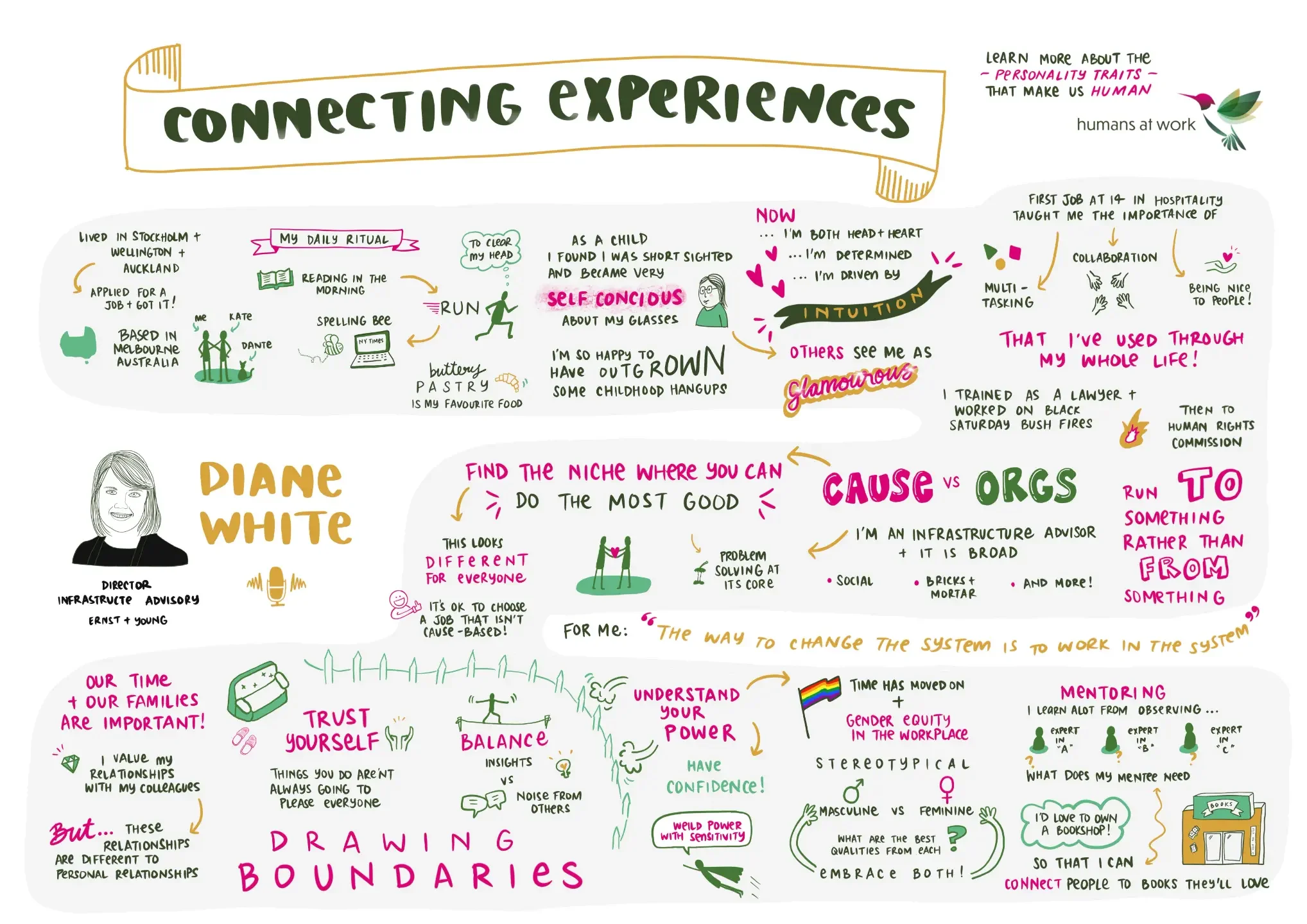
Jules: Kia ora, welcome to Humans at Work. I'm Jules, your host. Thanks for joining me and our latest guest, and thanks for taking some time in your day to indulge your curiosity about other people and their humanness. If your thirst is unquenched after this, check out jericaglobal.com. Let's begin.
Today I'm talking to Diane White. Rather than introduce Diane, I'm going to ask her to introduce herself, tell us where she's sitting right now, what her current job is, and what her favourite thing is to eat. Over to you, Di.
Diane: Thanks Jules, it's great to be having this chat with you today. I'm here in Melbourne on Wurundjeri land, lands of the people of the Kulin nation. I'm sitting in my office — it's my back shed which has been repurposed into a bit of an office. My current job is director at EY in the Infrastructure Advisory Team, part of our Strategy and Transactions Practice. My favourite thing to eat is an easy one for me — I'm a big pastry lover. I love all pastries, but particularly a very buttery croissant is probably my favourite food.
Jules: We should so have breakfast. I love pastries — I would say pain au chocolat is my absolute go-to, although I have recently discovered Argentinian pastries and there is a café locally that makes them, so next time you're here we will meet for breakfast.
Diane: I'll match you, and next time you're in Melbourne, I've sampled many, many, many pastries. I have my favourites and yes, I can take you on a small pastry tour of Melbourne. We have — some year, someone voted as the best croissant in the world — in Melbourne. But I would actually say they're very good but too much hype. I need something a bit more humble in my croissant.
Jules: Surely the best croissant in the world has got to be in Paris, or some small town on the coast of France somewhere.
Diane: I think they were going for the shock factor when they chose Melbourne, but it has led to this particular pastry shop having these ridiculous lines and it's all very concrete with a couple of men standing in a box with some butter on display whilst they're making their croissants. It's a lot.
Jules: It sounds amazing. Would you say that your favourite ritual of the day involves pastry, or do you have something else that you like to do every day?
Diane: Oh, my gosh, if I could have pastry every day, yes, that would be... I think at various times, unfortunately, I'm headed towards that. Favourite ritual — I'm a very ritualistic person, I love rituals. So most days I read in the morning. I love reading, so getting to do that every morning is, I've found, a really great thing to start the day. Since working from home so much, it's being able to fit that into the morning routine with a cup of tea.
I also run most days — not every day but most days. Again, a really important ritual to clear the head, whether it's in the morning or at night. The other ritual that my partner and I do almost every day is a thing on the New York Times app called Spelling Bee, which we just love. I sound like I'm an ad for both Lune croissants and Spelling Bee on the New York Times!
Jules: I would imagine that the running every day — and I didn't know that about you, so I'm very impressed — counteracts the pastries almost every day as well, right?
Diane: Yeah, that should be how the math works, but I think the running every day is very much a clearing of head, not doing anything else, ritual.
Jules: Do you listen to podcasts or music, or do you just reflect about your day and go over the arguments you could've had or should've had?
Diane: It's funny you ask that. Up until recently I often ran in the mornings and would listen to ABC's Radio National, but in the lead-up to the election which had just occurred when this is being recorded, I just couldn't stomach the campaign fever of everything going on. So I moved back to music, which I don't think I'm really paying attention to. When I'm running, I often find I have a particular "thing" going around in my head that I work out — and maybe sometimes it's one of those what-I-should've-said things, but usually it's a here's-a-thing-I-just-need-to-think-about-for-a-bit.
Jules: Who makes up your family?
Diane: My family here in Melbourne is my partner Kate and our cat Dante — he's very firmly part of the family. Back in New Zealand I have my Mum and my Dad and three siblings, and a couple of nieces and a nephew as well. Maybe being a migrant and moving to Australia, I end up treating my chosen family as quite a big part of my life as well, because you don't have that immediate family around. So particular friends who have become like family over the last seven years would form part of that family fabric.
Jules: What order do you come in the four of you from a sibling perspective?
Diane: Can you guess?
Jules: No, I can't guess! I mean I could, I think I'd be wrong though.
Diane: I'm the youngest. Through and through youngest child, absolutely.
Jules: What were you like as a child? Did you like to read?
Diane: I did, although not particularly widely. I just loved The Babysitters Club and Sweet Valley High — they were my favourite books and I read them a lot, and sometimes over again, because there's a limit to how many they can publish although there are many of them.
I was a very earnest child and probably still am quite an earnest person. Probably quite self-conscious — another way I'd put it is self-conscious about things that didn't really matter. One of the things that I managed to divorce the emotional weight from in recent years, because it felt like the biggest thing in the world when I was a child, was around the age of nine or ten I identified that I was short-sighted and needed to get glasses. Shouldn't be a surprise — many, many people above me family-wise are all short-sighted. I was just so mortified by that as a realisation, so I spent the next three years working out ways to avoid people around me finding out that I also needed glasses. And I am very, very short-sighted. It's funny — why was I so self-conscious about it? Part of it was I was at a small school, and I don't even know if there were many, if any, other kids that wore glasses. But for whatever reason, I was so self-conscious that it felt almost catastrophic.
Jules: Have you embraced the glasses and short-sightedness now?
Diane: Yes and no. I wear contacts most of the time. I have glasses — I have lost my glasses if anyone's seen them, that would be great. When I was actually in New Zealand last, they didn't seem to come home with me and I haven't bothered yet to get new glasses. I love my glasses when I wear them, but when you're really short-sighted I think it takes a lot to get used to either wearing glasses or wearing contacts, and either way, shifting back is a difficult task. Embraced to some extent, but clearly still something there.
Jules: I too became short-sighted when I was about 11 and needed glasses to look at the — then — blackboard. Before whiteboards. I wasn't self-conscious, I wouldn't say, but they were just very frustrating because it rained a lot and they would fog up and get wet. I actually had laser eye surgery when I was 29 — it revolutionised my entire life. I was so short-sighted that when I was in the shower I would have to pick up the shampoo bottle and bring it towards me to see whether it was shampoo or conditioner. The minute I had the laser surgery, within three days I could drive without glasses. I suddenly discovered a whole new world. It sounds hyperbole to say that, but actually being able to see without having to think "I need to put my glasses on," being able to wear sunglasses, being able to see first thing in the morning — it made a massive difference. I share your pain.
Diane: I should think about it. It's that thing where contacts get you halfway — you get the benefit of being able to see in the shower or not get the fog up and things like that, but you don't get the being able to wake up in the morning and be able to see. That one is especially for laser eye surgery survivors, I think.
Jules: Do you think you still have that self-consciousness about things, or do you think it's been beaten out of you, or you've grown out of it?
Diane: I think I do, but it's funny the way it manifests. It's probably that thing where sometimes you need someone else to hold a bit of a mirror up to you to be able to see these things. My partner jokes sometimes that it's almost like — I grew up in a very small town, farming community, not at all worldly or cosmopolitan, and neither of my parents studied at university although they're both really intelligent people. That kind of upbringing where I felt very aware of the fact that I didn't come from the educated class — and that still carries through in quite funny little ways, or so I'm told. The feeling of needing to project an image of not being a country hick — which is interesting to interrogate more as I get older. Self-conscious in different ways. I don't think I still have the same physical hang-ups and things that you have as a child or a teenager. I'm very happy to have outgrown those.
Jules: What would somebody close to you say — the three words they would use to describe you now?
Diane: It's a funny one because I find it hard, like most people, to think of how someone else would describe me. There's the head and the heart bit — I'm both a head person and a heart person, very intuitive, so I feel things a lot but I'm also very driven by my intuition in a way that I sometimes have to check on myself a little bit. Third one, determined. Just very determined — that can definitely go towards stubbornness. I like to just plod along and get things done.
Jules: If I was to describe you, one of the words I would use would be glamorous. It's interesting, isn't it, if you think about how you were as a child in terms of your self-consciousness and the "I'm from a small country town." You live in a very glamorous city now — Melbourne is known for its bright lights and its culture, always on, buzzy. Your projection of your image to me, as a former client and now someone I talk with fairly regularly, you come across as glamorous. It's interesting to see that it wasn't one of yours.
Diane: Hell, no — and so funny off the back of the way in which I... I guess the antithesis of glamour is the country hick. It's very funny that you've picked up on that. I genuinely love some of the things that represent that glamour thing — I love fashion, I love culture, whether it's shows or books or things like that. I didn't expect that!
Jules: Why did you decide to leave New Zealand and go to Melbourne? Is it the first place you've lived and worked in as an adult, or did you just land there after many travels?
Diane: Somewhere in the middle, I suppose. Speaking of glamorous places, I lived in Stockholm — I lived in Sweden for a little while back in my early twenties, studied in Oxala and then moved to Stockholm and worked there as a live-in nanny for a while. Then I went back to New Zealand, quite reluctantly, to finish my degrees which were both otherwise going to fall by the wayside. Then worked, had no money, just tried to earn a bit so I could move overseas again.
It was probably after a couple of years living in Auckland — after I graduated I worked in Wellington for a little while, then I moved to Auckland, and I really loved Auckland. Auckland was in a really great place when I was there, still think it is. The old idea of Auckland back 15 years ago of being devoid of culture and soulless had well and truly passed, and I loved living there.
I was working for Government, which is quite unusual — especially at that time, I think it's more common now, but seven or eight years ago there wasn't a lot of the bureaucracy based in Auckland. I knew I really enjoyed working for Government but I knew I didn't want to move back to Wellington. The main reasons for that were the weather — it's a silly thing, but after living there for six, seven, eight years off and on, I was just tired of it and Auckland was so warm and glorious. I knew I wanted a new job; I'd been in my job for a couple of years and was ready for something else, and I didn't really see many other opportunities in Auckland.
I really just opened up one day the Victoria jobs website. My partner at the time and I were coming over to Melbourne for a wedding of two of our close friends and I thought, I'll apply for this job. And then I got an interview — we were here for the wedding, so I had the interview in person — then they called me the next day and offered me the job and I went, "Oh God, what are we doing?" We hadn't even really talked about it. It was just, I'll apply for this job and we'll see what happens.
Then we decided to move here. It was going to be at most a year — to the point that I was also interviewing for a job in Auckland and was going to try and see if they could defer the offer by a year so we could come back. I'll just spend a year here. This is what happens with Australia generally, but particularly Melbourne. And as a New Zealander it was a privilege — we moved here with no visas, no need for anything, so it's just so easy to stay. So here I am still.
Jules: Do you think Australia is it for you, or do you think you will move somewhere else — maybe back to New Zealand?
Diane: It's one that I think anyone living overseas often contemplates, but particularly over the past couple of years with COVID. Had I been in a different country during COVID than Australia — where I actually was able to come back during the course of the pandemic and I felt close to home although far away — I didn't have the same experience that perhaps people living very afield had. If it wasn't for being in Australia, the last couple of years would've made me really think about moving back to New Zealand. Now that we feel a bit more through the pandemic and I can travel easily again, I feel like staying here for a while is the plan.
My dream is to be able to spend long periods of the year in New Zealand as well as here. I think that my work and the way that work is moving will only enable that kind of flexibility. For the time being staying here, but with the view of spending a lot of time in New Zealand.
Jules: What would you say is the most memorable country you've ever visited?
Diane: It's a few, but absolutely the most memorable experience in travel is always that combination of the place and where you're at. The one that comes to mind is Turkey and the time I spent in Istanbul. It was the combination of an extraordinary city that just leaves me speechless — it's such an amazing city, it's big, there's so much about it, so much history, so much culture, there's everything happening all at once.
Also, where I was at the time — I'd been in Europe for three or four weeks and was coming through a hard time on a personal front. That holiday represented working through a whole lot of stuff for me, and that period at the end when I was in Istanbul was where I felt like I had a bit of a breakthrough and I just had this extraordinary time. I just loved that city so much and I can't wait to go back again.
Jules: Where's the next place on your list?
Diane: I have such itchy feet at the moment after not being able to travel for a couple of years. We just went to Vietnam for a couple of weeks which was just fantastic — I absolutely loved it, it was amazing to be able to travel again. Hopefully end of August either Japan or Peru — those are the options at the moment. But flights to South America are not very friendly right now, with lots of stops and not many direct flights. Japan is still actually not even open to tourists, so things will need to change there.
Jules: They sound like very different holidays.
Diane: Yeah, they are. My favourite holidays are usually a combination of food and nature and city. I've been to Tokyo before but not to other parts of Japan, so that would be all of those. Peru — not long before COVID I got my first real taste of South America and I've just been hanging out to go back since then. It's a bit of a different one but very nature-focused still.
Jules: Thinking about work to earn the money to pay for the flights — was nannying your first paying job, or had you done some work before then?
Diane: I've worked since I was relatively young. I did bits and bobs earning glorified pocket money, I suppose. My first real job was when I was about 14 working in hospitality in a café, and I worked in the same café until I was about 19 in all my school holidays. Very much I feel like I grew up in hospitality. Then I started doing nannying when I was about 19 at university on the side, which was wonderful for many reasons. Two families I nannied for in Wellington both remain close in my life to this day, and it's really wonderful watching the children grow up. When I moved to Sweden, I didn't plan to spend time nannying there but I didn't want to come back, and I could do that without too many visa issues, so that was a good fit.
Jules: What would you say are some lessons you've learned from your early roles that you might still lean on in your current work?
Diane: Anyone who's worked in hospitality knows — I use those skills every day. Multi-tasking: there's no job that you multi-task in like a busy hospo job. You're thinking about what to do next, you're thinking about all the different people that need different things from you. It's an incredibly collaborative environment — you're relying on everyone else to do their role well but you're also constantly supporting people in those roles. You learn to be nice to people.
Hospitality teaches you in terms of being nice to customers, but you also really understand how horrible it is when people are not nice to you — and you get a lot of that in hospitality. Trying to hold on to those lessons is really important as you go through your career. You will be frustrated at people and frustrated that things are outside your control, and how you try and hold that is a lesson I've learnt but continue to learn.
Jules: In your current job, how relevant is the job title to the work that you actually do?
Diane: Our team has a constant existential crisis about what our team is called. We're called Infrastructure Advisory and that means many different things. It's relevant as an area — we do advise on infrastructure, whether it's traditional hard infrastructure, transport infrastructure, bricks and mortar, through to social infrastructure that often comes down to people and processes and systems. The work that we do broadly fits under that umbrella, but people don't always think of me as an infrastructure person — and I think that's interesting in and of itself sometimes, in terms of the way people perceive your skills and what you might be suited to do based on your skills, your gender and other things.
My job really, as you would know, is a lot of problem solving and sense-making. That's what the day-to-day looks like, whether it's big-picture problem solving or zooming in on a particular issue. That's the core of it.
Jules: When's the last time you moved jobs or organisations?
Diane: I've been at my current role for four and a half years now, so it's been a little while — it's really crept up on me. Within the context of my role, I've got to do so many different things that you feel like you're constantly doing new jobs and new roles. But it's been a little while now since I've moved into a new role.
Jules: Have you ever resigned on the spur of the moment?
Diane: No, I haven't. I've always tried to be quite careful about not getting to a point in a particular role where you need to leave — feeling like you really need to get out — as opposed to, I'm not learning now, I'm not growing, I'm not enjoying this, and I should look to move on. I think that's the point you want to be at. I've been lucky enough to have a bit of a runway and find the next opportunity every time I've made a major change.
Jules: I have resigned — not on the spur of the moment, but on a Sunday night dreading the Monday morning. When I was younger, early in my career, I didn't want to feel like a failure. So despite all of the weight of the work, or the context, or the hours, or just being over that kind of work, I used to just keep going. I was brought up with that sense of you don't move jobs unless you've got a job, but the decision to look for another job would've been to admit defeat.
I did find myself, one memorable occasion, having the Sunday night blues and I just happened to take a call from my Mum that night who was overseas. She must've had some sort of intuition because out of the blue, in the conversation, she said, "You know I'm very proud of you." And I just burst into floods of tears and decided right then and there that on Monday I was going to go in and tender my resignation — and that's exactly what I did.
Now as I'm older and wiser, my advice to people is always: it's good to go to something rather than run from something. Because what you don't want is for the memories of your previous role to be all about the ending, which in many cases can be quite a grind, quite a negative experience. If you run to something, you're actually running from one positive experience, you made a really strong choice, and you moved to another hopefully positive experience. Whereas if you get to the point where you're almost breaking and you're forced to do that, what you'll remember is that you felt like you were forced into something.
Diane: Absolutely. Probably once or twice I've felt like I've been in that category, and what that has led to is probably moving to things that weren't quite right or the right thing to do. I was lucky enough to find my way out of that.
The one job that comes to mind — I studied law and trained as a lawyer, then worked in what I would call law-adjacent jobs for a few years, not as a practising lawyer but doing legal work of some kind. The job I moved to Australia for was to work on a big class action that followed the Black Saturday Bushfires of 2009 — I was going to be working with the judge who was writing the judgment and basically supporting that process. When I interviewed for the role, they were at the point where they'd accepted that it wasn't going to settle. Usually a big class action almost inevitably settles before judgment, but in this case it had gone so far — 200 days in court, the longest civil trial in Victoria's history — and it still hadn't settled.
I came onboard with the expectation that it would run through and we'd do this judgment, and it would be great to be part of that. Then within a month of starting, the case settled. When a big case like that settles you literally just drop pens and everything stops.
I was still employed, I still had a job, but the judge got me to work on other judgments, and it was during that period that I was like, I'm not actually very interested in the law, I don't actually like the practice of law, other people are far more excited about this than I am. I needed to find a job to do because I was doing things that I was very much aware I didn't really want to be doing.
I was very lucky that it was a very supportive environment, but I was not wanting to do that work, so I ran from it a bit. I was just lucky that the thing I ran to led me down a really good path, because it could've easily not been that case.
Jules: Do you think you're a cause person or an organisation person? Do you go to a job because of the kind of work you can do and its end purpose, or because the organisation sounds interesting and has good values, or is it a mixture?
Diane: I don't think I used to ever know there was a distinction, and I wish I had known so I could've been a bit more deliberate about it. I used to be a hundred per cent cause — I just wanted to do meaningful, purposeful work that I felt really excited by. The transition I made when I came to EY was when I moved from being a cause person solely, to being an organisation-and-cause person, looking at who do I work with and the people around me and that kind of thing.
I'd been working at the Human Rights Commission leading an inquiry into sex discrimination and harassment in the Police. That, to me, was my golden cause — really passionate about Police culture, reform, change, and gender equity. Great golden mix. That role was really great on some fronts, and I really enjoyed parts of it, but it was then that I realised that actually what's important to me in a job is so much more than that. Moving from what was so much purpose work to something that on the face of it didn't look as purpose-driven was something I had to really grapple with.
And going back to the earlier point about self-consciousness — being seen as a good person by virtue of my job title was really important to me. Moving to a big global company with a job title that would mean nothing to anyone, that was a really big growing experience and absolutely was the right one. I'm so pleased that I did it, but I think I had to let go of being a cause person in doing that.
Jules: I think there's something about finding the niche where you feel you can achieve the most good — and for everybody there'll be a different niche. I remember working in the not-for-profit sector, working and leading people who were working with very vulnerable clients, and realising that where I got most of my satisfaction from was not the day-to-day engagement with the clients, but actually from the engagement with actors across the system — Social Services, housing agencies, the Police, central Government, setting all of the policies in place. Being able to work at that level and influence for a better outcome in the end, as opposed to dealing with people on a one-to-one basis where the amount of influence I had was really only down to my ability to show empathy and do what I could within the system.
It was quite a strong realisation for me, because I was always of the opinion that how you treat people is going to be the thing that makes the most difference. I was probably about 24 or 25 when I realised that the way to change the system is to work in the system, but that is not the same as working on the front line — for me.
I consciously took roles where I was actually a step away from the clients on the front line while still trying to retain that sense of really clear connection and that sense of outcome. When you work through agencies or at a system level, at a national or regional level, you have to have some trust that eventually it will actually make a difference for the individual, but you're not going to be there to necessarily see it and implement it — you're a step away, thinking slightly ahead.
Diane: A hundred per cent. For me, maybe even more and slightly cynical, is that it's also not just about the purpose of my work — I'm allowed to want to have a good working environment that I enjoy on a day-to-day basis. And absolutely if you can get that in a purpose-aligned role, that's fantastic. Being able to enjoy going to work each day and working with great people, and working in a culture that supports and inspires you in some way and is invested in you — that is really, really important. And it is okay to prioritise that above, or equally to, what is the purpose and impact of my work.
It's probably moving past that saviour complex and going, actually, I want to have a job that I enjoy and that I come to each day and get to do good work. And regardless of what the purpose of that work is, if I'm doing work that I find really meaningful — and like you, driving systems throughout change — absolutely. But that doesn't need to be the only thing I focus on in what I want.
Jules: Do you have a best friend at work? Do you believe you need a best friend at work?
Diane: I don't, on both fronts. I really like so many of my colleagues and I enjoy the company of so many of them — some of my colleagues I do probably friend-like things with — but I also find it really important to have quite good boundaries in a workplace context.
A lot of my work has focused on power and the way in which power is mediated — whether it's between two people at a citizen level, whether it's between the state and the person, or whether it's between a corporate and another actor and the citizen. All of that has made me think a lot about how you see and understand power, and you see and name power, rather than pretend that we live in societies that don't have power structures.
In the workplace context, a lot of the work I've done has really drilled down to where boundaries are not well articulated, understood and eventually exploited. I try to have a really healthy boundary around my personal relationships in the work context versus outside of work. I generally get it pretty good, and it's hard when you're someone who naturally loves to engage with people and build positive relationships. But I can look at all of my relationships in a work context and they're not the same as the relationships I have in a personal context — even though they're relationships I cherish, value and enjoy so much.
Jules: That really resonates because I'm an open book type person. I don't believe in hiding who I am when I'm at work, and I try to be the same person and have integrity in both arenas. I love finding out about people and having fun at work and having a joke — I don't like to take anything too seriously, although the work is serious.
What that does is translate into people's expectations that you actually want to spend a lot of time with all of your workmates. I love my family and my home life and generally I keep them quite separate. I found, certainly when I had young children, the expectation that I would stay after work and have a drink. And I used to say, "I've spent eight hours with you and I really like all of you, but you know what, I would prefer to go home and see my babies. I just want to go home and put my comfy slippers on and be at home with my family, because you're not my family, you're my work people and I really value you, but there are some boundaries there."
Diane: Absolutely. My experience has been that people are really receptive to that, whether it's explicit or more implied. It's something that people think — if I like the people I'm around and I enjoy spending time with them, I therefore have to have a friendship, as opposed to there being this other category of people at work that you really enjoy being around and spending time with.
I think moving into an environment from where I came — a very purpose-orientated sector where your identity was so tied up in your work that, as a result, your whole life had to be tied up in your work and your friendships and your relationships.
I have some friendships from those jobs and that time that are still really important to me. But when I came to EY it was, to start with, a really nice and somewhat of a relief to be in a space where I felt like my relationships were so much more professional. I started to build this sense of being able to have people who I work with who I really, really like and enjoy spending time with, but I don't need to treat them as the same as my friends and they don't need to be integrated into my social fabric outside of work in the same way.
Jules: I'm interested in that because I think it ties back to the concept of power as well. I wonder if you would reflect that potentially that's also about you having more confidence in your own power, your own professional experience — that people might value your advice and listen to what you say without their needing to necessarily like you.
Diane: That's a journey. I think I'm getting there. I'm definitely still grappling with what it means to be a people pleaser, but very much getting better at accepting that people will not always like you. Even more so, the next step in that journey is almost embracing, to some extent, and trusting yourself that there will be things that you do that do not please everyone — and that's still the right thing to do.
That's a really hard experience, and it requires you to have good people around you who call you out on things, or who help you come to good decisions, and that you can trust that if you ask them for their advice you'll get a really honest response. But that you don't just use the feedback that you receive as the barometer of whether or not something was the right decision.
Every day in my work I'm navigating this at a micro level — making decisions about, I think we should do it this way, I think we should do it that way. And being really conscious of: when do I hold to what I believe because I have information or insights or expertise that ensure that decision is the right one? Versus, when do I say, actually, all of this noise that I'm hearing around it suggests that this is not the right decision and I need to rethink it?
Jules: Would you say that there is a link there between that sense of confidence and using your own power, with gender and gender experience in the workplace?
Diane: Yeah, I think so. My experience of gender in the workplace — I've thought a lot about it and it's something I find really interesting in that different spaces it's been more or less pronounced. I've actually, in recent years, come to understand more the value of certain stereotypically coded masculine qualities as much as feminine qualities. Earlier on, sometimes that narrative in the conversation around gender equity can become binary but also very overly simplistic — where it's like, woman is good, man is bad.
In recent years, working in an environment that often has a really interesting mix of the stereotypically masculine with the stereotypically feminine, I'm more and more starting to see the importance of bringing those different attributes together. Gender equity in the workplace shouldn't just be about finding space for those feminine attributes, but also reflecting on what are the great attributes that might come from those more stereotypically masculine attributes.
Jules: I couldn't agree more. I remember a conversation with a male colleague — both of us were going through quite a tough time for very similar reasons. He absolutely felt the pressure to retain a very calm, professional exterior and deny, even to me and to himself, the impact that it was having on him as an individual.
Whereas he was incredibly sympathetic when I was ranting and upset in a safe space, and never once thought that I should deny my own feelings — yet he reflected back on himself and was actually denying his own feelings in that situation. In that situation I actually said to him, "Your feelings are just as valid as mine. You can feel that way too, we have to work our way through it."
I completely agree — sometimes people will feel the pressure regardless of the reasons why, regardless of who they are. And that pressure comes from a power dynamic that isn't wielded properly, as opposed to stereotypical labelling or something that puts people into a box.
One of my favourite sayings is from Spiderman: "With great power comes great responsibility." And I would say that as you progress through your career, you also have power that you have to wield quite sensitively and be conscious that you're not doing to others what may have been done to you, quite subconsciously in many situations.
Diane: A hundred per cent. I think I'm seeing this and thinking about this more now, as I come to accept what I would call a generational gap. My colleagues like to tease me about the fact that I'm grappling with my increasing irrelevance in aging and no longer being young — and there is something there.
I reflect back to my boarding school days. At boarding school there is a really unhealthy culture — as there are in many hierarchies — of people treating the Year 9s terribly, and as you got older you got treated less terribly until you were the one treating everyone terribly. That was the kind of culture, in very sanctioned ways — very like, you could get the Year 9s to do these tasks that were, frankly, a bit exploitative, whether it was cleaning or doing things like that.
I think about that in a workplace context — you have to be really careful. I've caught myself a few times where you feel that little bit inside you where you're like, I had to do it this way. And catching yourself on that and thinking, what am I doing? Why do I think that? How can I challenge that so that I'm not trying to just replicate an experience that actually can be quite negative, simply because I now have more power?
I think people are very uncomfortable about talking about power, and especially we talk about it in different ways — we talk about it in terms of gender, or we talk about it in terms of culture or race. But it all comes down to power, and until you name it and find space to talk about it comfortably, it can loom over organisations and people and society.
Jules: If somebody asked you to mentor them, what would you draw on in terms of providing advice and support?
Diane: In terms of sources, it's everything. I caught up with a friend of mine at the weekend — a New Zealand friend — and we accidentally talked for two and a half hours, which was lovely. In that conversation her wisdom and her thinking on certain things informed the way that I would perhaps mentor someone on a certain topic or a certain issue in a work context.
I learn a lot from watching and observing. I have, in the context of my current work, people who I see as role models for various things. I don't have one person where I'm like, oh, that's the God, that's the person. It's more like, that person is amazing at this, and this person is amazing at that. So in mentoring someone, being able to draw from those different experiences and people, and really identify what is it about this person — the person you're mentoring — that makes this lesson important. It's that tailoring of advice. Consulting makes you good at that — you need to always be tailoring your advice.
Jules: If you could do any job in the world, anywhere, for any organisation, what would it be?
Diane: It goes a bit to what I was just saying about what I like to do in mentoring. I would love to own a bookshop — that's my ultimate dream. But when we dig into that, my partner always points out, "You hate admin, who's going to do your admin?" I'm like, "I'd have to outsource that." The actual day-to-day grind of running a bookshop may or may not be that enjoyable, although I genuinely love the idea of creating spaces, and I so much love books that it would be a wonderful thing to be able to pull together.
The thing I love about the bookshop idea is more that I love to recommend books to people — not based on "here's a book I loved, you'll love it," but what does Jules, as a person, love and what is she interested in, and what kind of book do I think she would like? And then recommend books based on that. If I could do a job, it would be something like that.
Maybe books is one thing, but maybe it's just more generally — I love to connect people up to things that will help them or that they will enjoy. And I get to do a lot of that in my job at the moment as well.
Jules: I think a bookshop that also sold pastries — you could go in and have a little conversation with you and you would say, "I think you'd really enjoy these books, and here's a Danish pastry or a pain au chocolat and a cup of tea, go and enjoy." I think that sounds amazing.
Diane: I agree, although I would definitely need to outsource the pastry making. My endeavours to learn how to make pastries have been incredibly unsuccessful to date.
Jules: You are a champion cake maker, I understand.
Diane: I love a cake, but a cake and a pastry — I feel like there's a lot of distance there. I've got a long way to go to get into the pastry game.
Jules: It's been great chatting today, time has flown by. I think our next conversation definitely involves food of some sort. I do want to say thank you so much — very generous in your honesty and the stories you shared, so I really appreciate it, and I'm sure everybody who listens to this podcast will as well.
Diane: Thanks, Jules, so nice. And I want to go through and ask all the same questions to you, so maybe we'll do that with our food next time.
Jules: Sounds wonderful.
Thank you so much for listening, and thanks, as always, to the generosity of our delightful guests. The stories of how others have faced up to their challenges can help give all of us courage to keep going with our own. For more great episodes, blogs and learning packages, go to JERICA Global.
Humans at Work Podcast