
Martial Arts, Gig Workers and Post-Pandemic Work Practices — with Jeff Mike
Humans at Work Podcast | Episode 4
Host: Jules Harrison-Annear | Guest: Jeff Mike
Jules: Kia ora, welcome to Humans at Work. I'm Jules, your host. Thanks for joining me and our latest guest, and thanks for taking some time in your day to indulge your curiosity about other people and their humanness. If your thirst is unquenched after this, check out jericaglobal.com. Let's begin.
Today I'm talking to Jeff Mike. Rather than introduce Jeff, I'm going to ask them to introduce themselves, telling us where they're sitting right now, what their current job is, and what their favourite thing is to eat. Over to you, Jeff.
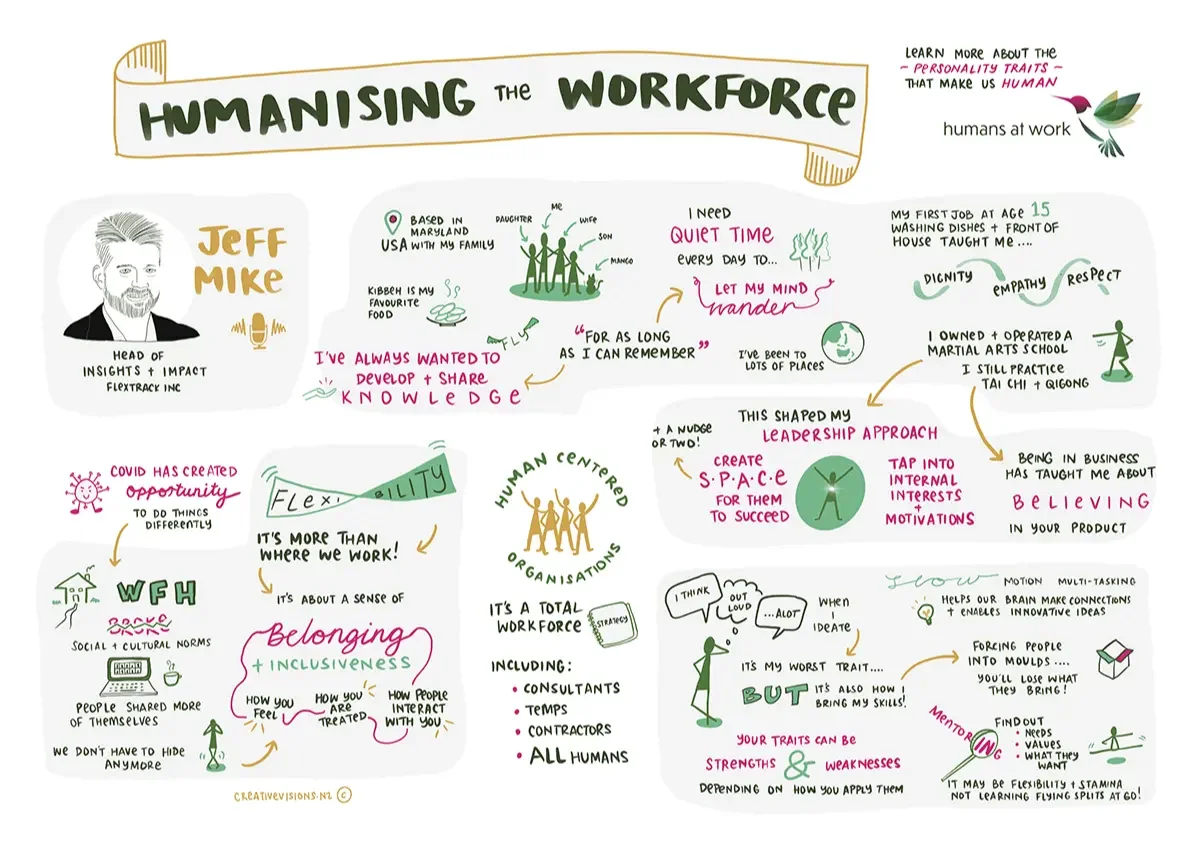
Jeff: Thanks, Jules. I'm Jeff Mike, I'm currently in Ellicott City, Maryland, after having spent some time overseas teaching in Morocco. We loved the east coast of the United States where we get a full spring — coming from Texas previously, we got the short spring, maybe a few weeks, and we've enjoyed two months, going on three, of a beautiful spring here in Maryland.
I'm currently Head of Research and Managing Director for FlexTrack, and we are an extended workforce solution provider built on Salesforce, primarily coming out of the vendor management system space but we're much broader than that. Our overarching vision is to unify the employee workforce with the non-employee workforce for a total workforce strategy.
My favourite thing to eat — there's so much to choose from. My wife is from Lebanon and she's an amazing cook! What I chose was a dish called Kibbeh Arnabieh — have you heard of that?
Jules: No, I've never heard of that, it sounds delicious.
Jeff: If you've ever had Middle Eastern food, kibbeh is very common — it's ground meat, typically beef or beef and lamb with pine nuts, spices and bulghur wheat. Kibbeh Arnabieh is that type of beef with a citrus tahini sauce, and it takes all day to make if you do it right. There's probably three, four, five different types of citrus with the tahini. It's very heavy but it is absolutely delightful!
Jules: It sounds amazing. The question is, have you learned how to make it or do you rely on your wife making it?
Jeff: I'm not allowed to touch food in the Lebanese kitchen.
Jules: I wanted to understand a bit more about you and what you were like before you became the person you are today. But my first question — as a person with a first name as a surname, do people ever call you Mike by accident?
Jeff: Oh, boy, I could tell stories for the rest of the hour on that one. There's a funny movie called Roxanne, from the late eighties, where Steve Martin goes off for maybe 10 minutes on those kinds of jokes, and I could probably do the same. My favourite one is when I said, "Yes, my last name is Mike," and people say, "How do you spell that?" One time I was in a particularly bad mood and I said, "S-m-i-t-h," and that didn't go over very well. I generally answer to both, unless you know me well, and I give everyone three opportunities — you can call me Mike twice, but after the third one, we might have a conversation.
Jules: The three-strike rule, I like it.
Jeff: Exactly.
Jules: You talked about your wife being from Lebanon — who makes up your family?
Jeff: I have a wife, obviously. I have a daughter who is 12 and a son who is 9, and a cat named Mango who's 2.
Jules: Why Mango?
Jeff: That was what she was called at the shelter when we brought her home.
Jules: That sounds like a good family, a good unit — some gender diversity there, a little bit of species diversity as well. That's always good.
On a day-to-day basis, do you have a favourite ritual? Something, no matter how small, that you do almost every day and you potentially might feel a little uncomfortable if you haven't managed to do it?
Jeff: I need quiet time because I'm definitely an introvert. I love being around people and I love engaging and interacting with people, but it does tire me out just by personalities. Typically in the morning I like some quiet time, and in the evenings quiet time. Sometimes meditation, but it's not an everyday must-have practice. I do like my quiet time — it helps me think more clearly and be more patient with the people around me.
Jules: Patience is a virtue, particularly I find in my own life when I use it all up in my professional life and then at home I don't have a lot left in the battery. Then, of course, the guilt sets in because you've maybe used up too much in your professional life and not saved enough for your home life.
Jeff: It's a tough balance but you're absolutely right. Especially when we're working from home and maybe there's an important meeting or we've just gotten off a sales call, and a little one walks in. It's hard to sometimes adjust — having to remember to adjust the tone and speed and the intensity for family members. But they're usually pretty forgiving too.
Jules: We certainly know a lot more about that after two-plus years of the pandemic. I think before that, maybe there was more of a separation between home and work, family and professional life. But the last two years have taught us that you can blend them — as you say, it is difficult. You have to do the mental switch in your mind maybe three or four times a day, just to make sure you've got the right hat on, the right persona on, for the situation you're in.
Jeff: That's correct.
Jules: That quiet time — does that go back to what you were like as a child, or is it something that's developed as you've gotten older? Were you a child that liked to go off on their own and have some quiet time, read a book, daydream?
Jeff: No, I think this is an innate trait of mine. As long as I can remember, I of course like interacting with people, but I've liked my quiet time. I particularly like to let my imagination wander in different directions when I'm alone — typically that's outside. So I feel like this has been a consistent way of doing things for as long as I can remember.
Jules: When you were a child, what did you want to be? Did you want to be a fire fighter? An astronaut? Did you want to be a researcher?
Jeff: It's interesting — I didn't want to be a researcher until I was in high school, when I started to understand what research was like. I have this affinity for discovering and creating knowledge and sharing it. So I've at times wanted to be a teacher, a professor when I was a child, which I had an opportunity to do. If I go back to some of my earliest memories, I always wanted to fly — something that allowed me to fly, either in an airplane or ideally without an airplane, which isn't quite possible yet. But typically my aspirations involved developing and sharing knowledge.
Jules: That's really interesting — that's been a common theme from when you were very young?
Jeff: Correct, yes.
Jules: I know that you've done some teaching in Morocco, so if I was to say to you: what's your favourite country that you've ever visited, would it be Morocco?
Jeff: I'd get in trouble if it weren't Lebanon, I think! I've visited some pretty interesting places. I have a background in international development, so I've been to places like Sub-Saharan Africa, Zambia, Pakistan — which was very interesting — and Haiti, which was fascinating, inspiring and depressing all at the same time. I wouldn't say I have a favourite country, but really what I enjoy is immersing myself in other cultures and experiencing them first-hand.
Jules: I'm fascinated to know that you went to Zambia, because something that not many people know about me is that the early part of my life, my parents lived in various countries in Africa — they were teachers. From when I was six months old until I was two, we lived in Zambia. We lived in the middle of the countryside, in a compound around a little regional school, and all the teachers had to live on site because it was so far away from any of the cities or any infrastructure. The kids came from all around — they would walk long journeys to get to the school because education was obviously very, very valued there. I started my life, really, in Zambia.
Jeff: Oh, that's very interesting. Do you go back ever?
Jules: I haven't ever been back to Zambia. From Zambia we went to Malawi, and we were there for four years, and then we went to South Africa. I have been back a few times to South Africa, including as an adult, but never quite made it back to Zambia. I'm not sure I could find the small rural school in the middle of nowhere, but we've got loads of amazing photos from that time and we all think of it very fondly. When were you in Zambia?
Jeff: I was working for a Government contractor that did basic education programmes for both urban and rural areas, and they needed some HR help with the programme in Zambia so I went out. It was 2006. I will tell you, it was the first time I had been to Sub-Saharan Africa and it wasn't a very long trip, but it reshaped my whole perspective on the world. It was very interesting.
Jules: I'm sure we could talk about that for a long time as well. If I take you forward from your childhood a little bit, what was your first paying job?
Jeff: I was a dishwasher at a deli in Scottsdale, Arizona. I think I was 15.
Jules: Has that shaped your life? Do you do the dishes at home?
Jeff: We share the dishes at home — my wife is very specific about the way to do them and she's trained me. But I think what it's done is, I was in high school and in college in particular, I spent a lot of time in food service — both dishwashing and front of house, waiting tables or serving. It really gave me a perspective and appreciation for people who make their living doing that work. I did get a sense of empathising with people that that's where they worked, so I try to remember those times when I'm interacting with a service employee somewhere.
Jules: What was the first job that you went into after university?
Jeff: I opened a martial arts school in Seattle during my senior year in college at the University of Washington, so I would say it was running the martial arts school full time.
Jules: Wow! All of these different hidden career jumps that you've done, Jeff. I would never have pitched you for being a martial arts expert. Are you still able to do the moves?
Jeff: Yes — I often refer to that time as "20 years and 20 pounds ago," but I do practice, probably the breathing movements, Qigong in particular. I also do a lot of the movements that are helpful in opening your joints and developing flexibility without a lot of impact — Tai Chi type movements, in particular.
Jules: As all of us get older, the importance of that kind of exercise really starts to come front of mind as you start to creak, and are maybe less resilient to get through the day without a little bit of self-care and discipline. I'm with you on that.
Your early roles are quite different — service industry, front of house, and then running a business. What do you think are the key lessons you've learned from those early roles before your research and HR career really took off?
Jeff: As I've mentioned, the first roles gave me an appreciation for service workers and doing my best to treat them with respect and dignity, and having an affinity for what they do. I think that has lasted throughout my life.
In terms of teaching martial arts and running the school, there was a lot there. One of them in particular has shaped my leadership approach — rather than trying to make people do things, I try to create space for them to pursue the things that are interesting or that motivate them, maybe provide some tools or some knowledge and from time to time some encouragement or a nudge or two.
Really what I've found is that tapping into internal motivations from people I work with, and then helping to create space for them to succeed, was something I learned while teaching martial arts. Then running a business — if people didn't come in and sign up, I didn't pay the bills. So I learned how to prospect and how to sell and how to really believe in what I was selling, in order to get people to see the value and ultimately pay for the services I was offering.
Jules: Those two things are quite complementary, aren't they? If you're working in HR or you're leading by influence or by hierarchy, you also have to believe in what you're saying. You have to believe in your people, because sometimes you're selling to them what you see — about themselves or about the situation — that maybe they don't see. I can see how those two things have combined and are really complementary in terms of where you've gone in your career. Have you found that?
Jeff: Yeah, I think you're exactly right. Particularly coming from an HR background, "selling" is sometimes a word that is distasteful to some people, or even in non-profit experience that I've had. My perspective on that is — I'm not psychologically manipulating anybody into anything. It's understanding what their interests are, and if their interests align with what I have to offer, then we have a discussion about the value of that offering and whether it's for them or not. It's really based on what is their motivation, what are they trying to accomplish, and can I help them do that with whatever it is I'm selling?
Jules: How would you describe your current job? What's a day in the life look like for Jeff?
Jeff: That's a great question and I'm fortunate enough to have an employer who is very flexible and hired me because they don't have what I can do. Part of my job is bringing all of this energy and creativity and investment that we've seen over the past half-decade to a decade with the workforce — particularly the full-time employee workforce around payroll — and bringing that to the contingent or extended workforce, which is approaching 50% of the average company's workforce in some areas.
We talk about creating a human-centred organisation. Certainly that applies to regular employees or full-time employees. But how can we extend that to non-employees, like consultants or independent contractors or temps or gig workers? There are different ways to approach those segments of the workforce, but at the core, they're human as well.
My opportunity is to try to translate and apply — or even develop some new approaches for — humanising that side of the workforce, and ultimately developing a total workforce strategy. That's generally my guiding principle and mandate. In the details, I'm doing a lot of research and having a lot of conversations.
I started my career, when I sold the martial arts school, by going into staffing. I went to a temp agency and said, "I need a job," and they said, "Why don't you come work for us?" That's how I got into HR.
After 20 years of that, I'm still learning about the contingent workforce. Technology and digital transformation has changed a lot, so a big part of what I do is learn about what technology can enable, but I try to synthesise that and share it in a way for people who want to humanise their workplace or want to have a better experience with their workforce, no matter what segment that is. It's a lot of conversations, a lot of learning, some writing, and recording and editing of interviews.
Jules: Do you find that since the pandemic you face less resistance in terms of some of that thinking, or do you think it was already well on the way ahead of COVID?
Jeff: That's a great question. I think COVID has softened the resistance to some of these ideas that we've had and been trying to address in HR and staffing for a long time. It's one thing when an HR person says, "We need to humanise the workforce." It's another thing when the top five platform businesses in the world are saying, "We're going to humanise our offerings," because of the challenges and disruption of the pandemic. The way I like to describe it is — someone took the ant farm and shook it up, so there's an opportunity to reset how things are done right now. I think the pandemic has created opportunities to do things differently than we have in the past.
Jules: I'm interested in this personally because I have always had — the common term would be side hustles — primarily driven by curiosity or endless enthusiasm that might not be treated with eagerness in the job I'm doing, but I need to have an outlet for it. I've always very much enjoyed working from home or remotely and having that flexibility for life.
I'm interested in your perspective around the focus in the media and the public eye on the strategy that companies are taking about location of work. I think all too often, the idea of flexibility and human-centred workplaces focuses on: do you make your employees come into the office for set hours, or do you allow them to work from home?
In my experience, human-centred workplaces are much more than where you work. You can work from home every day, but if leadership isn't supportive of what you're doing, if your diversity and uniqueness isn't valued, if you feel bullied or the work isn't meaningful, all of those will have a far greater impact than where you sit when you're on a computer or taking endless Zoom calls.
Jeff: I think you're absolutely right that it's more than where you work. I had the good fortune to work for an organisation that allowed us to work remotely prior to the pandemic — part of the strategy to save money on office space was to have a number of us work remotely, and then we would hotel-in or travel a lot to client sites, which had its own implications. Generally speaking, for a long time — six years at least — I've been trying to figure out how to look at a screen all day and not become fatigued, as well as how do I engage people when we're not in the same room? There are tools and techniques to be able to do that.
Something you touched on that I think is really important is this sense of belonging — and belonging is not where you sit, for sure. It's how you're treated and how people interact with you. There are research studies that indicate some of the highest-performing teams, at least pre-pandemic, are hybrid teams where people work remotely but they come together regularly in person.
Even in my new role, I have a great group of colleagues and we've enjoyed getting to know each other. We spent a week at a conference together and our relationships will transform from that. There is something valuable about being in-person, for sure. There's also something valuable about being at home and particularly not having to commute.
Going back to this notion of digital transformation — it's about aligning individual preferences with the needs of the organisation and being flexible. It's not something that's easy to do or that you can set and forget. It's something you have to continuously try to engage, which is hard, but at the same time it's better for the relationships.
Jules: In the States, have you found, as I have, that enforced working from home has cut through a little bit of the hierarchy, and also potentially allowed people to be a bit more comfortable in showing their personality?
If I give you an example — when you're presenting to a group of executive leaders, the chief executive or a board, and every single one of those board members is sitting in a homemade office with a cat walking across the screen or a child walking through the background, they know that you know that they're a human. There's some levelling that has been experienced, certainly personally by myself, and by many of my colleagues in New Zealand, that it has brought a bit more of the human out across some of the hierarchy within traditional organisations.
The other aspect is the ability for people to belong to an organisation without hiding who they are. Quite often during the pandemic there would be some instance where everybody on your screen would see who you were living with, who your partner was, what kind of family makeup you had. Whereas, if you were always going into the office, if you were worried about sharing the fact that maybe you were in a non-traditional family setup, you could keep that very quiet — it would be a part of yourself that was hidden, and there might be really good reasons for that.
My observation is that through having to work from home, there have been opportunities for people to test out, to pilot showing parts of their personality to their colleagues on a screen, that is not quite as confronting as going into the office — maybe dressed in different clothes for your gender. All of those different things that people should feel comfortable and supported to show — I think we've had an exponential step forward, not always in a positive way, but there are some deeper-seated changes that have come through from common enforced hybrid or home working.
Jeff: I think it has, and I think you've addressed a number of social and cultural norms that were broken by the pandemic, as we've discussed. When I hear your questions and your comments, I go back to the early days of the pandemic when nobody knew what was going on, nobody knew how dangerous this disease was — and still is, frankly. There was a lot of fear and uncertainty in the world. During that time, a lot of the norms were just broken around this hierarchy and these — I don't want to sound negative — facades or pretences that we put up or how we showed up in person at work. "You have to dress this way and walk this way and talk this way." I think some of that just went out the window when the service people we were talking about earlier were really risking their lives to make sure we had food, gas or basic services.
I do think in many cases there was a recognition that maybe all these images that we presented are less important than the human beings on the other side. I remember a lot of those early conversations, just checking in — "How are you? Who's your family? Who's your cat? Who's your domestic partner? What's your family like?" What I think was a more sincere interest in identity than the virtue signalling that may have been in person previously, or the downright resistance to those ideas previously.
In terms of working, I've been very fortunate to be with a number of organisations that are aspiring to be human and are human at their core, and really allowed for that understanding of humanness, regardless of the norms around them at the time.
Jules: Again, that's something we could talk for a couple of hours on just on that topic. Maybe we'll do another series for that.
In terms of your working style — I'm always interested in this because it fascinates me how different people approach it — do you respond to emails and messages as they come through? Are you an instant replier, or are you one of those people that has a schedule and only checks their emails at certain times in the day because they really want to focus on some work or some think pieces in between?
Jeff: I really wish I was one of those people you're describing because I'd probably get a lot more done and maybe have less stress. There's lots of advice out there about blocking your time and the best way to be most efficient and productive with your emails. I'll go back to the earlier conversation — I love to let my mind wander, and as a researcher and a creative person trying to operate within a business environment, I go through stretches where I will cover all my emails and then there will be two or three days when I'm doing something else and my mind will be working on either a perplexing research question or something else.
Generally speaking, I try to be respectful to the people who are interacting with me and I do recognise that things happen at a certain speed. If I'm prospecting and trying to set up a conversation with somebody, certainly waiting a week to get back to their scheduling is not a good idea. I've also realised that everyone's very busy, so a day or two delay in getting back — if it's not a critical issue or if it's not going to lose momentum — is something that's helpful.
Email, I feel, is one of the biggest wastes of time and one of the most inefficient ways to communicate ever. Particularly at one employer, I remember I had someone senior say, "Your emails are way too long and nobody reads them." It's almost like emails are a different form of text, and if you really want to have a rich communication, you schedule a call.
A little bit of a meandering response, but I'm not one of those people who's disciplined. I do my best to try to respect other people's time and the momentum of a particular context, but I'd much rather be having the conversation, talking about ideas with a group of people or trying to organise them by either writing a script or writing a blog or something like that.
Jules: I have to say, I wish I was one of those people too, but I'm not. I listen to a podcast called "Cautionary Tales," and one of the episodes was about this concept of slow-motion multi-tasking. The concept really is that in history, people who have invented something amazing haven't actually focused all of their time on that one thing until they have the lightbulb moment. Actually, what they've done is interjected completely different topics and let their mind focus on one to the other to the other — often for quite long periods of time — and then come back to their original piece of work.
The concept is that that allows your brain to do exactly what you said — to daydream, to make connections, to come up with innovative ideas that it might not do if you were a hundred per cent focused and very narrow in your field of vision. The podcast refers to a number of historical geniuses, and I'm not saying I'm anywhere near that, but I find that's given me the licence to say: the reason why I'm not one of those people is that I don't want to limit the opportunity for that spark across different topics or different conversations, different channels. They're all the things that can drive innovation, ideas, cut through on a really complex problem. I feel I now have an excuse not to be one of those people, because I'm walking in the footsteps of geniuses that have gone before. You can feel free to use that if you want to justify it for yourself as well.
Jeff: Oh, I'm going to. Those poor project managers who are very patient with me and follow up on deadlines — I will use this to try to explain myself when I miss a deadline or require a second follow-up. It's not something that I do all the time, but I know some people are very linear and scheduled, and more power to them. It's just not me. Yes, I will use this argument in the future.
Jules: Talking about your work colleagues — what do you think your work colleagues would say are the best and most annoying things about you as a colleague?
Jeff: Sometimes I think out loud like we've been describing, and it's hard to follow. If we're ideating sometimes and I haven't thought through and organised my thoughts, I know my boss is sometimes like, "I have no idea what you're talking about." He's patient and he's obviously created a lot of space for me to be who I am, which I really appreciate. But sometimes this stream of consciousness thinking is tough when there's someone on the other end — or a few people on the other end. He's president of the company, he's driving towards results, he's got a lot of things to do, and here I am thinking out loud sometimes. While I have space for that, I think it does require some patience on the side of my colleagues.
Jules: I would imagine that's probably one of the best and worst of your traits — that's actually why they need you there, for that ideation, for the imagination that you bring. They just have to stick with it and give you the freedom to do it. I find quite often with people, the things that are really annoying are actually the things that you really need that person to do, and you just have to allow them to be whoever they are, not fit in with your own timetable. Quite often it's the timing issue or your way of doing things. If you force them into a certain mould, you'll probably lose the thing that you really need from that person, which is part of their personality and how their brain works.
Jeff: That's exactly right, and you've got a little bit of martial arts philosophy inside you if you ever decide to pursue that practice — where your traits can be strengths and weaknesses depending on how they're applied. I think you're absolutely right. The team appreciates and has recognised my ability to create and what I bring to the table and, again, they're patient with me, bringing me to a focus when the time comes.
Jules: Do you believe in planning your career moves? I know that the move to FlexTrack is relatively new. Was it planned? Is that how you've moved through your career, or have opportunities dropped into your lap and you've thought: why not?
Jeff: Oh, why did you ask this question? I used to think that I would plan my career and do what I want. Certainly being a professor and doing research and teaching at university level is something that I've wanted to do since at least 17 or 18 years old. There are times where I've pointed myself in that direction and not.
Generally speaking, I've found what works better is when I am very clear on the type of work that I want to do and how I want to do it. A long time ago I calculated how much time people spend at work as adults and I thought, being in HR or understanding people at work is something very valuable — I could apply this research and knowledge, and leading HR teams was part of that.
Where I found it doesn't work for me is when I'd say, "I'm going to do this and work for this organisation and then do this and work for this organisation." With having clarity about the big picture — the type of work that I wanted to do and the type of people that I wanted to work with — I've been very opportunistic in terms of the specific organisations and specific roles that I've accepted.
My current role, I hadn't even thought about it. When the recruiter wrote me I thought — what, VMS, I dealt with that a long time ago, I don't think so. But let's take the call and see what happens. They articulated a vision and values and are looking to disrupt. I wouldn't have thought of this for myself, but someone reached out to me and said, "You should look at this opportunity." I learned a great deal and thought: hey, here's an opportunity that I haven't thought of before. Big picture, the type of work — yes. Specific organisations or timelines or steps — I've not been that planful.
Jules: If someone asks you to mentor them, what do you think you would draw on to provide that kind of support and advice?
Jeff: Going back to what we talked about earlier in terms of the martial arts school, it would really be: let's find out what your interests are, your needs and your values. Specifically, depending on those answers, how can we get you to where you want to be — or where you need to be — in terms of developing skills, developing perspectives, and taking a particular path. When I've mentored or led somebody or a team, it's really been about getting to know them and what they want to accomplish within the constraints of the work environment, and trying to find ways to help them along for something they have already articulated that they want.
From time to time, using the martial arts analogy — if you're teaching a 60-year-old, you're not going to be doing the flying splits any time soon. I'm going to help you develop flexibility in your hips and some stamina. But is that really what you want to do? Or do you want to have that flexibility in your hips and the stamina that it takes to do that? Sometimes reframing that question without pulling away those interests is helpful.
Jules: I like that analogy very much. I'm feeling like I need to take some martial arts classes after this, I have to say. At this point in your life, how would you describe where you're at?
Jeff: I would say very fortunate to have an amazing family who's been through a lot with me over the past few years and — thank God — we're still together and working through things. When that question comes up, that's the first thing I want to express: gratitude for my family and the many, many people I've interacted with, both personally and professionally, who have treated me with respect and a genuine interest. That's the big picture, and I take some gratitude there.
I have to admit, given the state of higher education, a little bit disappointed that the full-time long-term professor role hasn't materialised. But that being said, I've had the opportunity to do the teaching, to do the research, and to interact with a lot of very interesting, intelligent and motivated people throughout.
In terms of where things are — feeling very fortunate to have a good family, good people around me. The team I'm part of right now is motivated and seems to be a fit for me in terms of letting my mind wander and staying focused on a big goal of really humanising the non-employee workforce. I feel like I have an opportunity to draw upon all of these experiences — education, practical experiences and life lessons — to really bring myself to that role professionally, and to bring some of that expertise back to the personal relationships that I have. I'm feeling fortunate. I'm cultivating gratitude around these things, but I'm not at the finish line yet.
Jules: That sounds like a really great place to be, actually. Just to echo the gratitude point — time has flown by and that's the end of this conversation. I can't believe it's gone so quickly. I feel like we've got five or six topics that we need to schedule in for further conversations. I do want to say I really appreciate the generosity in sharing your life and the stories that you've told us — it has been really insightful. I do want to say thank you very much for joining us and hopefully we will talk again.
Jeff: My pleasure, Jules, and thanks for the great questions and the genuine interest that I'm feeling from this conversation. I appreciate it.
Jules: Thanks very much.
Thank you so much for listening, and thanks, as always, to the generosity of our delightful guests. The stories of how others have faced up to their challenges can help give all of us courage to keep going with our own. For more great episodes, blogs and learning packages, go to JERICA Global.
Humans at Work Podcast