
Why trees don’t have to go to school andrethinking solutions for global crises — with Jay Naidoo
Humans at Work Podcast | Episode 6
Host: Jules Harrison-Annear | Guest: Jay Naidoo
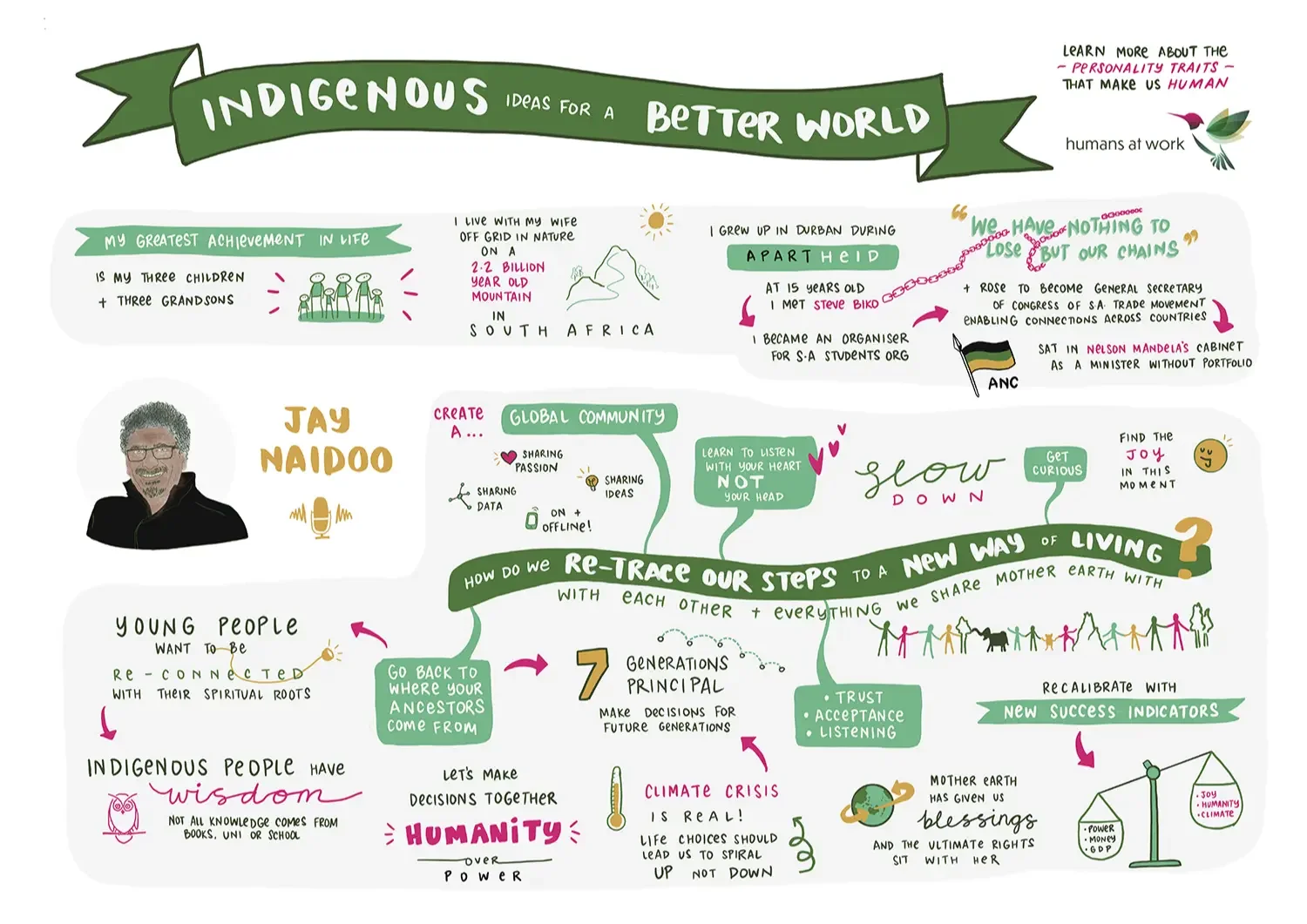
Jules: Kia ora, welcome to Humans at Work. I'm Jules, your host. Thanks for joining me and our latest guest and thanks for taking some time in your day to indulge your curiosity about other people and their humanness. For this episode, we're stepping away from our usual format and we are splitting the conversation into two parts.
This first part features Jay talking about what it was like as a young person growing up under the apartheid regime in South Africa, his political activism and his spiritual awakening. Our conversation traverses the need to redefine what success looks and feels like, the failure of global institutions and systems to adapt, and the opportunities for new ways of co-creating solutions.
Today I'm talking to Jay Naidoo. Rather than introduce Jay, I'm gonna ask him to introduce himself, tell us where he is right now, what he would say his current job is and how he starts his days. Over to you, Jay.
Jay: Thanks very much, Jules. It's a great pleasure to be with you and to have this conversation. What do I do today is a big question! I live just outside of Johannesburg in the Magaliesberg Mountains which is probably one of the oldest mountains in the world – over 2.2 billion years old. I live off grid which is useful with our electricity problems in South Africa.
I live close to nature. So my wife, Lucie Pagé, is a writer and a journalist, and I have moved back into nature and feel that our life is here. I'm a grandfather first and foremost! I have three grandsons. I have three children – I consider them my greatest achievement in life! I'm married to a French Canadian who I met in 1990.
I'm an elder today so although I've never actually had a job, I never considered myself as a career person, I've pursued things that I feel very deeply about and, of course, much of my life has been borne under an apartheid regime which you are all very familiar with. The world was familiar with it because the world helped us defeat one of the last institutionalised racial systems in the world.
I was a student activist when I was younger in school and university and that came out of my actual experience of apartheid. When I was four years old, we were evicted from our home and I never understood why we had to move from this most beautiful place with mango trees and pawpaw trees and any imaginable fruit you could find in Durban which is the port city where I was born.
Eventually, it became apparent that we were the wrong colour on the wrong side of the street and as apartheid entrenched itself, it really pushed anyone who was not white into the margins as a lesser species, basically, of human being. That was what I grew up with and, of course, it generated a lot of anger in me. At some point when you go through racism that is so institutionalised and so defining of your life, then you start to believe there's something wrong with you. You start to believe that why am I born black and you start to question your parents and the anger starts to rise within you.
I was fortunate to meet with Steve Biko who was a very charismatic student leader who brought to us the philosophy of black consciousness – be proud to be black. It was at a time in the late sixties where, in fact, the world was in ferment. Young people were building peace movements, the Sorbonne University students that rejected the system they were living in. It reminds me very much of today how young people do not trust Governments, do not trust business, don't even trust civil society. Trust had broken down and in that a new energy had been released in the world and we were caught into that.
I could remember being in a meeting with him when I was 15 years old and I can remember it as if it was yesterday. Steve Biko to your listeners, was as great in our minds in, what we called ourselves "the 1976 generation", as Mandela was. That's how important he was. His core philosophy which I capture in one of the slogans he had – "We have nothing to lose but our chains because the mind of the oppressed is the main weapon in the hands of the oppressor".
That was my baptism and I ended up going to university, becoming an organiser for the organisation he had set up – the South African Students Organisation. In 1977 he was murdered by the Police, so many of us had to go into hiding, and I had to go underground, basically, and many had to leave the country. I chose not to leave the country.
I became a volunteer in a fledgling union movement for black workers, which was still illegal. And as we negotiated to get some limited recognition, I joined the union full time and rose to become the general secretary of the Congress of South African Trade Unions, which was probably the largest trade union movement in South Africa's history and became a backbone of the struggle against apartheid.
That's where I connected to many trade union leaders across Australia and New Zealand and the world, built real solidarity – not the type of solidarity decided by log frames like big philanthropy does, but solidarity determined by people to people, understanding that our struggle is the same, to get to the humanity we want to be.
Out of that we, of course, allied to organisation like the African National Congress led by Nelson Mandela, because it was tried, it was tested, its principles were the same, its sympathy and connection to the working class was very strong.
In the discussions with Mandela, he wanted me to come into Cabinet, so I led 20 trade unionists out of the COSATU into Parliament on an ANC ticket. And eventually Mandela asked me to be the Minister of Reconstruction and Development in the Office of the President, as a Minister without portfolio. A very long, elongated title because I told him I don't want to be Minister of Labour because that will create a conflict of interest!
He created this position, and I sat in his Cabinet, but I actually never was a politician. I'm a political animal, I'm a political activist but, actually, I don't like formality of political parties and particularly Governments.
That's where I left when he left in 1999. I chaired a global foundation on malnutrition across the world. I sit on a board of the Mo Ibrahim Foundation looking at leadership and good governance in Africa. I'm very involved with intergenerational conversations across Africa and the world looking at how we tackle crises that face us – whether it's climate crisis, whether it's exclusion of women, whether it's the discrimination on the basis of sexual orientation or race or culture or any of it.
How do we assert the right to our human dignity and to the power that we have over our own bodies, particularly in the context of what we face in terms of health and the pandemics today.
That's a bit of a tour of what I've done in life, not as a career, not as a job, but as a passion.
Jules: It sounds a little bit to me like you're an influencer and you've always been an influencer. I know that term is overused these days in terms of a YouTube star or TikTok or one of those social media platforms. But it sounds to me like you have brought people together, encouraged debate and tried to make a difference which, to me, is a definition of a true influencer. It's not about you and what you're peddling, it's more about trying to bring people together and get some conversation going and some collaborative action. Would that be about right?
Jay: Yeah, I don't like labels, but I yes. In a sense, it's trying to get people to see who they are. I think a great challenge of young people today and particularly those that have suffered, whether it's slavery, colonisation – these are the original sins that we still live with – attempted to erase our identity.
My great-grandmother came to South Africa to work on the sugar farms as an indentured labourer in the 1860s. I'm the fourth generation from the south of India. They came as slaves, and if you look at Africa and if you look at your own history in New Zealand, there's always been attempt by colonisation to erase people's identity and to create a conformity and a uniformity of thinking.
We live with a dominant culture which happens to be the dominant western culture and that's the reality. If we get to a point where we say there are many wisdoms in the world – indigenous wisdoms that have the same equity, that have the same equivalence as any other knowledge.
If you take the pandemic and you look at it … I was yesterday in an amazing farm that works with herbs – natural plants – and the person running it, it's been in their family for generations. If you go back in all our histories, whether it's in Europe or in the Māoris or the Aboriginals or India, you find that there never was a situation where our ancestors, even our grandparents, even our parents, would go to a doctor every time they had a cold.
Food was the medicine for them. The forest was a pharmacy in which you would get the herbs that will heal you. It was your supermarket where you got your food, it was your temple where you went to reach harmony with yourself.
These basic principles of how we live should be things that we should be revisiting, and that's why I'm encouraged by the fact that at least there's a conversation in New Zealand between Māori culture and the coloniser culture. There's an attempt to have a reparation, a reconciliation that accepts that there needs to be an apology for what happened and there needs to be an acknowledgement that this culture is real – I see it, I feel it, I respect it – and then a reparation to the damage that was done.
That doesn't happen anywhere else in the world, even in my own country. The way in which we continue to exclude indigenous people, whether it's their cultural beliefs, whether it's their spiritual beliefs, whether it's their knowledge and wisdom of health and wellbeing.
I think that, yes, there is a need for us to have these conversations where I learn to listen – not with my head but my heart. That's what Mandela always said, "The most difficult journey in life is also the shortest journey, from the cesspool of the mind, of its cravings, its desires, its ego, its attachments. To navigate that to the seat of the soul, which is compassion, solidarity, forgiveness."
I think that we are caught in a situation today where we have defined success as materialism. I spend a lot of time with indigenous people and young people. When they look at a forest, they don't see timber to be cut down to make money; they look at the spirit of the forest, the spirit of the mountain, the spirit of the river or the ocean.
I think we are facing a tremendous crisis today – a crisis in legitimacy of what we have defined as democracy. The way in which democracy has been captured by vested interests in this country, in this world. The growing inequality and poverty of the majority of people in this world and the concentration of power and wealth in the hands of the 1%.
The Davos Club that is meeting today who think that they have some sort of legitimacy and authority to decide what should happen to all of us in the world – 8 billion human beings – and now want to assert the control, not just over how our countries are run, because most of our countries and leading politicians are living and working for that club.
And so, yes, young people feel abandoned by it. Africa feels abandoned by this world, so we recognise that we have to find our own way and I think that's what we have to do. I think we're entering a period of great tyranny that we're starting to see. The reason why I agreed to do your podcast is because I think the mainstream media has lost its role as being the guardian of the truth and now it has become the puppets of a corporatised media that is now owned by corporate interests.
I think that people are yearning for truth. They're yearning for the conversations about what does our humanity mean? Where are we coming from? Where are we going? What does it mean to be human?
I think in that context, young people I find that I'm meeting increasingly in South Africa and across Africa, are yearning for their spiritual roots which means going beyond the last 500 years of colonisation to say, "We're human. We had Gods. We had a sacred relationship with the soil, with the forest, with the river." Those values and principles – first principles of our humanity – are important – and Africa is the cradle of all humanity, of all biodiversity.
How do we come back and almost retrace our steps to a new way of how we live with each other and how we live with everything we share Mother Earth with?
I think that this is the time cos we know from all the signs that we're running out of time. If you look at all these COP27 – we have an increasing number of COPs – they have achieved nothing, because if you just measured the graph of carbon emissions or of greenhouse warming, it shows a steady increase.
I think young people have an absolute right to question us – my generation – everything we've done. And we must have the humility to accept to be questioned, and to talk about what we missed and how we can work together in an intelligent way. And how do we get out of patriarchy, because everything in our lives, whether it's family or religion or politics or business is patriarchal. It has crushed the sacred feminine.
So, what does it mean to be a woman, has to go beyond just the feminist defined debates. And there if you go into indigenous wisdom and if you go to, for example, the Iroquois – the native Americans in the United States – they talk about principle of seven generations. They make the decisions – the grandmothers – and they make decisions based on what would be the impact in seven generations? Surely that's a philosophy that we should all embrace rather than saying we are here for six months, or we are here for five years, and then we need to make short term decisions that make us look good. It's short sighted. I think we need a completely new conversation and that's what I want to play a role in.
Jules: I completely agree. It's interesting. A couple of reflections. Having children myself, and thinking and talking to them about what life will be like when they are an adult, cos they're still quite young, it does force you to think about what will life be like for them when they have children or their children's children are in the world?
That is an uncomfortable realisation, I think, for people when they suddenly think ahead. And I think it turns the dial on the clock ticking because people tend to get busy in their every days lives, and you think I'll sort that out next time or next year or in a little while we'll resolve that. Or an answer will come to us.
But time moves on, people age, things get destroyed, decisions are made and they're very, very difficult then to undo. The time it takes to undo decisions is extremely long, and I think knowing the conversations that I've had with my children certainly has forced me to think a bit more deeply about the urgency of change now, rather than change for somebody else to think about later.
Jay: Exactly. I'll give you an anecdote here. In the area where I live its also a farming area. So, I learned three weeks ago that people are seeing … we live with baboons and monkeys, we are living in their territory. Because there have been visitors that come here rather than just the residents, visitors have been feeding them and so, yes, they become a bit of a nuisance. But the solution was, we need to cull and kill the lead male baboons.
This is a symptom of how sick humanity is. We have this strange belief that we have some sort of dominion over everything and, therefore, everything exists to serve us. This has placed us almost close to an extinction event.
My grandson has been coming here since he was nine months old, so he's grown up, he's three years now. He calls this house where he comes to his grandparents "monkey house", he calls it maison de singe. He loves seeing monkeys and baboons and he's got to understand them.
Our philosophy is not to kill anything, even though we have rats and mice in the house, we have designed things that capture them and then we can release them. I taught him, at 18 months old he was doing it. He's grown up with that and understands that, that rat or that butterfly or that beetle or that baboon has the same rights as you and he respects that. Then I have to tell him, no, there's people here wanting to kill the baboons.
Then you start to look at it and say, how superficial can this humanity be? Everyone here is educated but if you just look at the spiritual beliefs of monkeys and baboons in Africa or India – I have Indian lineage – we have a God, Hanuman, who led an army of monkeys against Ravana who represents the forces of evil. You have, across what we call the Golden Meridian that runs from the Sphinx of Egypt right down through the Rift Valley through to Timbavati where there are white lions. This is in African cosmology, this is called the birth channel of all the biodiversity in the world. This is where we came as humans from, this is where all biodiversity comes from.
All along there is the recognition, even in Egypt there are temples built to baboons. This is the problem we face today where we try to erase other people's beliefs that may challenge the way we want to be. Unfortunately, we are all becoming uniform in that and we're destroying the magnificence of biodiversity so that today, in Africa at least we have wild animals; in most parts of the world they've killed them all. So how do we protect and how do we learn to live in harmony? How do we build the harmony and intelligent collaboration between the sacred feminine and the sacred masculine?
There's no log frame and graph to measure that in business or GDP terms or profitability terms, but maybe that's where we've veered too far off the path of understanding our humanity. I think young people are saying, "We've had enough of that."
My own children who didn't want to go to university. He wanted to study farming and he went and spent three years working on different farms, to build a farm that switches from industrialised chemical driven agriculture that causes the two thirds of our disease burden in the world, to a regenerative, organic way of producing food. And my daughter again refused to go into the corporate sector. She said, "No, I'm gonna build an NGO," and she set up an NGO called Seven Generations.
Young people are saying, "Listen, we don't want to follow you. We want to build our own way cos you've left us with a huge dilemma of whether we're gonna have children or not or whether we can have children that will have even the most basic needs of themselves met."
We are at a point, Jules, where we have to make some tough decisions, and it's not based on money and power. It's based on understanding our humanity, our custodianship, our relationship with every other species over which we have no dominion and no rights, in fact. Mother Earth itself is the one that has given us these blessings and the ultimate rights sit with her.
If we are to recalibrate our relationship in order to survive, then we have to change how we exercise the blessings that we have been given. So it means moving away from the patriarchal arrogance that has defined so much of us in the last few hundred years.
Jules: How do you maintain your sense of hope and optimism? You talked earlier about being angry of what you've experienced as a child, and that anger and illumination – from talking to people like Steve Biko about the possibilities – driving you forward. What do you draw on now, particularly when you're talking to the young people or you're part of this global conversation, to keep your optimism or keep your hope?
Jay: Curiosity! I start from a point where I recognise that my ignorance is far greater than my knowledge, no matter what I've done in life. That's one.
I get inspired. I'm inspired by my grandchildren, they teach me things every day about how to live in the moment. I'm inspired by young people who come with challenging ideas because they're thinking out of the box. Every generation thinks the generation before them screwed up things!
I thought when I saw what was happening in my country and I said I wanted to get involved in politics and my parents said, "No, you know the consequence of politics in this country – you'll end up like Mandela – you'll end up in jail or even worse; you'll get killed or tortured or whatever." We defied that and we broke the rules.
The second thing is the recognition that I am more than this body, I am more than this mind, I am more than my intellect, so what is it? Who am I? When I ask someone, "Who are you?" they'll give me their name, but that's something they had no involvement in because their parents gave it to them! You're a man, again you were not involved with it, it's the X and Y chromosomes that happened to get together!
Everything in our lives are defined by what we've done, not who we are. At a certain point, in a deep rural area, I went through a process of transformation which threw me down a deep rabbit hole, which took me on a journey where I was questioning everything I am and trying to discover who I am through my inner journey.
I ended up in what would have been clinically described as a depression, but I didn't wanna take any tablets, I wanted to deal with it. I ended up at the beginning of COVID in March 2020 I was going to India, because one of the messages that came to me is go back to where your ancestors come and maybe you'll find answers.
I went to an ashram, and I was going for a few weeks to do yoga and to learn some tools of meditation and mindfulness. One of the first books I picked up that was written by the visionary yogi and the mystic that set up Isha Yoga Centre and Ashram called Sadhguru was on death, and I was feeling so close to death. As I read this book it spelt out for me exactly how I felt.
We spend so little time talking about mortality, yet it's an absolute certainty. For everything that exists in the entire cosmos – there's a birth, there's a life and there's a death. As I discovered more and more of my lineage, the whole pantheon of what is actually a monotheistic religion which is a way of life – Hinduism, which my ancestors were – was defining these different phases of life. Of being born, of living and going through different rites of passage, to a point where you actually renounce and then you let go, and then Mother Earth will take every single atom that this body is.
Because what are we? We're just a bunch of earth that has produced food that we have eaten that is walking around, and when we go, Mother Earth will claim every single atom. She is the greatest recycler. So is there something more than that?
Anyway, one of the benefits and why I see it as a blessing, Coronavirus arrives and one of its messages is slow down, the times are urgent, fall into the cracks, understand who you are.
The fact that everything closed down and I happened to be in an ashram, I stayed there for five months! And it was the most remarkable experience I had, because while I could understand who I am intellectually, what I was able to, using in the tools, is experience, to feel it, to be it. If you ask me, how do I manage, before I had my interview I'd been up, I'd done my practices, I've done my yoga, I articulated my prayers for the day, my prayers not just for me and my family but for my community, for the country, for Africa, for the world.
That's how we've gotta think – that everything is connected – and that ultimately I have come down here to have this human experience because I have to learn something. Or something bigger than me wants to learn something and I just contribute through my human experience how that consciousness is growing or expanding. If we as the homo sapiens have been blessed with the ability to have free will, not predetermined like so many other species. That's why a tree doesn't have to go to school, or a tiger doesn't have to go and have a nutritionist advising them! They know what to do.
Human beings, we have to explore against a spectrum of duality. Mandela, when you talk about him, he would represent compassion, forgiveness, reconciliation. Take a Hitler or a Mussolini or whoever – a tyrant – and they represent something else. There's a duality. So, the life journey and how you exercise choice, should lead you to spiral consciously upward to the supramental – beyond the body, mind and intellect – but what we see is the downward spiral amongst humanity in the way we behave.
Like these people here that suddenly thought that, no, we just need to kill the male lead baboons and the baboon problem will disappear; not understanding it's a human problem that has created this problem and, therefore, the answer has to be addressing human behaviour, not baboon behaviour. They haven't changed their behaviour because they wanted to; because we have changed it in a way that has put them into a difficult position now vis-à-vis the human/baboon interface.
If we can start to rethink that and not to be so arrogant about who we are and what we see as success, as I work with indigenous people I go into huts – they have nothing, no water, no electricity – nothing. What they have is wisdom.
If I look at my life as a trade union organiser, I lived under apartheid. Most of the workers were migrant workers, they were born away from their families, mistreated and brutalised, in almost concentration camps where they had to work in the mines and the factories or the townships. Actually, many of them may not have been able to read or write, but I learned things from them and this is the thing. If we can start to understand that not all knowledge comes from a textbook or from a university or a school; there's a whole range of other knowledge that exists in society. And if we took the time to understand the culture, and understand the spiritual belief system and their notions of how they solve disputes and how they resolve issues, and what is the role?
We have a sacred tree in Africa called the Baobab tree. It's an ancestral tree where we sit around, and we sort out problems over thousands of years. And now they want to start a project where many of these trees are where they want to cut them down to build a coal mine and some fancy other investment that they want to make.
Can we get to the point, Jules, where we just need to know what is enough? We've taken enough.
The West, one of the dramas about the pandemic is because the climate crisis is real, and they're scared that the rest of the world is going to want to live like the United States. In the United States, if each one of us want to live like that we'll need four planets. What do they have to do? Because they have created a problem – the industrialised world created the problem.
Africa is the one that will suffer the most. All these COPs are completely useless and so is the Davos' of this world, cos they don't address that point. You have caused the problem that is threatening the lives of people that are nothing to do with it. How do we deal with this crisis, as humanity?
How do we recalibrate what we think is our goals as a humanity? And it's not money. It's not power. Can we start putting new indicators rather than GDP? Can we look at happiness? Can we look at communing with nature? Can we look at educating people in the ancient ways? Can we look at the recognition of the diversity and the wisdom of so many traditions that should be brought to the fore?
Can we approach the challenges we face as humanity, whether it's climate crisis, whether it's new pandemics in a different way because many of these pandemics is a consequence of our behaviour – our misbehaviour on this planet. When the glaciers melt, don't think they just contain water; they contain whatever has been there for billions of years. When we tear up the land, its contents both the positive and the negative microbiome.
I'm just saying that this is the conversations we need today but we don't find places we can have them. Part of it is how do you create the community, whether it's electronically and harnessing the internet so it's not used by just those that are rich and powerful but used by ordinary people to share.
I know one of the doctors that lives in my community was living in New Zealand, and he's South African but he's come back, and he tells me about the river in New Zealand that is recognised as a person or the tree. That's the right direction where nature has rights.
Jules: Hello everyone, welcome to the second part of my conversation with Jay Naidoo. We talk about: how to foster greater creativity, innovation and connection across the world through truly democratic mechanisms, and finding ways to connect and support young people. And, of course, the importance of having fun along the way! I hope you enjoy this as much as Jay and I did!
To my mind, there's a really clear link between who are the people who are the governors on the boards of the big companies or the elected officials, the politicians and the decisions that get made and the way those decisions get made.
I'm really interested in this because it's a hot topic of debate in New Zealand around the concept of co-governance which is the idea of the relationship between the Crown – which is a colonial institution that is now set into the foundations, if you like, of the country but wasn't originally – and the Māori and the iwi which is the traditional set of institutions. How does that balance work, where you have equal or a respected collaboration between indigenous voices, indigenous theories and westernised Crown-oriented theorists. And it comes together in the people who sit around the table making the decisions.
I'm really interested in how you see that changing fundamentally. If it has to change in order to get more of those voices to the table, then what role does governance as a function play in bringing more of that to the surface?
Jay: That is a really important question because we've always talked about codetermination or the right to self-determination. How you construct that path as you're walking it, because there's no model out there, could be a very exciting way of looking at it. Challenging but exciting.
I think today no one in the world has a solution for what we should do. We all know what's happening is wrong and it's the shortcut to falling over the precipice without a parachute! How do we co-create something? Co-creation only works if there's first of all trust, where there's acceptance, where there's empathetic listening. A lot of the conversations that establishment has around this type of question will be saying we have to live in the real world. That's their standard response. Who determines that real world? Who says that we should target inflation and we should target GDP growth? Why can't we be like Bhutan and target happiness? Surely that's the goal of life – pursuit of joy, of the human experience.
We're all like slaves. From the time we're born it's getting into kindergarten and then getting into primary school and secondary school, and there's always a ladder we're climbing, climbing, climbing. Some people end up their whole lives climbing and not living, because someone has set a goal for them. How do we get to a point where work is human dignity? Not because I have to go because I'll starve if I don't have a wage. What type of society will embrace that?
We're living in a world that is post-ideology so all these ideologies of socialism, communism, social democracy, democracy itself, capitalism. For many people, it's lost its allure because it's impossible to achieve, some big American dream. You know how many millions of Americans don't even have Medical Aid, access to medical care let alone anything else. This idea that we're being sold that the trickle-down economics and that somehow if you work hard … if you're poor, for example, the ideology if you're poor it's your fault.
I think we need to change the basic tenets of what we see as success, around a co-creation of how we live closer to the earth, how we understand that there are boundaries that we cannot exceed in our climate. What is the lifestyle that we will be able to create that is sustainable? We live in an ecosystem that is circular. You can't have an economy that's linear. The most basic understanding of mathematics says those two things don't come together, it's like oil and water.
What is a set of values that would inspire us? I don't think we're gonna get that in Davos or we're gonna get that in New York or London or wherever else. I think we're gonna get it by actually going back and retracing the step that we've made. That's why listening to the Māoris and even here, the way in which we settled the black/white divide and apartheid, ended up with a few black people who are politically connected benefitting from the whole sacrifice made by countless generations who have fought for the freedom.
Yes, when I look at it and I understand the legitimate grievance that young people have to the extent, Jules, where in the last election 36 million people had a right to vote in our country; 26 million, around that, registered to vote, only 18 million people voted. If you look at the people that didn't register and didn't vote, it's young and it's black.
In my lifetime, the thing that I would've died for, and many did die for, half the young, black youth, don't believe it. So who am I to go and tell them, no, you must believe how important this vote, is when it hasn't made much difference in their lives. You start to ask that question, not just of a democracy like South Africa but ask about it in the United States or ask about it anywhere in the world.
We're coming to a point where things are broken – the heath system is broken, the economic system is broken. Today even if you're a graduate, you can still walk the street looking for a job. The technological revolution that's had such a deep impact, that more and more machines, artificial intelligence or 5D printing or whatever nanotechnology, is going to replace and do much of the manual work, and that's a good thing but what would we do with the time? Surely, we have to think about this. What would be the education we need? What would be the health systems we need? What would be the way in which we build a creative sector? How would we communicate?
I don't listen to television news anymore, it's not much sense. Thirty second microwave journalism that tells me about some crisis in the world and makes it so simplistic that no one can really understand. There's no detailed conversation like we are having, that elaborates and details and doesn't answer but, actually, sets a context, a texture of how we're struggling to understand our humanity, and that's what's important.
Jules: I completely agree and that's behind my setting up the podcast is because I don't have all the answers and I don't think one person out there has the answers. What I'm interested in, is how people think what they've experienced, how they're processing things and what they're doing about those things because out of that, I and other people will get a spark of inspiration that they can take forth and make their own mark, be creative.
I watched a little snippet on YouTube a few days ago about the education system and how when you first take your children to go to school, they believe anything is possible and they're wildly creative. And as they go through the education system, they get to the point where they almost have lost all of that or they've put it in a box and they've put a lid on it because it's not conformist. They don't wanna fail, they don't wanna be seen to fail. And then we shove them out into the world and we say to them, "They have to be creative and they've gotta solve all of these problems," but we've put them through an education system where, actually, they're designed not to be creative and to stunt all of that part of their personality.
I think one of the things that really interests me is that around the world, people have all of these ideas. What we don't have necessarily is the ability to share those ideas in ways that connect with other people's ideas, and to grow creative solutions in a way that's not an institutionalised framework. That, to me, is that sense of a global community where we can solve a lot of these issues. But you can't solve them listening and talking to the same people who've created the problems, because if you start and go forward with the same kind of people and same kind of thinking, you'll get the same answers. And they haven't solved them yet so why would they solve them in the future!
Jay: Exactly. That's why the mainstream media and even now social media doesn't answer this question, because it's about power. Addressing what you are saying is decentralised, localising, and rather than institutionalising, you are allowing the emergence of something that is spontaneous, that is organic, that is natural.
We live in a human mentality defined by what is my advantage I get from what I do. My advantage of going to university is that, in the past, it used to guarantee you a nice suburban house and two cars in the garage and ability to go on holiday internationally once a year, but it doesn't do that anymore. The system has reached a point where it cannot deliver in terms of its original mandate to have enough people that benefit from it.
What's happening in the United States, what's happening in Europe, is the middle classes are being crushed, and as you remove the social security net, more of them are falling deeper into a class of people they never considered themselves part of, that they have to work in order to live. We are facing that crisis where everything is falling apart and, of course, the first thing that Governments will do is cut social security when the country's in crisis. Now the world is in crisis – we see inflation rising, we see possibility of a recession, we see a slowdown in key parts of China, slow down and gets a cold then we're all gonna get the cold.
We're in a world that's really unpredictable and volatile. But with a generation that lives today, that is born for this moment, because unlike any other generation before us, what we do and how we co-create an intelligent and authentic intergenerational conversation will determine whether we continue to survive as a species.
A lot of people talk about that Mother Earth is in danger. Yeah, but Mother Earth has been here 4½ billion years, she's gone through five natural extinctions already – the last 60 million years ago with the dinosaurs. For me, I don't have a concern about her health unless we do something so dramatic, I can't imagine what that could be. But say it takes her 50 million years to recover from our stupidity, that's a rounding era if you're 4½ billion years old! Let's swat these fleas off my back and let everything settle down and then let's restart the experiment, cos we're a laboratory.
If you look at life and you say, oh, man, there's one consistent thread that ties everything together and from this human experience my next human experience. If you're going to ancient indigenous lineages, they always say, like the Buddhists, always be prepared for mortality cos you never know; could be the day after you're born.
The idea is to find the joy of the human experience no matter what the circumstances you're surrounded. It could be stormy like it is today. Find the eye of the storm. Always try to find the eye of the storm and once you're in that eye of the storm, you'll see the thread that if I can find the joy of this moment, even if I'm in the middle of a war, I can find something that I can do that makes me feel. It could be saving someone's life, a child's life, or whatever it is, and I extend, I know that thread. That thread will continue building more awareness. I'm not accumulating what they call karma.
The next time I come down into a human experience, whatever it is, I know I don't have to repeat the lessons. What humanity hasn't learned, it's constantly repeating its trauma. You go through trauma of war and then you think, maybe we've learned a lesson from the second World War, 60 million people died and such massive destruction – we should never have war again. We create a United Nations as a multilateral system and, yes, it keeps things quiet, but then there's a cold war that starts immediately and now and then it flares into a hot one, and now we're having a situation where we're even talking of a nuclear war.
The question is why don't we learn the lesson? That means what is your approach to life? And one of the simple lessons I learned in the ashram was that you're sitting on the banks of a river and you look at that river flowing and you keep thinking that the river remains the same river, but it's changing every nanosecond. If you look at the co-operation between the river bank and the river body of water, it's a relationship of great harmony, and when harmony breaks down and it overflows, then it always comes back. There's always a restoration. There's crises. You never know; it could be a drought, it could be a flood, whatever it is and that's what they talk about the masculine and the feminine – the feminine being the water, the masculine being the bank.
If you think about life like that, it's a flow of experiences, some of them are joyful – the birth of your son or the birth of my grandson. It's great joy. Some of them are very painful, hurtful and some of them are traumatic like you're born in Syria and for no reason, you're getting bombed and you can't understand that. All of them are experiences and the trick is always to say, how do I take that pain of that experience and understand its lesson or even the joy of it but keep the distance with the actual experience cos that's the quicksand of emotional and psychological trauma that will get you deeper and deeper into despair.
This is something we have to have a discussion with young people cos the way in which the pandemic was handled generated a new pandemic of mental illnesses, of depressions and increasingly of suicides. This past few months, I've seen two people I know, young people in their twenties, commit suicide. Highly successful.
We are missing something, and we've gotta find the ways in which some of the ancient ways and how we understood the rites of passage of young people and how we could be the rail guards of allowing them to tackle the challenges we are leaving them. These are things that I think are more useful to talk about rather than saying, "Go on antidepressants," or giving children Ritalin in school. Can you imagine they're giving drugs to kids in primary schools? That's what's happening all over the world. What are we doing to our own humanity?
Then you have these adventurers from, I call them Davos, where they wanna talk about transhumanism – planting chips in us and they think that's progress. A machine will never have a soul. No machine. It can have a lot of intelligence, but it won't have a soul, it won't have empathy, it wouldn't understand emotions so what are we trying to create?
This is the most sophisticated technology that exists; everything else we see, even me across to you and through this technology is created because it happened first as an idea in our heads and then it became manifested. Why do we spend so little time understanding this technology – the technology that sits in here? It has access to all knowledge, all wisdoms across all types.
I think if we could start to have these conversations, Jules, it gives hope to your question, it gives hope to young people, and it allows them to explore something that is not following in my footsteps or my shoes. I don't want anyone to walk in my shoes; I want them to walk in their own shoes, and that's my approach to life.
Jules: I wanna ask also about people as a mentor, but I also want to think about that question about young people feeling despair, because I think that's something that's common across most countries and the pandemic has magnified it. I know that a lot of young people felt that they lost contact with their peers, they lost their position, they lost their sense of security during the pandemic, and things have been really, really tough since then.
I wanted to ask about having heroes or heroines, because earlier on when we were talking you talked about your eyes and your heart being opened when you first met and heard Steve Biko and then you've talked about Nelson Mandela who stood, and stands for, something greater than the individual that he was. For a lot of people globally, people like Steve Biko and Nelson Mandela are heroes, partly because they were themselves dynamic individuals who had innovative new ideas, but because they stood for something. Whereas now I wonder whether or not there's a lack of heroes for people to aspire to; not to be like but to walk alongside.
I wonder whether you share that, or whether or not you see there is a growing population of new heroes that are out there that people can get some hope from, can get some inspiration from?
Jay: That's a really good question which is difficult to answer. Because when the uprisings took place in North African countries where young people rose against dictators like Ben Ali and Mubarak and so forth and the struggle there was a very basic struggle. It was about freedom, it was about justice and it was about bread which is jobs. It was a struggle for the revolution of human dignity, but the way in which western media characterised it is Arab spring and there must be a leader.
A lot of young people don't believe in the concept of the institutionalisation of leadership, and they believe more in the notion of leaderless revolutions. I have a great sympathy. Look at my country, South Africa. Look at what this African National Congress that I would have given my life and many people gave, and Mandela gave much of his life in jail for – it's a shadow of itself. It today represents the shadow of what we were and what we stood for, so it's been compromised, it's been captured but so has everything.
Look at your own country. When I first heard your Prime Minister, I thought she was an extraordinary person and I listen to her now and, wow, what transforms people? Why does access to power suddenly generate this notion of arrogance, of power, of belittling people, ridiculing people, demonising people, dividing people? Like in the pandemic, the divisions that have been created between people who choose to be vaccinated and those that chose not to be vaccinated. What we know today is the vaccine did not stop immunity, did not give you immunity, did not stop transmission. We're seeing increasingly the side effects of it, and they're still pursuing it without conversation in a divided medical community. That can't be.
That's why my wife who has been a professional journalist for 45 years said the media is dead. The media is the forth state. It's supposed to be the watch dog, supposed to be there presenting all sides of the view. I have seen vaccine injuries in my own family, friends, community but no one wants to talk about it because it's seen to be you're suddenly anti-vaxxer. If you look at the methodology deployed, it's the same that apartheid used against us – ridicule, demonise, ultimately create the conditions to eliminate those who disagree with you.
This is George Orwell on steroids here and we have to talk about it. I want to hear all sides of opinion, that's what the media is supposed to bring to me. There's no newspaper I can pick up today that I feel gives me the facts of what I want to hear on all sides. I think we're at the point where we're actually facing one of the greatest challenges in our human journey.
I recognise tyranny because I grew up with it and I see the tell-tale signs all around us and I fear for the next generation. It has characteristics that represent the worst of fascism, but clothed in a language that seems to offer us hope and offer us a place but actually it doesn't. The wolf in sheep's clothing.
I think the responsibility of people like me is to speak my truth; I don't claim it is only the truth but my truth based on my experience and my position today that I don't need anything from anyone. I don't want anything, I don't want any position, I'm stepping off everything, I'm happy to sit where I am and spend time with young people.
Like my son said, he wanted to study regenerative agriculture but there's no place he can go and work where … he doesn't wanna go and sit in a university cos the internet allows him to get all the information about the best farms. So he's been working three years in different farms and now he wants to set up a regenerative farm here in South Africa, and embrace youth people cos we have huge unemployment in this country, probably 60% of young black kids under 25 are unemployed.
He wants to create something that is gonna be an operating farm, employ regenerative methods of respecting the land, because soil health is linked to food health is linked to human health and wellbeing – it's a cycle. He wants to train young people where they can come for a year and work and understand. How do we shift from a chemical driven industrialised system that has destroyed 40% of the topsoil of the world, and when we destroy the topsoil we've got no life left because we can't grow food.
These are enormous challenges facing us, Jules, and that's what should be the focus of our conversation. But I don't have the answers to it. I can tell you more or less what not to do, because these were mistakes we made.
But we need new ideas, but we need new data, we need new passion, we need new adrenalin. How can we create this through conversations like this and then create the connection?
That's what's happening – connect the dots so that wherever a person is sitting in a remote village; if they can have access to the internet and get to these conversations and what they want to do and they've decided in their life and they just type in "I want to do this", it must give them a hundred examples in different countries where similar young people have tried things with the similar type of resources.
That will help us build the human connection between us, and also break down the divisions of nations, of races, of cultures, of our languages to a point where we see the wonders of our humanity.
Jules: That sounds amazing! Let's go for that!
Jay: We'll have fun doing it, we'll have great fun doing it! When I was a trade union leader and organiser in the community, I had fun! We had fun here in the worst times. When did life become so serious, and that's another thing in life – don't take yourself too seriously. Shakespeare had it done beautifully – the world's one big stage and you can decide where you want to make a drama cos drama makes more karma. Know your entrance and know your exit. If you figure that out then life is beautiful, actually.
Every moment, no matter how difficult the challenge is, I look at it and I say, "Let me use my curve ball thesis." Maybe I should explain my curve ball thesis!
In whatever situation you face, understand the number of curve balls coming at you. If there's a curve ball coming, it's like this cricket ball coming at a speed 150km. What are your choices? You can step out of the way and miss it, but you need to be versatile, and you need to understand it, you need to understand the many dynamics before it hits you. How to step out and when to step out – timing – but you can step out. The disadvantage of that is that you miss the experience, the lesson, cos you stepped out of the way.
The other is that you catch the ball or if you're in baseball you hit the ball, send it to another dimension, and you think, I'm putting it on the backburner, I don't need to deal with this now. My response is my answer and I've hit it out of my life, not gonna affect me anymore.
The third option, which is the most interesting, you take it on your chin! Then whether it's 30 seconds or three years, you're gonna sit with that experience cos it's painful, it's hurtful. But then you have to ask yourself why did this ball hit me? Why did I allow it? Then you have to come to terms with who you are. Maybe it is a lesson I had to learn. It is something that I've gained from, and I feel more confident now that I'm not gonna repeat that again. That one is too painful.
That's my curve ball thesis and you apply it to relationships, to work, to living, to thinking – whatever you're doing, it's the same thing. In fact, that's the way young children work. Look at a playground. There'll be screaming and crying and then fighting and the next minute they are all up to playing on the jungle gym. Kids are born with that, and we adults forget that through our socialisation, or we delete it though it's never deleted. You just come back and maybe it'll be so much better to have that lesson when you're 25 than when you are 60!
Jules: It's never too late!
I wanted to say thank you very much. I think we could talk for many, many hours on these topics and maybe we can talk again. I wanted to say thank you so much for giving your time and your thoughts and reflections. And I can feel that you'll have a poem out of this conversation that you're able to write and send to me. And I'm looking forward to it because I love your poems and your poetry! I did wanna say thank you so much, I really appreciate you giving us your time.
Jay: A pleasure. Great to see you and I hope to see you one day physically. New Zealand is one place I have never been, and my wife and I have talked often that we're looking at the last few places in this world that we haven't been. If you happen to be here in Africa, come past.
Jules: I'm hoping to be there later this year, so I'll come and see the monkey house!
Jay: And meet my grandson.
Jules: Yeah, and meet the grandson. Thank you so much, Jay, I really appreciate it.
Jay: Pleasure. Bye.
Jules: Talk soon. Bye.
Thank you so much for listening and thanks, as always, to the generosity of our delightful guests. The stories of how others have faced up to their challenges can help give all of us courage to keep going with our own. For more great episodes, blogs, learning packages, go to the JERICA Global website.
Humans at Works Podcast