
Nelson Mandela, Moral Courage and Executive Leadership — with John Samuel
Humans at Work Podcast | Episode 7
Host: Jules Harrison-Annear | Guest: John Samuel
John: He had this amazing belief that if you looked hard enough, you'll find some good. It was astounding.
This is the other point I wanna make – this ability to look at a situation and figure out how best to behave in that situation. He'd learnt this on Robben Island. When he was in prison, and prison was both a physical thing but also a metaphorical thing, because imprisoning you on Robben Island, they were not only trying to physically isolate you but also mentally imprison your mind. Mr Mandela knew this so he would always say to these fellow prisoners, "Never, ever give the upper hand to your jailers. Never."
Jules: Kia ora, welcome to Humans at Work. I'm Jules, your host. Thanks for joining me and our latest guest and thanks for taking some time in your day to indulge your curiosity about other people and their humanness. If your thirst is unquenched after this, check out jericaglobal.com. Let's begin.
Today I'm talking to John Samuel. Rather than introduce John, I'm gonna ask him to introduce himself, tell us where he is today and a little bit about his life and career. Over to you, John.
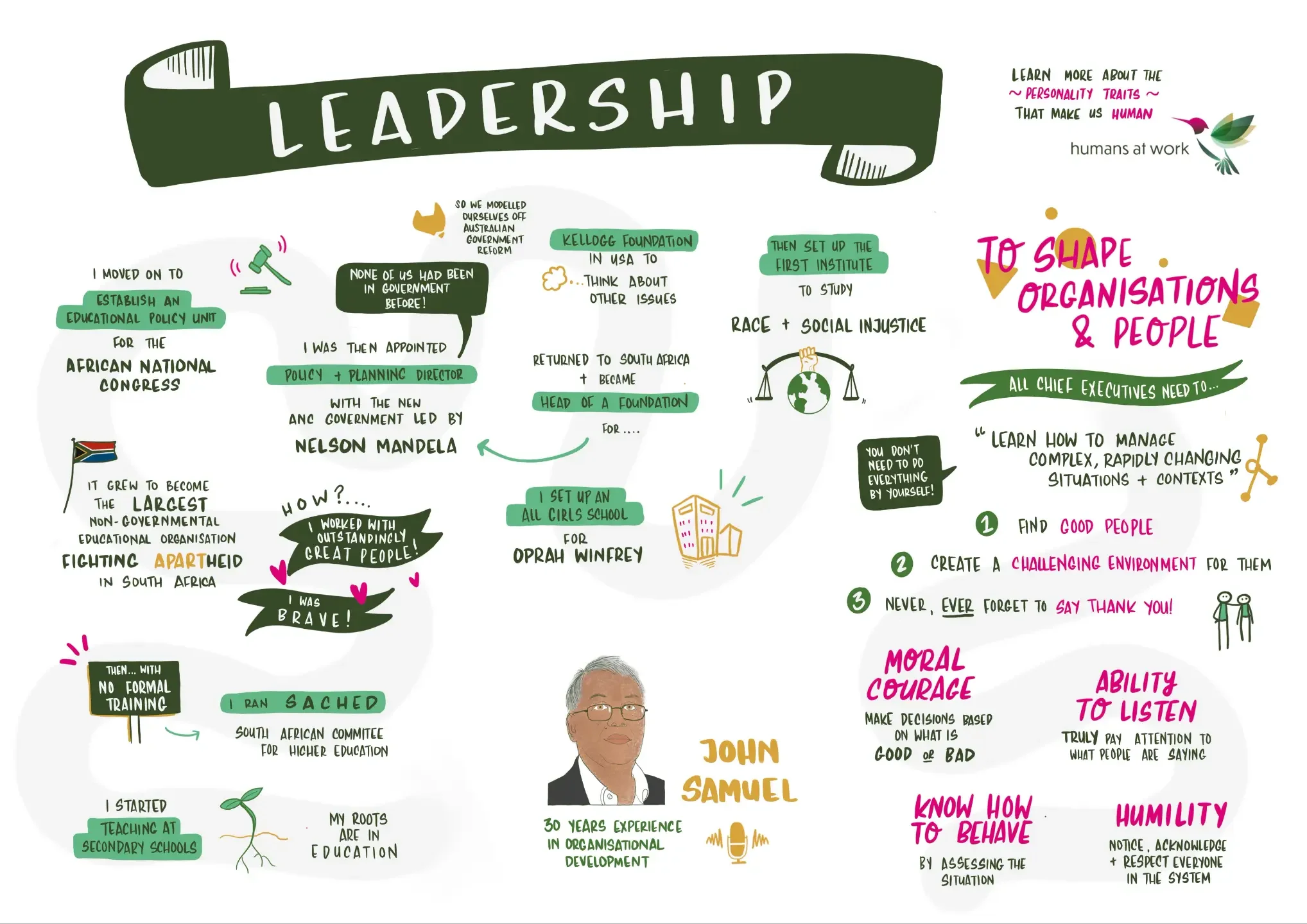
John: Thanks, Jules. I'm in Johannesburg at the moment, Johannesburg, South Africa and I'm happily in retirement, having spent almost over 50 odd years in public service of one kind or the other and also across a number of different countries.
Mainly most of my time was spent in Africa, West Africa and Central and South Africa. And during that time I started off as a regular ordinary garden teacher and I taught at secondary schools in Zambia, Ghana, Zimbabwe, Tanzania and South Africa. My involvement in education started, I started really at the foundations, in fact, and the experiences that I gained as a teacher certainly proved to be invaluable later on when I had to do more complex work in education. For example, formulating policy, giving direction to the new Government and so on.
In an ironic fashion, even though my starting point was education, I had no intention whatsoever of going into education. My entire family are educators; both my parents, my cousins, my aunts, my uncles, all were in education in one form or the other. So, growing up I was absolutely clear that there was no way – you couldn't drag me into a classroom. It really turned out to be quite ironic that I then spent most of my life in fact working in education in one form or the other.
But I would say that while education was probably one of my major obsessions, because I had certain beliefs about education, my actual professional career spanned a range of different things, but they all involved either setting up new organisations and institutions or managing them at a senior executive level.
I would say that while my roots are in education, my experience gained over the years really relates to both new organisations and established organisations. And so in typical organisational management vocabulary, I would say organisational development was probably my major occupation starting about 30 years ago.
I have a considerable amount of experience in running organisations and starting them up. I think that each one presented a different kind of challenge but I'm not going to go into that yet; what I'm going to give you an idea is the progression.
My first experience of being asked to manage an organisation was one that your parents joined in South Africa in the eighties, after much persuasion because in those days, it was not fashionable for people to come to South Africa because of the apartheid policy. I managed to convince your mother that it would be far more useful for her to be in the middle of the struggle in South Africa than pontificating about it outside, in the comfort of London. She eventually bought the argument!
The organisation was called SACHED – South African Committee for Higher Education – and it had quite a long pedigree because it started as a very small and very modest organisation by a student organisation in those days called The National Union of South African Students. It was a student initiative as a way of demonstrating their opposition to apartheid university education which was being introduced at that time.
From very modest beginnings, it grew into the largest non-governmental education organisation fighting apartheid in the country. At the height of SACHED in the mid-eighties when your parents were there, it grew into a truly national organisation, in 11 different areas of South Africa and employing over 200 professional staff.
That was something that I would say probably was one of the most testing times in my career, for two reasons:
One, I never ran organisation before; I was a teacher, I ran schools and while schools are organisations, they're fairly well established. There's a routine to them and if you get that right, you get your schools right.
Organisations are more complex and particularly an organisation like SACHED, which was working contrary to the Government of the day. There were loaded issues around running SACHED and I hadn't a clue. I hadn't been to business school; I hadn't done any courses in business management. I hadn't even read a book, I think, on organisational development.
So, whatever I learnt, I learnt because I worked with outstandingly good people, and secondly, I was brave, courageous enough to try things. And sometimes some of these turned out to be total disasters; other times they were brilliant in the light of what an organisation could do. That was my first in-depth and complex kind of challenge in terms of organisational development.
Then from that, I went on, I was asked by the African National Congress, the major political organisation of the day, to set up an education policy unit so that we can begin preparing for the time we came into Government and that was in 1990.
This was a smaller task in that I had a very small staff, and that is why I decided to set up a highly specialised unit to do policy work, which was at arm's length from the ANC, so it retained some credibility. But also because it was an attempt by us to create a national policy, it had to be seen, at least, to be non-partial.
The actual office was small, but the task was huge. In the end, in the process of making policy, we had close on 300 people working on it. So, again, another complex management task because none of these people worked full time; they all were part time people, many of them voluntary, so keeping all of this together challenged us in some amazing ways.
The natural progression from that, because in '94, the African National Congress came into Government as the Government of the day led by Nelson Mandela. And I was then appointed chief policy and planning director, which meant that I had the responsibility for seeing all new policy initiatives and the budget through the first three or four years of the new Government.
Again, the task of managing this was, in itself, quite difficult, because none of us had been in Government before, we had no experience, this was absolutely new, so we had to begin thinking creatively about how to do this, how to run Government.
That was fascinating because one of the countries we used as a study model was Australia, because, at that time, the Australian Government was going through major internal reform. I think they had come through a period where they recognised that the way they ran the administration of Government – not the politics of Government but the administration – was old fashioned and was not responding to the challenges of the country. So, all the departments, including education, were undergoing major reforms, so we were curious about this and spent time in Australia looking at it.
I worked in the new Government for four years because I think basically at that time I was totally worn out.
And from there I took a position with the Kellogg Foundation based in the United States, and that was really a way to put my head somewhere else and through that, to revive myself by thinking about other issues and other problems.
That I did for three years and when I came back to South Africa, Mr. Mandela had just retired and had set up a foundation and he asked me if I would be interested in helping him run the foundation. I had just accepted an academic position at that time, and I said to him, "Sorry." He said to me, "Oh, I see, you don't want to help me."
Of course, that concluded the matter and the next five, six years I worked as the head of the foundation and essentially boosted up from scratch. There wasn't much there, there was just a couple of officers and some correspondence, and over the next six years I worked quite hard at creating a really first-class institution that would do Mr Mandela proud.
When he retired, I decided to retire as well and no sooner had I done that, that Oprah Winfrey invited me to join her in the task of starting an all girls' school about an hour outside Johannesburg. And I worked on that for two years because as much as I enjoyed it, it was not something I was too keen to spend too much time on. I enjoyed particularly the part where you were given a blank slate and an unlimited budget and told, "Build me the best school in the country." That was quite enjoyable!
I returned after that to almost my starting point, which was going back to university. And the task I had there was to set up the first institution that would study race and social injustice. I spent two years setting up this institute, right in the heartland of Africana racism. It was a fascinating exercise. And then the vice chancellor of the university asked me to stay on for another year as an advisor to him on strategy.
That really is a long way of telling you what my major career steps were. I'm sure you can see running through it particular threads, but mainly I would say learning how to manage complex, rapidly changing situations and contexts and, therefore, shaping organisations and people so that they had the capacity.
The one thing I quickly learned that when you occupy the senior executive position, it didn't mean that you had to do everything yourself! I tried that and discovered that at the end of the first week I was ready to collapse.
Slowly but surely, I learned some invaluable lessons, not the least of which was that one of your key roles as chief executive or in any other executive capacity, was to, one, find good people, two, create a challenging environment for them because you selected them because they were good so you create a challenging environment, not too comfortable but nevertheless they must know that you have their back 24/7. They must know if they venture down a road, that dead end, you are there, you are behind them, you will rescue them and you will support them.
Thirdly, never, ever forget to say thank you. Once I had worked that out, and it wasn't easy because, as I said, I had no experience, so it was almost having to learn on the job.
But once I'd figured those elements out in the role of an executive in an organisation, it was all smooth going after that in many ways. It was that the context changed and, therefore, one had to.
I think from an external point of view, the key lesson I learned was study your context. Study it so that you understand it as much as you can, so it's not that you can avoid having something come at you suddenly. That's the challenge, I think, that's in the nature of the job, but you reduce the chances of that suddenness throwing you too far off course, and that's a very, very important skill that executives needed. I think more than any other, I would say today, because of the complex nature of society and the way in which we're evolving, it's not getting easier.
I think with going from a whole range of social challenges to economic justice to the environment to climate change to nationalism to racism. These are hugely demanding and complex challenges, and no organisation will ever be exempt from any of these. So the sooner one begins to figure out how do I manage this, what do I do, what's my strategy – this is where chief executives now have to spend 90% of their time, I would argue. I think I'm going to stop here.
Jules: I have lots and lots of questions. That was really interesting, John. I've got some questions that I'm gonna fire at you now, in no particular order, just the order that they are playing in my brain.
First question, I just wanna talk about that resilience and that preparation point that you've just made. Because I 100% agree that the ability to pre-emptively plan for the unknown and the shock, is one of the biggest skills that leaders need to develop. And I think what's happening is that people are so busy with the day to-day or the near term, that they are not taking enough time away from that day to-day to think about what is my context, what has changed, what might come and hit us, hit me, hit the organisation? And how can I shore up my defences or make sure that my people are as prepared as they can be for the unknown?
I'm interested in what you might have learnt from being involved in these really complex organisations that are forging new ground, that might be helpful for people to think about in terms of that preparation for the unknown and the unknowable.
John: Again, some of these lessons emerged out of the context in which we worked so they are experiential based, they're not theoretical. I didn't go to textbooks to pick these up, they were based and then shaped from organisation to organisation. The one thing I think that chief executives and executives have to learn, is that, as I said earlier on, their job is not the run the work; you employ middle level management for that task. That's where I spent most of my time so that I knew the organisation was operational and I could do other things.
For example, once a week I had meetings with all my heads of department, one hour per week. I don't care if the Prime Minister was coming to see us, it became known in the organisation that when you had that meeting with John Samuel, you better make sure you were there. It was a non-negotiable. Through that one hour meeting I developed a kind of gauge on what was working, what wasn't working, how to help people overcome that hurdle and so on, but I never got involved in the actual running of the organisation.
That then created space and time for me, to talk to people in the political arena, to talk to people running foundations, strategic people and so on, so that I began building up a better understanding of the context. I think this is probably one of the greatest weaknesses of many people who run organisations now, and in the past. And that is a failure to come to terms with the fact that, one, the world is changing and it's changing rapidly and two, it's generating complex contexts.
In a way I've argued in the past, in fact, that some people of mediocre talent, seek refuge in work because they are incapable of managing complexity.
I think if executives want to be good at what they do, then they have to start with recognising that they need to develop a more sophisticated understanding of context, and the challenges embedded within those contexts. Not everything will come at you but I can guarantee you that something is coming at you, therefore, the better you understand it, the better you are likely to come up with organisational strategies to help you cope with these things. And no organisation is an island unto itself. It lives in a context, it has people, and that combination of context and people is one of the most challenging combinations you can find.
I think, again based on experience, listening to people is a very important skill because, as Mr Mandela told me once and I asked him because he kept saying, "It's very important for you to listen to people." One day I asked him why, and he said, "If you listen 100% to people, you may hear things that you haven't heard before. Secondly, in some of the things that are being said by the other person, there may be some good advice or good information. Thirdly, it is always courteous to pay a hundred per cent attention to people." Because he said in his experience, people would be listening to him but at the same time, half of their hearing is being preoccupied with preparing their answer to him long before he's finished. People are very fond of doing that – they latch on to something you've said instead of listening to you, and then spend time trying to understand or formulate a response to that, instead of listening to your entire presentation.
The skill of listening is very important, and executives need to pay attention to both the internal noise and the external noise. Internal because that will help them understand what's actually going on, and that they don't get caught with their pants down because something happens inside and they're not aware of it.
Externally is very powerful in that that's where you're going to pick up information on the major waves that are building up and are likely to turn into a tsunami one day. Those two aspects – the internal noise and the external noise – being able to listen to both is vitally important.
That would be some of the advice that I would give to people running organisations. It's not easy, let me make myself absolutely clear, because it may sound easy in that it's taken me 30 to 35 years to get to the place where I can articulate it in this fashion.
It does require courage. I can remember times when I began to wonder, I'd supported a member of staff and things weren't working out, and I was beginning to question whether my strategy was right. In the end, that person came through; it wasn't without its challenges but if I had given up, I think it would've thrown a whole lot of doubt on my approach.
Jules: I'm interested in your use of the term "courage" because it's one that I have used often when talking to leaders about the role of leadership and the role of a leader in an organisation. I use in two ways, have two meanings. The first is that it actually takes a whole lot of courage and bravery to be a leader, to put yourself forward to be the one where the buck stops, or to have to have that vision and to keep something going forward when there's a whole lot of complexity or a whole lot of people saying, "Are you sure you're right?" That doubt can creep in.
The second is that in the end, within organisations the way they're structured, quite often the leaders are the ones who have to make the final decisions. You can listen, you can take advice, but the way organisations are structured is that in the end there's somebody who makes the decision. And as a leader, if you fail to make a decision because it's too ambiguous or it's too big a decision, you don't know what to do, actually, you end up paralysing the whole organisation.
In the end, as a leader, you have to have the courage to make the decision. I'm really fascinated that you use that same term because it's not often part of the discussion when we're talking about leadership.
John: I think you're right. I often say, having read just about every book on management and organisational development there is, I often say two things; one is what I call airport literature – 5 minutes on how to run an organisation. A lot of bullshit.
Secondly, there are organisational tricks and there are organisational management, and I think sometimes there's too much emphasis on organisational tricks. After all, you can train a monkey to do tricks, but training somebody to run an organisation is a lot more demanding than simply being able to do the SWOT analysis and so on and so on. It may be a useful tool but, honestly, in my experience, SWOT analysis is an absolute waste of time, whereas strategic thinking, on the other hand, was extremely helpful.
Distinguishing between the superficial, and what's on top and what's underneath, and part of the underneath armoury of weapons includes courage. Courage is to be seen in two different contexts and shapes. One is moral courage. Leaders must possess, to make that decision, no matter how unpopular, they must have moral courage.
Again, if I can draw on Mr Mandela's experience. When he was released on Robben Island, during this time KwaZulu Natal was embroiled in terrible riots. People were being murdered at the rate of 10 a day and so on. There was an internecine battle going on in KwaZulu Natal between the ANC and the opposition party called Inkatha.
He knew this was one of his major challenges and he went down determined and he started off in Johannesburg and went down to Durban where there was a huge mass rally – thousands and thousands of mainly young people. He had decided, and he hadn't informed many of his advisors that this is what he was going to do. During the course of his speech, and he was addressing, I think, mainly the younger generation, "I want you to throw down your spears and weapons and I want this violence to come to an end."
There was tremendous booing, waving of arms and saying, "Get away! Get away! No! No! No!" He stuck to his guns, and he repeated this, he repeated it at least three times until there was a kind of hush in the stadium. While he didn't necessarily win the day, he'd set in motion a thought process that would percolate slowly, not overnight, slowly, into the consciousness of many of the youngsters. That was the moral courage, it was based on what he thought was right, and even though the consequences were rejection initially, he nevertheless went ahead, and he would emphasise this point.
I had the privilege of spending hours and hours with him in private conversation, and this point about moral courage and leadership. When you look at leadership, particularly political leadership today in the world, you'd be hard pressed to give me an example of a leader with that moral courage. I dare you to cite me an example of a leader. Probably the closest that came to it was your Prime Minister of New Zealand, but you can go through the rest, starting from America and going to Zanzibar and you'll find it.
It's happening at a time when that quality of moral courage and leadership is needed the most. At a national level, at a local level, at an organisational level.
The reason for this is that because we face complex challenges that are embedded deeply in the ills of society, no amount of organisational tricks are going to get you out of these issues. You can do SWOT analysis 'til the cows come home and it's not going to change racism, social injustice, the environment, climate etc.
I really want to emphasise this point because I think I tried to run my life as an executive on that basis, and I suspect that in the end, much of the respect that I earned as a leader came out of that, rather than my ability to perform some fancy footwork on the dancefloor, as they say. It's that aspect that the business schools don't teach you, and the textbooks hardly mention it or, if they do, it's mentioned in passing.
Jules: Do you think that those two things that you've cited – the ability to truly listen and the moral courage to say and do what's right in the face of adversity – are the things that really made Nelson Mandela stand out? Or are there other aspects that he brought into the role of a leader that would be useful for people to reflect on?
John: I think so, but I would put those two at the heart; moral courage, I would say, is number one because it's so difficult, because it's so complex and challenging. It's easier to bow out, than to make that decision based on your beliefs about what is good and what is not, what is bad. At all levels, whether there's organisational, whether there's personal relationships – at all levels – it certainly was at the centre of his life and that set him apart from leaders in other parts of the world but also in the leadership in South Africa historically.
The listening part, it took me quite a while to understand why he was placing so much emphasis and I would agree. It's an enormous skill that you have, because when you are in dialogue with somebody, particularly if you're trying to persuade the other person, you are in so much of a hurry to get your point across that you don't pay attention to what the other person is saying. And many discussions, many negotiations have broken down around that point – the failure for parties to listen to each other properly. It's not that they weren't talking properly, it wasn't that they weren't making sense. It was this fundamental flaw of basically saying, "I think I've heard what you said but what's more important is my point of view," and pushing that.
Some of the other qualities I think that helped him a great deal was being able to figure out a situation.
I've seen Mr Mandela sit in on meetings and not say a word for seven hours. Not a word. Then he would clear his throat in his very studied form, would put his hand up and say he wanted now to make a contribution. It was quite amazing.
In those seven hours he was listening to everything, nothing escaped him, not a note, not a pencil. First of all, he would begin by summing up the different positions, and then pulling out of that the good, and then saying, "This is what I think." He never started off by saying, "Well, I've listened to you guys, half of you are talking rubbish and the other half, I'll take some of that." He never negated, even though he knew some of it was rubbish. He had this amazing belief that if you looked hard enough, you'll find some good. It was astounding.
This is the other point I wanna make – this ability to look at a situation and figure out how best to behave in that situation. He'd learnt this on Robben Island. When he was in prison, and prison was both a physical thing but also a metaphorical thing, because imprisoning you on Robben Island, they were not only trying to physically isolate you but also mentally imprison your mind. Mr Mandela knew this so he would always say to these fellow prisoners, "Never, ever give the upper hand to your jailers. Never."
For example, when people went to see him – his family – he would say to his family, "The visiting hours are from 2 o'clock to 4 o'clock but I don't want you to wait 'til 4 o'clock. At quarter to 4, I want you to get up and leave. Take your goodbyes and then leave." They would say, "But no, 15 minutes …" He said, "No, 4 o'clock is the time the wardens have put as the time you can leave, but if you leave at a quarter to 4, you are setting the parameters, not the wardens."
This is central to his ability to have managed all that time on Robben Island in a way that enabled him, first of all, to keep his dignity and, secondly, to do so in a principled manner.
That was an astounding ability which he then applied after coming off Robben Island to many political contexts and situations, and during the negotiation as well.
Jules: It's an incredible story. I went to Robben Island and at the time you could be escorted round by an ex-prisoner, who would take you to their cell and would talk about what life was like and how they kept their wellbeing during those many years. It's an incredibly stark place. It's very rocky, the sunlight bounces off the pale stones, there's hardly any trees, there's not a lot of protection. It's not even the prison itself but the whole environment is very harsh. Nowhere to hide, which is the whole point.
That ability to take where you find yourself and create a little bit of control, a little bit of your own world, must've been an amazing saviour, not just for him, but for the people that he was with.
John: Yes. I should mention in the list of characteristics in terms of his leadership, the last point I wanted to make is his deep sense of humility. Don't get me wrong, Mr Mandela had an acute sense of who he was. He knew he was a historical character, a leader of great eminence; he knew that, but he never flouted it. His humility is demonstrated so many different ways.
Probably the most striking was this ability, capacity to say thank you to people, no matter who they were. I remember being on a plane from New York – this was before he became President – and he walked the entire length of that plane shaking hands with every single passenger.
The first time I met him, we were flying down to Cape Town to meet with the then president – the white president. When we got off the plane, he got the stewardess to line up the staff of the plane – pilots, co-pilot and the steward attendants – and he shook hands with them and thanked them. He would do this all the time. All the time.
Part of that was his ability, for example, to spot children in crowds. I'll never forget, we were in London, and he was just getting out of his car and I don't know how he spotted this young boy. When he got out of his car he said to the security guard, "Bring that boy there. You see that boy in the crowd there? Bring him, I want to say hello to him."
This humility was not false in the sense that he would do it; it emerged out of his nature, his respect and love for people.
Jules: Those things go hand in hand, don't they? The ability to notice everything, pay attention to everything and really concentrate. That story about sitting for hours and hours without talking is an exercise in discipline and concentration.
If you're noticing everything around you, then you're also noticing the fact that the plane can't fly without every part of the system working, or every person in every role doing their job, which is very much like an organisation.
You have the people who make sure the offices are clean, you have the reception, the reception desk, you have people who do all of the accounting, all the way through the organisation. And it's very easy to pay attention to the people who speak the loudest or who seem to be the most important but, actually if you take away those people who make the organisation function, the whole thing falls down.
There's something to me in his understanding that if you notice everybody and you acknowledge them by thanking them and listening to them, then what you're really doing is being an absolute system thinker. Because you see the system and the people that perform all the roles in the system very, very clearly which is an amazing skill.
Thank you so much. I really appreciate you coming on. I know it's difficult and it's been a bit of a hard few months. I hope you've enjoyed it and let's book again when we've got some more electricity time.
John: Alright. Thanks so much.
Jules: Thank you, John. Take care.
John: Bye.
Jules: Bye.
At this point my conversation with John had to be cut short due to load shedding in South Africa. Basically, regular, managed power cuts to lessen the drain on the country's power suppliers. We aim to pick it up again in a few months' time, in the meantime, I hope you enjoyed this first opportunity to hear John's fascinating stories and leadership insights.
Thank you so much for listening and thanks, as always, to the generosity of our delightful guests. The stories of how others have faced up to their challenges can help give all of us courage to keep going with our own. For more great episodes, blogs, learning packages, go to the JERICA Global website.
Humans at Work Podcast