
Adaptive Leadership and Decision-Making in a world with AI and Purpose — with Diane White
Humans at Work Podcast | Episode 8
Host: Jules Harrison-Annear | Guest: Diane White
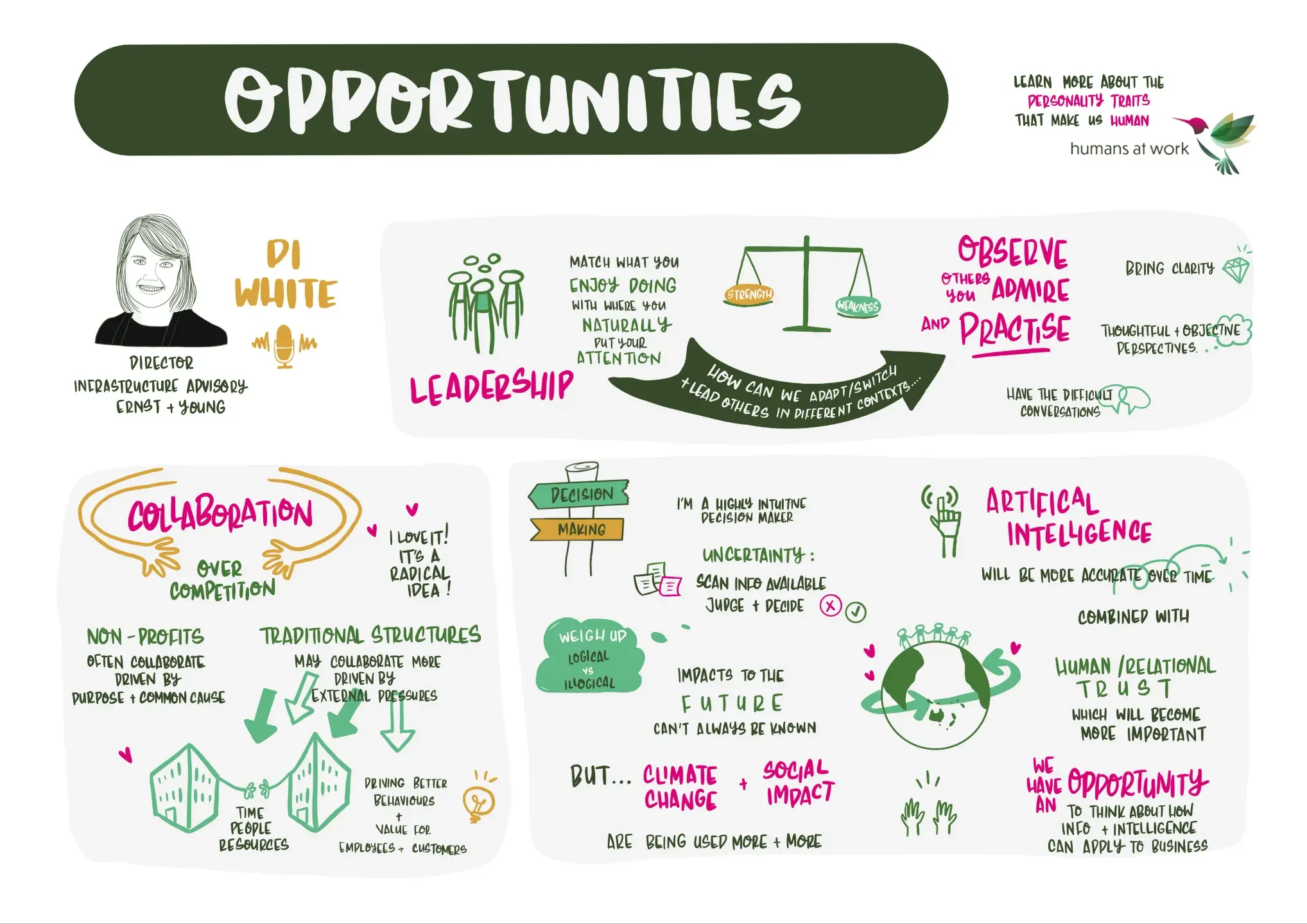
Diane: More and more, I feel like I'm seeing that I've got my happy place or my preference and where I feel most comfortable in the style of leadership. That works for a certain number of people, but there are other situations and other people that need something quite different from me. And, it's actually the ability to adjust my leadership style for different contexts and different people, I think, is the next big challenge.
So, to your point, learnt who I am as a leader and what comes naturally. That's something that I can play into often in the context of my work. But what about in those situations where that style of leadership isn't going to work because of the context of the person?
So, yeah, I think that for me feels like the next big challenge for me is starting to really think about how I am as a leader in situations that might not be as comfortable for me or as context as easy as that don't come as easy for me.
Jules: Kia Ora! Welcome to Humans at Work. I'm Jules, your host. Thanks for joining me and our latest guest. And thanks for taking some time in your day to indulge your curiosity about other people and their humanness. If your thirst is unquenched after this, check out jericaglobal.com. Now, let's begin.
Great to see you again, Di. Although we did catch up for lunch, as promised, in between.
Diane: Yeah, we fulfilled our podcast promise.
Jules: We did. I do have to give you a little bit of feedback. One of our listeners said to me that she was really enjoying listening to the podcast interview with you while she was exercising. She was doing a big walk. And then we started talking about pastries. And she then got really annoyed because she was supposed to be exercising, and all she could think about was getting back quickly so that she could have a pastry.
Diane: I guess this is my time to apologise to that listener.
Jules: Look, I wanted to catch up because I want to understand, you know, in the year since we last talked, what's happened? What are you focusing on from a work perspective? What is giving you the most joy in terms of the types of work or the causes for which you are working for? So, can you just give us a little rundown on what's giving you most joy from a work context at the moment?
Diane: I think, yeah, it's been interesting to reflect. It's been a year because in some ways I've probably been doing more of the same, but more and more finding out what it is that I both enjoy and feel like I'm at my best at.
And I've been lucky enough to be going through a kind of leadership development program that my work has, which I think has enabled me quite a bit of time for introspection and thinking about leadership style, what it is that I most enjoy doing, what it is that I put my attention to, how that matches what I enjoy. And just having more of an opportunity, I suppose, to think about what leadership looks like in the context of the work that I'm doing.
So, you know, the actual day to day content of my work, I think, would be much the same, but probably with just a little space to think about some of those bigger questions about my work in that respect.
Jules: And I'm interested in the adaptation or the evolution of leadership styles. Because for many people, once you're a leader, whether that's a thought leader or a hierarchical leader, you are what you are. It all becomes about the team or the outputs from the team that you are responsible for.
I'm interested in your views on the importance of adaptive leadership, given how big the changes are in the world, the world of work, what employers and workers want.
Diane: Yeah, I've had the benefit of, like I said, spending some time thinking about this.
One thing I think I've really started to understand is that I shouldn't have one leadership style. So I'll have my preference in terms of the way I lead. That plays, again, to my strengths, weaknesses, who I am as a person.
But being able to have multiple leadership styles that you can employ at different points in time, particularly to meet the needs of different people and what it is that they need.
I think more and more, I feel like I'm seeing that I've got my happy place or my preference and where I feel most comfortable in style of leadership and that works for a certain number of people, but there are other situations and other people that need something quite different from me. And it's actually the ability to adjust my leadership style for different contexts and different people, I think, is the next big challenge.
So, to your point, learnt who I am as a leader and what comes naturally, that's something that I can play into often in the context of my work. But what about in those situations where that style of leadership isn't going to work because of the context of the person. So yeah, I think that for me feels like the next big challenge for me is starting to really think about how I am as a leader in situations that might not be as comfortable for me or as context as easy as, that doesn't come as easy for me.
Jules: And do you find that translates well into the critical friend role that you take when you're consulting?
So, I guess, if I talk a little bit about my experience of consulting, is often you're working with people who are peers. They are leaders as well of their own functions or their own organisations or industries. And they don't necessarily want another leader to lead them, and they don't necessarily want a staff member to direct.
Actually, when they are talking to consultants with expertise, what they want is a peer who can help them through "peer leadership". And I think that for me has been one of the growth areas in terms of my consulting role, is that I'm a critical friend. I'm somebody who can translate what I know into peer leadership for clients. So, I'm interested if you find the same.
Diane: Yeah, I've never heard that term peer leadership, but I absolutely love that because I think that goes to the heart of good practice when you're in a consulting role.
It's being able to bring clarity, have difficult conversations, bring a very thoughtful and somewhat objective perspective to a situation or a problem or a challenge, but work in a very different way and show your leadership in a very different way.
At the same time, often, at least in my context, having more traditional leadership at the same time, of a team who need direction and support and framing and guidance. But having to move between those different styles, often in the same interaction, basically.
Jules: Yeah, I think I was just going to say quite often you find yourself switching really, really fast. And that switching can be quite overt, or it can also be quite subtle in terms of the language you use or the tone of voice or what have you.
But that's something that quite often we don't give a lot of time and thought into practicing, because we're in the moment and we do it. And it's only when it doesn't land well that we take a step back and we think, "Oh, okay. So how can I switch more effectively, in ways that are going to work for each audience within the same environment or the same day or the same programme or the same workshop?"
We tend to think all of those things should be automatic, and we should be amazing at them without having to think about it and having to practise.
Diane: Yeah, yeah. And I think that practicing and seeing it is something that you get better at.
I think one thing I'm really lucky at in my work is getting to observe, often, others and how they do that. So whether it's my peers or people that I'm working with in a project context.
I think over the last year, if I reflect on something that I have had the benefit of, it's spending quite a bit of time with a couple of key people who I watch. How they've approached that, and how they communicate an idea or a point in a way that is going to best get the right outcome, but also land in the right way and how they'll adapt across those different audiences.
So yeah, I feel like if I actually reflect on it this year, I feel like it's been a lot of perceiving and watching and observing. Which is a wonderful way to learn and to see how you contrast that against your own ways of naturally doing things.
And sometimes those natural ways of doing things are really, really effective and actually a great way to approach something. But sometimes those natural ways of doing things are not. So, having that ability to watch others and how they approach those situations, and then how the difference in the results and how things land, I think it's been really valuable.
Jules: One of the things that we talked about in the full podcast last year was boundaries. We talked about it specifically in relation to the interface at work with people who could be a friend, but are definitely a work colleague, and how you grow over time to understand the importance of those boundaries.
I want to divert off that a little bit because one of the things I'm really interested in is the artificial boundaries that are created by organisations. So, they become a separate entity. They create a boundary between them and others.
And it's a completely artificial boundary if you think about how often organisations share the same customer. They share the same processes. For government agencies, they share the same ministers often, and the same funding sources and the same outcomes.
And so in my quest for what is the next thing that will take the place of traditional business transformations, thinking more around regenerative approaches to how organisations can continue to add value and have purpose, is to think about are there opportunities for those artificial organisational boundaries to become a little bit more blurred. And for cooperation and collaboration to be more of a focus, particularly for citizens or customers.
So, you work in Australia. I primarily work in New Zealand. They seem similar, but they're quite different. New Zealand has the state and national government systems and frameworks. So, I just wanted to understand from you whether or not you see any potential or even some organisations taking some steps down that road, where the focus is more on cooperation and collaboration than it is competition and setting ourselves apart from others.
Diane: I mean, I love it as an idea. I don't think I probably feel like I see that in practice as much as perhaps the potential is there to do.
It's quite a radical idea because I think we expect that competition, and the way in which organisations structure themselves is important to get outcomes and results, right?
And when you think about it, maybe that's something that's actually been inherited by governments, that is particularly antithetical to what they're trying to achieve because they are working across the same people and the same objectives.
But I think probably the major issue I would see in that approach is, it's almost a mental load kind of thing. So, I think one thing that people I see value in having those artificial structures in place is, the certainty it gives people in terms of what they need to focus on and what they don't.
It's interesting that it's the idea because it's a very systems-thinking idea, right? We're all trying to achieve the same thing or working with the same people. How do we do that together?
I would be interested in how different people would react to that approach, whether they'd find it difficult to have such ambiguity around traditional structures that they've come to know and value so much.
But I think there has been a couple of situations in my own industry where you can see probably more collaborative approaches, between what have been traditionally very firm competitive lines. I think they probably actually do happen at different levels and different points of time quite a lot. It's just not necessarily an ethos of the organisation.
So yeah, it's a really hopeful idea. I really love it as an idea. It feels like it's got a lot more potential in a place like New Zealand, where that proximity between people and therefore the transition between people between different roles, is just so much more palpable, rather than perhaps here where people can feel, I think, less proximate and therefore less connected.
Jules: I know that you do a lot of work with non-for-profit organisations. I used to do a lot of work, I used to work for non-profit organisations way back, way back in the day.
I found at the time, and I'm interested in your current experience in Australia, that non-profit organisations are more willing to join up for a common customer or a common cause. And they have all the complexities of where they get their funding from, and how do they show the value of that funding and what have you. But the cause will drive behaviour change to blur those organisational boundaries.
And I guess my question for you is, do you see some of that activity happening in the non-profit organisations that you work with or that you align with in terms of where you are in Melbourne?
You're in Melbourne, aren't you? Just checking.
Diane: Yes. Yes. Yes.
Absolutely. I mean, in the not-for-profit sector, it's collaboration and a sense of working towards a common goal is so core to how the sector works, and therefore, collaboration just comes so naturally.
There's a sense of... I think your idea is such an interesting one, because perhaps as we see for-profit companies becoming more purpose driven. Purpose being something that is seen to be at the heart of companies with a really strong connection to the employee value proposition, purpose being really prominent.
If that is to become more and more, I guess, important, then it would make more sense to collaborate more with others with a similar purpose, right? I think that that natural collaboration you see in the not-for-profit sector is because they are truly purpose driven organisations.
Whereas perhaps in corporate world where still, purpose is important, but hasn't become truly the North Star of organisations. Because if it was to be, then I think you're right to say that that collaboration would be much more organic and natural.
Jules: I think for non-profit, they always have a struggle with not enough resources, whether that's people or money, or actually it's a voice, influence or what have you.
So, I guess where my thinking is going is that resources are running out. The access to talent, speed of access to talent, the workforce, we can't keep growing as a population across the world. But also, those skill mixes are changing so fast that there will, I think, always be this real struggle to get the right capabilities that you need at the time that you need it.
Plus, there's a whole lot of evidence around the fact that we will run out of resources, whether that's money or fuel or whatever it is. And so, the pressure will start to come to bear on those bigger organisations, who up until now, have really suffered from an abundance of those.
And so that may then drive a re-looking at how do we achieve what we want to achieve for our customers or our shareholders or the public. But with much more limited resources, that might drive some more of that collaborative approach.
Whether that's joining up at the same point to deliver similar services, or it's actually joining up across the supply chain in much more considered ways, so that you have a much more efficient way of delivering end-to-end services and you are one part of that supply chain in a collaborative rather than a competitive, profit-driven mode.
So that's one of the reasons why I think organisations should be looking at that, is that everybody is struggling to find time, people, resources, and we can't keep scrabbling over the same things. We have to think about those things differently.
Diane: Yeah, I think it's an idea for our time. I think it's exciting to start thinking about in that lack of abundance or that scarcity, how might that drive better behaviours, better experiences, for not only customers, but for workers as well.
I think the one thing that I think people in my organisation, almost one of the most common things they'll say about why they enjoy working at my work is the variety of work that they get. And that is one of our most important parts of our value proposition. That's something that many other organisations, I'm sure, could benefit from, being able to provide greater variety, greater exposure to different ideas and perspectives and opportunities.
Jules: Just jumping from that to the topic "de jour" of artificial intelligence. There's a lot of rhetoric out there around the risks and opportunities, and there's been quite a few articles and think-pieces around the challenges for industries like consulting, with the advent of artificial intelligence and those big open-source large language models. But also all of the ones that are being developed by the Microsofts, the Googles of this world.
So, I wondered if you could reflect a little bit on what you see as the opportunities or challenges with AI?
Diane: I think the opportunity is definitely to focus us more on delivering the high value aspects of what we do. Which is, to go back to our conversation earlier, I think that peer leadership piece, it's exercising judgment, and deciding what's important and what's not important, and carving a clear path amongst all of the noise and trust.
I think trust is something that is going to become even more and more important. I think when I, like everyone, have played around with ChatGPT and other tools that could potentially be used, the thing that always strikes me is that I don't feel a sense of trust in the quality and the accuracy of what I'm getting out.
Now, the irony is that, within a very short space of time, AI will probably become more accurate than what my brain could go away and do in terms of scanning for the various information that might come up with a similar answer. But will it be able to still engender trust?
Trust is such a relational and human thing. It's about leveraging on experience, not just within a professional context, but more broadly, a person's experience. All of those things that I think will become just more and more important in the work that we do as consultants.
So, rather than seeing our role as generating information or intelligence, it will be about thinking how that information or intelligence applies in the context of our client. And in a way that is done with, I think, the understanding of what's important to them and the things that are spoken and the things that are unspoken. So, all of that nuance, I think, will become part of our value proposition, being able to understand that and respond to that. So yeah, there's a huge opportunity, I think, for us to do more, into the future, be able to see our value.
Jules: Okay, I think where we were going there was around finding out what the consistent value proposition is going forward when perhaps traditional services can, in the future, be done from at least at a baseline more efficiently and perhaps even more effectively through tools such as AI.
From that, I wanted to ask about decision making. Because there is a difference between having all of the information, having all of the data at hand in a succinct way, and being the one that makes the judgment call and then acts on that judgment call to put something into place. Which is that point of decision making.
My view is that that will become even more critical as a skill going forward, because it will be easier to get the information and all of the data. There's less of an excuse not to make a decision because you have an absence of information, and you have to wait or what have you.
I wanted to ask, you've done this work on your own leadership style over the last little while, but how would you describe your decision-making style?
Diane: I think, and this would be consistent, I think, with most people who have worked with me. I am highly intuitive decision maker, and I think that is often related to thinking about the various ways that information will be received, the consequences of that information, the bigger picture, I suppose.
My decision making tends to be thinking about, what's this going to mean? How is it going to be received? What are the sensitivities, the things that I need to be factoring into this decision which may or may not be equally weighted? Often, I think, a very human consideration.
I'm very driven by how people will perceive a particular decision, and take account of that in my decision making. I think as a decision, I'm lucky enough to be in a role, I suppose, where I feel like I get to practice decision making a lot.
So constantly making small decisions, building that muscle of scanning the information available to you, taking into account those, both highly logical and highly illogical considerations that are important in a decision-making process. And quickly exercising that judgment to decide how to go forward.
It's probably based on a lot of perceiving of a situation, rather than what the information is in front of me saying the logical decision might be X. Whereas I know that I take into account a lot of other factors that mean even if that was the logical decision making, a logical decision, actually in this particular context, it's Y, and having a really strong intuition for that.
Jules: And do you think that more and more organisational leaders are taking the future into consideration in the decisions they're making now, in part because that's the strategic thing to do?
And everybody's been banging on for years and years and years about organisations needing to be strategic, but also because the whole agenda around sustainability and regeneration in terms of environmental drivers has become so much of a burning platform over the last two or three years, definitely. I think it's sort of screaming now, whereas before it was shouting.
So, do you see any evidence of that being taken into consideration more with the organisations that you work with?
Diane: Yeah, absolutely. I think thinking about the future and various trends and what they might mean for a decision at the time it's being made, feels like it's become very relevant no matter what the sector, industry, or context is.
Whereas perhaps in the past, I think there was more of a sense of certain trends or strategic directions were relevant to certain industries and certain sectors. I feel like now it's more common to see, quite consistently, organisations thinking about climate change, thinking about social license.
Those kinds of considerations are not really siloed anymore into certain industries. They're across the board and definitely creates more of a future focused mindset for leaders, I think.
Maybe it's a sense that there's all of these broader pressures that need to come into consideration in one's decision making. Decisions cannot be made just on the information in front of you and the facts of the day.
There's more of an acceptance of uncertainty, and how you have to make decisions in the context of uncertainty and still take things into account, even if you don't have all the information or the impacts of certain things can't be known into the future.
I think climate change has been a really interesting one for creating maybe just more of an acknowledgement that decision makers need to think through a lens of longer-term future. That has probably changed the way that a lot of leaders think about a lot of different issues.
Jules: One last question, what is the thing that you are most looking forward to from a work perspective in the next year?
Diane: Well, I think, as you know, for me, it's a little bit funny because my partner is having a baby in four months, so I'm going to be taking a big chunk of parental leave for this next period.
I think I'm actually really excited about that because I think that will challenge me in a whole lot of ways that I will bring back into my professional practice. I think it will be challenging in the ways that it is for many people in terms of taking long periods out of the workforce and recalibrating your identity and all of those things. I think it's a funny one because it might not seem like it's something that's a work-related thing to look forward to. But in some ways, I think it will shape me and grow me in my work as much as anything possibly could. I'm excited about that.
Jules: I'm excited for you.
Diane: Thank you. Yes, it's an exciting time. First time parent, excited. Maybe when we talk in a year from now, I'll be very different.
Jules: Possibly, possibly. What I would say is that next time we talk, I fully expect to be holding your baby while we're doing it because I love baby snuggles, so I can't wait for that. It might be the thing... Not even the pastries could get me to Melbourne this year, but maybe the baby will get me to Melbourne next year.
Diane: The baby would be very lucky to get to meet you.
Jules: Thank you. Hey, listen, thank you so much for that Di.
Diane: That's all right. You're welcome. Lovely to catch up.
Jules: Thank you so much for listening. And thanks, as always, to the generosity of our delightful guests. The stories of how others have faced up to their challenges can help give all of us courage to keep going with our own. For more great episodes, blogs, learning packages, go to the JERICA Global website.
Humans at Work Podcast