
Inclusion for Alternative Workforces and Action-Focused Decision Making— with Jeff Mike
Humans at Work Podcast | Episode 9
Host: Jules Harrison-Annear | Guest: Jeff Mike
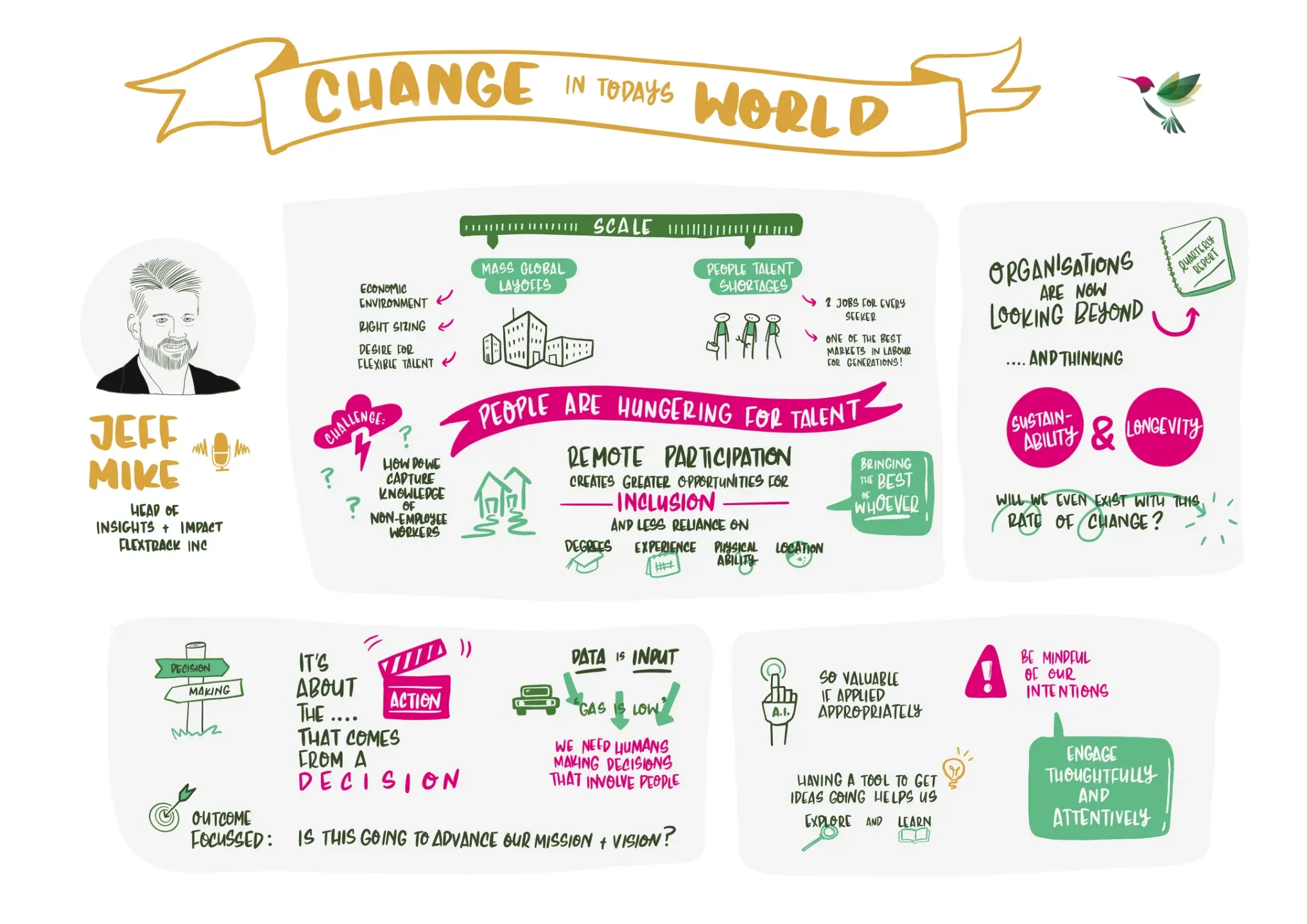
Jeff: I think sustainability has been an organisational or a corporate responsibility for a long time. Just look at all of the, we call them continuity plans in case of an emergency. But most organisations that I know, and I work with, are looking beyond, say, quarterly returns.
Again, while there are those market pressures, I think organisations recognise they want to be a going concern. I think I saw a statistic recently where a certain number of CEOs were wondering, maybe the majority were wondering if their organisations were even going to be in existence in 10 to 15 years, given the rate of change.
So, I can tell you, from what I see, that notion of longevity and sustainability, maybe even outside of environmental concerns, is something that I'm hearing and seeing a lot of. And then, of course, those organisations that want to make environmental sustainability and cultivation of their workforce wellbeing, part of their strategy. I think there's a great opportunity to do that now.
Jules: Kia ora, welcome to Humans at Work. I'm Jules, your host. Thanks for joining me and our latest guest. Thanks for taking some time in your day to indulge your curiosity about other people and their humanness. If your thirst is unquenched after this, check out jericaglobal.com. Now, let's begin.
Hi, Jeff. Long time no see. We find ourselves in pretty much the same position. Although last time I was actually sitting in a cupboard, which was my studio that I had set up for doing podcast recordings, and now I actually have a proper room with proper set up. So, I'm slightly more comfortable than I was.
Jeff: So that's progress.
Jules: Yeah, that's progress. That's progress. I'm interested in how the last year has been for you in terms of some of those topics that we discussed on the last podcast, your work looking at gig workers and how to really integrate them into the way organisations think about their workforce, but also their software. Can you give us a little summary of what you've seen and what you've been working on in the last year?
Jeff: Sure. The vision that I bought and had bought into was about bringing non-employee workers to the forefront of employee experience or raising their visibility and raising the investment we're making in non-employee workers.
And the going hypothesis at the time was that things are very busy, we're having talent shortages, there's disruptive talent markets. And so, I can say with confidence over the past year that that perspective, if not a hypothesis, has been validated. In particular, through conversations with HR professionals, with procurement professionals, and their mutual desire to raise the visibility and raise the profile of non-employee workforces as a fundamental part of organisational talent strategy.
A lot of the work that we've done, the research we've done in that area, is giving those workers a voice, adding non-employee workers to strategic workforce planning activities. And so, I can say that that perspective and the things we talked about last year have been validated in terms of desire.
Now, we've had a number of disruptions, we'll say, or bumps in our global economy along the road. I think when we spoke, when people were dying for talent, I think that has moved from maybe starving for talent to hungering for talent a little bit more because of some of the market shifts.
But I also think that people have seen a different side of work, and there's plenty of people who have decided to go out on their own who are going to stay that way, regardless of the economic situation. So, all in all, progress in many ways more so than expected. Just creating the vision and creating the solutions is...we've gone past proof of concept to actually rolling up our sleeves and getting it done.
Jules: That sounds great. And it's always nice when you have a hypothesis that's to some extent or fully validated, you feel like maybe you were right. You were right all along.
Jeff: Yes, of course, I knew I was right. The question did the market know we were right at the time, right?
Jules: Yeah, absolutely. I wanted to ask, there's lots of news coverage about these mass layoffs, particularly in the States, but actually I was looking the other day, it's the same in Australia and New Zealand. So, you know that it's a bit of a wave when it actually starts to hit the bottom of the hemisphere right the way over here. Yet at the same time, we're still hearing about talent shortages.
What's happening, do you think, in terms of the market where you have those two ends of the spectrum that seem so far apart?
Jeff: The layoffs always get a lot of attention in the media and social media. And of course, it's very painful having been through one myself and having delivered more than one as an HR person. It's very difficult on an individual level, and it's very painful. So, we don't want to lose sight of that. And so, a lot of times those individual stories get a lot of attention. And there are people you know who are suddenly looking for work and through no fault of their own are now looking for employment. I'm want to start by acknowledging that.
I also want to recognise, I think that there was, we've heard this narrative about organisations, particularly the tech organisations staffing up for growth. And so, they ended up accumulating a lot of that talent. And then over the past year, as the macroeconomic environment has changed, as they've responded, we'll say, to different pressures from investors, they've gone on the route of layoffs.
So there has been a lot of layoffs, although I'm hearing and seeing that a lot of the people affected by these layoffs are able to find something before too long. I think we went from, in December, maybe November, two jobs for every seeker in the US, and now it's 1.6 jobs for every seeker.
So it's still a seller's market in terms of labour, particularly if you have the skills. But I think as with so much we're experiencing right now; the traditional models don't necessarily apply.
Yes, there's overabundance of talent in some areas and underabundance in other areas, and the sweeping generalisations that we hear a lot of times don't necessarily tell the whole story. I don't know if that's the answer. I do think that there's still some right sizing, we'll say, that organisations are looking for. And again, some of that is responding to pressure and can be a little bit contagious in the public markets. On the other hand, I still think it's a tremendous opportunity and perhaps still one of the best markets for labour that we've experienced in generations.
Jules: And do you think that translates into the opportunities for non-employee workers? That the war for talent or whatever we want to call it, gives them the opportunity to really hone in on their niche value proposition and provide organisations with that opportunity to not buy into an employee for a certain period of time, but to pick and choose the talent that they want when they want it.
Jeff: I think there's a desire there, on both sides of both on the provider of skills and services or the employee side or the contract employee side as well as the organisation. It's not as easy necessarily as just saying it's there, let's go for it.
There are lots of assumptions and mechanics and a lot of times patterns of behaviour that need to be addressed. In particular, I think, while on the one hand, enterprises are saying we have a desire for flexible talent, and a lot of the research I've seen suggests that that desire for non-employee workforce is going to continue to grow.
On the other side of that, there's a question, what happens when non-employees are providing growth and providing value and creating knowledge that we hadn't thought of before? How do we capture that knowledge in this more transitional employment environment or when it's more transactional versus a career relationship? That's one example of maybe, I wouldn't even say a damper on this idea, but it's one of the challenges that organisations are working to overcome as both sides of that labour equation are looking for more flexibility.
Jules: What about leadership? Because leading non-employee workers takes a different mindset in terms of what they're there for, how do you lead them, and how do you lead them alongside your employee workers? Because most times leaders end up having a mixture in my experience, and they tend to apply the same practices across the board. What do you think about the leadership traits that are required to really maximize the benefit from that mixture?
Jeff: Yeah, one of the things we talk about a lot, and this is a great question, is inclusion. How can we increase inclusion in the non-employee workforces?
And then, of course, a lot of the folks that are focused on risk management or risk mitigation or risk elimination, depending on how you look at it, say, you can't treat non-employees and employees the same way because we have co employment, we have classification issues. Which, of course, we do. And so there are practices that you can put into place to mitigate some of those risks.
But at the end of the day, when you're sitting around on a Zoom call or in a conference room trying to get work done, day to day, you want to include and bring the best of whoever's in the room to the table for solving the problem. So, on that side I think, the best managers are going to get the best out of their people, regardless of what employment arrangement they have, particularly if it's short project cycles or on project cycles. They do have to be aware of some of these constraints, but it's not as restrictive as people might think in terms of inclusion.
And really, what we're talking about in terms of inclusion is a recent study by Deloitte that says up to 70% of an employee's perception of inclusion is related to the manager, and more specifically, the manager's recognition of their own biases and attempts to mitigate those biases.
So, I don't think there needs to be a complete management overhaul. I think, more importantly, is managers need to recognise their biases in a broader sense with regards to different types of workers with different types of backgrounds, and try to incorporate, include those individuals, into the work they're doing.
We can set up systems and structures like very clear policies or tenure practices, make sure we're looking at the requirements for one type of employment or not, as someone comes on board and shouldn't necessarily have to be too much the responsibility of the manager with a few broad principles in place.
Jules: I'm really interested in this focus on inclusion because it has so many layers. One area that I know has become a real discussion point is the freedom that being a non-employee worker gives you if you have disabilities or certain health issues that mean that you are much more comfortable and able to participate remotely. Particularly when, again, you have in the headlines these organisations saying, we need everybody to come back into the office.
Do you find that in the non-employee workforce, one of the attractions for people is that it enables them to really give their all professionally, without having to negotiate all of those physical location challenges that sometimes organisations just aren't willing to see or to negotiate on?
Jeff: I think without a doubt that this growing acceptance, and maybe there's a little bit of a backlash towards remote work, has made it easier for people with, we'll say, alternative abilities. I like that better than disabled.
But people with different types of abilities can bring themselves...the screen is in some ways very much an equalizer. You don't have to necessarily make it to a campus, even though at this point all campus should have the appropriate design and accommodations. We know that they don't. It's a different challenge for different people to come to an organisation or to an in-person meeting.
So, to be clear, I value in-person connections and I feel like they're richer, but is it required to be able to produce? No. I think this greater notion of not necessarily having to come into an office creates greater opportunities.
But I would add that that's one facet in a broader effort towards inclusion. We're also seeing less reliance on degrees. We're also seeing less reliance, quite frankly, on experience, as well as less reliance on geographical location for being able to engage somebody.
Jules: And how do you think organisations are approaching questions of sustainability and regeneration, which sometimes go straight to environmental aspects, but are equally valid, I believe, in terms of workforce and talent, and making sure that there is wellbeing in your workforce, regardless of where you source that workforce from?
Jeff: It's interesting. This is one of those things that get the, sustainability in particular, but also wellbeing, is one of the things that gets a lot of attention in social media and media and sometimes is subject to hyperbole, depending on who's saying what just to get attention in that world.
I think sustainability has been an organisational or a corporate responsibility for a long time. Just look at all of the, we call them continuity plans in case of an emergency. But most organisations that I know, and I work with are looking beyond, say, quarterly returns.
Again, while there are those market pressures, I think organisations recognize they want to be a going concern. I think I saw a statistic recently where a certain number of CEOs were wondering, maybe the majority, were wondering if their organisations were even going to be in existence in 10 to 15 years, given the rate of change.
So, I can tell you, from what I see, that notion of longevity and sustainability, maybe even outside of environmental concerns, is something that I'm hearing and seeing a lot of. And then, of course, those organisations that want to make environmental sustainability and cultivation of their workforce, well being part of their strategy, I think there's a great opportunity to do that now.
Jules: One of the drivers of that change and that pace of change, obviously, is the emerging technology and the use of generative AI. What are you seeing in terms of the challenges or the opportunities, particularly from a workforce and job perspective with the way that generative AI is going?
Jeff: It feels like this conversation is turning into the debunking hype conversation, perhaps a little bit!
I think there's a lot of value to these generative AI tools if they're used and deployed appropriately. I've never been a big fan of the robot apocalypse coming. I think that jobs will be displaced. I think some smartly and some by mistake, people wondering, applying these generative technologies in an inappropriate way.
I'm a ChatGPT user, but ChatGPT doesn't do my work. ChatGPT is something that helps me get started on an idea, or might give me some initial concepts to further develop or to shape if I'm looking for a communication. Being able to predict words in a sequence is very different than being able to predict the meaning and application in real life.
My concern about generative AI in particular, is that in a rush for what people might call efficiency, they might rely on less than reliable sources and solutions to be able to do the work and end up with more mistakes than we had anticipated. I think it's a good tool. I think we should proceed with caution and with intention on what we're using them for, and whether or not we believe the words that sound so eloquent to our ears or to our eyes. Are they, in fact, true?
Jules: Absolutely. There's a lot of conversation to come, I think, in terms of how to use sensibly and how to use with efficacy. I also am a bit of a ChatGPT user, partly for my own amusement, actually, to see what information has been inputted and how it comes out.
But also, because I think one of the responsibilities that we all have is to explore and learn, rather than put our heads in the sand and hope that something's not going to happen, or it's not going to be used in different ways and perhaps non constructive ways.
Jeff: I agree with you 100%. We need to engage thoughtfully and intentionally. Because I would say, it's improved my productivity on certain tasks as well because I don't have to generate...if I have an idea, when I finish a blog or I finish a paragraph or an email, it's mine. But having a tool to generate the idea sometimes is helpful to get things going.
Jules: One last question, particularly about your style. I'm interested in how you would describe your decision-making style.
Jeff: Is there a context for that question?
Jules: Decision making, I think, is quite a personal thing. Increasingly in the context of tools such as AI, where it seems as if the answer can be produced by a machine, my hypothesis is that decision making and reflection and understanding of our conscious decision making will become really, really important, even more so than it is now.
I'd say it's critical now, but I think particularly for leaders and decision making, decision makers, understanding how they make decisions and being able to plug and play with new tools but not lose that sense of their own biases, their own processes, their own reflection, is an area where we need to concentrate even more.
What I'm doing is I'm asking people for their reflections on their style, to collect ideas and to challenge my own thinking about what decision-making is?
Jeff: Yeah. So, I think that's a great question. And to answer, I would go back to the broader context. When I make a decision, I work in an organisation where we constantly focus on business outcomes and objectives. One of the personal criteria that I run through when I'm making a work-related decision, is this going to help us achieve those outcomes that we've agreed upon or that are going to advance our mission and vision. That's the first step.
It's hard to convey all of the nuance around those outcomes to something that might be automated. So, when it comes to tools for making decisions, I've always seen data as a tool or as an input for decisions. At some point, there needs to be a human making a decision when it affects human people.
I know that's a sweeping generalisation, and probably someone come up with a thousand different examples of where it's not. But let's go back to say...I'm not a physician, so I'm not going to say into a medical context, but the evidence is pointing to this, it's overwhelming that you need to make this decision, then it's easier to make the decision necessary than if you have evidence that's split in either ways.
But I think just that example provides a sense of why I think there needs to be a human involved in decision making, especially when it involves people. My gas tank could get low and the sensor on the gas, I'll use this one instead of medical, sensor on the gas tank says, 'You need to go get gas', right? Because you're about to run out. I still need to make a decision to turn the car around and go in that direction, but that's pretty much an on and off decision. You're low, here's data for you to make a decision of how you're going to spend your time.
The decision isn't whether you need gas or not. The decision is whether what you're going to do with that information, if that makes sense. I believe that in a human environment, we can automate a lot of processes, but when there is time for a judgment, the data should flag, 'Here's what the data is saying, and here's an indication that you need to make a decision. What's your decision?'
But it's really hard to answer that question in a few minutes when there are so many different contexts, which you can certainly automate and speed up decision making with the use of analytics data and maybe even generative AI.
Jules: Great. Thank you. That has given me some things to think about actually in terms of decision making. Because how I hear you talking is not about the decision itself, it's about the action that comes from the decision. That's where that interface between humans really is important going forward. That's a new slant on what is a decision. A decision is not deciding. A decision is deciding and putting something into action.
Jeff: That's how I look at it, yes.
Jules: Great. Hey, thank you so much, Jeff. I know that it's been a little while since we spoke, and I always had the idea that we would catch up again for what I'm calling a postscript moment. It's only taken a year. We're finally here. Hopefully, it won't take a whole another year for the next one.
Jeff: I look forward to it. Thanks for catching up.
Jules: Thank you so much for listening. And thanks, as always, to the generosity of our delightful guests. The stories of how others have faced up to their challenges can help give all of us courage to keep going with our own. For more great episodes, blogs, learning packages, go to JERICA Global website.
Humans at Work Podcast