
The importance of vocabulary for feelings and our gut instinct in decision-making— with Andy Longley
Humans at Work Podcast | Episode 10
Host: Jules Harrison-Annear | Guest: Andy Longley
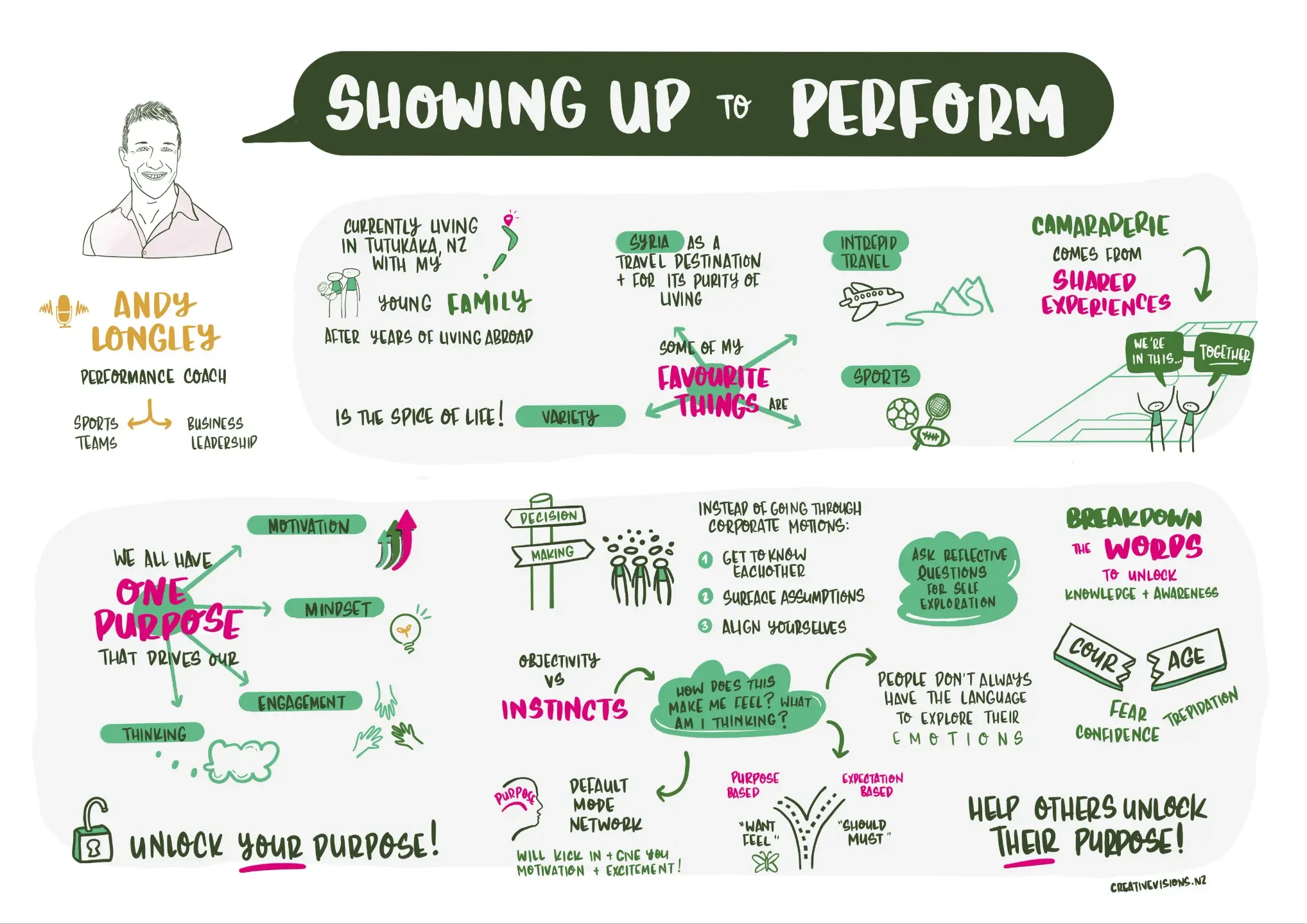
Andy: I could be altruistic and love this organisation I'm working for, but my core purpose could be something around sociability and engagement and just making really rich connections with the people I work with. That could be the thing that gets me out of bed.
So hearing a company purpose and talking about this, that might sound great, but that may not be what I need to access and understand consciously before I can really give myself to this organisation.
All of these different purposes, even in a great organisation, don't mean we all share the same thing. That's the, I think, the hard part with working with purpose and helping teams acknowledge it, is that everyone will have a different one and it's really hard for an individual to put their finger on what theirs is.
If you can help them do that, then you can find some common ground to create that shared purpose for the team. And that may be different to the organisation, and that's okay, but understanding it and then not building your operating rhythms as a team around what that is. And that becomes your own team's story line that you share becomes really important.
Jules: Kia ora, welcome to Humans at Work. I'm Jules, your host. Thanks for joining me and our latest guest and thanks for taking some time in your day to indulge your curiosity about other people and their humanness. If your thirst is unquenched after this, check out jericaglobal.com. Now let's begin.
Okay, I'm here today with Andy Longley. Andy, I'm gonna ask you to introduce yourself, tell us what you do and where you're sitting right now.
Andy: Thanks! Morena, Jules. I'm sitting up in a little place called Woolly Bay on the Tutukaka coast of Northland, New Zealand. I'm looking out at pohutukawa tree and some ocean which is a nice way to spend it. I'm not originally from Northland, I'm originally from Christchurch, although I was born in Levin, not too far from where you are, back from 0 to 1 and then grew up in Christchurch.
I am a, I guess professionally, I'm a performance psychologist and I recently moved back to New Zealand from living abroad for about a decade. I met my wife, who's from Lisbon abroad, so we've come back to New Zealand in November, just last year so that's about six months and we've got a 12-week-old, Alannah and was born so our first child. We moved back to New Zealand while pregnant and have settled in a little remote place in Northland to have the next life adventure back in New Zealand after a long time.
My wife, Bea, she's never lived in New Zealand, she's just done a lot of Christmas holidays here as we came back each year when we were permitted to come back, so this is her first adventure living in New Zealand; it's my first time for 10 years and it's really interesting to feel and notice the things as an expat when coming back to New Zealand. That's been quite a nice process.
I've done a couple of years as the OE in the early millennium. I did four years abroad and came back but when I was in my early twenties, and it's a very different experience than returning a couple of decades later now and having 'what's New Zealand like from the outside' lens on and when we've got a bit of a reset. And it's lovely but it's also very interesting to understand ourselves better.
It also gives a nice parenting lens when you start to understand the New Zealand culture from the inside and the outside and what that can look like, when you're also gonna be explaining to a tricultural child what being a Kiwi is, what being Portuguese is and trying to understand that.
That's where I find myself. What I do is, apart from learning how to be a Dad for the first time and having the world upside down and the joys and tears that come with it.
Also sports obsessed – I've turned my career into sports, but I've always been very sports-focused as an athlete and as a coach. I also work in performance psychology; I've got a couple of businesses; one is helping sports coaches create better teams, and the other one is doing leadership and performance coaching for business leadership.
There's a lot of diversity there and that probably rings true to who I am a lot as well. Variety is definitely the spice of life is one of the philosophies that I've kept pretty dear to my heart and that's where I find myself at the moment. There's obviously a lot more of that journey but I think it's a nice starting point.
Jules: And I have to ask, first of all, what's your favourite country? Other than New Zealand, obviously, you've lived in many and you've travelled a lot. What would be your favourite country and why?
Andy: I'll also excuse Portugal because Portugal is dear to my heart. I had the last year we were living in Lisbon and it's a beautiful country – the language, culture, people. The favourite country I have travelled to – I've lived in quite a lot – is Syria and I've also lived in Syria. I did a year as a United Nations peacekeeper 2010/2011 and I was living in Damascus for six months and then lived in southern Lebanon for six months. And I loved Syria.
I was there at the starting point for the Syrian uprising, so just when that began, I was living in Damascus – interesting story in itself. What I saw for the five and a half months before that started to explode, was just a wonderful country which no one ever went to, it wasn't on the tourist map, there was a real purity of living.
You could travel around the country really easily and have really rich personal experiences with the Syrian people. I spoke quite a bit of Arabic at the time so I was able to communicate reasonably well and I just loved seeing it. All the different cities you're able to travel to, with Aleppo and Homs, and Damascus in itself was just wonderful. That was probably the most authentic experience I've ever had travelling and living there.
When you come from a culture you could argue was quite distinct from the Syrian culture, but you felt so at home quite quickly, and I'd lived in Canada before, I'd lived in Scotland which you could also argue are much more aligned to the New Zealand culture in some respects. I love Syria the most. It was just pure and really eye opening because it wasn't an easy country for the Syrians to be living in at the time under the dictatorship which is still present. Those connections were very pure so I love that one.
Jules: I find that really interesting. I've just been to Egypt, and I've never been to Egypt but always wanted to go because I've got this fascination with the pharaohs and hieroglyphics. I used to know how to write hieroglyphics, kind of weirdly, but I just was fascinated by the idea of pictures as language and how descriptive they could be. I was a bit nervous about going to Egypt because of the political situation for many years and being a female in a Muslim country and travelling a lot.
What I found really fascinating, is how culture and warmth between individuals just blurs all of those differences in an instant. I wonder if it was a similar experience in terms of Syria, is that you meet people who you can connect with regardless of how they were brought up, what they believe in, because actually you see each other as human beings, and all of that stuff is just window dressing, really.
Andy: Yeah, it's amazing what can be said through a look, an eye contact and a smile – a smile is pretty universal as a gesture, and I think it's the same. What I have found, you can go to really popular countries for tourists to go to, whether that's the Amalfi Coast in Italy or Lisbon is very touristy at parts or Vancouver or wherever it may be. The people living there are pretty apathetic towards tourism, to a degree, even though they might earn their living from it. It's like, yes, more tourists, more tourists, more tourists; I preferred it before the tourists can be a sentiment you can feel.
But when you go to countries where there's not much tourism, there's a joy that someone has chosen to come see where they live. And I think that's from a, oh, there's something new and interesting that I can interact with. But I also think there's a degree of sitting behind the scenes – the typical psychologist, degree of that self-validation that if someone comes and sees this as beautiful, then that makes me feel better because I'm living somewhere that someone else can appreciate and I feel like I'm in a lovely place in itself.
That's what I find off the beaten track with the intrepid travel, it's purer and richer, even though you may not have as many tourist things that you go see in these places because that's where the tourists don't go; you can have a better experience. I've always liked that the intrepid, off the beaten track, that type of stuff's always been more interesting. Again, that variety coming back, I think you get a little bit more shock value.
Jules: Now you're based in New Zealand, and have you been reminded just how far away from everywhere else New Zealand is?
Andy: Yeah, and we're planning at the moment to go to a couple of trips, and it'll be the first with our young one so obviously that creates a different dynamic that we're not used to.
I met my wife, we were both working for Emirates Airline, so we're probably one of the definition of travellers. That was why we both went and worked for an airline, because you just go explore the world. And we're going to Jackson Hole, Wyoming for a wedding in August and then we're also going to one in South Africa, interestingly enough, in October and then back to Lisbon to visit the family back there.
That's when it really dawns in terms of the distance, I think. I've never really blinked at the long flights, personally. When I was living in Dubai, the 17-hour flight back to Auckland, I did that many times. I'd come for a long weekend – because you're working for an airline, you can, and you can sleep on the plane and come back, and you have an event and you go back. The world was very small there but now it's feeling very different through the lens of being a parent, but also the fact that long haul travel wasn't something that I think I will embrace as much as I used to. Very much so.
It will be an annual thing, I would imagine whereas, previously I never had this parameter around how often or when I could go back to New Zealand so I didn't feel quite so removed from it. But now I do feel quite removed from the northern hemisphere, especially in Northland, because there's also a couple more legs to do to get to an airport for me now rather than just drive my car to the car park and get on a plane. It's a bit different.
Jules: It's interesting isn't it? My advice for travelling with small people is take much more food than you think you'll ever need, and also a whole extra spare pair of clothes for you and the little one. I can tell you horror stories of travelling with babies and vomiting, or running out of food and the plane not having anything that was suitable. And then you've got a hungry baby for many, many, many, many hours and everybody hates you! Everybody hates you on the plane.
I was gonna say when I lived in Europe for a long time, I lived in England for a long time, and travelling was something taken for granted. You could hop on a plane or a train or a boat and you could be in Europe, and you could go to many different countries. And you could also go to a whole lot of other countries not in Europe for a fairly cheap price and not very long. I didn't do half as much travelling as I wished I had done. As soon as I landed in New Zealand, and I realised just how long it would take to get anywhere. So I have been to Italy more times since I've lived in New Zealand than I ever did when I lived in England!
Andy: It's the appreciation.
Jules: Yep.
Andy: You're very right. The complacency which comes with proximity or ability to do that. I think I was living in Germany just before Portugal for five years, and the same thing – you get in a car, drive to Austria, drive to Slovenia, drive to Italy, drive to France. It's great. We did a little bit but probably not as often as now I would appreciate to be able, in four hours I could be in France. That would be a wonderful ability to have at the moment. But that's human nature that we don't always appreciate and take advantage of what we can when it's so available.
Jules: Tell me a little bit about your sportiness. Because you look quite sporty, you like sports as entertainment, presumably you also played sports? What was your favourite sport?
Andy: First sport was football – soccer, football. Played that all through school and that was the main one I dived pretty deeply into 'til I was 18. And swimming for a long period as well when I was younger. That's a tough sport – swimming – in terms of the training demand that it places on swimmers.
It was definitely football, and that's still a lifelong passion. I'm a Liverpool Football Club supporter as well as the All Whites and some of my old clubs down in Christchurch.
Then, as with many teenagers in New Zealand, switched to rugby to follow the peer group and hang out with my buddies once I left school, and then played rugby and then rugby became my main sport. Those are the two ones I balanced. Snowboarding has also been a lifelong living close to the mountains in Christchurch growing up again, a lovely place to have access.
I travelled for a few years playing rugby, that was the main way I travelled on my first OE. So I had a great couple of seasons in Canada, played in Scotland for a couple of years and then mostly around New Zealand.
But also, when I went to Dubai, even though I was past my prime from a playing point of view, when I went to Dubai, I think the second day after landing there, going purely for a work reason – relocated for a job – just joined the local rugby team. Coach had already emailed me and said, "Yeah, I'll come down and play," and then immediately 50 friends one day after landing somewhere. And that's what I love about the sports element. I've just continued playing until early forties. I was even playing in Germany, and then I had an injury and burst a lung playing rugby and decided that was the time to hang up the boots a couple of years ago.
Rugby is a sport, but I love many sports from a viewing point of view and a participation point of view and that's probably started to change now my body's broken down a little bit. I'll be definitely focusing more on the snow and the hiking, and probably won't put on rugby boots or football boots for a while.
Jules: You must have analysed yourself to death, but do you think it's the social, team aspect of sports or is it the competitive aspect or is it the physical, you know proving yourself and improving all the time? Or is it an equal combination of all three or something else?
Andy: Yeah, that's a wonderful question. I'm very competitive and I know that from the behaviour I've demonstrated for many decades on the sports field, but that's not my main driver.
Interesting, when you challenged me to self reflect. It would be the social dynamic, I've only ever played team sports. Swimming wasn't one I was particularly attracted to, so I didn't do it for too long. The team sport, the camaraderie, the social side.
And we were chatting briefly that the levels of so-called extroversion can evolve and shape differently, or sociability is maybe a better way to describe it, with age and different experiences. I've definitely noticed that the social side was huge for team sports when I was attracted to it. And my sociability has definitely decreased, as it does typically with age or social circles get smaller and tighter and maybe stronger. I think that's been the main one but also the physical element.
There's definitely something that drives mobility in me. I'm always doing something, whether it's still going to the gym, even though I'm not training for anything or any purpose; I will still go because I think that's something maybe I'm habituated to, or I still enjoy. So social first, physical movement would be second and I don't think it was the competitive elements that really drove me; I think that just came out once I crossed the white line.
Jules: That's an interesting one. I actually used to train in swimming as well, but what I hated about it was having to compete, and so I stopped when the push came from the coaches to become more and more competitive and spend weekends going – this is many years ago, obviously – weekends going to meets and competing for the club and all of that sort of stuff. That's when I turned off it.
I've never been a team sport person. I am a football supporter, funnily enough, I supported Manchester City for many, many years while they were dramatically unsuccessful every season and then moved to New Zealand and lost the easy ability to follow. Of course, since then they've become wildly successful because of all the money put in and what have you, so that's just goes to show.
I like watching some team sports, but I've never been a team sports person at all. Yet I'm quite a sociable person. I just don't like that mix of competitiveness and sociability. To me, it ends up getting a little bit itchy, I can feel the itch in my back if I'm working with friends but it's in a competitive environment. And that's why I think, if I was to reflect, I've always steered away from team sports/team activities. I'd say I'm a team player work-wise, but not in a competitive sense at all.
Andy: Do you think it's because it in some way degrades the type or quality – I don't know which is the right word – of the social interactions you have when there's a competitive lens, whether it's against the opposition or the extra pressure and expectation that comes with your teammates? Do you think it's a degradation of the relationship that competitiveness can bring? I think it does, inevitably.
Jules: I think so. I think there's a purity about friendship or even collegiality when you're working with people. Where I like to be supportive and challenging and achieve what we're there to achieve. If there's competition, you're actually saying there are other things that are more important than me supporting you or us together being successful. And I don't like that, it doesn't sit well with me.
Andy: Yeah. It's made me reflect. I understand and I think the best friendships I've had through a shared experience, as well, is probably from the Navy days. Those that I went through basic training with are still incredibly close no matter what, and those lifelong friends that are just tagged as a lifelong friend and you give up and you always just come back in and out of those relationships like they haven't moved on. And that was through a shared experience.
That was a team because I think I joined with 28 other young persons at the time, and then we were forced to go through an ordeal for six months. You were competing against the system, and you were competing against surviving, not literally, but not choosing to exit or not being punished or whatever it was. That shared experience really deepened the camaraderie not only quicker but also deeper, I think.
That's interesting because that's very different to the camaraderie you feel through a team sport, as I reflect on the different relationships that have come through those two different kinds of mediums.
There is something about the sociability and the friendships and the connections can be strengthened maybe when you're not competing against achieving an output, like a win or a result and there's wins and losses, but it's just really around we're in this together. And it is probably a very pure collaborative experience because if someone couldn't clean their boots, you would help them because there was collective punishment for all of that. It already distanced us out from, I want to stand out and be the best player or I want to score goals, or score tries or whatever a lot of athletes would be trying to do from an individual element. And it really strips it back down to the collective good. You would think team sports would do that, but they don't, purely.
Jules: No, I don't know that they do. I'm interested because you've taken some of those experiences and your interest in sport, and you've channelled them into the businesses that you run. So somehow, whether consciously or unconsciously, you've sifted and filtered through the things that are constructive and positive about both and brought them into your work.
Andy: Probably more subconsciously. I was always interested in people behaviour, group dynamics, that was an element of the psychology out of school – that's what I did my undergrad and postgrad in. I didn't really know, I was 17 and pick a major and, honestly, I chose psychology because it had the later lecture starting time, so I was like, that's a good reason. Law was 8, psychology was 11; I'm going with 11, that's a much better option.
I don't know if the choice I had but then, of course, you have to enjoy the subjects to continue. So understanding the social observational dynamics is very fun. I did that in the operational with the military stuff for a while and then the corporate stuff for a long while, but I missed sport.
I missed the purity of sport. And with a lot of leadership development in the corporate space, it can lose a little bit of the purity, I've found. Because often you're working with individuals who are trying to accelerate their own career, and that is a very common mindset in people in the corporate space.
Nothing wrong with it; human nature, to a degree, because we're trying to provide, we're trying to validate, we're trying to build up our own career ambitions, our self esteem, all of that sort of stuff so it's natural.
I did find when you're working with them as a leadership or team coaching, that it was harder to emotionally connect to that element because you're trying to work at a collective sense, "Let's do a team development session or let's do team coaching and let's focus on making you as a group better." But there was always someone who was like, "Yeah, I wanna do that but only as long as it helps me get the next promotion." This isn't an overt thing, but you see it through the behavioural habits.
So that's what I found. I did a bit of work with a rugby team here in New Zealand down in Canterbury, and I realised understanding the dynamics of the team and how you can make this group better was pure again. Because, all of a sudden, they're not trying to get ahead – they are genuinely trying to make the team better because they were a professional team but not many people go into it thinking that way. It's all amateur for the love, and then suddenly you're good enough and you end up getting money. I didn't choose it to go in for a career in that regard.
When I was working with sport again, and you're working with amateur coaches who are coaching because their kids play football or rugby or soccer or tennis or whatever, they're volunteers. There's a real purity of intent and purpose in that, and that was what I connected with a lot more.
The corporate stuff was harder to find, it's definitely there and there was a lot of amazing leaders in teams, but it was harder to find but in the sports it's ubiquitous. It just is. Its people do it because they want to be doing it, so the reasons were a lot easier to connect, and you're working with people who are genuinely trying to get better because it's not for a promotion. It's because it will make their kids have more fun or it'll make the kids learn better or whatever it is and that was really interesting.
That's where I transitioned, really only a year and a half ago, back into the sports world from the corporate environment because you have those conversations and you look at people's eyes and they're doing it for love versus promotion and it was much easier to connect that way. Have you found something similar?
Jules: Yeah. I do find that fascinating. I suppose my experience is largely with leaders in the public sector and some not-for-profit. I have worked with private sector companies. And what I've found with engaging with those leaders, who generally they tend to be the sort of owners or the CEOs of those companies, is that it's a different conversation completely from the very beginning.
I think I find that more challenging personally to have to shift my mindset, my conversation, the words that I use, probably because I worked less in the private sector than in the public sector. I've lived it in the public sector, I've worked in non-for-profit, I've worked in local government, I've worked in central government. I've seen it, so I have this wellspring of stories and anecdotes and my own reactions to things that I can bring to when I'm doing leadership development or the peer mentoring that I do.
Whereas when I'm working with private corporate sector clients, I'm thinking, I have to put myself in their shoes, I have to do some research, and it's a harder mental effort for me, I guess, in that situation.
What I find in public sector, and increasingly I think it is becoming more widespread, is that if you can connect on purpose, then the promotion aspect starts to become less important and less of a driver. But you have to clear away a whole lot of stuff to get to purpose.
I think it's one of those things that's really underplayed in organisations. Because an organisation will say, for example, "We're a public sector organisation, therefore we're here for the public good and citizens. We have a mission statement; we have a purpose statement. The government set us priorities; therefore, it must be completely clear to everybody in the organisation exactly what they're here for and why they're doing what they're doing."
Of course, it's not at all. And so for leaders you start from the perspective of trying to understand, do you know your purpose in this organisation for this cause? If you don't, then you can't expect anybody else to go the extra mile or to suddenly become super collaborative. Because they've got nothing to aim for, they've got nothing that brings them together. Your job as a leader is to find that purpose for yourself, and then be really good at storytelling that, so that other people can find that for themselves.
I think for you in terms of, what I got, is that you don't have to do all that purpose work when you're looking at sports teams or coaches because it's completely obvious. It is actually obvious to everybody what they're there for.
Andy: One of the areas I do focus on specifically is purpose and how to create a shared purpose. When I've been working with founders or Leadership Teams, even in organisations that have a really great reason for existing – they're helping people or they're enabling or whatever it may be. Ones that on the surface you would think this organisation is easy to connect because it is purpose-led.
That doesn't mean the people in that organisation will share that purpose and everyone is singing off the same hymn sheet as well. Because every individual's life experiences will be different, and everyone's purpose will be very different. Even if I'm working for the greatest not-for-profit that is helping feed underprivileged children somewhere, I may have altruism in me which has attracted me, but that may not be my defining purpose for me personally.
You don't have two different purposes – we don't have a professional purpose and a personal purpose, and we operate them differently. We have one purpose that sits and drives all of our behaviours, our mindset, our thinking, our motivation, our engagement.
It's really hard for people to identify what their own purpose is, because most of it's sitting in the subconscious in terms of driving our behaviours. I could be altruistic and love this organisation I'm working for, but my core purpose could be something around sociability and engagement, and just making really rich connections with the people I work with. That could be the thing that gets me out of bed. So hearing a company purpose and talking about this might sound great, but that may not be what I need to access and understand consciously, before I can really give myself to this organisation.
All of these different purposes, even in a great organisation, don't mean we all share the same thing. That's the, I think, hard part with working with purpose and helping teams acknowledge it, is that everyone will have a different one and it's really hard for an individual to put their finger on what theirs is. If you can help them do that, then you can find some common ground to create that shared purpose for the team. That may be different to the organisation and that's okay. But understanding it and then not building your operating rhythms as a team around what that is, and that becomes your own team's story line that you share becomes really important.
In sport, you don't need to do quite so much of it because people are driven by their purpose, they end up in it. You're not gonna get out of bed on a cold Canterbury morning when it's frosty, the kids have got an 8 o'clock kick off and you're putting them in three thermals and out the door. You're not gonna do that unless you're getting some pure reward from it. And your purpose may be to see your kids thrive, which is a very common one.
That's great, because that's purpose leading no matter what. When you're getting together a bunch of amateur coaches or professional coaches, you can find that quite quickly. What I have found is when I'm working with teams in the corporate sector, it's hard work, and it should be, to help them identify their purpose and create one together. In the sports teams, it's almost like we fast forward that step, which is a fundamental step, so you really see the conversations start and finish in different places. Maybe that's a representation of where I've been drawn from, is purpose following into sport because it's obvious – something, that element.
Have you found the same cos purpose is something that is a is a buzzword but it's a buzzword with good reason. It's a buzzword because it is so genuinely sitting behind what unlocks a lot of our wonderful qualities in life and work. How've you found it? It's really hard to help people identify it themself.
Jules: It's really difficult. I think what I found - I'd be interested, because you run a couple of businesses yourself – is that when I made the decision to fundamentally shift away from being an employee or a contractor or working for other people and decided to work for myself and for my purpose, that was hard mental effort.
Actually, for me, what catalysed that was a burnout situation, where I was lost in the fog for a few months, and that had never happened to me before. I've always been really driven, get up in the morning, go and do the work, work long hours – didn't matter because I had that sense of 'I'm doing this for the greater good' or whatever it might be.
When I woke up and realised that I actually didn't care, that's what I thought, oof, alarm bells going off everywhere. And I thought, I need to really think about this. Because I can't keep going on that same hamster wheel if what I end up having to have, two or three months out because I'm physically incapable of bringing any passion to anything work related. It bleeds into your personal life as well very, very quickly.
I did a whole lot of introspection, to work out what would be my solution to this problem. And my solution to that problem was to set up my own businesses where it's really clear to me every single day what I'm doing and why and for whom and for what.
I don't have to go through corporate jargon, I don't have to have debates with other leaders or bosses about this decision or that decision, because they're actually much clearer if you have that sense of purpose. Having been through that, I know the joy that it brings when you don't have the weight of all that obfuscation.
When I'm working with individuals – I'm not a trained coach so I don't call myself a coach because I'm really aware of the difference in terms of what I do versus what people who are professionally trained and what have you - what I call it is peer mentoring, where I can bring my lived experience, I can listen to people, and I can say, "Well, you know, if I was on the receiving end of this, this is how I would react, so maybe we can think of a different way of doing it."
I do a little bit of that, and I do some work with leadership teams to bring the dynamic together. What I've found, particularly with those leadership teams, is that the focus is trying to get the dynamic to work so that they can have a leadership teamwork programme, that they can get some real exponential shift because they're all making decisions in their area of accountability but that go in the same direction.
And they come to it thinking it's about business planning or doing a strategy piece of work or whatever, and what you realise very quickly when you talk to them individually and see them in a group, is that they don't know each other, they don't know their own motivations, they don't know each other's motivations, and so they talk past each other.
On one end of the spectrum, you'll have somebody who's an introverted person who thinks deeply about everything and wants to weigh all the evidence up. And, on the other hand, you'll have somebody who speaks as they think, and who is driven by instinct and has a try and fail fast kind of mentality. Those two people in a room or in a leadership team, unless they understand how each other's gonna approach a situation and where they can meet in the middle, it's never going to work, ever. They're gonna annoy each other, they're just talking past each other all the time.
Even though they might have a really clear sense of they're aiming in the right direction but when you get them to say, "What's your purpose of being in this team?" there's a, "Oh I don't know. I've never been asked that question. You can ask me what my role is. You can ask me what the purpose of my function is within this organisation. You can ask me for the elevator pitch for the organisation. But what you're asking me to do is say, what am I in this team for?" And they haven't got it, and it's not a criticism; it's that nobody's ever asked them or given them the opportunity to think about that.
Andy: A lot of organisations go through the corporate motions because that's the way it works rather than understanding it. Another area which I hear you talking about, is really understanding where there's shared assumptions and where there's different assumptions, in terms of how the team gets together. People think they're doing the same thing but they're at very different starting points, or they're looking at it through the different lenses and they have very different assumptions around what good looks like or what the objective is or whose role is what.
A really great exercise is to talk about, well what are the assumptions in this decision, and getting people to blindly share their assumptions and individually do that without discussion. And then seeing the alignment or the disparity and some of those can be really good discussion.
When I work with individuals or teams around their decision making, that's one of the core platforms that I try is, "We've got a key decision – merger, acquisition," or team game plan if it's in sports or whatever it may be. "This is a really important one that's gonna have a big impact so we wanna get it right. What are the assumptions that we're all bringing into this in terms of what's the objective we're trying to do or who's got decision making or what is the key information we're basing this decision on?"
People have very different starting points on that unless you talk about them early in the decision-making process and do, as you said, surface those assumptions and go, "Great, now let's align on them. This is the information we're using. This is what we're trying to achieve. These are how we're gonna do the roles, and then you can actually get the boat rowing in the same direction."
It's always left to chance because we're in a hurry, we do things quickly. Some cultures, in particular, have a little bit more transactional nature to the working environment, take less long with the relationship building – straight to business type elements, and then that has collateral damage that can follow through with it as well.
You also triggered something in me when you said you had a couple of months when you're in the fog and a bit of burnout and that was your catalyst as well. I had quite a similar experience.
I was working my last in-house corporate job when I was an employee, was just before or just in COVID, and I'd just moved up for a big e-commerce company in Berlin – really fascinating company. It was a German unicorn, so it was a startup that had been hugely successful. It was a tech-led company, so my intellectual decision making to go for that job was, that's a couple of new industries, startup tech. I'm really fascinated by that – let's go do it. I'd become a little bit apathetic in the previous company, of not really finding the love in what I'm doing.
Then went up and I thought, okay, great, I just needed a change. That's what I've done my whole life – I've either changed countries or changed something else and I've got a new burst of motivation and stimulation.
When I did that, after two weeks, I realised like, this hasn't worked. I'm here in the same place as I thought I was running away from. And, to be honest, I really don't care about this job.
I like the people, I'm gonna do my best and I will continue to do because professional standards and all of it. Behind the shutters, I was like, I really don't care. That was when I knew I needed to make some drastic decision. That I could no longer continue on on that career path. It was one I'd invested two decades in, it was the only one I knew, it's like, what next?
I had never seen myself as an entrepreneur in any way, and even as a psychologist I've done and accredited every psychometric you can think of and a lot of them purport to measure entrepreneurialism. I'd always scored really low, no, terrible, not me, it's nothing to do with it. And suddenly I'm faced with the decision when I actually have to do a drastic career change. I don't know what it's gonna be but I just know in my heart, I feel – the head was trying to say, no, what are you doing? This is a great paycheck – stay here. My heart was like, sorry, I'm out. My heart makes the decisions in the end that I had to do something.
I had a really similar journey to you, was I'd just reached a crossroad and I didn't see it coming, necessarily, but I knew there was a moment that I just had to change tact. I know a lot of people would have that and that's the scariest moment.
We are humans but our brains hate uncertainty, it's one of the things we're almost allergic to, so just changing of a tact of predictability, known security, safety, financial security, ego validation – all the stuff we've been investing in – and suddenly you go, I'm just gonna go into this tunnel where it's just black and I don't know what's gonna happen but I know I have to.
Normally you would assume that you would sit at that crossroad for a while and like, what am I gonna do? I felt the decision was quite clear, even though I had no idea what that decision was gonna be, I felt that that was an easy decision to make. Did you have a similar experience? Was there a defining moment where you knew the answer to the decision or how was your journey?
Jules: I did. I was walking on a beach, cos there's beautiful beaches nearby. And part of my therapy for myself was to do long walks on the beach, listening to different podcasts, trying to find answers but also just trying to get interested in something again. I had like a flash of inspiration and that was the moment that I came up with the Humans at Work concept and decided I was going to host a podcast, even if nobody listened. And that I wanted to use my voice in a way that I wanted to use it, rather than being driven by other people.
And that was the decision. I came home and I said to my partner, "I've decided this is what I'm gonna do." "Okay, cos you went out 45 minutes ago and this wasn't even on the horizon." But it was there somewhere. It had been bubbling up for a for a long time, so the decision was easy.
What was difficult, I think, was taking a chance on yourself when you have all of these expectations upon you – you have a mortgage, you have a family, you have a profession, some sort of reputation. And people would say to me, "Why are you doing that? What makes you want to do that?" It wasn't that they were criticising, it was just that it didn't fit with what they thought I should do.
You get the collywobbles, which is a very old-fashioned English word. You get the collywobbles but when you have that purity of purpose, it's like that weight can be lifted off you. When I wake up in the morning and I think, great, I'm gonna do all of this stuff today. I don't think, ugh, I have to do this.
Some days I'm like, it's a Saturday school sports and it's raining and I've gotta get up. I still have that. But when I'm doing things for the companies, for the purposes that I've set up, I don't have that dread. The Sunday night dreads that I think you get in school, and sometimes they stay with you all through your career.
It was the easiest decision that I've had to make in the last couple of years and I certainly don't regret it. I would have regretted not doing it and that was the key for me. If I don't do this, then I'm gonna think about it forever; if I do, do it, then great, I won't ever regret it, no matter whether it's a success or a failure or it peters out or whatever. If I'm gonna have fun doing it and I think it's worth it – it's worth my time and my energy and my passion - it's worth it.
Andy: Yeah, it triggered a couple of thoughts. I love instinct, whether we call it gut instinct or whatever it is. I think it's a misunderstood thing. We try to use what's called a construct, it's so psychology, its a misunderstood thing. As a trained business psychologist, objectivity is the be all and end all. Whether you're running assessment centres and selection centres – all of that stuff is objectivity, which is great cos human biases are everywhere and inevitable. When you're doing that, I remember we used to joke about, "Person said gut instinct." No, they don't make decisions on that.
Now as I've studied a lot more of the science behind it, instinct is a fundamental thing that we need to be able to access consciously to guide good decision making. There's times when you don't wanna trust your instinct – if you don't have enough information, if you're not an expert or anything (and everyone's an expert in their own life – just as an important caveat) – but then actually listening to your instinct with intent. Sitting back, and if someone else is listening to this and they're at a sliding door moment whether their career, life, hobbies, whatever it may be – to sit back and just listen to your feelings, your sensations, your body feelings.
What am I feeling when I ask myself the question should I go left, or should I go right? Then try to notice is it a knot in your stomach? Is it fear? Is it anxiety? Is it excitement? Note the sensations and you can write them down, it could be quite useful. Note them, and then ask yourself these questions periodically and see if the sensations get deeper or louder, because that is a really great way to guide decision making, is the gut instinct.
The reason that I think that happens is back to our purpose conversation, funnily enough. In our subconscious brain, we've got this part of the brain which is called the default mode network. And this is 24/7 whirring along going, what is my place in the world? It's constantly trying to figure this out. We don't know it's happening, and often our conscious brain can't even access it, but it's going, what is my place in the world? When we are doing stuff in line with our purpose, our genuine real purpose, this part of the brain goes, this is great I'm gonna give you some motivation, I'm gonna give you some excitement, I'm gonna give you some joy.
That's where it starts to feed from, so if we can take a step back and go, I'm at this sliding door moment, what am I listening to myself? What you're really doing is you're listening to this part of the brain going, is this in line with my purpose? What are my sensations that I'm feeling and thinking with my gut instincts? That's actually your default mode network, or your purpose and your subconscious going, this is going to be really good for you cos I'm gonna give you bursts of motivation to do it. That can be a really nice way.
You had an epiphany moment listening because you were giving yourself an exposure to different materials that your subconscious was constantly probably working on and going, this is giving me energy and you listened to that moment and go, I'm gonna follow my energy. Rationally, your brain probably gone, this is not a very good idea – my mortgage is coming out in three days' time, there's no route to mortgage payment on this one, let's not do it – but you listened to your instincts.
The other thing it triggered in me is the language that we use when we answer these questions. When we were sitting and thinking, I'm at this fork in the road, what am I going to do? If we ask our self the question, or we can ask our peer or our partner or whoever it may be, what are the reasons why you should go left or right? If we say the word "should" or "must", should is a really tricky one. If we say these words, then that's giving us indication that maybe that's not the right path. When we're saying "should" or "must" or "need to", this is around our conscious, logical brain going, hey we've got some responsibilities or people expect us to, let's go do that.
If you're saying, "I want", "I feel", the language you use when answering that question yourself, or if someone asked you it, is also a really good indicator of which fork in the road is gonna help unlock that purpose. If it's "I want" or "I'm excited by" – "I need" is a tricky one because it can go both ways, but the language we use can also give us an indication.
If we're in those tricky moments, listen to your feelings. What is my instinct telling me to do and what language do I use when I describe why I should go either way? That can give a couple of really good indicators on where you're gonna be more fulfilled and excited and motivated down those paths. I wish I knew this beforehand. This is all reflection on my experiences. You're laughing. It's the same thing. This would have been great if I actually trusted my instincts back then, but it's something I've learned as a result of, I think.
Jules: That concept of vocabulary is so important. I'm finding it with having children – I've got children of different ages, some of my own, some blended family – and what we're trying to do is give them more vocabulary to describe their feelings about something or their feelings about what they're experiencing. Because they're limited by the vocabulary that they have or that's cool or that's used on TV or by their peers. Actually, it's a blunt instrument.
So if you take something like fear, "I'm afraid of this situation," and you say, "Let's break that down. How do you know you're afraid? Do you have butterflies in your tummy? Do you feel a little bit sick? Are you going through in your mind different scenarios of what might or might not happen? Let's break that down a little bit."
So maybe the butterflies are a little bit of excitement because, actually, you think this might be really, really good and you can't wait to do it, and so you've got a bit of excitement in there. You might have a bit of dread. You might be doing some catastrophising because you're thinking about the worst-case scenario and what might that mean. You might let people down, so you don't want to let your friends down.
There's all of these different things, where if you break down a word into different kinds of words, you're able to break down the problem. I find that with the kids and with the teenagers, that that really does help if you're trying to understand, what's a route through this, is to break it down.
It also works with leadership, I think. I'm a leader, as well as supporting leaders, I'm a leader of a team, I'm a leader of maybe like a movement – it's my own movement but I'm still the only one having the vision, I'm the one doing the driving, I'm the one making the decisions. If you take leadership and you say, let's break it down. Leadership can be so many things but if you just use the term "leader", you're missing all of those different things.
For very many years, like 25 years, I have been driving home this point with leaders around, decision making is a fundamental role of a leader and so, therefore, is courage. But you might not think you're courageous because it doesn't gel with what you think courage is. But, actually, when you're making decisions, which you must do as a leader, a lot of that will take courage.
That's a feeling. And what comes with courage is fear. It also comes with gut instinct, because you can be much more courageous about a brand new thing if your gut is telling you this is the right thing to do.
All of those things bundle up into, I'm a leader, or whatever it might be. Unbundling them helps people grapple with, I wanna build this area or I wanna get better at this, or I wanna understand this a bit more so that I can tell other people. Vocabulary is often the thing that can unlock that for people. They just don't have the words.
Andy: I can't remember where I read the research but there is good research showing the vocabulary we have around emotions is directly linked to emotional intelligence. Hearing you say it, I'm brand new to parenting, but understanding how important it is and loving – I'm gonna steal with pride, you're exploring the different emotive language that kids or it could be anyone – family or colleagues use – is a really great way to help understand what the different emotions or sentiments may be. And with that understanding then comes self-awareness and ability to adapt behaviour and all the stuff that lead to emotional intelligence.
Often, and I think there's a really strong cultural lens, there's probably also an element of a gender lens over the vocabulary we use when it comes to emotions as well.
We may be stunting ourselves – "we" talking about myself and how I've grown up as a male New Zealander and how we talk about emotions. Then of stunting my ability to really be as emotionally intelligent as I could develop towards, because I don't have that same level of vocabulary. I may intellectually know what the words mean, I may know what "trepidation" means or whatever it may be, but I don't think of it that way. I don't use it, so it's as an intellectual knowledge, not a personal knowledge.
I think that's a really nice thought, is the words we use unlocks knowledge and awareness. And with that comes the ability to self navigate more effectively and more accurately, and make better decisions, and make better connections. And manage our behaviour more effectively and build stronger reputations professionally, if that's what we're trying to do, or have better connections with the people we play sports with or whatever the theatre that we're exploring.
Jules: It goes the same for physical, I'm sure, in coaching for physical performance. Is that you can have an ache but what's driving the ache? How do you break all of that down? I don't know much about it, not being an athlete, but the science of diagnosis, and therefore the science of what is the solution pack to repair an injured muscle or to improve your performance from 0.8 to 0.7, is massive.
Physically, I feel like there's been a lot of focus on vocabulary and the minutia of certain aspects. But one thing I notice as somebody who identifies as female, and also getting on a little bit, is that the vocabulary for female physical symptoms is really, really narrow.
You've probably seen there's been a growing movement globally around menopause and perimenopause and all of the things that go with that. It's really interesting to me to see that, actually, it's not so much that people won't be sympathetic or won't help or whatever, its that they just don't understand because some of the words or the connecting those words together, just haven't ever been used. The dictionary's there, we just don't use it.
But, for validation purposes, you know I'm sure better than me, that if you can reflect back to somebody who's telling you about their story – how they feel, their worries, their aspirations – if you can reflect it back to them, both in their language but also in other language, it feels validating and they feel seen. That's how I feel.
People feel seen, they feel heard, they feel understood. Sometimes what is a barrier is that people just don't have the language to be able to reflect back to people in a way that isn't just rote. "I heard you say that you were feeling afraid. I can see that you're afraid." No, no, no.
Wouldn't it be so much better when you say, "I hear you talking about this mix of emotions you have, which includes some excitement, some trepidation, you're feeling the physical effects, the hairs are going up on your body. I can see that, I feel that. You're right – you're feeling it."
Andy: I can imagine in the parenting context that, because parents have the ultimate purity of wanting to help, that that's a conversation that if parents feel capable and knowledgeable, they would love to move towards. "If I can help you understand – you've fallen off your skateboard and your knee's sore, let's explore what's hurting and what you're feeling and let's try to validate, but also get you to be aware of it so we also know what we need to do."
My brain jumped to, I'm trying to picture that conversation in a business environment. And I was trying to imagine a leader sitting down with their team member, and maybe it's through a bad performance review or maybe a project hasn't gone well or maybe it has gone well.
And the leader going, "Tell me what you're feeling when I've just given you this feedback or this rating," or whatever they have. Then really exploring it that way and what are the emotions? This would not happen.
That level of conversation of a leader sitting down and really trying to help a person explore the emotions. And maybe if we take performance review out, maybe if it's did a bad internal presentation or client presentation, something that the leader was observing, is maybe a bit easier. Sitting down and going, "How did you feel through that? What are you thinking now? What thoughts come to your mind when you think about doing the next presentation? What do those feelings and sensations you had tell you about that you can learn from to build more confidence for the next time?" That would be a fantastic leader, but that does not happen.
Why do we not bring more parental nurture and support into that leadership context? That would be a highly emotionally intelligent, very technically aware, gifted leader to have that conversation. It would be 1% of the leadership population at best, in my estimate. Wouldn't that be a wonderful way to actually do mentorship or leadership or peer support or whatever it is, to be able to do that?
We never go in that depth. It's like, "How do you think you went?" "I don't think that went very well." "What would you do different in the next time?" And this is a good conversation. "Next time I think I'll probably prepare a little bit more and do a bit more rehearsal and maybe run a few of the dummy questions with you beforehand." "Yeah, good plan." Away we go, slap on the back.
We never explore the sensation element behind it, because that's what's gonna drive behaviour – emotions exist to elicit responses in ourselves, but we don't explore the emotions a lot; we explore behaviour, and we could go a level deeper. I think parenting maybe naturally goes there much faster.
Jules: I completely agree. That's why I think there's been much more of a proliferation of people wanting coaches and mentors, because in those conversations they can do that thing, they can do that conversation. I can remember working with a tier 2 leader, very experienced, high up in the organisation. About having to go into an Executive Team discussion, that they had three times a week, but this one, they had some big decisions that they needed to get made. I was providing a little bit of support ahead of time and I said, "If I was you, I'd be scared because they're a tough crowd. They can whip you with their tongue, they're your peers but also they're your customers, and your boss is watching. I'd be really frightened." There was this pause, and this leader said, "I am. Yes, I am."
We didn't go into it any in any more depth in that moment but actually, sometimes all it needs is somebody to acknowledge there is some feeling in that. We are human beings, we bring ourselves to work. However, I know that's become a much-overused phrase, but we don't leave our personalities at the door. We don't leave our worries, we don't leave grief. We don't leave physical symptoms at the door – why do we think we leave emotional symptoms at the door? We bring all of that, yet we just don't talk about it, and it doesn't take very much to have a feeling conversation.
I think the whole movement to leaders as coaches, originally was designed perhaps to tap into what you were talking about. But I think somewhere it's lost that sense of human-to-human, and it's become more about performance coaching. Absolutely, that is needed, but it's not needed every single time you're talking to somebody who works for you. Sometimes you just wanna know how are they going? Are things really terrible? Is it overwhelming them? How's their family going? This sore knee that's been troubling them for months, is it really still getting them down, causes that will be dispiriting, it'll stop them sleeping.
You can spend 20 minutes over a coffee asking just about those things, and showing empathy and showing that you care, and performance can lift because they have somebody alongside them who sees them.
Andy: I agree. There's not an athlete in the world or a leader or a professional person that doesn't have self doubt and fear leading up to a performance moment. Doesn't exist. Our brain is hard wired to see threat first and foremost and it casts a bigger shadow than possible reward. It's part of the challenges of trying to overcome fear and trying to move forward and move towards action.
Understanding that even though this person's the best performer on your team, whether it be business or sports team or they're your leader and you look up to them, they're your role model, they will still be nervous or anxious or performance anxiety of some degree relating to it.
Talking about it can also help because sometimes when people are the leader of a business or the team captain or anything, when people are looking up, we assume that they've got it sorted. What could I do to help them? I can't, they're better than me, they know more, they always perform. But actually understanding they're gonna go through their own version of performance anxiety, and exploring it and empathising with it, is also a great way to form an extra connection. But also help that person feel like they can actually come to you if something does go off the rails later on.
It's that foundation of trust as well, but we often don't do that to the good performers. We assume they're the sorted, because they wouldn't have been a good performer if they haven't. But trying to build that connection can be a really great way. There will be different contexts where that person will be flipping it and their anxiety will be really high. It maybe a different context to us, but they will have those moments and if they're always left alone because they've got it sorted, then they're gonna be very vulnerable in those moments because they won't have had interactions of support. They won't have had people to either empathise or to ask them reflective questions so they can self analyse. Or they'll just feel lonely because they won't have these common connections, and everyone will leave them to their own devices as well. That can be in life or a sport or work. It's a really nice approach that you shared.
Jules: We have been talking for well over an hour and I feel like we could probably talk all weekend. I can hear a hungry baby that wants some Dad time. So I wanted to say I really appreciated you sharing your time and your thoughts.
There's a lot that I'm gonna take away personally and think about how can I refine what I'm doing. If life is a constant kind of refinement process, we're not just getting more grumpy; we're actually getting more refined in what we're willing to take or not.
I wanted to express some gratitude for your time and your thoughts and your sharing of your experiences. And to say I am here if you ever need anything from me. I'm a firm believer in something called quid pro quo which is about sharing and helping each other out. Thank you very much.
Andy: Likewise. It's a pleasure and it's wonderful that we were connected and had a great conversation. Likewise, I also want to reflect back that I took a lot away myself from hearing your story, from seeing some parallels and some differences and also a lot of great learning. Having been a solopreneur for a few years, understand the value of networking and helping each other out and making connections and I wanna offer the same kind offer back to you as well. We're both sitting on little coastlines in a small little country, but I think it's a great way to be and look forward to staying connected.
Jules: Fantastic. Thank you so much, Andy.
Andy: Likewise. Have a great day.
Jules: You, too.
Thank you so much for listening and thanks, as always, to the generosity of our delightful guests. The stories of how others have faced up to their challenges can help give all of us courage to keep going with our own. For more great episodes, blogs, learning packages, go to the JERICA Global website.
Humans at Work Podcast