
Ocean Regeneration and Climate Action, a Marine Biology Perspective — with Johnny Singh
Humans at Work Podcast | Episode 11
Host: Jules Harrison-Annear | Guest: Johnny Singh
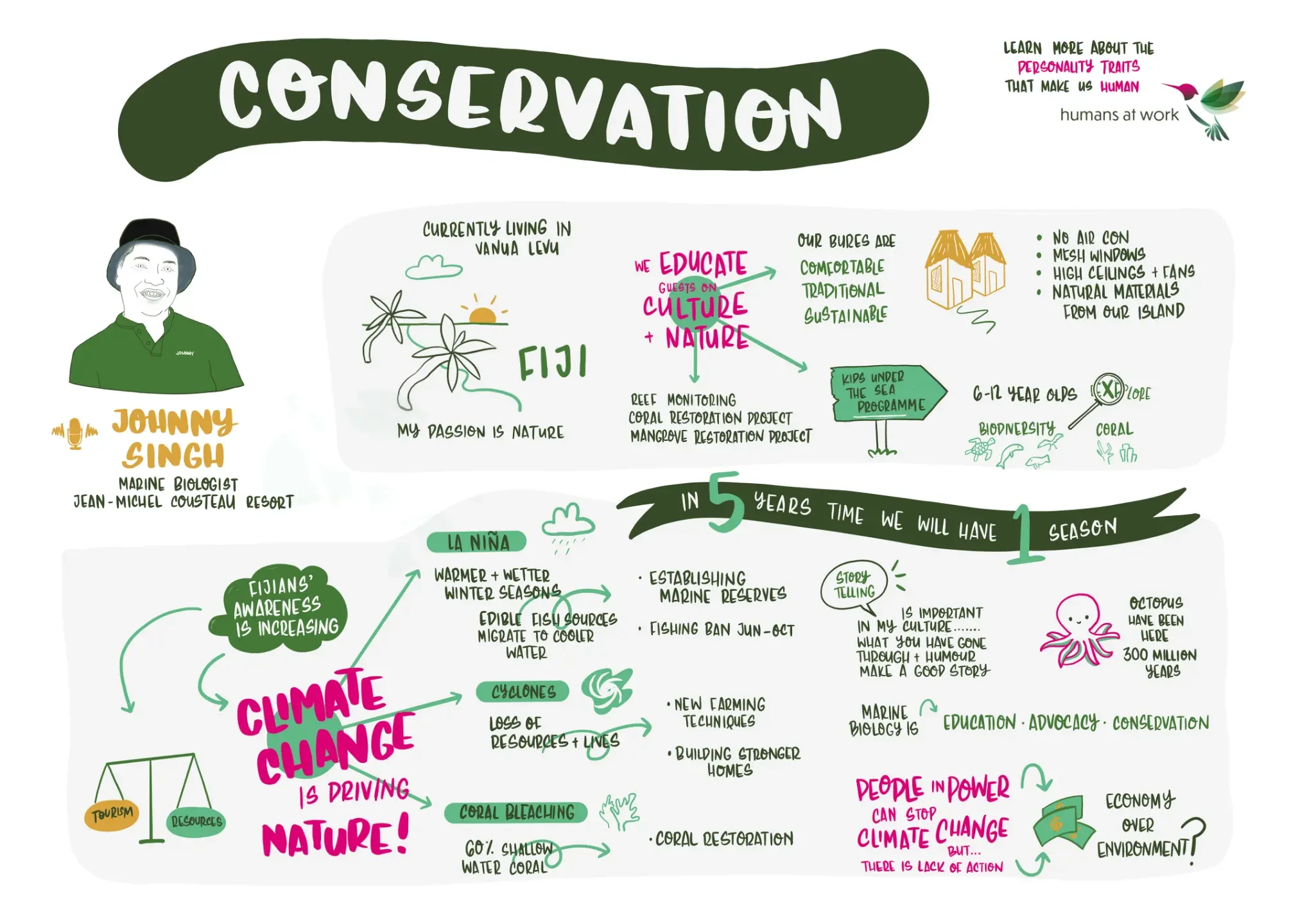
Johnny: It is a serious issue. I think it's not just up to one person, everyone needs to know about this, realise what's really going on. You know, you don't need to be a scientist to be in. Even in Fiji, ask any local people in any village, they'll tell you. Climate change is real.
Jules: Kia ora, welcome to Humans at Work. I'm Jules, your host. Thanks for joining me and our latest guest and thanks for taking some time in your day to indulge your curiosity about other people and their humanness. If your thirst is unquenched after this, check out jericaglobal.com. Let's begin.
Today it's a little bit different, I'm on location in beautiful Fiji and so we have a couple of videos, a portable microphone, we're sitting in a yoga studio at the Jean-Michel Cousteau Resort on Vanua Levu in Fiji.
And hopefully we don't get any noise from revellers having fun or boats going past but if we do, well, we're in Fiji so there you go.
So, it's a little bit different today because I'm in person with the person that I am interviewing for the podcast and, as you know, most of the time we are doing it virtually because it's people all around the world and I don't often go to, get to go and visit them. But today I'm super lucky and Johnny and I are sitting here across from each other, a little bit warm but we're having fun.
So here we go. Johnny, would you please tell us who you are and where you work.
Johnny: Well, I'm Johnny Singh and, currently, I work as a marine biologist at Jean-Michel Cousteau Resort in Savusavu, Vanua Levu, Fiji.
Jules: Can you tell us, did you grow up in Fiji or did you land here because of the coral?
Johnny: Actually, I did grow up in Fiji, not in Vanua Levu, in Suva which is in Viti Levu, the capital of Fiji. That's where I grew up, pretty much. Went to school, high school and then graduated, came back and just joined Jean-Michel Cousteau.
Jules: So, how long have you worked here at this resort?
Johnny: I've been here for almost like 13 years now.
Jules: Wow okay. And what is it that keeps you here?
Johnny: I guess it's my nature, I'm a very nature-oriented person, it's there from the very beginning when I was growing up. My house was near a beach all the time so my Dad used to go surfing, swimming, snorkelling and from there my passion just built up.
Growing up in the 1980s, being a marine biologist was a cool thing for everyone so pretty much I pursued my career towards that and, like I said, went to high school, went to University of the South Pacific which is our regional university. I graduated there, and then I managed to get a scholarship and I went to Australia to do my post grad at James Cook University. After graduating I came back and then this was advertised and I applied for it and, surprisingly, I was the first local to get the position; before it was all held by Americans.
Jules: Wow. That's amazing. Congratulations.
Johnny: It is a good start, yeah. Thank you.
Jules: How many marine biologists are here at the resort?
Johnny: Right now there's two of us – my assistant and myself.
Jules: What would you say is a normal day for you?
Johnny: A normal day would be just waking up, having cup of coffee then checking emails what's going on, having a staff meeting, you know, and then see what the plan is for the day and just follow the plans and activity. That's it.
Jules: I know that at the resort you have a real focus on education so there's a kids' club where kids can learn about the biodiversity, they can learn about the coral and they can graduate. They can get a certificate. Tell us a little bit about that?
Johnny: There is a lot of physical elements to the resort as well but one of the elements is educational. We do try to educate the resort guests about Fiji's culture and nature as well. We do have a school Under the Sea Programme which is targeting kids between 6- to 12-year-old.
We have standard programmes as well, but this is very specific so when the families come in and the parents want their children to be part of this programme, they actually fill out a form, it's like an actual registration form and they tell us a bit more about the kids, what they're interested in.
They get a curriculum which is seven-day curriculum, pretty much, there's optional activities and there's compulsory activities. Compulsory ones need to be done in order to graduate, and once they've done that, they've done all the activities of the marine biologist. Then we have a graduation night where they graduate, if they graduate, they get a cool graduation t-shirt and a certificate as well.
Jules: Is this about making marine biology cool again?
Johnny: That's the whole idea, I wanna get them inspired and motivated about the ocean. Back home, they won't get a chance like this but here, we actually want to motivate them, get out there. The more marine biologists the better, I think, to be honest.
They get to learn about the oceans because back home they're always on their phones, probably on TV. And I bet you must have noticed that in our resort here we don't have any TVs there and that's a good thing because we are trying to engage them. Go out there, live the life of the 1980s. Kids like when we grew up in the 1980s, we had the freedom to do everything. We didn't care about the consequences! Just go, learn and if you get hurt, fine. Survive it. So we wanna get the thing motivation going on about nature. Go out there, explore.
Jules: What is it, do you think, about kids that makes it so much fun to teach, right? 'Cause they're just fascinated, aren't they?
Johnny: For them, it's like every time I take them out there. I bring something and all the "eeeehhhh aaaahhh aaahhhh what's going on? Take it away from me, what is that?" It's the reaction that is memorable and I say, "Come, come, just have a look."
It's that spark they have, they wanna know, "Okay, what is it? Alright. Okay, is it gonna hurt me?" No, it's not gonna hurt me. Okay, fine. They start playing with them, they get more connected with it. That's the whole idea, you wanna get the tiny spark light up and once the spark is there, it just takes off.
Jules: You mentioned that there are physical aspects to the resort as well as educational, so tell us a little bit about those.
Johnny: The physical aspects what I mean is like the structures or the design of the bures. It's a very sustainable design up here. We try and minimise our impact on nature as well. None of the bures have air conditioning in them, because the design of the bures itself. We have organic gardening happening.
We have a number of restoration projects like Mangrove Restoration Project, Coral Restoration Project. We also have our clam nursery over there as well. We do reef monitoring work as well up here. I try to get the guests engaged as much as I can in both cultural issues and environment issues as well through our activities.
Jules: The sustainability of the buildings is really interesting. Because obviously we're staying here, so there's no glass on the windows, it's mesh with blinds. There's the tall ceilings with the fans and no air conditioning, and it's actually really cool inside, isn't it?
Johnny: Yeah, it's because looking back, the Fijians traditionally used to live in these kinds of bures. It has a natural cooling system but, sadly, unfortunately as more raw materials became available like concrete, cement and galvanized roofings, which are relatively cheaper, less labour intensive and they tend to last a bit longer. People have been turning towards that as well.
By maintaining this design, the resort is actually preserving that art from dying down from Fijian culture. It's human nature. If you don't use it, you lose it. Simple as that.
Jules: Because all the materials are around on the island, if you have damage through the cyclone, you can just repair it, right? You don't have to wait.
Johnny: Mostly it's easy, yeah. All the timber you see, all these thatchings you see, they're all found naturally up here, grow and when they get old, we can use it again in the gardens somehow one way or the other. Everything gets recycled, nothing goes to waste, it gets recycled.
Jules: And do you find that your guests from, because people come here from all around the world, do they appreciate that?
Johnny: I think they are getting appreciative of the whole thing. Now climate change is a big thing in the world, and people wanna go to places where the people actually put emphasis on nature as well, preserving as much as they can. They appreciate the works we have done up here.
And remember the Cousteau name, remember it's the only resort in the world that have Cousteau name, and with the Cousteau name there are strong environmental mandates had to be met and people appreciate what we are doing right now – preserving Fijian culture, the environment, all works in together for us.
Jules: Do you find that most people come because they want to experience that? They want to see what can be done; they want to learn more?
Johnny: It's one of the things. They wanna see as well along with other aspects as well like luxury living. They wanna see all this nature preserved and nowadays, you can go anywhere in the world, nature's been going through a lot of things right now, especially with the climate change. The frequency and intensity of cyclones in the Pacific has increased.
There's a lot of changes going on and people wanna see what we are doing as locals to actual adapt to that. How we're adapting. These things we are doing up here is incredible. It shows what we are – we're committed.
Jules: Tell me about what you see happening with the coral and the reef and the biodiversity over the last few years.
Johnny: I've been here for almost 13 years, and one of the things I get to witness is the impacts of climate change on the coral reefs. I've seen a significant amount of damage done in the oceans. For me personally, anything before 2010 was quite amazing up here – spectacular. But then over that period until now, because of the frequency and intensity of cyclones that have been going very, very high. I've been seeing a lot of damage as well but there's also rebound as well.
It is a serious issue, I think it's not just up to one person. Everyone needs to know about this, realise what's really going on. You don't need to be a scientist to be in. Even in Fiji, ask any local people in any village, they'll tell you climate change is real. It is happening.
Jules: What are they doing? How are they dealing with that? This is how they live their lives and it's really personal and every day, it's changing the weather patterns, it's changing how wet it is, it's changing how things grow.
Johnny: Now they're actually building more stronger houses then and I bet you, find some of the strongest houses in Fiji after the cyclones we've been through. People are doing more farming, to be honest, and they're learning the importance of soil fertility as well.
The soil fertility, even the UN said, maybe in the next 10/15 years food could be a huge issue – shortage of food all over the place. People are actually learning new farming techniques, trying to improve the soil quality. They're doing a lot of things up here, literally.
Jules: What about fishing? In other parts of the world, overfishing has become a real problem. Is that the same in Fiji?
Johnny: In some parts of Fiji there is, but now people are aware of the importance of what's going on with overfishing so in Fiji, marine tenureship is very unique from any other country because here it is the local people who have the traditional say. They are the traditional owners of the resources and everything has to go through there. Now most of the people in all those villages are getting together and they're establishing marine protected areas. That's one of the best ways to protect coastal fisheries.
It really works. In one particular area it works and it's nothing new in the Fijian culture. The concept was always there in the form of tambu areas so when someone in hierarchy dies in the village, the villagers close a section of the reef for a couple of months because they know if you close it, fish will come back. Ironically, they then go back there and fish it out with a huge fish to honour the chief's passing away.
Now they've taken the concept and they keep it for a longer term and they know if you keep it for a longer term, there will be some seepage into the unprotected areas and people getting fish there so their fishes become more sustainable.
Jules: How do you think Fijians feel about tourism as being one of the biggest, if not the biggest, sources of income for the country and the balance between over tourism? You get too many people coming out snorkelling, using boats or using the resources.
Johnny: I think those things can be controlled easily, they just need to rotate the whole thing. People in a overcrowded area, just rotate the site every now and then so you don't put too much impact on one particular side. They're aware, they're getting more educated, more aware of these things and how they control it. They're getting aware of those things.
Jules: Going back to you and the sea, the marine environment, tell me a little bit about what you love about the sea.
Johnny: Like I said, I grew up near a beach all the time so everything about it, I like it. It's the only place I feel alive and especially when I scuba dive, I can hear my own breathing. I can say, I'm alive, I can hear my own breathing. It's just everything – the ocean, the feel of it, the critters there. When you're there, you have the zero-gravity feeling as well so it's liberating. It's very meditative, let's put it that way. Personally.
Jules: What would you say is your favourite creature in the sea?
Johnny: That's a tough one cos I love all of them. I can't describe each of their own adaptive traits but if I get to pick one, I'll go for the octopus most likely.
Jules: Interesting. Tell me a little bit more about that.
Johnny: An octopus, they've been on this planet for almost 300 million years, far older than dinosaurs. They're very intelligent. They have half a million neurons in their body, two thirds of the neurons are located in their hands so pretty much they have nine brains, literally. Cool creature has three hearts, blue blood. What else is there to know? Each arm works independent of the other. Amazing masters of camouflage, they can learn easily. Sadly, they only live a couple of years; that's it.
Jules: It's all that brain activity.
Johnny: Yes. Most average octopus, like the octopus vulgaris, they live for two years; that's it. But they can learn so much in the two years, and imagine they live for 10/15 years. You get a kraken in the hands. They know everything they have to figure it out.
Jules: I didn't actually know all that about octopus/octopi! What about coral and coral bleaching and coral farming? Coral farming has become a bit of a buzz word in terms of regeneration. Is that something that you do here?
Johnny: Yes, it's part of, we do have a Coral Regeneration Programme. Basically, from the last bleaching here that we had was in 2006 and we haven't had any from 2010 until this year because of the cyclones we've been having. The cyclones use the heat from the water to fuel themselves so in a way, we don't have any bleaching.
But this year, according to NOAA, Fiji was in level 2 alert for coral bleaching. It was happening, we could see it, it was a lot worse for shallow water reef systems, you can see the bleaching. I think for us, it killed almost 60% of the corals – the shallow water ones which are vulnerable, naturally. The deep-water corals were literally fine.
There's a lot that survive from the bleaching events, so those are the corals we're actually taking fragments of and growing them. And it grows, because they're more heat resistant and once they come to a decent size, we can transplant them, we do that on a site and replant that over time. That's the whole process.
Jules: How long does that process take?
Johnny: Growing to a size where you can transplant them, give them six months. The ones you're planting, aqua pores are very fast growing. Within one year they have a 12cm cubical growth so that's a decent growth, literally, cubically. We can take those species and plant them up.
Jules: With the heat resistant species, are there some fish that prefer those or not? Do they just want diversity in the coral?
Johnny: They prefer diversity, to be honest. Some fish, they really don't care what species there are, coral is their home for them to hide, they'll just go for it, literally.
Jules: Have you seen stocks of certain fish dying away or becoming less obvious or hiding away in different places because of hotter water or less coral?
Johnny: Yes, especially with large predatory fish like the groupers and the snappers. In the warmer time, you couldn't see any of schools. They prefer cooler waters which are rich in nutrients and oxygen for them to breathe easier. The tropical species are okay, they can tolerate those temperatures but not the larger predatory fish – the ones that people actually eat – so they will migrate as well.
Right now, we actually have a ban on the harvesting of groupers as well as snapper. So, groupers, it's from June 'til October there is a national ban on harvesting them. If anyone is caught with them, there's a hefty fine, so all the things helping them come back.
Jules: That's tied in, I suppose, with the insecurity around food production …
Johnny: At the same time as well, yes.
Jules: … because if there's no eating fish or they're not big enough to eat and you can't produce your food on the land, then you're stuck.
Johnny: Exactly. Totally.
Jules: Tell me a little bit about the weather, because we were talking earlier off camera about what you have experienced in terms of the seasons.
Johnny: In Fiji, there's like the tropical Fijian winter and the Fijian summer. Doesn't make much difference to foreigners, for us locals, 1 or 2 degrees changes equivalent to 10 degrees change, so we call it Fijian summer and Fijian winter.
From April to November, that's our Fijian winter which is supposed to be hardly any rain and supposed to be cooler months which means cool southeast trade winds keep blowing in. This year I've noticed, I can even feel it – not just me, the locals and everyone, ask them and they will tell you – it's getting warmer and a lot more wetter. It appears like, somehow, it's not nature driving the climate change, it's climate change driving the nature now. And it's pushing more for a La Niña conditions. So more rain and more wet seasons and you can see it from here. All this rainy season for this time of the year, very unusual.
For me, I personally like warm winters, I was in the water all the time and when you come out of the water it's getting a bit cool and that's the only time I get sick with sinuses; nothing else. This time it's warmer I'm like, at least something came good out of climate change, maybe it's helping me with my work. I don't know but, overall it's changing.
I tell people, give it five years from now – 2023 give it five years. If I'm not here, mark my words, this is gonna get warmer and warmer, it's going to get a lot wetter, pretty soon we'll only have one season – tropical season. It's going to be wet, tropical, a cycle going on. That's it.
Jules: What do you feel is gonna be the impact of that?
Johnny: One of the things I think will happen, especially when it comes to the ocean, with the fish there might be a polar migration – fish will start migrating towards the cooler water which means we will start losing our fish stocks. Fish start migrating towards cooler water, that's something that's gonna be huge. It will affect our fish stocks, major fisheries industries like tuna industry and all that, this will be impacted as well. That in turn has a domino effect on economies. It's all gonna change.
Jules: Would you say that there is enough recognition, not just from the Fijian Government but Governments across the world, about the impact of that? Particularly on island nations but actually just on the planet generally.
Johnny: The word is there but what's happening out there, people know what's going on there but there's a lack of action. People in high positions, they're not using their power properly. They need to take more in charge of the whole thing.
Personally, for me, it's frustrating to see that when I go out there in the ocean, I've seen it at its best and now these changes are happening. I'm just to witness, I can't do much and it frustrates me. We are here trying to preach over the environment but we only can do so much, that's it. People in power have so much power to change it, if they can. The question is why are they not doing it? Economics comes in. The question is what's more important – the environment or the economics? We can live without the economics but the environment, we need it. It sustains us in multiple ways.
Jules: What would you say to people who are thinking about getting into marine biology now? What are they gonna experience?
Johnny: Marine biology is a competitive market. When I was growing up, it was a pretty cool thing but it is very competitive. If you're expecting a high salary job, that might not even happen. Most people who graduate with a marine science degree, end up as an intern or doing some temporary job before they get a permanent one. Even if you get a permanent one, don't have too much expectations with salary because there could be longer hours. You have to work long hours; if you can do that, that's fine.
But it is a cool thing, to be honest. If you get a job like I did, I'm very proud, I've begged my boss every year, "Come on, give me my contract. Give it to me, I'll do anything. You can bring my wages down, bring it. I don't care, I just wanna be there. This is great." I do everything up here – education, conservation, advocacy and it just keeps me going. It keeps me healthy, in a way. I love it.
Jules: One of the key aspects of the Fijian culture is the skill of storytelling, and you've obviously got it. Tell me a little bit about why storytelling is so important in Fijian culture.
Johnny: In the Fijian culture, there is no written text, literally. Even in the olden times, everything was passed down – traditions, culture, everything was done either verbally or through traditional dances all the time. That's how we pass it.
Jules: What makes a good story?
Johnny: What makes a good story… If you have a good experience, that will make a good story. Personally, I think. Me, I share my story with everyone about the ocean and what I've seen up there. People like that. What are your experiences? What have you gone through? That's the ones that make the best story, and a bit of fun in there, humour, all those things add up the whole thing.
Jules: Great! Thank you so much for sharing your story. I think it's been fascinating I can't wait to come along to one of your presentations or come snorkelling with you and you can show me things.
Johnny: I would love to, I would love to.
Jules: Maybe that's our date for tomorrow.
Johnny: Definitely. See it through the eyes of a marine biologist.
Jules: Absolutely. Thank you so much.
Johnny: Thank you, Jules.
Jules: Thank you so much for listening and thanks, as always, to the generosity of our delightful guests. The stories of how others have faced up to their challenges can help give all of us courage to keep going with our own. For more great episodes, blogs, learning packages, go to the JERICA Global website.
Humans at Work Podcast