
Creating a Better Future with Mother Tree — with Dan Sherrard-Smith
Humans at Work Podcast | Episode 12
Host: Jules Harrison-Annear | Guest: Dan Sherrard-Smith
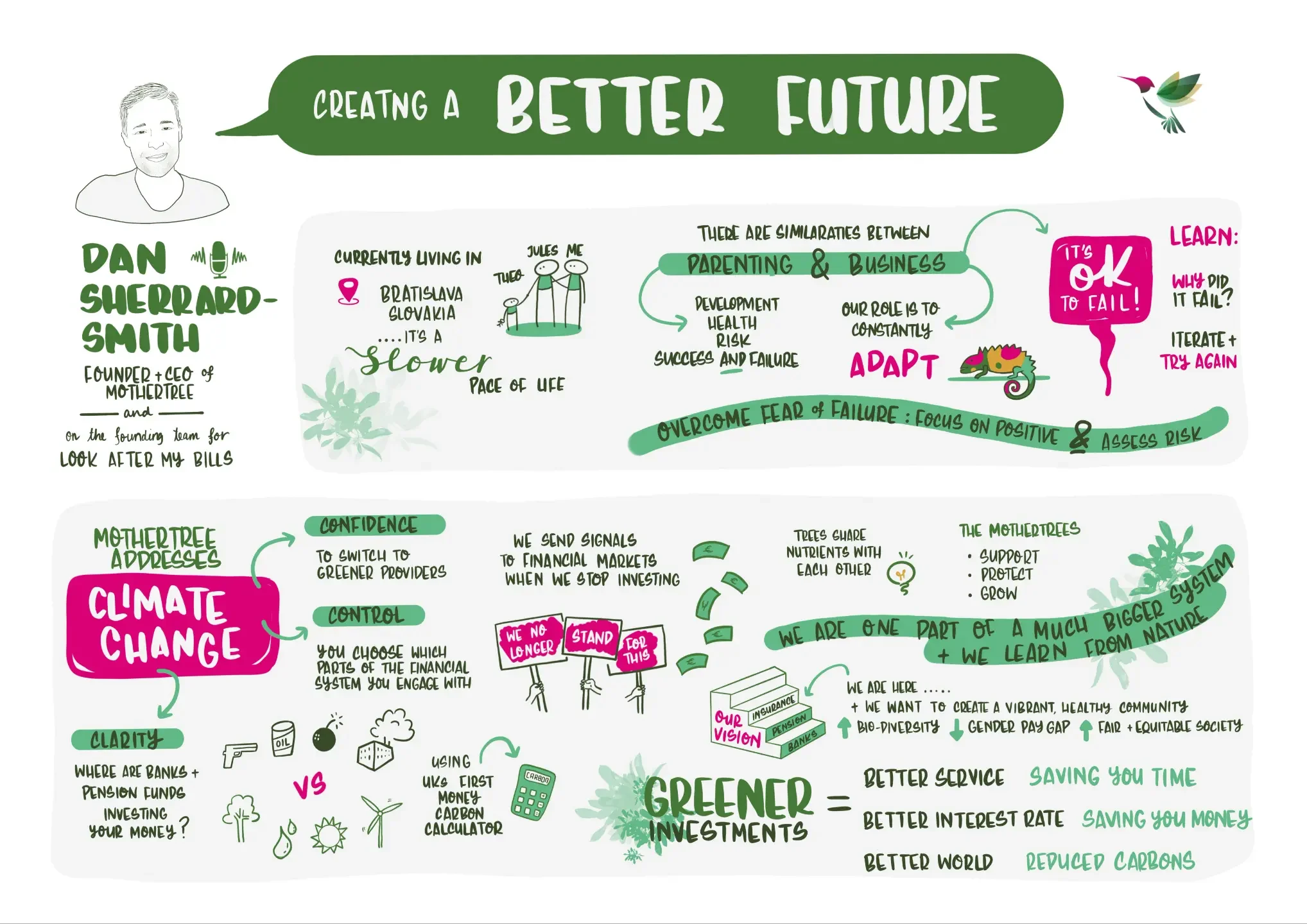
Dan: The name MotherTree comes from a book called Finding the Mother Tree which is written by a scientist called Susan Simard, a Canadian. She discovered that trees in forests and trees of different species, share nutrients with each other.
It completely blew my mind that you had these, what we'd originally thought were competitive species – oak trying to out compete beech to get the most sunlight on its leaves – they're actually co-operating, they're supporting each other. It's absolutely magnificent.
So, oak will pass the nutrients that beech needs to thrive, and beech will pass the nutrients that oak needs to thrive, because they're both able to create different types of nutrients, their differences actually support each other.
The mother trees, in particular, tended to be the biggest trees in the forest who were able to support the most other trees. The seeds of the mother tree that had landed within the mother tree's root range, they were also able to support the most, protect from the sunlight when it was too sunny, give more rain when that tree needed it; it was like they understood the support system.
Jules: Kia ora, welcome to Humans at Work. I'm Jules, your host. Thanks for joining me and our latest guest and thanks for taking some time in your day to indulge your curiosity about other people and their humanness. If your thirst is unquenched after this, check out jericaglobal.com. Let's begin.
Welcome Dan, thank you very much for joining us on your morning and my evening. Can we start by you introducing who you are, where you are and who makes up your family?
Dan: Hi Jules, thanks for the welcome, really great to be here. I'm Dan, I'm the founder and CEO of MotherTree. I live in Bratislava in Slovakia. Who makes up my family – my wife Jules, who is a Slovak which is the short story of why we're here, and my son Theo, we've got a two-year-old son.
Jules: Do you have any pets?
Dan: We don't, we'd love to have a dog when we're a bit older, I'm already fairly old. We both run businesses, so we feel like at some point we'll have a dog but perhaps when we've got a little bit more time.
Jules: You've got a two-year-old, it's kind of like having a dog, if my memory serves me correctly. What's it like being a first-time parent with the terrible twos?
Dan: It's an absolute journey. It's really funny, my wife and I talk about this quite a lot. We used to, very unfairly, judge parents for their screaming toddler and we were like, "We'll never be like, our toddler will never scream," and he's got the loudest scream of anyone, it feels.
It's great, he's an absolute wonder. But there's definitely different stages. The first six weeks I was just this complete wreck, had no idea what to do, wouldn't even put a T shirt on him without fearing I was gonna break him. You watch the nurses in the hospital with him and they're just throwing him about, he's not this fragile thing, he's just a baby it's fine. You get used to it and figure out how to change the nappies and stuff.
I'm quite a nervous Dad whereas my wife's quite a relaxed Mum. I'm the one who tends to be cotton wooling him a bit too much, I suspect, but it's great.
Jules: That's interesting actually, that you're the nervous one, cos you're out there setting up these businesses and doing all this stuff globally and being on screens or whatever. And when it comes to a tiny human, they reduce you to nerves.
Dan: Yeah, it's not the only feeling, luckily, and I'm definitely getting better as he gets older and more robust and he can think for himself a bit more, I guess I'm increasingly less nervous. I think I hadn't ever made the connection between my business and my son in that way. I think I'm more aware of where he is and slightly more shadowing, I think, than my wife.
Jules: Do you find that your businesses are less like your babies since you had your own baby?
Dan: That's an interesting question. It's just so different. I've had businesses that have, Look After My Bills which is this incredible success story and then I've had others – Good Company which didn't work out and we ended up giving quite a lot of the funding back for that one, it was a charity.
I've had successes and failures. I guess parenting is kind of like that, you have ultimately successes like the kid has got through the day – that is where the bar has reached now. We do some things well, I sometimes think, I hope, ultimately by the time he gets to 18 he can think for himself and he's a decent human.
I guess that's similar to companies, I'd never made the connection. Each day it's a series of successes and failures and you hope by end of the day the business is slightly better than it was at the start of the day. And you look back in a number of years and you've achieved something, but I don't really have that perspective day to day, you're just in the grind, you're just trying to make it work.
Jules: Yeah, yeah.
Dan: It is similar, I've never made the connection, that's really interesting.
Jules: Maybe I'm projecting, because I've got two businesses and a third that I run with a business partner. And when I think about how much time I spend thinking about their health and their development and what's gonna work well and what risks they're gonna be facing, it's kind of like parenting. Particularly as kids start to explore the world, which two year olds are starting to do and it only gets worse and more scary for the parents.
Is that, to certain extent, you're thinking ahead, they're going into this situation, what are the things that are gonna happen? What can I do to prepare them for that? What's my role as a parent and how am I adapting?
And I find in my businesses that I'm constantly thinking, oh look, when I'm in this situation with this client or in developing this idea, what's my role gonna be versus other people's roles, whether they're in my team or they're partners or partner organisations.
I've started thinking how alike that is to the thinking that you do once you take that step back from parenting and you think, I've got to be the one to adapt now cos the kids are doing their own thing. They're developing, they're growing; the parents then have to adapt you can't stay still. I'm probably projecting over to you about how I think about it.
Dan: No, I think that's true. I think there is this constant element of adapting and what does the business need at this point? I think it is the same with parenting, the role and responsibilities to look after a six-week-old are very different to a two-year-old and I'm sure will be different to a six-year-old.
It's really similar to the company, I was doing absolutely everything with the exception of the engineering work on day one of MotherTree, and my role has already dramatically changed. We're a year and a half into this journey, not even. I see that, I hadn't ever reflected that way but you're constantly adapting. How can I fit best into this to make this succeed as best that I can?
Jules: I want to delve into MotherTree in a minute, I just wanted to reflect that one of the things that my friends and I talk about every year around the time that our kids have their birthdays, is we tend to say to each other, "We've done okay, they're still alive."
I've got some really close friends that I got to know through antenatal group, and it doesn't matter how often we meet or not meet, when we do meet we're reflecting on how hard it was last year and this year it's just as hard, you hope that it gets easier.
One of the things we congratulate ourselves on is that actually we have done sufficient that they are actually still going, still alive, still doing what they need to. Cos sometimes that you're parenting, that's the most that you can aim for in the exhaustion and the confusion of the everyday.
Dan: I'm glad I'm not alone on that one. (laughs)
Jules: I think having twins teaches you very quickly you're either gonna be a nervous wreck or you're gonna have to let some things go. I can remember when the twins were small babies, having to do some things that were probably looked down upon by other parents or parenting gurus, but as a parent of twins you just have to do.
If you wanna go to the bathroom or do any kind of laundry or whatever, you have to put the babies down. You can't actually feed and change and look after both of them at the same time when you're single handedly.
You come up with hacks, if you like, for how you can keep one baby safe while you're doing something with the other baby or both babies safe while you're doing something for you. I can remember putting the babies in their car seats and wedging them into this very small, little bathroom that we had so that I could watch them while I showered, and not being able to get out of the shower cubicle because I had these two baby capsules in there! I didn't think this one through but at least I was clean. You know?
Dan: Twins, it's not just double, it's exponential, I suspect, versus one. There's the kinda saying, "It takes a village to bring up a child," so maybe it takes a town or a city to bring up twins.
Even with Jules and me, it's so intense with just one of them. I do think there's lot of gurus and stuff but ultimately, it's what works for you and the kids in that situation. Nobody's an expert on your kids except for you, right?
Jules: Absolutely. Or your life, because people have different home situations, they do different kinds of work. I didn't run my own businesses when I first had the kids and I wish I had because I'd have had a lot more freedom, I think. Although looking at your face I think possibly that freedom comes with its challenges as well!
Dan: Is that how I've aged? Is that the number of grey hairs I have?
Jules: I was just thinking about having to go out to work and leave the babies with daycare or whatever, that was back in the day when you had to be in the office most of the time. These days there's a lot more flexibility with managing those things. You just have to do what's right for you, and nobody can see looking in from the outside what you're doing to keep them alive and to keep yourself afloat.
Dan: That's definitely true. We talk a lot about balance cos there's no point running the business if it means sacrificing the marriage or the relationship with Theo. We're really lucky, living in Bratislava, my wife and I, we work from home so there's no commute and at 4.30 every day, we are with Theo and most evenings we're back to work again once he's asleep. It's very, very lucky; I think pre-COVID it would've been difficult to find that balance even with running our own … I guess the advantage of you running your own business is you set your own hours, but I don't think that would've been possible pre-COVID cos the whole culture was you had to be in the office. We're very lucky to be doing what we're doing now post-COVID.
Jules: It's one of the positive shifts that came out of COVID, I think, is this sense of, not necessarily from organisations but from individuals, that there is a different way that the daily grinds can carry on without you needing to commute for an hour and a half through traffic or stay 'til 5 o'clock. You can fit work around life.
I quite often do the same thing as you – finish work when the kids come home from school, spend a few hours with them doing dinner and books and watching TV and all that sort of stuff that you do. And once they've gone to bed, do a couple more hours' worth of work, which you can't do if all of your work is based on in-person interactions in an office, it's just impossible to manage all of that.
It's one of the positives that's come out of the pandemic. I think there are a couple of other ones, although I suspect that's slightly contentious for people. But I certainly found that there's a real lack of desire to go back to pre-COVID ways of working. Even people who love going into the office, they'll only go for a couple of days a week; they get their fix from a couple of days a week and the rest of the time they're happy working from home.
Jules: I wanted to ask about when you moved to Bratislava. Was it before or after you set up MotherTree?
Dan: It was before. The story there is we'd sold the last company, Look After My Bills, to Go Compare. So I was working for Go Compare, COVID hit six months into that sale and I was working from home in London, we lived in Brixton and Jules was pregnant – classic COVID baby, COVID pregnancy or is it lockdown baby, I don't know what they're called.
We didn't need to be in the office. Suddenly people were working from all over and I just asked her, "Where do you wanna give birth?" and she wanted to be near her Mum in Slovakia. We left the UK November 2020 and haven't looked back, it's been great, two and a half years here now. It's absolutely flown by.
Jules: What's different about it to living in Brixton?
Dan: It's a lot quieter, much slower pace of life. When I was in London, I always had this sense, the keeping up with the Joneses, there was always this sense of I guess you'd call it FOMO. Your mates are doing these interesting things, I should be doing them with them. So, the time to think about what MotherTree could be and put the time into making that happen just wasn't on the table in London.
When we got to Bratislava, suddenly there was this free time to really think and start to experiment. We lived like monks for about a year, partly cos of COVID, you couldn't go out. It was perfect for Jules and me cos we just focused on our businesses.
It's a lot slower way of life, it's a lot greener here which I think Slovakia for Europe has the most trees per person, so there's this beautiful forest right on our doorstep. The food tastes a lot better, which I wasn't expecting, even cucumbers and tomatoes and stuff. I don't know what the British do with the food anymore, but it tastes a lot better here. There are trade-offs, I definitely miss my mates and my family, but you find additional friends over here. The main difference is it's just a more relaxed pace of life.
Jules: Did you grow up in London?
Dan: No, I grew up in Swansea in Wales. I'm used to that smaller city, and Swansea's by the sea so there's this pretty laid-back culture there. I am definitely more at home where it's a bit quieter.
Jules: How did you end up in London? Did you go to uni in London, or did you move there for work?
Dan: Yeah, for work. I went to uni in Exeter, and I was working for an energy company called OVO Energy in the UK and they had a Bristol and London office. I was in Bristol commuting to London, and then left OVO to launch Good Company, which was the charity I mentioned. We launched that out of London so moved there probably 2014/2015 something like that.
Jules: You said earlier that Good Company didn't go as well as you hoped it would, so what's the story there?
Dan: We launched Good Company as a social business originally and our aim was to address loneliness, that was the reason for it to exist. We pivoted to a charity which unlocked about half a million pounds in funding. We came up with this idea of volunteers meeting with the elderly in their local area. And the spin, cos that exists, the spin that we put on it was the child of the elderly parent would pick the volunteer, so there'd be this vetting online process through the child of the elderly parent.
It didn't work out, we spent 18 months trying to prove that idea, it didn't get anywhere near the impact we were looking for and we ended up giving 95% of that money back and sharing the learnings with some loneliness charities.
For me, the big reflections were, we came up with the idea in a meeting room, and we were rigid on that idea for a long time. And now I'd do it the exact reverse way.
For me, all the ideas are simply just tests for who's your target audience and how can you serve them the best. When we actually did that towards the end of the charity, we came up with some ideas that actually would've had more impact. Still not the impact we were looking for, for us it was about being nationwide whereas the impact we were having were, at best, city level and probably more like borough level.
The really big lesson through all of it was had this real fear of failure back then, it felt like I was working with the handbrake on. Which is Arsène Wenger's saying, "Playing with the handbrake on." I was so scared of failure; I was so worried that this thing would fail. And then it did, and I remember very clearly crying on the kitchen floor and my wife picking me up.
After that it was this release, it was this realisation that the only thing that's bruised here is my ego, that's it. That was probably the most formative 18 months, the best education I could've got was those 18 months in terms of what it took to launch a business. But crucially understanding that it is okay to fail if you fail for the right reasons. If your morals and values are in the right place, it is absolutely fine to test something out and fail.
The challenge became how quickly can you prove that this idea is gonna succeed or fail. Okay, it fails, why did it fail, iterate on that, let's try the next idea. That was one of the biggest lessons by far. It released this huge amount of just trying stuff out. I wrote two novels, I launched a couple of side businesses, and ended up on the founding team of Look After My Bills which was this big success story. A lot of the things I brought to that company were built on the things I learnt at Good Company.
Jules: That's really interesting, there's two parts to that. What I heard was one, you felt that you had a handbrake on you, and potentially that is that fear of failure but also not going full tilt when you've got an instinct about something, or you're not going wide enough, not being bold enough.
The other one, I think that resonates with a lot of people, that idea that you can't do something if you think there's half a chance you're gonna fail at it, but actually that is the biggest box that you find yourself in.
Because what is failure? You have a dream, you try something, you don't manage to do what you did but you learn something, and you move on and you do something even better. Is that failure or is that success?
I think back to that kid's book that has Chicken Licken, about the sky falling in, and I think there's that concept of you're thinking all the time about what's the worst thing that's gonna happen if I try this, as opposed to thinking about the best thing that will happen. It can paralyse you from doing what you can.
Dan: One hundred percent. One hundred percent. I think the fear of what... the focusing on what's bad, it's important from a risk perspective, but if it becomes the thing, that's the thing you're focusing on. Yeah, I think there's this tendency that if we really focus on something, that's generally the thing we're gonna end up with, that manifestation piece.
The more I witness it, the more I think that is absolutely true. So this fear of failure thing for me was I was so scared of what would happen if this didn't work out, well, that's what we got, that's what we ended up with.
You have to focus on what could be bad from a risk perspective, but actually it's about holding that vision of the future and visualising it and that's the thing you manifest. There's a definite balance but it's really trying to hold what the future could be in a really positive way, as opposed to being scared of that failure.
Jules: When you went to start MotherTree, you had all this time, you're surrounded by all these forests, was that what gave you the idea or do you think it was something that was built up over many, many years like a little kernel that just grew slowly as you went through different companies, different ideas?
Dan: The name MotherTree comes from a book called Finding the Mother Tree which is written by a scientist called Susan Simard, a Canadian. She discovered that trees in forests and trees of different species, share nutrients with each other. It completely blew my mind that you had these, what we'd originally thought were competitive species – oak trying to out compete beech to get the most sunlight on its leaves – they're actually cooperating, they're supporting each other.
It's absolutely magnificent. So, oak will pass the nutrients that beech needs to thrive, and beech will pass the nutrients that oak needs to thrive because they're both able to create different types of nutrients, their differences actually support each other.
The mother trees, in particular, tended to be the biggest trees in the forest who were able to support the most other trees. The seeds of the mother tree that had landed within the mother tree's root range, they were also able to support the most, protect from the sunlight when it was too sunny, give more rain when that tree needed it; it was like they understood the support system.
And for me, that's fundamental to the values of MotherTree the business, mymothertree.com. Which is we want to support others to create a vibrant, healthy community. Be it reducing carbon, be it getting money towards reducing the gender pay gap or promoting biodiversity. We want to be that kind of sharer.
Also acknowledging we are one part of a much bigger system, but that if enough people are building that and doing good, then we will create a really, quite amazing world I think. I've riffed a bit on it, but the MotherTree is the connector, if you will.
Jules: I love that, and I think it's a really good example of when you actually stop and look at what nature does, it's incredibly complex but very collaborative. Which is what we're all aiming to do, I think, is not be too simple because simple won't necessarily keep us all satisfied and we live complex lives, but to do them in ways where we're not taking from others, we're actually sharing resources, sharing ideas and building that sense of community.
If you look in nature, you see that all over the place. I think what's interesting to me about the climate action movement, is that there are starting to be more positive examples of how nature does that and how humans can interact with that system in a way that is more regenerative and long term, to give people those ideas.
The mother tree gave you the idea for an amazing company and a concept that's growing. If that happens a thousand times, we have the sprouting of all of these different companies and different concepts that are growing these new systems. And we've learnt them from nature, which is so cool.
Dan: It's really cool. I'm a bit of a geek for this stuff. The blades of a wind turbine are shaped on the fin of a whale. It's those kinds of things where we realise nature already has the answers. I think is it called biomimicry? There's a technical word for it but basically by observing nature we realise a lot of our problems they're already solved because they're already millions of years old.
Jules: They've been solved for many years.
Dan: Trees are 330,000,000 years old, we're 45,000 years old as a species – they have been on this planet a lot longer than us and they understand it a lot more than us. That's been there since I was 12, since I found out about climate change in a geography lesson; I just never knew what to do about it.
Having that time post Look After My Bills helped me think, what can I do? What can my part be? My wife actually came up with the idea of something called The Climate Challenge, which is, about a year and a half ago, which is groups of about eight people who took on 30 challenges over 30 days. We went vegan for the day, we got rid of single use plastic, we looked at our carbon footprint. We're just doing tasks that, what can individuals influence. For me it was great cos I got to observe how people reacted to different tasks, and then asked them, "Did you do it? Did you not do it? If you didn't do it, why didn't you do it? How did it feel? When you got the result was it what you were expecting?" all of those things.
That was the start of MotherTree, cos a few tasks within that were really quite shocking, we got consistent feedback. When people realised where their banks were investing and where pensions were invested, those two tasks really woke people up.
Cos you realise, my bank's just put £20 billion into oil and gas; well, I don't support that. Or my bank's put money into cluster bombs that have been traced to killing people; I'm definitely not in for that.
I looked at my pension, first time I went to The Climate Challenge, first one we did, I looked at my own pension, 2% in BP and Shell, 1% in tobacco, 1% in weapons. If I had spare money to invest, which I don't right now, but if I did, I would never put money into those areas, and every month some of my hard-earned cash had been going there.
It just felt this absolute insanity that we had people who were already vegan, already quit flying, already doing these massive actions, protesting, part of Extinction Rebellion, really putting their lives on the line. And there was such little awareness of this massive money machine that was continuing to fund the biggest problem we've ever had.
That's where MotherTree focused. We built the UK's first and possibly world's first and only money carbon calculator, to give people that transparency of exactly what their bank and their pension are doing from a carbon perspective.
We've expanded that now so we now run a service which, on an individual level, actually looks at exactly where your money is, the impacts of that money. But also where it could be in terms of, not only just carbon but also biodiversity, reducing the gender pay gap, making sure there's a fair living wage, reducing that racist, how to put it, basically making it a more fair and mobile society is the positive way to make that. Making sure our money's going to places that we want, for our society to actually be, cos we can get there if we make sure the money's going to those places.
Jules: It's really fascinating. I think one of the things I've been reflecting on when I was looking at what MotherTree does. And obviously I'm based in New Zealand, it's more difficult to find out anything about the banks and the pension funds and what have you here … we need a MotherTree New Zealand thank you very much, Dan, next job for you.
One of the things I've been reflecting on is that engagement with those big systems like the pension system or the financial system, is something that individuals have lost, if we ever had, lost that sense of control over.
We rely on algorithms and individuals in banks to give us mortgages when we want to buy a house; we don't have any control over the fees that they charge for credit cards, for example. They loan us money on credit cards, and we're expected to feel grateful for being charged huge amounts of money on that, but actually what sits behind it is a massive financial system.
I think what people are finding is that they don't really feel comfortable with that lack of control. And it's a dominating relationship. It's a little bit like, I describe the relationship that humans have with the planet as a relationship of dominance rather than a relationship of partnership.
It's very similar in terms of the money system. So, it used to be, I can remember when I knew the bank manager of the local branch, they knew me – this is when I lived in the UK in a tiny little town in coastal Essex – and it was much more of a relationship.
Whereas now, I might know a couple of people in the organisations that provide financial services for my companies, but I wouldn't say that I get the sense that they're with me on my journey. They are just the entry point to a massive system that is very, very difficult for people to get their heads around unless you're in that system, and very difficult to find any information out.
You feel like you're on the periphery of control, and I think what MotherTree does is it gives people that sense of, you don't need to know all of this stuff to take back a little bit of that control. You're not changing the financial system, you're just choosing which part of it to engage with, and that little choice gives you that sense of control.
That's one of my reflections in terms of people's difficulties in getting engaged in the massive system changes that need to happen for climate action, is that they're closed systems and people are on the outside. They know that, but they don't know how to get in there, they don't know how to change, they don't know how to get some of that choice back.
Dan: They're almost deliberately closed systems. The banks aren't forthcoming, certainly the British banks that we've looked at aren't forthcoming in terms of where they're investing. They don't want that scrutiny and yet, as an individual, one of our biggest powers is making sure at least our money isn't going to places that are opaque in where they're investing. And when we peel back that layer, are investing heavily in fossil fuel, just as one example.
I could not agree more, and I don't know about the New Zealand system, but it's easier to switch than ever before in the UK. And what we're realising is things like interest rates are actually better in greener banks. You make more money by going to the banks that are doing better for the world.
Suddenly it's like this form of activism, but you also get all the upside from it as well. I just think it's this magnificent area and we just need more awareness of it. More people waking up and realising actually I don't have to stick with the bank that I was with at 18 cos they gave me a free rail card, and the service is pretty crappy but I'm gonna stick it out cos that's what I know. You can get better service, better interest rate and create the kind of world you wanna live in, you wanna retire into.
Jules: I completely agree. I think some of it, and I suspect your companies are focused on this, people are really time poor, and they also feel like maybe they don't know enough.
I don't know how global financial institutions work. Do I ever want to? No. I couldn't think of anything more boring, that's my personality. Do I want to know that whatever money I have is being used for ethical purposes? Absolutely.
How am I gonna find that information out in a way that's easy for me to understand, and doesn't take me months and months of delving and asking questions and all of that sort of stuff. Services that cut through that, I think are amazing for people who want to do something, they just don't know where to start or they don't have the time, they're really busy, they don't think it's gonna make any impact anyway or whatever.
It does make an impact, and your stats that you're regularly publicising are really a visible explanation around actually "money talks", and you might have £10.00 or $10.00 in the bank but if a hundred people use their $10.00 in a different kind of way, then it starts to get noticed, it starts to have an impact.
Dan: That's exactly it. There's some really interesting themes to pick up on there. Firstly, the money absolutely does have an impact. If we think about the language that CEOs understand, they look at the number of accounts that are open with that bank. That's one of their stats that tells them if they have people depositing money then they can lend money to other practices, and one the things some banks do is they lend money to fossil fuel. If the CEO sees that number of accounts falling, they are going to take action, they're gonna wanna understand why is that happening. That is just a great signal to send to the market even if you have £1.00 in an account, make sure that that account is in a green bank.
The second thing is time, we are time poor, probably more than we've ever been. We have more information in our pocket in our phone than we've ever had access to before, it's easier to get than ever before. The flip side of that is we have less time because we're trying to figure out where to focus our time given all that information. Everything we do at MotherTree is about how can we give people genuine clarity, confidence, and control, without them having to spend more than 10-15 minutes to get across this, probably maximum amount of time.
We're really iterating and the people we work with, our clients, everything we do is how can we save them time, save them money and save them carbon. That's the game we're in. I think you summed it up really well, we're time poor and it's very hard to get that clarity but not impossible. Then it's about how do we send the right signals to the market to say we no longer stand for this.
Jules: What are the next ideas you've got? You strike me as a bit of an ideas factory – as you're staring at the forests or running after Theo, there's different things growing. What are some of the things that you think are ripe for more action or more impact?
Dan: The thing we're building, I'll start with the mission. I'd love to get to a point where, with a couple of minutes of input from a customer, we can give them real clarity across their whole lifestyle, what's their impact. Not just carbon cos carbon's just one part of the equation but also things like biodiversity and reducing gender pay gap etc. Not only give them that clarity but then work with them to switch to providers that are actually better for the environment, match their values and save them money and save them time.
What we're realising is we're unlocking that in a series of areas already – banking, pensions, insurance, energy, home improvement. Those areas are already there in terms of savings both in time, money, and carbon. That's what we're building, that's what we're iterating on.
Ultimately, that's a service I'd love someone to come in and just be like, "Here are the actions you need to take, we're gonna do those actions for you and, by the way, your life's gonna be way better for it and you're gonna be doing better for the planet". So we're not gonna retire into a place that's on fire, we're gonna retire into a place we can enjoy and thrive in. That's the goal.
I think that's the vision, what does that mean in terms of the staircase to get there? All we're doing is building the next stair each time. We're really clear on banks, we're really clear on pensions. The next one for me is insurance.
Insurance is fascinating because a coal mine could have all the funding it needs to get going but if it doesn't get the insurance, it's not gonna happen. The dynamic's slightly different in insurance but we've already started looking at who are the insurers who are actively insuring bad practices. I use bad practices as fossil fuels.
It doesn't matter about the funding, those projects aren't gonna happen. And suddenly we build up a portfolio of you've got your money going to the right places, you got your insurance going to the right places, and we're putting pressure on fossil fuel in a significant way to then flip now into a renewable energy future. For me, insurance is the next staircase to make that happen.
I realise there is bad connection. If you missed anything, let me know.
Jules: I think we're okay. We missed a little bit, but you covered off with something else that you said. I think we're okay.
I was just reflecting, I think what you're building is an alternative system. And I'm interested in that because all of the people that I'm listening to, I count that as research, it's how I learn, I learn from other people. Where everything's going is that the systems that we live and work within fundamentally will not deliver the future that we need them to deliver.
So we have to create alternative shadow systems that people start to move towards, and then we can dismantle the systems that we rely on. It's really, really difficult for people, in their everyday lives, to think about breaking a system that they rely on if there's not an alternative. You can see it when you think about democracies breaking down, the alternative is not necessarily better than the democracy.
People think that way about a lot of things – the energy system, the education system, the health system. People get paralysed because they think, we can't just stop this system when we have nothing else. But if you can create shadow systems that are better and that are built on different foundations, and you can encourage people to move over to those, then you can dismantle and stop the systems that we've come to rely on that are so negative and damaging, because you've got an alternative that keeps life going on.
It's a little bit the same around electric cars and EVs. I know there's a huge debate, it gets very, very technical about cobalt mining and what do you do with solar panels when they've come to the end of their life? We haven't solved all of those problems.
But the point of those systems is that they are an alternative. You can move from coal fired power stations to solar energy, and then you can dismantle the coal fire ones. You haven't solved all the problems because you've still got other issues with what do you do with recycling or whatever, but if you don't have any of that then people will stick with what they have because they have to carry on with their daily lives.
It's one of those things I think where perfection is the enemy of making progress. And it sounds to me like picking off various systems over time and saying, we can do this in a better way, we can grow the ones that are doing it in a better way, and we can divert customers to those ones. Means that once you've got enough of that momentum, those other systems will fail anyway, but you've carried on, you've got sustainable systems in place already.
Dan: I think that's absolutely right. Let's just take oil and gas. There is this fear of what happens if we shut down oil and gas in the UK? Does that mean prices spike? Does it mean I can still light and heat my home? The truth is, yes, we have the systems in place to handle that already. Wind and solar, we have the technology and the infrastructure to make that happen. Battery technology is expensive, cos wind and solar is intermittent, but then nuclear plays an important role and despite the issues there's been around nuclear, it is a part of the energy transition.
The systems are already there, and partly it's painting a vision, a future of actually our lives are gonna be better for moving to these systems. We'll have cleaner air, there'll be less issues around air pollution for people. We'll have, in theory and this should hold up, cheaper energy cos it's already cheaper to produce wind and solar in the UK. The batteries aren't but that technology's getting there. So it will be cheaper, and, in many ways, you can live a guilt free life in terms of the electricity.
We're constantly turning off lights. If it's coming from a green source, that becomes slightly less important. Yes, turn them off so that the insects don't get confused at night, but you can party and enjoy it because it's coming from a source that's clean. There are these upsides, we can genuinely live the same or even better standard of life by making the transition.
Partly it's the story that we're saying is, often what I hear from the oil and gas supporters is, "We'll be completely screwed, the system relies on it." It does, but not entirely and it doesn't have to, and we have the systems in place to already replace it. From a British perspective, we often hear, "We have to import a lot of things." We could be completely self-sustained because we're British energy.
Jules: There's so many arguments as to why things won't work, and most of them you stick a pin in them and the balloon deflates immediately, particularly if you ask the right questions or you take the right stance.
I'm all for guilt free energy. We have solar panels and a battery that cost a lot of money, and an electric car which is charged using the solar energy. When I take a journey to go and do something in the car when it's raining or whatever, I do feel that little glow of, I made this energy in a green way. I can charge the car back up next time there's a sunny day and it's not costing me a thing. I can go days and days and days, even in winter, without needing to take from the grid, so you do get that little green glow, if you like.
I think the challenge for people is that it takes an investment to get to that. And it's the same for these big systems, it takes a whole lot of money. Some Governments are saying, "That's where we should be spending our money," and they're going for it because they're thinking generationally; they're not thinking of the next election.
We take a seven-generation principle approach in the companies that I run, and personally in our family. So we're always thinking about if we're the second generation, cos our parents are still alive, then what do we wanna put in place for six generations from now, and how are we thinking about that in what we're doing?
Governments who are driven by election cycles are thinking in two or three years, what can I do to get me back into power? That's not to say that they're not trying to do stuff in terms of climate action, but it's the wrong timeframe. Because by the time you've spent a whole lot of money in investment in some of these different systems, the election's come and gone and you're either in power or you're not. And if you're not in power then, guess what, that funding often gets pulled on to different things.
That's one of those systems where, we built those systems, we built election cycles; we can change election cycles. We built the foundations by which investments are decided on and measured; we can change them. It's a little bit like that question of lack of control in relation to money. When our money is in a bank, we think of it as ours but if the bank decides to charge us for something, we think that they're entitled to do that without questioning it.
It's a little bit the same when it comes to big investment in those big systems. We think it's okay because we built them like that, and we've allowed ourselves to be taken out of that dialogue.
Dan: That's exactly it. Let's take pensions, 50% of all of the money in the world is in pensions – everything in property, in stocks and shares. If we grouped up all the money in the world, 50% in pensions. Yet we have such little awareness of what our own pension is doing. Even just pulling that lever, even just making sure our pensions in the right place suddenly has quite a big ripple effect in terms of how that money's invested.
These systems are complex, they've been built up over many generations by people way, way more intelligent than me. We talk about markets and things and there's these big ideas but ultimately, from individual perspective, if we just made sure our own money, our own actions were in line with, let's say a 1.5 degree world, and if enough of us did that, that is a market.
It's really simple in many ways, as long as what I do is congruent with my values and how I want the world to be, and enough people get onboard then we've created a market. We can change that system.
Jules: One last question, because we are almost out of time. You are such a positive person, every time I see you, you're smiling, you're enthusiastic. How do you keep so cheerful and optimistic?
Dan: It's definitely a journey. If you ask my wife she'd say it's not always 10 out of 10 with me and she'd be right. I really enjoy making positive stuff happen, I get a real sense when the purpose and the mission is clear, absolutely, this is what I enjoy. I enjoy problem solving, I enjoy working with other people to make good things happen.
I've been on the other side of that fence when I haven't got any purpose when I'm working on something that I just don't see as having a positive impact. I'm pretty passive, I can be quite down at times. For me, often it comes down to purpose, and it could not be clear enough right now. That's about positive relationship with my wife and my son, and the work that I do at MotherTree making sure we fight to live in a healthier thriving planet.
Jules: Thank you, that's nice, it's lovely.
Dan: Thank you. I've never really examined why I'm so positive. It seems really weird to look so internal. I just keep going on that conveyor belt.
Jules: I do think purpose matters so much. I know when we talked, a couple of months ago maybe now, and you were asking me about why I set Humans at Work up, what was the thing that drove me? That sense of, there's a value in this that I feel so strongly about that it doesn't matter whether it is successful in anybody else's eyes. If I do it and I do it to the best of my ability, I'll feel satisfied because of that sense of purpose. It's such an internal drive and it takes you away from necessarily being so concerned about other people's views on what you're doing or how you're doing it which gives you a sense of freedom. You step outside that box that people try and put you in – the world's your oyster.
I never know why we use that saying because why would you want to be in an oyster, but anyway. Now I'm gonna have to look that up and work out where on earth that has come from. I suppose it's come from the idea that the pearl is created in an oyster but it's a really weird saying now that I've thought about it.
Dan: I've never really enjoyed oysters.
Jules: I can't eat seafood and I can't eat shellfish because I'm allergic, so I'd never try to eat an oyster anyway.
This idea that you let yourself be put into limited spheres because of other people's views on what you should and shouldn't be doing. If you have that real sense of internal purpose, you'd smash through those limitations, you just ignore them or you step over them and you just keep going anyway. And that fills you with confidence and an inner fire that gets you up every day.
Dan: I love the way you've put that. I think that's so right and often I'm realising the box that they've put me in is a reflection on them more than it's a reflection on me.
Jules: Completely. But we listen quite often more to other people than we do to ourselves. Maybe it's an age thing. I don't think you necessarily get wiser as you get older, but I think you do learn through trial and error and hard knocks, that you do need to be true to yourself. And value what your inner voice is telling you is the right thing, to value your gut instinct in relation to decisions or situations.
I think that comes with the confidence and the scars of trying different things. That can come at any age but, certainly, I think it comes from those experiences. And once you learn to value yourself as much as you value other people's opinions, then you start to see that you can be whatever you want to be.
That sounds really trite, but I think it's really true. You don't have to be what society tells you you should be, you can be whatever you want to be. So long as that is not something that's gonna do damage to other people. Let's be clear, you can't be a serial killer just cos you want to be. But you can be whatever you want to be and do whatever you want to do if that's what drives you.
Dan: I think that's it. I think we have a fear in society of failure, to come back to that point, which means lots of people, me included in my twenties, play it safe. If we commit, if we take risks with our values in the right place, as you said, we're not harming other people, and we're willing to go through that painful experience. Often, it's the fear of failure, not the failure itself that hurts, it's the thought of it, not the actual action. When we actually go through it, certainly for me, I learnt something about myself. And you do that enough times you build up those scars, that experience and I'll continue to get those absolutely. It's part of the fun of it.
I certainly found I'm not someone who can work in a corporate job in a big company environment because I found I was hiding. Whereas for MotherTree, every single day counts. Every single day there's something we're gonna find out that's new, a new challenge or a new problem to solve. That's exciting, that's where I wanna be. It's this idea of commit, take the risk, be fully in, just experience it for six months or whatever it is.
Let's accept that's not the permanent thing, that's not what we're boxed in for, we can always then change, and we'll learn through that experience which I only realised in my late twenties that I started to do that. That was really game changing for me – commit, take the risk, really commit to it for a period of time and experience it – but also accept you are not defined by what happens in those six months or whatever timespan you give it.
Jules: Hey listen, I know we have been talking for over an hour and I'm pretty sure we could talk for many more hours. But you've got businesses to run so I just wanted to say thank you so much. I know it's been a few months in the making this podcast, and we've had a few internet glitches but that's just the way of the world, that's what working life is like for humans like us.
I wanted to say thank you so much. Really, really interesting to reflect on what you have done and what's driving you, and what MotherTree is doing. If you do want to set up a MotherTree for Australia/New Zealand, I would definitely be one of your first customers.
Dan: Jules, thank you so much for having me, it's been an absolute joy, I really appreciate being on the podcast. Would love to set up MotherTree for Australia/New Zealand, we're probably a year or two away from that yet but I'll definitely let you know when we're down under, we'd love to make that happen.
Thank you so, so much. You ask such thought-provoking questions, it's really fascinating the parallels you make between family and work, I hadn't really thought about that before. Also, internal motivation I hadn't really reflected on. So I really appreciate the really thoughtful questions and time you put into this, thank you so much.
Jules: You're welcome.
Jules: Thank you so much for listening and thanks, as always, to the generosity of our delightful guests. The stories of how others have faced up to their challenges can help give all of us courage to keep going with our own. For more great episodes, blogs, learning packages, go to the JERICA Global website.
Humans at Work Podcast