
Strategic Thinking and Sustainable Value Creation — with Jeroen Kraaijenbrink
Humans at Work Podcast | Episode 13
Host: Jules Harrison-Annear | Guest: Jeroen Kraaijenbrink
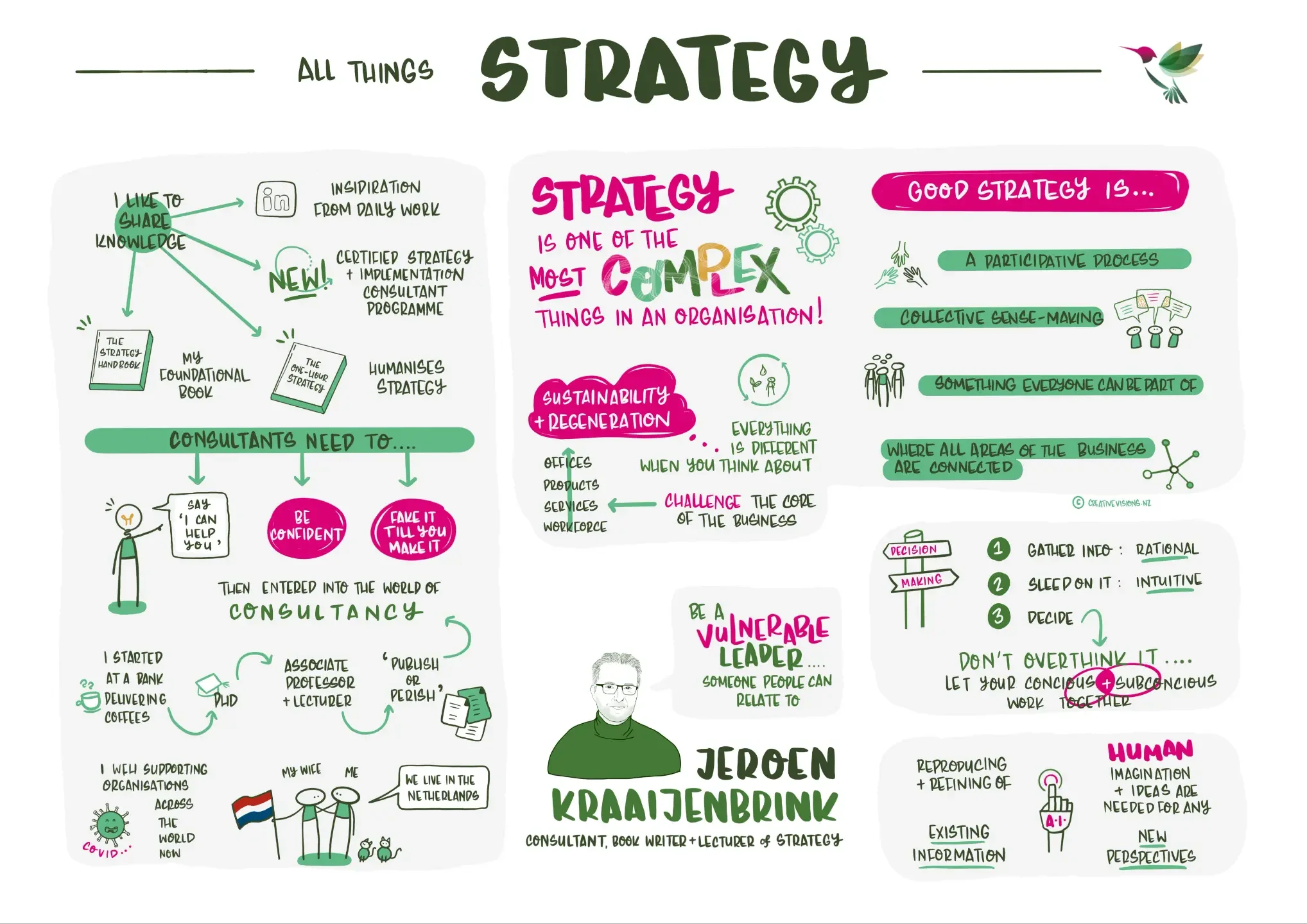
Jeroen: For me, less and less discipline perhaps. I first had to unlearn the scientific mode of writing because I was trained in that, writing journal articles and writing a PhD thesis and so on and there is a certain structure and style that's not yours. For me it's really finding your own style or your own way of thinking, writing and so on but also feeling comfortable in doing that way.
In that sense, every new book has been easier than the ones before. You say "many, many books" – it's also not that many, it's a handful, basically, with some variations. The main work still is The Strategy Handbook (The Strategy Handbook: The Secret Sauce to Daily Business Success) which is the longest book I've written, that required a lot of discipline.
Jules: Kia ora, welcome to Humans at Work. I'm Jules, your host. Thanks for joining me and our latest guest and thanks for taking some time in your day to indulge your curiosity about other people and their humanness. If your thirst is unquenched after this, check out jericaglobal.com. Let's begin.
Hello. Today we're talking to Jeroen. Jeroen, I'm gonna get you to introduce yourself and tell us exactly how you pronounce your name, tell us where you're sitting today and who makes up your family.
Jeroen: Thank you, Jules, that's a lot of questions. How do you pronounce my name? That's probably the question I get most, it's Jeroen Kraaijenbrink so you did very well, and we haven't even practiced. I'm sitting here at my home office. So this is basically the place, also the background that most people see when they talk to me because I do a lot of work online, remotely via Zoom, as we do now. My family is my wife and our two cats, so we live here together with two cats who actually have their second birthday today so they're still quite young and active.
Jules: Are you based in the Netherlands?
Jeroen: Yes, in a small town in the Netherlands but the Netherlands is small anyway.
Jules: Have you always lived in the Netherlands?
Jeroen: No, not always. Definitely most of my life, but we've lived five years in Germany, not that far from the Netherlands but 30-40 kilometres from the border, just to experience how that part of the border was.
Jules: Do you travel a lot, obviously pre-COVID?
Jeroen: Pre-COVID, yes. Post COVID, no. Not for COVID reasons but more for time reasons and climate reasons, so I try to limit my travelling. I'm working a lot internationally but virtually everything is remotely. I've travelled a lot and now if you look at it from a carbon perspective too much, especially for work. But I think I'm now at a phase where I don't have to do and I'd rather work from here.
Jules: Do you find since the pandemic that people are just a whole lot more able to make virtual work? They're more willing to make virtual relationships and virtual connections work?
Jeroen: Oh, yes. A complete shift and maybe also because before COVID I was already preparing a bit for that, doing some more work remotely. Since COVID, I think the openness to do things, when you're even in the same country, in a tiny country as the Netherlands, even if it's a one-hour drive, it's much more accepted now to do things via Teams or Zoom and so on. For me, it's really opened up my world, basically, business wise because before COVID I mainly worked with companies here in the Netherlands and now I mainly work with companies everywhere else.
Jules: It's one of the benefits, isn't it, of something like a pandemic that forces that change on people, whether they liked it or not. Once you're in it, sometimes you find that actually the change wasn't that bad, it was something that you feared, or you didn't think would work but actually once you're in it you find that it was all gonna be okay.
Jeroen: Yeah, except for the health part, of course, but I think there were many more advantages. We're packing our times again with too many activities, while during COVID it was kind of okay and accepted to stay home and do nothing, because there was nothing. I think that part was pretty precious during those two years. We're animals of habit so we move back to what we did before, and start travelling again and visiting everyone and filling our calendars with all kind of appointments.
Jules: When you're working with the organisations in different countries, do you find that you have to adjust your approach? Or do you find that as much as your work in the Netherlands was characterised by certain problems, certain challenges, certain techniques that would work, they're much the same in different countries?
Jeroen: I expected it should be different because there are so many cultural differences and so on and so forth but to be honest, I do exactly the same. Maybe the diversity of countries I've worked with and cultures I've worked with, is not that big enough to really test that. I've worked with people in Europe, definitely different countries, but also with the US, with Saudi Arabia, with China; I do the same with everyone.
I think we're much more a humankind, so one breed of animals. Of course, has differences but in terms of how you would like to interact, having someone to pay attention, listen, people want to speak out, they want to contribute, I think that's very universal. The way I work is, I might adjust a little bit maybe, but hardly anything.
Jules: Let's go back to your career and your early career. What was your first ever job?
Jeroen: I don't think that fits into the box of career. I think I was 15, the summer holiday job, I think the very first job was at a bank where I had to bring the coffee. That was still a time where they had someone bringing them the coffee rather than the machine and all other small activities like making sure all paper was collected. I actually liked it a lot because I had a lot of freedom there and it was a unique role.
In that sense now, talking about it, it probably was the start of my career because independence and doing something that the rest is not doing, is probably still something that I value very much. It was 30 years ago, to be clear.
Jules: Presumably making lots of connections with people as you went around delivering coffee and seeing different parts of the bank.
Jeroen: Yeah, and also being part of it but not really part of it. That's also in my role as a consultant, as a mentor, as a trainer, you are with the group, with the team and with the company but not really part of them. And this in between situation is, I think, something I like to be at.
Jules: That's very similar to what I prefer as well, that I've learnt through a time and experience and battle scars, is that I absolutely like being involved and helping organisations and helping teams but I don't like to feel like I belong or I'm stuck inside that. I like to be able to move across different friendship groups or different organisations, different teams, different kinds of work – that's my sweet spot. I belong to myself and something that I am driving my own business but if I feel like I've become too stuck into an existing organism or organisation, I lose my spark.
Jeroen: We have that very much in common.
Jules: From the bank at 15, presumably, you went onto further education?
Jeroen: Yes. I went to university or at that time I was still at high school. University, then did my PhD and then my first career was basically in an academia. I did my PhD, became an assistant professor, associate professor and so on so that's really the first half of my career was at university.
Jules: What did you like most about being at university?
Jeroen: Again, I think it's the independence. Of course, you're part of a group, you're working at a department but in terms of research, you're still quite independent. There's lots of rules on how you should do your research and how you should publish; that's the part I didn't like and also there were some other reasons I left in the end. I think the autonomy, the independence, also especially the freedom to explore, to take a deep dive to learn more because that's still something I still do every day but in a different way, in a different mode because I'm not at the university.
Jules: Traditionally in universities, you're incentivised to look for innovation, to explore things that others haven't explored or take things in a different direction. Because obviously that brings more kudos back to the university if you can publish research or deliver lecture programmes on things that nobody else does or that are brand new. Was that something that characterised your time?
Jeroen: I wish it had. It was in the beginning, and I think especially when you're doing your PhD, at least in my case, I had all the room to explore what I wanted. Still high ambitions to do it differently, to change the world, to come up with the next big idea or the big theory, but my experience has been quite differently. It's a pretty conservative industry, risk adverse. So, the best thing to do for a career is to stick to the rules, find ways to create publishable and citable articles, and that's not necessarily high-risk innovation, new developments. That's also one of the parts that I did not like as much as I thought in the beginning.
Jules: You made the decision to leave academia, where did you go? What did you do?
Jeroen: I have never fully left, so I also don't wanna give a very negative picture about the university because I still am involved with the university ever since, especially for mentoring students with their Master assignments. I've been teaching a lot until two years ago, especially in MBA programmes, executive MBA programmes. I still like a lot of the stuff happening at the university but not the strict system where it's like publish or perish, the only key performance indicator is number of cited articles. That's the part I couldn't avoid, it didn't work for me.
I had the luxury of doing this in a fade in/fade out model, where I could reduce my contract at the university and at the same time started as an independent consultant. With what I knew from the university and what I thought of all the models, tools and strategy that I taught, I started to try to find my first customer and say, "I can help you. I'm a consultant," so that's what I did. It worked quite well and that's what I still do part of the time.
Jules: I'm interested in your experience of starting as a consultant. It's such a common story, isn't it, when you know that you can do something different, and you have this sense of your own value that you can help clients. But getting that first client is often something when I'm talking to people who are considering going into consulting, that is the thing that holds the biggest fear. Once they've got the client, they know they'll be able to deliver. But it's that selling, finding the first client and being able to really sell the value proposition, that causes the most fear.
Jeroen: I dunno whether there was fear in my case. I think the approach is fake it until you make it and behave as if you're doing this for years already. I think that's what I consciously or unconsciously did is, okay, I am experienced, I know stuff about strategy, I know this better than you. Maybe just from a research theory teaching perspective, I've not done this, but I still think I know better than you so I'm a consultant, I can help you. I think that has worked out reasonably well.
Of course, you have to be a bit lucky with the first client, that someone actually buys that you're saying this and for a long time I felt that my academic background was a disadvantage. That's the difference between countries, by the way, where in some countries having a PhD is good; in other countries and the Netherlands is one of them, having a PhD is also like a stamp, you're theoretical, non-practical. That's something I felt for quite a while and probably has also led to this being very important for me to emphasise the practicality of my approaches because I know where I come from in my first career. I don't know whether that's the real answer to your question, but anyway.
Jules: I'm a member of the fake it till you make it school myself, so that resonates a lot. I find it interesting, your reflection on having that kind of research and theoretical background and whether that's a strength or a weakness.
Because, for me personally, one of the areas that I do a lot of consulting work is change management, particularly in relation to big strategic shifts and then the people aspect of change management. I have developed or honed what I think are my skills in that area by practical application – trial and error, being in the thick of things, doing them, seeing what worked and what didn't work and then adjusting. Because of the personality that I am and the life I've led, I haven't had the time or the inclination to get a whole lot of theoretical certifications.
In change management, particularly in the last few years, not so much now perhaps, there was a whole lot of emphasis on, "Have you got this certification? Are you trained in X?" I faced quite a lot of challenge in whether or not I was any good at change management or change leadership because I didn't have the certification. Maybe that's the culture that I have been working in, that has traditionally valued academic or certificate-based learning, over practical lived experience.
Jeroen: I recognise that quite a lot. I think it's not so much the academic background that people want but some certification or at least prove that you … I think it's twofold. One, is the coaches and consultants themselves, to feel more confident that their intuitions, their experience is valid. They love it when there are models, theories that depict what they have intuitively done. I've seen that also with entrepreneurs, with any type of person probably, a confirmation that you're doing it the right way.
On the other hand, also, the certification, the accreditation, at least some diploma, something like that which is exactly why … I'm still a consultant but I'm at a stage where I try to leverage my expertise and help others do it. One of the forms is training, the other is books and so on.
Exactly what you're mentioning here is why we're actually right about to start a certification programme for consultants. So, a certified strategy implementation consultant programme, exactly for that reason, is because it's really focused on people that are already experienced but that lack the explicit tools, some of the theories and the certification. Or also the confirmation from someone like me who has been in the research and the teaching side and knows the theoretical and the practical, that they're actually doing the right thing. I think there's a real need for that which is exactly why we created a programme because I get these kind of questions.
Jules: I must confess that, you know I follow you on LinkedIn, you're prolific in the guidance and the models that you publish on LinkedIn. A few months ago, I was facilitating a leadership workshop with a group of leaders that I've been working with for a while. I wanted to bring them to the point of understanding their role in strategic decision making as opposed to operational decision making. Because that is something that has characterised their performance as a team as well as individuals, and it's not enough to deliver the outcomes that they want. I went hunting for something that would resonate with that audience, to bolster my message over many sessions.
I found one of your models which is around single loop, double loop and triple loop learning and I used that. I had another model from somebody else as well, and I used both of them to see which worked for this audience, which resonated. They kind of ended up in the same place, but it was trying to find the model that would stick in those people's minds and yours did. It was like a lightbulb going off. I was thinking to myself, I've been talking about this in different ways for many sessions but there was something about the simplicity of the picture that you had provided that really stuck. By the way, I credited you, obviously.
But it's exactly that. I knew exactly what I needed to do, I knew the theory and I knew the practice but what I didn't have was a model depicted in a way that would resonate with this audience.
Sometimes it's trial and error with facilitation anyway, depending on the day, depending on the group. But it was a real success story for you, as well as for me in terms of being the facilitator of knowledge, and facilitator of tools and techniques that are gonna really help somebody. So, thank you.
Jeroen: I'm glad it was useful. Let me also be clear but credits not what I try to do in all the posts I write, is that of course, the whole idea of single, double and triple loop learning is not mine, that's Argyris, Schön (Argyris, Chris; Schön, Donald A. (1978). Organizational learning: a theory of action perspective. Reading, MA: Addison-Wesley. ISBN 978-0201001747. OCLC 394956102) and then some others. Even the picture, it's also not fully original.
But that's how I typically work is, take a good idea, take a model, take something written or developed by others and then try to make it accessible for a big group. Sometimes it's a minor change, sometimes it's a major change but it's always this combination of a picture, an illustration and the model; it gives kind of an immediate insight. Plus a comment with my viewpoint or what to highlight, because if you just dump a picture, that doesn't work.
LinkedIn works quite well since, less than a year actually, but ever since it works very well. You get a sense of what people need, how you can help them. Also, for me, a nice sweet spot where I can still use my researcher mindset, I can still bring new stuff to the table but I'm not restricted by the limits of the scientific journal article and it's certainly far less work and much more rewarding and much, much, much, much faster. I'm glad that worked out for you and I think what I get from the comments, it works for many people in that way.
Jules: You are very disciplined, it appears from the outside of your writing and you're posting on platforms like LinkedIn, a week doesn't go by without you bringing something new to the table. How do you actually do that?
Presumably, you think of that as work, you schedule it into your workday, your work week. Do you plan ahead in terms of the kinds of topics you're gonna cover over the next few months or is it more about what you're interested in that day?
Jeroen: No!
It's discipline. I have a discipline three week, always Wednesday, Thursday, Friday, same time and that's non-negotiable, I have to stick to that.
It starts with, I really like doing this. If you do it for the followers to get the hits and so on, I think you can't do this. I really like this part of my work, also because I've invested so much or am invested so much in this, that I can reuse things I've been teaching like 15 years ago or stuff that I've seen 20 years ago. I've created this huge repository of post ideas which are basically like bits and pieces of the presentations and lectures I've given. Also, to be frank, I have barely touched that repository, because there's so much popping up during a week.
Actually, just before our conversation today, it's 8.30 now here so I've had my dinner and after dinner I had some spare time. I've written two or three of these posts in that time because, things pop up, I get inspired, and then I write them in one take and then it's done. The only thing that's structural is the discipline, but for the rest I do it very intuitively based on what pops up, what I think is a suitable topic. "Think" is even a big word, it's just what pops up and what I would like to write about at that time.
Jules: You are the author of many, many books. When I was doing research for this podcast, I was looking at Amazon, looking at the trajectory of your authorship with moving from potentially the ones that focus more on models, through to the handbooks and now The One Hour Strategy (The One Hour Strategy: Building a Company of Strategic Thinkers). To me that mirrors what you talked about earlier in the sense of moving much more to the practical, particularly with One Hour Strategy.
How much discipline does it take to write a book and get from start to finish?
Jeroen: For me, less and less discipline perhaps. I first had to unlearn the scientific mode of writing because I was trained in that, writing journal articles and writing a PhD thesis and so on and there is a certain structure and style that's not yours. For me it's really finding your own style or your own way of thinking, writing and so on but also feeling comfortable in doing that way. In that sense, every new book has been easier than the ones before.
You say "many, many books" – it's also not that many, it's a handful, basically, with some variations. The main work still is the strategy handbook, which is the longest book I've written, that required a lot of discipline because it's a long book, it required a lot of development. That's also the book where I have developed the main approach to strategy that I still use in my teaching, my consulting and so on, that has been a pretty foundational book for me. The way I wrote that, at some point of time it's really block time, sometimes a couple of weeks, sometimes a couple of days. Also, writing before breakfast every day, one or two hours – get up early, write, have breakfast and then do your ordinary work.
For the latest book, The One Hour Strategy, that went very differently, it basically just came out, that's the way it felt like. It's a short book so it's also less work but I started writing and it basically wrote itself and it's a cliché but it really worked like that.
For those who haven't read it, it's a story, it's about Martin, it's fiction but it's not a novel, I wouldn't call it a novel but it's a nice story where through the eyes of Martin you see how a company does strategy in a new and innovative way. As soon as I had the character there and, of course, I think a lot of subconscious work has gone before that, up to the point where I felt now I know what the book should be about so I had a basic outline of the main chapters but very rough and it has changed. I basically started at page one and ended at page hundred and made some edits, some more edits but that's basically it.
Jules: I think the concept of The One Hour Strategy and having Martin learning about it as he goes about his life in the new company, is such a humanising approach to strategy. Because quite often people think that strategy is something that other people do, as opposed to thinking that it's something that you can employ in all of your life actually, as well as your professional life. I really like that concept that you make it something that everybody can be part of, everybody can belong to.
Jeroen: Yeah, I think in two ways and exactly the two ways that you mentioned. For me and that's a little bit in The Strategy Handbook but much more in The One Hour Strategy is strategy as a participative process or a collective sense making process, is also what I sometimes call it because I think you require everyone. Strategy is probably one of the most complex things in a company by definition because it's integrative, it concerns marketing sales, production, anything. All of that needs to be connected so it's a very complicated thing. There's this paradoxical or idea that you can do that with the top of the company, with just the executive board – just a few people.
I think it's much stronger for many reasons if you do it together with people, you get better strategy because you have more perspectives, you get better executions, smoother execution because people have been involved. You get better alignment because people hear what others are saying and you get competence development and people learn a bit about strategy, they learn to think strategically and look strategically at their job. That's within organisations, where this is everyone's job.
As you also mentioned, outside the organisation you can apply some of the tools there just to your own private life and it's what I try to do as well. I practice as I preach, and I've also used that quite often in an executive MBA course, the last lecture where I argued everything that you've learned in this course, you can also apply to your private life.
There's one model in The Strategy Handbook, it has 10 elements, it's called the strategy sketch, in The One Hour Strategy, it's a six element model – the 6M model – but it's basically the same idea. You have a template or a canvas as people like to call it, where you can make sense of your life, your organisation, your department from a strategic point of view.
I think lots of the things that I currently do is by explicitly or implicitly applying that tool to my own career, to my own life. You asked in the beginning what's your family so it's my wife and I, it's not that we sit on the kitchen table with that model and talk about who's our customer and what's our model in terms of values and goals but implicitly it is guiding how we live our lives and how work and getting an income is part of that.
Jules: I don't sit around the kitchen table with my partner using a canvas either, but we have a similar approach. A much simpler model that I devised where you spend a bit of time as an individual or a group, or with my consulting team, on looking at: In the next 10 years what do we want our lives to be like? Who do we want to be? How do we want to spend our time? What's the impact that we want to have?
Then we say, "What do we want to do? What do we want to be in the next few years and what do we want to do in the next few months?" You do an initial exercise where you jot down all of those things and then you look for alignment. And what you find quite often as a team, as a partnership or as an individual, is that you have these aspirations for how you want to live your life and the impact that you want in 10 years. But nothing in the next few months or the next few years is designed to get you to that 10-year stage. Or most things are, but you've got some big things that are actual distractors.
The question then that you ask is, do I still have to do those things? Or can I take them off the table? If you put that in an organisational context, there are pieces of work that come up for my consulting business, for example, where, yes, we could do that work but it takes us in the opposite direction to where we want to be and the values that we might hold as a company team. It's a really big question every time, is this something that is taking us towards where we want to be in 10 years' time? We do that personally as well, thinking about small life choices but also big life choices.
It's such a simple method that can go across a whole range of different contexts, but I find it really valuable to go back and revisit, and just sense check all that time that I'm not being dragged into the day to-day or the short termism of other people's wishes or other people's expectations. Or you get into habits, and you find that unless you step back and take a pause and look at the big picture, you don't break those habits but they're not constructive habits.
Jeroen: Being a strategy person I can't object to that. Maybe one addition is it doesn't require a crystal-clear view on where you wanna be in 10 years or five years. For me, strategy is much more having this maybe vague idea but more in terms of direction – you know which direction you wanna move, you don't have to express the end point. I've never done that, I have no idea, but I do kind of know where I'm heading at. And then assess whether the things I do, whether they still contribute or whether I rather stop them and replace them with something else.
That's also the way I work with companies. You don't need a crystal-clear picture of the future, and you don't need smart objectives that are very measurable and that there is an end point. It's not the end point that's important, it's the direction because once you've started, the end point changes anyway but at least you know which direction you're heading. As you said, it's also something I do privately and that's how we make good decisions in what we want to do or what we do not want to do or where we want to stop.
Jules: I'm interested in your own decision-making style. How would you characterise your decision-making style?
Jeroen: I don't know whether there's a name for it but it's gathering a lot of information, sleep over it, then decide. This is not just me but this I think, neuroscientists show this, I think it's one of the Dutch professors here, a Ap Dijksterhuis, he's also writing about it. Let your conscious and your subconscious work together where consciously rationally you're very good in gathering information, in looking at the complexity and really gathering all kind of relevant information. But it's far too complex for your rational part or your conscious brain to make the decisions to let your subconscious do that. That's the way we make our decisions.
It's also the way I work with clients, where in a strategy process we have a couple of interactive sessions, and those sessions are kind of group interviews. It's all the ideas, all the issues, all the insights that are there are collected, then I sit on them for a while and then patterns will pop up. I think that's also going back to my research background, it's how you do inductive research, is you gather up lots and lots and lots of rich information so you really immerse yourself into a context and then the patterns will pop up. If you trust that and trust also your subconscious part to work with you, then you can make very complex decisions or can make a very nice, structured story picture from what seems to be chaos to your client. I think that's the way I…rational preparation and then very intuitive decision making.
Jules: I think you'd get on with my mother very well. She has always said to me, "Think, think, think and then go to sleep. And when you wake up in the morning, you'll know what's the right thing to do."
Jeroen: Exactly.
Jules: You've provided the scientific explanation for what she's always taught me.
Jeroen: The main challenge, if you are quite rational is, don't try to explain why it is the right decision because then you're probably making the wrong decision. I also know that part I'm good at making that mistake as well. My wife's helped me sometimes to make decisions. Don't overthink them because then you try to use your rational brain which is still very in its early age. The rest of your brain is much older and much more mature than the rational part.
Jules: Thinking about the future which is very difficult to predict and why would we want to anyway because we're making it every day. I know you've done a lot of thinking and you publish a lot on leadership, what do you think are gonna be the key traits that leaders will need to display walking into that future?
Jeroen: That's a big question. Of course, I've written posts, and not trying to reproduce one of those now. But it's actually something that I've been writing on, just as I mentioned before our conversation. Is the importance of being vulnerable or daring to be vulnerable, rather than humble.
I think there is lots of talk about humble leadership because we're sick and tired of the dictator, the top down, the directive type of leadership, we want our leaders to be the opposite so they should be humble and invisible. I think that's not the real trait because humble leadership can still be this egocentric leadership because you want to be seen as humble so it's still about you.
I think vulnerable leadership is much more important because it's also authentic leadership because you're trying to be yourself, including the not so good things maybe; you try to be honest, you don't hide mistakes. That definitely requires a lot of courage, a lot of openness because I think people like to work for or with a leader that's also a person and that they can relate to. That's one of the things I find very important, it's probably a very incomplete answer to your question but that's the first thing that pops up because I've been working on that yesterday.
Jules: Thinking about part of that future is obviously the climate crisis and we talked earlier about the challenges of travel in terms of the climate and a whole host of other things. In your work, how do you think effective organisations are approaching those questions of sustainability and regeneration in their strategy and execution?
Jeroen: First, lots of organisations are not doing this effectively, I think that's the main issue. I think the ones that do, do this effectively really look at the core of their business. This also relates to the way I look at strategy and even the way I define strategy. For me, strategy is a company's or an organisation's unique way of sustainable value creation.
In my approach, in the very definition of strategy, there is this word "sustainable" and the way I mean this is not just planet proof but also sustainable from a commercial perspective, from a strategic point of view. If that's the core, if sustainable value creation is your core and not competitive advantage, growth, profits and so on and you at least start with the right attitude, the right mindset. Because it's about contribution. It's about thinking, who is this for? Who's the customer? Who's the target group? How do I create value for that customer? So how do I solve the real problem, how do I really help them? How do I do that in a sustainable way which means I take into account the interest of different stakeholders, I take into account the limited resources, the boundaries of our planet? And so on and so forth.
I think the companies that are doing this right are really challenging the core of their business, and they go way beyond what the average company does. I think the main problem that I see with many leaders/organisations is the radical mindset shifts this requires because you really have to challenge.
And this is something I try to practice in my private life, since quite a number of years. I know how difficult it is and how long a road it is because up to before COVID, I still thought travelling was normal. COVID's changed that but much more of the climate crisis changed that.
I also thought that shopping was normal. When you think about it, it's go to a city just for the activity of buying stuff, it's one of the strange and stupidest things we can do but still think the majority of people still feel that's a normal activity. The more you think about it or the more progress you make in this, the more you're challenging what you thought was normal a year ago or a week ago or two years ago. That's a very slow process I've experienced and that's just ourselves in our private lives.
For an organisation, really rethinking everything, whether it's what an office is, how you deal with your coffee, with your cars, with your customers, with your products, your services – everything is different if you look at it from a sustainable society perspective.
In short, two answers is really look at the core because you make most impact with your products and services as a company and radically rethink everything you're doing and do that in a step by step way because if you really make the picture up front because it's just too daunting, too much but start.
I've seen this happening with one of my clients. Two years ago, sustainability was something like, okay, yeah, so be it, like ha, ha, ha. We won't print that much anymore. Now, two years further, of course, society has changed as well, it's much more on everyone's agenda now but also at least at the board level, their mind has changed. They see the urgency, they see the importance and it has moved from a topic that I had to basically push into their strategy, to something they now pull and ask, "Help us do more" and then raise the bar.
Jules: I find that really interesting because I think some of the organisations that I work with are still in that first camp. In the sense that they might have a sustainability role within the organisation, but the strategy of the organisation is entirely disconnected to that concept of sustainability. There may be value creation within the strategy, but it's not linked to sustainability.
One of the areas that I work in is workforce and workforce strategy and if you think about workforce strategy, sustainability is a massive goal. There's been this huge problem with talent shortages. Actually, a lot of that is driven by the fact that organisations don't think about their workforce as a living organism that needs to be sustained and fed and regenerated; they think about it in quite a capitalist mindset.
Jeroen: Human resource.
Jules: Absolutely, human resource. There will always be more people, there will always be money to buy, and we'll always need to grow and, actually, it's really the opposite. It's more about, how do you maximise the people that you have and how do you grow them in the ways that are gonna continue to be valuable for your organisation and your purpose. It's not fashionable or cool to do a whole lot of thinking at a strategic level about that, it's much more, an individual leader challenge is to grow your people and to coach your people and to recruit the right people and to get rid of the wrong people, which is a very transactional level of leadership.
Jeroen: That's where also my field strategy is quite interesting and also this is something that I've written a couple of posts about is the employee centric strategy. You basically flip the entire company 180 degrees and rather than being customer centric, you're employee centric. What happens is you see your employee as most important stakeholder or as your primary customer so what's your value proposition as a company for your employees? How do you create unique, sustainable value for your employees?
I think that's something I do see changing at least at some companies, also including some of my clients. Also, because from the market perspective, getting clients is easy. But as you said, talent shortages, getting people and also getting people that are interested in working with you, their demands are different than 50 years ago, they wanna contribute, they wanna see what you're doing in terms of sustainability. That sounds quite optimistic so whether everything happens on time, I dunno but I do see quite a change in mindset, maybe even more from a young employee perspective than from a customer perspective. Either way, from both sides and also from an investor perspective, the early adopters are there, the early majority is starting to take shape, I think, and once that's moving on then things can go quite fast. If I'm optimistic, I think that's the way I'd like to look at this.
Jules: And one last question, because I think we are almost out of time. I just wanted to ask you about your views on generative AI. Because in the consulting business and in the strategy learning business, there's a whole lot of opinion out there about the challenges or the opportunities with generative AI and I wanted to gauge your views.
Jeroen: I don't know whether my views will be very valid because I'm a bit of a layman in this respect. One of the things is some still see it as a hype, like it will blow over and it won't affect us. I think we're beyond that and I think Chat GPT has shown us the reality of what generative AI really can do. I put in my entries and I'm quite shocked about the answers, about the quality of the answers. I think it will change a lot to work. And also, with one of my clients, it's an accounting firm, we're currently looking at how will that adjust. I don't think it will replace a lot of work, but it will adjust.
Also, for my own work and then related to especially copywriting, writing post, that part Chat GPT is incredibly good at. If you give it clear instruction what you want, that's what you get. I think with pictures and animations the same, you give a very clear instruction, generative AI can do a lot of the work. I hope that people will use it in a way that they're still using their own ideas, imagination because I think there's a lot of value in that, not just for the output but also intrinsically. I've tried to work with chat GPT also with some of my posts to see what the answer but if I would just rely on it, it becomes such a boring, meaningless activity because then it's just producing content.
For me, what makes it meaningful is I find a way to express my ideas and to get in touch with other people. I think if you manage to use it in the right way, I think it can really take off some of the burden, because who cares in the end who has written exactly the sentences that you write or who has exactly created the picture?
I dunno whether that's a good answer or maybe I change my mind two weeks from now. It will replace entire industries but it's a useful technology and like with every technology, you can use it for good and for bad. That's why I think it's good that there are concerns about this, that there's even this big group of experts saying, "Let's pause development for a while and first make sure legislation and society's ready for this." We'll find a way to deal with it and not afraid of that.
Jules: I agree with all of that. I, too, have played with it and what I found is it might give some of the factual answers, but it doesn't help with the judgement, with the voice, with bringing your personality to your content. In the end, people can find their facts wherever they look but a lot of people engage because they want the colour that you add because of your personality, because of your voice, because of your experience and that can't be replicated by …
Jeroen: It can be replicated. In my case, if I have many posts out there, so you can feed that into some generative AI and it creates something like what I created before. But the whole part, I want to do things differently. I think that creative part where you want to deviate from what's out there, that's so far still a human activity. Because whatever form of AI, it still uses what's out there so it's always pattern based, it always creates something along the lines of what is already there. It might look incredibly creative but it's always a reproduction or a refinement or a change, a further iteration of what is already there. And we really wanna bring in new perspective and I think that's still so far, more human contributions that we need.
Jules: It's you in the past, it's not you two weeks from now when you have a new idea.
Jeroen: Yeah, because I don't even know what my thoughts are at that point in time.
Jules: Thank you so much, this has been really fascinating. I think we could probably do a discussion just on strategy, just on sustainable value creation. I know that you are developing your course on strategy, and I look forward to seeing how that develops. Thank you very much for giving us your time and your thoughts.
Jeroen: You're welcome. Thank you very much for having me here.
Jules: Thank you so much for listening and thanks, as always, to the generosity of our delightful guests. The stories of how others have faced up to their challenges can help give all of us courage to keep going with our own. For more great episodes, blogs, learning packages, go to the JERICA Global website.
Humans at Work Podcast