
Conscious Marketing and Social Entrepreneurship — with Cláudia Guerreiro
Humans at Work Podcast | Episode 14
Host: Jules Harrison-Annear | Guest: Cláudia Guerreiro
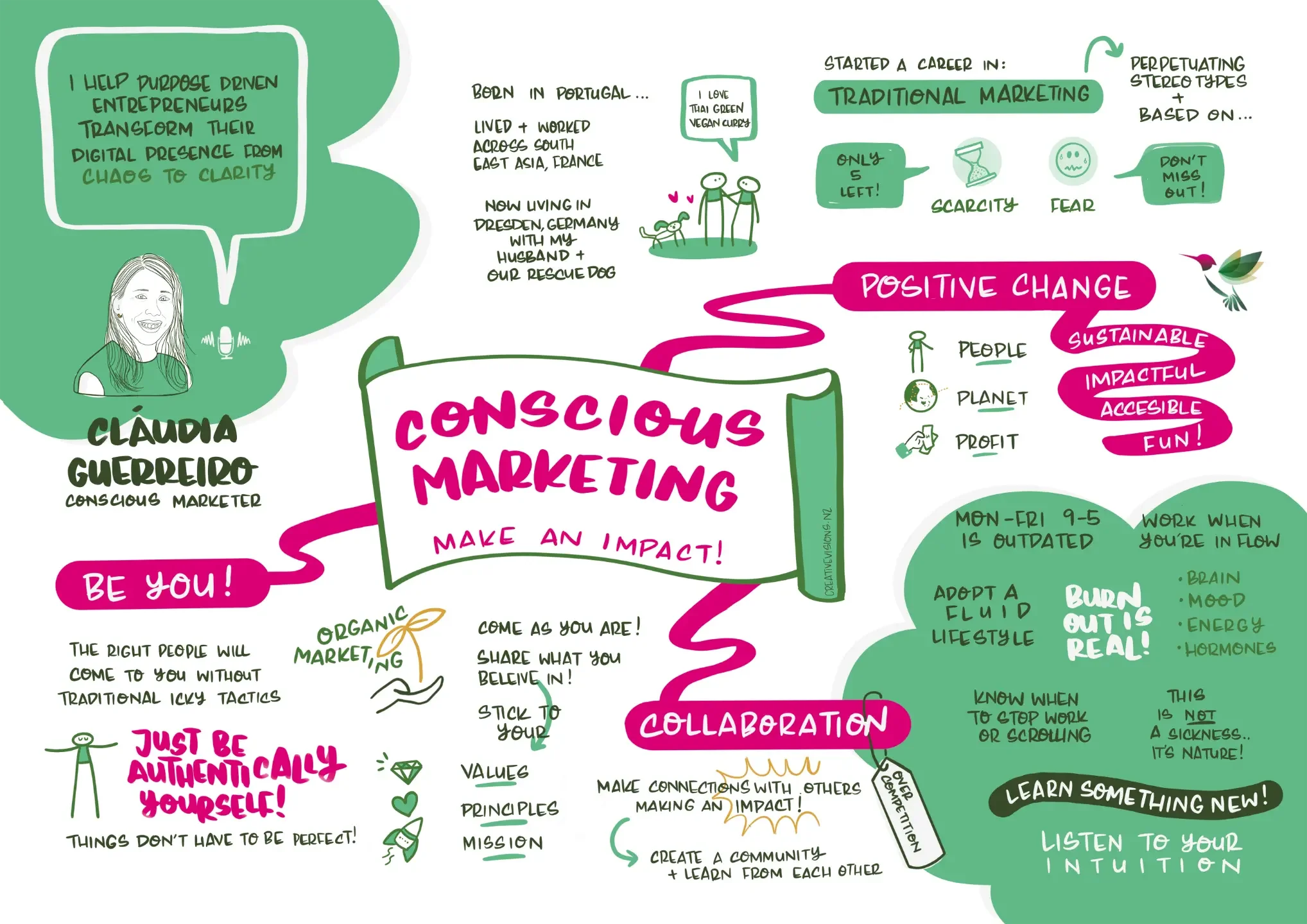
Cláudia: I realised that there were a lot of people out there that also feel icky about these traditional marketing practises where you promote scarcity, like two spots left otherwise you're gonna miss out this opportunity and so on. Also fear based marketing strategies such as fear of missing out, fear of not being good enough. When you are gonna buy something, they tell you that you're horrible, basically, if you don't buy this product or service and whatsoever.
That led me to believe that, no, there has to be a better way for us to do marketing, because marketing has the power to change behaviour. Marketing is really important in society. And instead of perpetuating stereotypes, instead of promoting scarcity tactics or fear-based marketing strategies, there is a way to use marketing for change, for positive change.
That's when I realised that there are people out there that believe the same. And so I joined this movement of impact marketing.
Jules: Kia ora, welcome to Humans at Work. I'm Jules, your host. Thanks for joining me and our latest guest and thanks for taking some time in your day to indulge your curiosity about other people and their humanness. If your thirst is unquenched after this, visit jericaglobal.com. Now let's begin.
Hi, Cláudia. Can you please tell everybody who you are, where you're sitting right now and maybe tell us a bit about your favourite food.
Cláudia: Oh absolutely. Thank you so much, Jules. Hello, everyone. I'm Cláudia Guerreiro – Guerreiro means "warrior" in English. I'm originally from Portugal, from Lisbon and I'm currently sitting at my home in Dresden, Germany where I live for a year now and I really love it. It's a beautiful summer day and I'm so excited to be here with you all today.
My favourite food. I love so many different types of food, it's really hard to choose but let me think. I actually love Thai curry – the green curry, especially if it's vegan with tofu; even nicer. Vegan curry would be great now for lunch.
Jules: That sounds delicious. I do like green Thai curry but I don't like it super spicy.
Cláudia: I love spicy!
Jules: You like the spice. Is that from living in Asia all those years?
Cláudia: That's right. I lived in Asia for almost 10 years. I started by living in Cambodia for two years where I was a volunteer and I also worked in hotels to support myself so while I was doing these volunteer programmes. Then I moved on to Singapore where I studied my Master programme and I worked in lots of different companies, including startups. Then I travelled pretty much all over all southeast Asia, I was in Vietnam, Thailand, Cambodia once again. I was also in Malaysia, Indonesia. It's been really a wonderful time in southeast Asia. I even met my husband in southeast Asia, he's originally from Germany.
I forgot to say in the beginning that I'm a conscious marketeer, in my introduction.
Jules: I'm sure we'll spend a lot of time talking about conscious marketing. I was gonna ask you how you ended up in Germany but, obviously, the husband factor had some part to play.
Cláudia: For sure, yes. I met him in Singapore and then during COVID times it became really difficult to live in Asia; I'm sure you're all aware that throughout the world there's been lots of restrictions, but Asia has been pretty severe on everyone. Luckily, now things have gone back to normal but during that time, we couldn't see our family, we couldn't see our friends, so we decided to move back to Europe. And we decided to move to Germany specifically, instead of going to Portugal. Also, we brought our rescue dog with us because we believe that we should not let animals behind; we should bring them with us. We adopted this lovely rescue dog in Singapore and he's here living with us in Germany.
Jules: What's his name?
Cláudia: Dante.
Jules: Dante, I love it.
Cláudia: Yes, so he has an Italian name so it's not Portuguese or German!
Jules: What do you like about living in Germany?
Cláudia: So many things. I love the culture here of going for walks and actually doing a lot of hiking and it's really nice to be in nature. People really enjoy nature and it doesn't matter the weather. People are out all the time which is a little bit different in Portugal – we have good weather the whole year but we tend not to go out the whole year whereas here people really enjoy walks, nature and that's something that I feel so connected with. I live here in Dresden in an area that is just beautiful, next to the river Elbe and I love the fact that we can go for walks every single day. That's something that I really enjoy about living here in Germany.
Jules: For your business, I would've thought that there's a lot of good things going on in Germany in terms of environmental sustainability and green technology and innovation. I would've thought that was a great place for you to be in terms of your business.
Cláudia: Absolutely. I go very often to Berlin where lots of startups are, and some of my clients also are based in Berlin. It's really a very amazing environment to be part of. I'm very happy that we are living here in Germany.
Jules: Can you talk to us a little bit about conscious marketing?
Cláudia: Yes. Absolutely. I did not start as a conscious marketeer at the beginning of my career; I started as a traditional marketeer and I worked in lots of different startups and also in F&B and hospitality. And I figured out that it was really difficult for me to be connected with this career.
I actually thought of quitting it altogether because marketing is part of the problem. We have to acknowledge this. Marketing has such a horrible impact in the world. We've promoted consumerism, we've promoted people not feeling good about themselves to buy something and, basically, all of this has led to where we are today in this massive problem when it comes to climate change.
At some point after working a while in marketing, yes, I thought of quitting my career. I thought it was not the right place for me because I felt like I wasn't doing the right impact, like what I wanted to contribute to the world.
Then I realised that there were a lot of people out there that also feel icky about these traditional marketing practises, where you promote scarcity, like two spots left otherwise you're gonna miss out this opportunity and so on. Also fear based marketing strategies such as fear of missing out, fear of not being good enough. When you are gonna buy something, they tell you that you're horrible, basically, if you don't buy this product or service and whatsoever.
That led me to believe that, no, there has to be a better way for us to do marketing because marketing has the power to change behaviour. Marketing is really important in society. And instead of perpetuating stereotypes, instead of promoting scarcity tactics or fear-based marketing strategies, there is a way to use marketing for change, for positive change.
That's when I realised that there are people out there that believe the same. I joined this movement of impact marketing, so I read more about conscious marketing. I read this book called "Conscious Marketing" by Carolyn Tate, she's basically one of my idols. After reading this book I felt like, no, actually, marketing is gonna be the career for me; I'm just gonna do it differently. I'm not gonna do it like everybody else that just want to grow at a massive pace and want to sell as much as possible and so on. No, I want to make an impact in someone's life and also, I want to make an impact in the planet, in people and basically, profit just comes right at the end. Conscious marketing is all about building a community of people that believe in your product and service because it's making a positive change in planet, people and profit.
Jules: It's so inspiring. I have been following you for a while and your tips and tricks on how to…it's almost to rethink how you've been brought up, how you've learnt your career, how you've been a consumer of marketing. And what I found is a lot of your newsletter and your advice and your posts on LinkedIn are about unwinding some of those automatic approaches.
That point about scarcity, there's only five of these left and you'll miss out if you don't buy now – that was one of the first pieces of advice from you that … I've never been a huge salesperson anyway, that's probably why my businesses aren't that big; I much prefer to have a relationship than to do a hard sell.
That was one of the first pieces of advice where I thought, I just need to rethink some of the things that I've been a victim of, if you like, and to see them for what they are; that they're not the only way.
It's not the only way to be, it's not the only way to be a successful business, it's not the only way to have an impact. That's one of that things that I think people find so refreshing about your advice and your postings.
Cláudia: Thank you so much, that means a lot to me. I feel really happy to hear that, that I'm slowly changing people through my posts on LinkedIn and my online presence. That makes me really, really happy.
There is a better way for us to promote ourselves that does not involve these strategies, but we are all victims of this because if we learn marketing through other people, advice online or even in university and so on, this is how marketing starts. It's still very traditional, very consumer driven like people have to buy and so on.
It does not bring this authenticity, transparency and also thinking about others as a community approach. And I'm so happy that people are starting to see that this is really important and this can change the world step by step.
Story telling can also drive sales. We don't need to use these tactics to drive sales. The right people will come to you, maybe with more time, especially if we do organic marketing which I'm a really big fan of. I prefer organic marketing to advertisement and so on, because I believe that if a product cannot reach any sales organically, what's the point of advertising it anyway? It means that there's no market for it. For me, it's very important to start organically and things will come to you that are meant for you, as long as you stick to your values, your principles and your mission in this world. I think that's very important.
I think we also need to rethink the definition of "success". So people think of success of this massive company, so everybody has to be Google or Microsoft or whatsoever. It doesn't need to be like that.
We are seeing that a lot of people are now leaving these big companies and starting their own thing because they want to have a better impact. And because they don't want to be part of these big companies, big corporations that, in fact, are not really creating a good impact to everyone.
I feel that we are in a very, very exciting moment that people are believing that there's another way, there is an alternative way of having a business. So more social focus, almost like social entrepreneurship and going towards more B Corps, like people want to act as if they are a B Corp, even if they are not certified. They want to run their small business as if they are a B Corp.
Jules: Absolutely. That completely resonates and I think that's you telling the story of my journey! I set up my own businesses, I've got the Humans At Work business and then I have my consulting business. And for two different reasons and with two different drivers, but the outcome that I wanted is the same, which is to have a positive impact.
I found that the only way I could truly do that was to be independent, where you've worked out what your value proposition is and what your ethics are and there's nobody to tell you that that's not the right thing to do. That was the driving force behind me setting up my two companies.
You're talking about organic marketing and wanting to do something because you wanna create that community is exactly what Humans At Work is designed to do. It's designed to get out there in the world and show people that there are more ethical, nicer ways of leading and there are better ways of making decisions that are long term and sustainable and help people.
You can do that by working with each other, you can learn from other people by talking to each other and interacting socially. I've fought against the big marketing budgets and the big advertising budgets and instead I decided that a way to spread that word and to have that impact was to talk to people and to get them to tell me their stories, which is what the podcast is about.
Partly it's me being super curious about people. I love to hear about people's stories and what they were like when they were younger and why they chose this career. But also, it's about making those connections with people. Even if I don't have a lot in common with somebody, through every podcast I find something that connects us, something that keeps the conversation going.
And then you end up with a network of people who are all trying to do good in their different ways, in their different countries, or in their different industries, and you feel like you're not alone, which is so important.
Cláudia: Absolutely. You're a conscious marketing advocate, I love it.
Just the fact that you're creating this podcast shows me that you're already applying also one of the principles so from competition to collaboration. These days, we need to collaborate; if we want to create an impact, we can't be alone. We need to hear others' stories; we need to support each other and I'm such a believer of collaboration.
I love the whole purpose of your podcast, I deeply resonate with it and I'm so glad that you're creating this because you're raising awareness through all sorts of different topics on ethical leadership and that is so much needed.
And for sure, having a small business is also a way of life. We don't all need to have big, crazy businesses. And I love that you are brave enough to create this path for yourself because entrepreneurship is not for everyone. Of course, we talk about the good side of it here but there is also a lot of difficult parts of being an entrepreneur, especially if you're a solopreneur. You might feel more lonely, you might not have anyone to collaborate with in terms of work full time. I think that it's important also to put it out there that it's not just a walk in the park; entrepreneurship is also very hard and requires a lot of time and requires a lot of change, which I love! I love changing.
I was saying that I lived in Asia, but I was also in France, I was also in the UK and now I'm here in Germany. I'm from Portugal and so on. I've travelled a bit all over the world; I'm really, really fortunate to have had that chance to meet so many different cultures and also that made me so aware as well of the impacts of climate change in different places.
In Cambodia, I faced this horrible flood one day that my motorbike just stopped working because the flood was that high. All of those things really changed me and made me the person that I am today. I feel that us social entrepreneurs, there's not really a difference between our work and personal life; we are kind of one and we are ourselves while we are doing this business. I think that's also very meaningful because the traditional thinking is that you are one person when you are at work, you're one person when you are at home.
For me, this is all mixed. I am the same person with my friends and I'm the same person in my business. I love helping others genuinely and the less it feels like marketing, the more it's you. It's just being you yourself and you don't need to use these traditional things that we've learned how we should market ourselves whatsoever. In fact, when you're just being yourself, the right people just come to you naturally without you having to use all those traditional icky marketing tactics. What do you think?
Jules: I completely agree. I was thinking about when you said it used to be that you were one person at home and then you were another person at work, you had your professional façade that you put on.
And when you are an impact entrepreneur or a solopreneur, you're just yourself. There's a lot of freedom that comes with that – you make the decisions about what you do, you can hold true to your values. But also, you're very naked because who you are is actually what people are engaging with. There's no artificial organisation around you that you can hide behind. I think some people find that scary before they've gotten into it. It's scary once you're into it, but it's nowhere near as bad once you're into it and doing it as the fear of what it will be like.
It can be scary, it can take a lot of moral courage for you to say, 'I'm gonna shed all of those different ways of doing things and I'm gonna forge a new path. Just me, I'm standing up for what I believe in. Will anybody want to talk to me? Will anybody want my services?'
I'm sure you must have had those similar thoughts where you don't actually know. The trade-off for that fear is that when people do want to talk to you and they do want your services and they do value, they're actually valuing your authentic self in that skin, so you get that much greater reward at the end of it because they're seeing the real you.
Cláudia: Absolutely. I completely agree.
Jules: I was just going to ask, your company, you do consulting, you have individual clients. Tell us a little bit about how it works.
Cláudia: I just wanted to go a little bit back of some things that you mentioned because they were so inspiring. You were just saying about personal brand, putting yourself out there and so on. I started in 2022 with just 1,000 followers on LinkedIn. I had lots of posts with zero likes, lots of posts with zero comments. It's not that we start off from high points. Throughout time, I've grown to over 15,000 followers. Today is July already, 2023. Yes, it did take time. Yes, it's not like I'm a mega mega influencer or something like that, but that doesn't matter for me because my definition of success is different.
I think it's very important for us to think about we don't need to only start something when we believe that we are more successful, according to society's standards. We can just come as we are today and share our authentic story, share what we believe in, share what we are doing. It can be that you have 100 followers, 1,000, 10,000 – it doesn't matter. You have to start somewhere and you just need to put yourself out there, especially if you are an entrepreneur – social media presence is very important.
You don't need to show all parts of your life, of course, I'm not saying that you need to show yourself having a shower. You can just show what you want and what you believe that you would like to show authentically to your community. Sometimes it can be wins – something really cool happens like being invited to this amazing podcast! Or some low times because entrepreneurship is all about ups and downs.
Coming back to what I do – conscious marketing – I help purpose driven entrepreneurs, especially women entrepreneurs, because I believe that so many women are out there but they don't have the funds to create a company. So conscious marketing can help them to kick start their business in a meaningful manner without needing all of these crazy budgets for marketing purposes.
I help purpose-driven entrepreneurs to transform their digital presence, from chaos to clarity. What's that all about? A lot of purpose driven entrepreneurs, especially in early stage, they start with online presence in every single channel. So they've now all gone to Threads, to TikTok, to LinkedIn, to Twitter and they've spread themselves across, very thin, because there's just too much to do. Social media is a full-time job, even just one platform can be a full-time job, and also then having their website, having their blog, having their email list. They do it all so that's chaos.
We have to think, where does our community really interact, engage and where they could be potentially and then focus on that platform. Just one platform to start with and that's more than enough. I help people working less in some way and working more meaningfully to promote themselves.
I help people a lot with their personal brand, like if they need help to put themselves authentically out there because sometimes you just need a little push and need to be brought to the right direction.
I try that clients don't become overly dependent on me so what I try is to give them the tools to succeed on their own. I have lots of different workshops; some on content marketing, some on personal branding. These workshops help people to kick start, to understand better how conscious marketing can be applied to content marketing and how conscious marketing can be applied to personal brand. Then a lot of them just continue on their own and that's when I feel the most happy, when I really help people to have the tools to continue on their own and then they come to me really happy for everything that I have helped them with and they are going through a very positive path now so having that clarity is very important.
What I want is to create a conscious marketing movement. I want a lot of people to change their marketing practises that become impactful, meaningful, sustainable, accessible because we way over complicate marketing and also fun.
I think a lot of marketeers are burnt out. I have experienced that myself when I was working and burn out is really, really horrible and you need to take a lot of time off. I did take a lot of time because I really need to reset. We marketeers don't have amazing careers, I would say.
I think a lot of people are really, really at the edge because they are constantly pressurised to make more sales and drive sales in general. When those sales happen, there isn't even a reflection on how we got there; just magically and some people think that this had nothing to do with marketing at the end of the day. Yes, I believe that marketing needs to be impactful, sustainable, accessible and fun. It's so important to have all of this together.
With my practice, with my work, I'm not only helping these purpose driven entrepreneurs but also bringing that awareness online and I really hope to create a community of people that have the same ideas and that we join together this journey. And that's why I have created also the Conscious Marketing Insights newsletter. I feature there amazing people that have the same beliefs because, again, collaboration is so important and learning from others is so important instead of thinking that there's only one way – your way. No, not at all.
I know there are many ethical marketeers out there that are doing great things, and they do deserve the exposure because I think that there's a lot of exposure for those traditional marketeers that use all of those nasty tactics. Then there's not so much exposure for people like me. So I'm changing that by highlighting that there are more people also out there that just think like me or very similar, and have the same ethical principles.
I hope that answers your question. That was quite a long answer. I'm so passionate about this, I could spend the whole day talking about this!
Jules: That was fascinating. I've got a couple of things I wanna delve into.
First, I just wanna acknowledge that I, too, have had a burn out episode and I'm really with you. It is something that is not like every day, it's not like everyday tiredness or you're annoyed about something at work or whatever. It is a fundamental change in your energy levels, your resilience, your hope, your optimism. For me, I ended up having almost three months where I was going through the motions of life, but I didn't really feel anything in those three months. That was the first time in my life that it had ever happened, and it scared me.
I clawed my way back and during that time, I've told the story a couple of times when people have asked, but during that time, that's when I went for a walk on the beach, cos that was one of my therapies, if you like, and I had the idea for Humans At Work. It was the first thing that had interested me for a long time, so I decided just to do it. Because if I cared enough that even in a burn out situation, I thought about it, it gave me a bit of excitement, it made me feel something again, that it was worth doing. For anybody out there and for you, I absolutely acknowledge that it's a really, really tough thing to go through.
The other thing I was gonna dive into a little bit more is you talked about helping people, particularly women, to turn their ideas into something and not going all out. Do you find that when you talk to people and you ask them the kinds of questions that you would need to know in order to help them with their marketing strategy, that they're able to articulate the real value, the passion behind the project, if you like? That is that depth of relationship that you can get if you ask those questions, you delve in a little bit more, you actually go under the surface and you see the person and you see what's driving them, and what it is about the idea or their life that is pushing them in that direction.
Cláudia: Absolutely. There are two types of people. There are some people that come to me that have a very specific mission, they just don't know how to articulate that online. But there are some people that have some sort of idea but need a little bit of help to brainstorm what could be the right direction or not. I help both, because it's also possible to help validate that idea and the market with marketing. And it's also possible to, with the power of storytelling, bring that idea to the world. So I help both sides and I think that's very meaningful as well.
I just wanted to answer the burn out as well. Thank you so much for sharing your story. I think that was really meaningful and I'm so happy to be part of your life in some way. Sharing this is very important. It's beautiful that you came up with the idea at the beach. Totally.
The best ideas that I have also come when I'm not at work, although your podcast is called Humans At Work! A lot of my great ideas come when I'm just going for a walk or just doing something else. Recently I've started also doing adult colouring books, I have one behind me because it helps me so much with my racing thoughts.
You know when you're a solopreneur, sometimes you have lots of ideas, racing thoughts and things like that. Because I'm very driven, a lot of times I have to stop myself and a lot of my clients are very similar and just like, I did enough for today. Even though that I love what I'm doing, I just need to say it's good enough today. I'm done for the day, I need to go and enjoy myself.
Sometimes I still have a hard time to do this, but I need to keep reminding myself there is more to life besides work. That's very important, especially I realise that a lot of the women entrepreneurs that I've worked with are very perfectionist – we are afraid to put ourselves out there unless it's perfect. I tell them all, to my clients, "My dear, it's not possible to be perfect, let's just run with this. Let's just test." Just having that strength of someone saying, "Let's continue, let's keep going, let's not be stuck in this."
I think it's very important and that's something I need to remind myself, especially at the early stages when I started sharing more my story online when I just had about 1,000 followers. I also had this pressure that I had to perform online, and I had to be perfect, and my pictures had to be amazing and I had to have the best graphics or whatsoever. Now, after one year and a half/almost two years of working for myself, which was also a choice that I did consciously because I really felt that it was the right time. Sometimes you have this call within you, I think that's very important to acknowledge that we don't need to be perfect online.
In fact, I think a lot of the trends now have shown us that people are connecting with authenticity and real authenticity, not just fake positivity or this kind of stuff. It's also not what I'm promoting here because there's also toxic positivity and that's also not where I want us to go. I want us to be real and if things are not right, we should also acknowledge.
I love the idea of impact failing because, again, we try to do our best. Maybe we did a campaign that we thought was really good and was gonna have a good impact but at the end, had a backlash. That's the impact failing, and it happens. Nobody is perfect, even Patagonia is definitely not perfect. We are all taking as much steps as possible to do meaningful change and that's how we can contribute. We cannot contribute with perfection but we can contribute with step by step meaningful changes.
Jules: You're so right. I think it is a curiously female trait to think that everything has to be perfect. I know there's been a lot of studies about people applying for jobs and the sound bite is, a man will look at the requirements in a job advert and say, "I've got most of those, I might as well apply." A woman will look at them and say, "I've got all of them except one, so I won't apply." That is how we've been brought up, really. That's all of the societal biases and what we've seen, what we've experienced so being conscious of that is so important.
You've touched on how to quiet your mind. I was gonna ask you if you have any tips for people who are active on things like LinkedIn, who have a social media presence. I know myself; I work hard at learning from others – a lot of LinkedIn reading and listening to other people's podcasts and reading other people's articles.
What I find quite often is, with myself I have to be really disciplined not to go on looking at other people's work and posting and commenting because I'm into the moment. Once you get into that, there's no 9 to 5, there's no end of that. You're in a movement, you're learning from others, you get a dopamine hit when you see an idea that you connect with. Then you find that you haven't had any sleep because you've been devouring all this knowledge and feeling part of this community and having this online presence.
Apart from adult colouring, which I have an adult colouring book myself, I have to say, what other tips would you give to people who are finding it a little bit difficult to know when is it okay to stop and live your life?
Cláudia: Thank you so much for this question, Jules, it's a really meaningful question. I think that first I wanted to address I think we think only successful people wake up at 5am. We have this trend to think we all have to be early risers and so on and there's no other way to be successful. Here's the 10 secrets of being successful and you have to wake up at 5 to start your work at 6 and then finish at 4pm whatsoever.
I think this is so outdated, this advice out there because, again, when you are an entrepreneur, you have to go with your flow of energy. When it comes to women, particularly, we have this 28-day cycle for those who still have the cycle; for those who do not have a cycle anymore they have a different type of energy as well.
You don't need to all wake up really early and finish really at 5pm all the time. I think we should work when we are the most productive in general. For me, that means waking up around 7.30 and instead of starting to work, I go for a walk with my dog along the river. I start my days really slowly and consciously. Then after this walk I have breakfast, calmly, again; if possible, I don't look at my phone until then. Then I do my adult colouring and then finally around 10 I start my day. I think that's really nice. I tend to finish around 7pm.
But I don't like to have this fixed structure all the time. If I need to start earlier one day, I also start earlier. If I need to finish later one day because I have some clients, for example, in Asia, in the US and due to the different time zones, sometimes I need to adjust a little bit. I also adjust my lifestyle depending on it and it might be that I have a morning free and I do whatever I feel like doing that day or an afternoon free. That's fine, it's very good to have the idea that also we don't need to work Monday to Friday; sometimes I do work on a Saturday and I take a Wednesday off.
Being an entrepreneur also gives you that flexibility. But because we have this mindset that we have to work Monday to Friday, we have to work 9 to 5 and we feel like we are not being successful if we are staying at 9pm working but, in fact, if we started later, what's the problem? It's all about mindset and shifting this mindset into a more fluid lifestyle. Instead of work/life balance, I believe in work/life integration which is this kind of concept of working when you are in your flow or when you feel that it's right.
That sometimes changes, sometimes I'm on my period and I just feel unwell and I don't feel like working so perhaps I will cancel my calls on this day and people will understand if I'm not feeling well and so on. You need to be transparent and acknowledge. Of course, you try your best within your capabilities to not disappoint others, but as long as there's open communication, I think that's very important.
Other tips to improve work. I have Notion – I'm not affiliated with Notion but I love Notion, I'm a big Notion girl. I put all my content ideas there and I try not to act on them for a couple of days. Sometimes I have these rushing ideas and lots of ideas come, and I have 10 posts suddenly lined up. But I put it all on Notion, let it sit for a day or two and then I come back to them again, because sometimes those ideas don't make sense anymore! At least I save a lot of ideas, save a lot of posts and use Notion a lot for these learnings.
I try also not to put so much pressure on myself to overlearn. I feel like there's so much content out there and amazing things out there but there is also so much time in our day that we can use for our work, for learning and so on. I try to have some days, for example, Friday is a little bit more easy going. So perhaps I might listen to podcasts or look for more ideas on this day. I try to have specific days that are more productive. Let's say Monday, for example, is no calls day, and then Tuesday, Wednesday and Thursday calls day and consultation days. And then Friday a bit more easy going, more like chit chat calls and networking and things like that.
I try to organise my week in a way that feels sustainable. Maybe, let's say, that I'm missing some opportunities here and there but, joy of missing out. We have to have mental space because otherwise it's just gonna be impossible. You can't possibly do everything, and I think that's something we have to acknowledge because people don't talk enough about this, about the pressure of having to learn more and more and more and more. For me, I love learning, if I could just spend the whole week learning with others and reading others' content, I would but, of course, I also need to work and earn money. I think it's okay to have this joy of missing out, not being part of everything. You are part of the things that you can and that's enough, let's say.
Jules: I think I will definitely take from you that idea of not jumping on the idea straight away. I am an ideas factory – when I'm having a shower, when I'm just to fall asleep, when I'm walking, when I'm doing the kids' breakfast or whatever, it's like ping, ping, ping, ping, ping and I'm very action focused. Oh I've had this idea, I'm gonna put it into practise straight away.
I don't use Notion but I do have a reMarkable electronic notebook which has revolutionised my life and my paper use, obviously, over the last two years. It's full of…what about this and what about that? You're right, sometimes you go back and you look at it later and you think, oh, no, that was never gonna work! I don't know what I was thinking at that time.
Cláudia: It's important to give some time.
Jules: That's right. The other thing I was gonna say is I really like the fact that you acknowledge the cycle that women have. I was listening to a podcast last week which was about hormones and there was a doctor who's originally from the UK and now lives in New Zealand. She was taking the audience through what happens hormonally for women who are still menstruating and the times of the month where they're gonna feel really, really good, their brain's gonna be super, super charged. And then other times of the month where, no, that is not gonna be where you are. It's nothing you can really help. You can push through, you can grind through but maybe also you could say, actually, for the next couple of days, I'm just gonna do the easy things, the administrivia of my life. I'm not gonna try and push myself through all of those things.
It's a topic close to my heart, because I'm in the middle of perimenopause and I didn't really know it was a thing until I started to feel weird. I started to have mini rage episodes in my mind; I never let them loose, but I was surprised at the feelings. And I would forget words, so I'd be talking to a client or facilitating a big leadership session and I'd have a word in my mind that was the crucial word for that concept, and I'd forget it. Oh, my goodness, I'm gonna look like a complete idiot in front of people. I'm fairly young, not that young but fairly young, and I was like, I'm not having hot flushes, I'm not a menopausal woman – whatever that is.
So, I started doing some more research and I found all of these things that you can have in perimenopause, and the fact that it can start 10 years early before you even get into your menopause. It can really take women's productivity away from them. A lot of people have it much worse than me; they can't function, they can't work because of all of the symptoms. So I've been on a bit of a voyage of discovery at the same time as it's become a bit of a global movement to say, hang on a minute, half the population in the world will have these kind of symptoms at the time when they're most productive, they're most impactful, they're looking after children, they're running businesses, they're running countries.
There's hardly been any investment in medical research or in therapies. There's no language for it, there's no vocabulary for it, nobody really knows about it. So there's been this big global movement. I'm lucky because I was going through my own voyage of discovery at the same time as there was this big global movement, and so the information was out there. And doctors are more able now to help you through it and prescribe therapies and what have you and I don't forget words every day now, only every other day!
I do think it's really important to acknowledge it and to say to people, actually, at any point you can be going through a whole lot of stuff. It affects your brain, it affects your energy levels and it affects your mood; it's not because you are uncontrollable, it's because your body is dictating what's happening. It's a force that's greater than you, if you like, in terms of your will. Just be a bit kinder to yourself and maximise your times when you're super, super fiery and energetic, and then rest in your times when you're not.
Cláudia: Absolutely, so important. I'm so glad that you're bringing this up as well. Because it is important for women entrepreneurs, women professionals out there to know this, that there is another way. And that 9 to 5 day has been very based on mens, on the testosterone levels, and there has to be a different way of working. That's why I believe that Spain now has period leave, if I'm not mistaken, for those that have really bad cramps and so on.
I think some people are saying that, no, maybe this is wrong, this is not right and it's making it like it's sickness and so on. I don't think so, I think it's important for the men to know that these women are at home because they are on their period instead of being sick. Because it's not right to call this a sickness, it's not a sickness, it's a part of our lives that we have to live with potentially since we are 12/13 or some women even earlier so why not acknowledging it. Thank you so much for bringing this up.
Jules: It's another example, I think, of this movement that I think you and I are both part of, which is trying to recognise nature and to interact with nature in more of a partnership so if you think about hormones and how your body works, that's all natural. We intervene in it and that's fine. I'm all for choice, but it's not a sickness. It's actually what keeps our bodies going and what keeps humanity going and all of those good things. It's one of those things where I know that people are starting to see the value in looking at nature and seeing how does biodiversity happen? How do ecosystems happen? How do you have balance?
It's part of that same movement, it's putting humans into that same dialogue and saying, "There are some things that, absolutely, we don't wanna experience if we don't have to" – you know pain, I'm all for not feeling pain or whatever – but we shouldn't be punished for things that are naturally part of what's happening with our bodies. Just as we shouldn't punish the natural world for things that are actually regenerative, and part of that biodiversity and that ecosystem.
Cláudia: Absolutely. You know what? You just made me think also about entrepreneurship and pregnancy. A lot of women start having businesses between 30 and 40, more or less, which is also where some studies out there, unfortunately, I can't quote one right now but I know that I've read a couple of studies that say that women are opening businesses at the same time that they are also potentially having their first or second child.
It is not easy to be an entrepreneur and having a family. It's difficult for everyone but there is a bigger weight on women due to all of nature parts. It is what it is.
Some of my clients also have a family, so my women entrepreneur clients have a family, and they have a business. And we have these conversations on a regular basis that, for example, she has to cancel a meeting because something happened with her baby and so on. We just have to be kind to one another because I think some people feel like we have to be perfect as mothers, as entrepreneurs. We go back to that perfectionism conversation. I hope that at least the next generation has a better head start on this, that we as parents, as aunts, as one day grandmothers, grandfathers, whatever, will be better for the next generation.
I think it's still very hard for our generation to be pregnant, to have children and be an entrepreneur or even a professional. There aren't that many alternatives besides just working part time which is a lot of what new mothers do, they just end up working part time because there's no other option. A lot of times there's also not an option for the husband to stay at home because the husband might be the one that brings more income to the family and so on, because of how the global situation or how society is set up.
They might want, as well, to be a stay home father and so on but there isn't that possibility so, yes, I really hope for meaningful changes in the entrepreneurship world and even in the professional world. All of this is part of, at the end, conscious marketing. Why?
Because marketing perpetuates stereotypes. The way that we sell things like cleaning products are associated with women. Cars are associated with men. Things like that are promoting stereotypes endlessly. That's why I believe in a better way of doing marketing that instead of just doing things as they are and perpetuating things, we are rocking the boat. We are doing things differently and why not the man being associated with cleaning products? Why not the woman driving a car? These are very standard, typical examples, I'm sure there's a lot more out there and also ways that we could include other communities like the LGBT community and so on, different ethnicities and not just white people.
All of this is so, so needed and I feel like we are just in this moment where things are slowly changing for better, and I really am hopeful for a future potentially for our children and whoever comes next. I know that there's a lot of fear associated with climate change and so on and maybe there won't be humanity after all. I'm really hopeful that there will be a change and that businesses will have a big part, a big role in that change; not just Government, not just NGOs. I really believe that collaboration between the three will be central for a better world.
Jules: I completely agree. I love your optimism, I like to always have hope because I feel like it gives you power to act and power to think. Whereas when you're feeling hopeless, you end up having no route out of it, really. I know we're nearly out of time.
I just wanted to ask how do you stay so optimistic and so hopeful about change?
Cláudia: That's a big question. Let me think. I've been brought up within change, I think. I've always loved exploring different cultures, I travelled a lot with my family, my grandparents also lived in Asia. I felt like change has been part of my life since the beginning somehow so that's, I guess, what makes me more comfortable with change than the, let's call it average person.
I think it's a lot about mind set and believing that things will work out in some way and following a lot our intuition. I think our intuition tells us much more than we think; we just don't listen to it. That's the advice that I would give to my younger self – listen to your intuition more. You were right about this, you were right about that! Listening to your intuition is very, very important.
Just trying different experiences because we tend to live in this comfort zone all the time, so I think it's important for those who don't like change or don't like so many different things, just try something different at least once a month. Whether it's trying a new food, a restaurant that you've never heard of the food. You go to Tunisian food because you feel like a change, or you go ride a bicycle even though you never rode a bicycle. Just try to do something different at least every month and I think that allows us to be comfortable with change more and more. It can be there's an amazing networking event that you are like, my God, I don't know if I have the capability to put myself out there because I'm alone and whatsoever so I'm not sure. Just go because this I'm not sure is like pushing you to say, no, you have to do it.
I also lived in lots of different places and that helped me a lot because I was alone and when you are alone in a new place where you don't know anybody, you have to push yourself to do things and socialise. We are social beings, and we are not meant to be alone. Sometimes you have to push yourself a little bit out of your comfort zone, at least on a regular basis, just to be more comfortable with change.
Jules: I have learnt so much today and I think I'm gonna go back over my marketing strategy and make sure that I am truly listening to everything you said. I know that you've probably got some colouring to do because we've interrupted your morning routine, but I just wanna say thank you so much. I know we've been talking about this …
Cláudia: Thank you.
Jules: … for a while. It's cheered me up and it's made me more optimistic, and it's given everybody a whole lot of things to listen and be inspired by so thank you so much.
Cláudia: Thank you, Jules. Thank you for this invitation, I'm really, really so happy that I had this chance. Thank you.
Jules: Thank you so much for listening and thanks, as always, to the generosity of our delightful guests. The stories of how others have faced up to their challenges can help give all of us courage to keep going with our own. For more great episodes, blogs, learning packages, go to the JERICA Global website.
Humans at Work Podcast