
The Ripple Effect of Change Making — with Carlos Terol
Humans at Work Podcast | Episode 15
Host: Jules Harrison-Annear | Guest: Carlos Terol
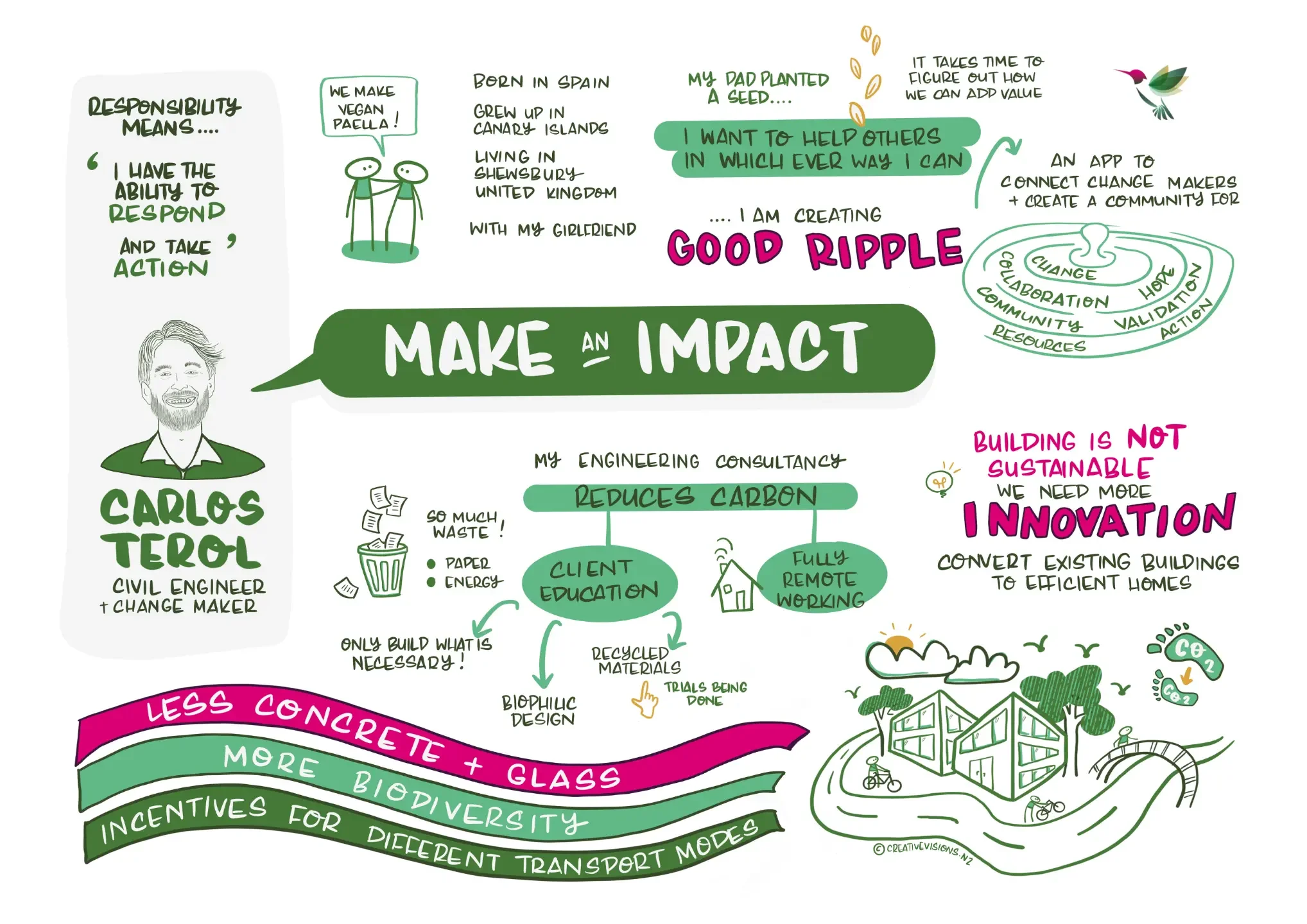
Carlos: When I was 24 years old I took a trip, I had a friend from Western Sahara which is literally in front of the Canary Islands in Africa and that's a 40-minute flight, it's really, really close. And that was my first experience going to a non-traditional western country. When I landed there after just a really short flight and seeing how people live there so differently to how we lived in the Canary Islands, how everything was less developed, there was less education, less healthcare and fewer opportunities in general for people, it made me click. Wait a minute, why do these people have less than me? Not just in terms of material stuff but in terms of opportunities and freedom.
It made me realise it was just because I got lucky to be born in the Canary Islands and because I got lucky, I realised that now I have this responsibility to help other people who maybe didn't get that luck.
That trip made me really realise my purpose in life is gonna be to help other people in whichever way I can – it can be helping one person or helping 1,000 but whatever I can do to help others.
Jules: Hello everybody. I am here today talking with Carlos who is currently in Italy, I believe. Carlos, can you introduce yourself and tell us where you are and who makes up your family?
Carlos: Awesome, thanks, Jules, for having me here, it's a real pleasure, especially after exchanging so many messages on LinkedIn. I feel quite proud to be here today so thanks for having me here.
My name is Carlos, I'm originally from Spain from the Canary Islands, although I'm normally based in the UK; lived there for the last eight years. Currently, I'm in Italy visiting my partner's family here but normally I would be in the UK. My family at the moment is really me and my girlfriend, planning maybe to expand it at some point but for now it's the two of us and we've got the extended families in Italy and Spain that we try to visit at least once or twice a year.
Jules: In Italy, are you having the heatwave that is having so many headlines around the world as evidence of climate change in action?
Carlos: Yes, it's pretty warm over here. I think yesterday we reached 33 degrees. I think the peak is gonna be Wednesday at 35, which is not superhot but still feels quite hot. I think they had a big heatwave one week or two before we came because we arrived this Wednesday, so I think the worst part was before we arrived. To be honest, me being from Canary Islands and living in the UK, I'm actually quite happy with this warm weather at the moment, it's not that hot so I'm still able to enjoy.
Jules: I grew up in Southern Africa until I was 11 and then I moved back to the UK and now I live in New Zealand, but I actually quite thrive in particularly the dry heat, I really like it. It's funny what you grow up with, you do get accustomed to what you grow up with and you can quickly go back into that coping mechanism. I think your body remembers.
Carlos: I've been in the UK for eight years, but I haven't got used to the cold weather there!
Jules: I think you live in Reading, am I right? In Reading which is near to London. Is that right?
Carlos: I used to live there, I lived there for five years, now we've moved a little bit more to the north, a small town called Shrewsbury which is an hour northwest of Birmingham but close to the Welsh border. Yes, I used to live in Reading for five years and got good memories there.
Jules: I was fascinated by that because my Mum, all of her family lived in Reading, and she grew up in Reading.
Carlos: Is that right? Small world.
Jules: Yeah, I know and when I saw you lived in Reading, I thought, gosh, it is really a small world.
Carlos: Yeah, which part of Reading are they based, do you know?
Jules: To be honest, I can't remember. I just think of it as one place, even though it's quite big, actually. I haven't been back there in years and years. She has very fond memories of it, of it being a really good community when she was younger, which was 70 years ago. I'm not sure if it's changed.
Carlos: I was quite lucky. I'm super glad that I went that cos that was my first place in the UK when I arrived, mostly because I got a job when I was paid for. I came to the UK, and I was super happy in Reading, and they were such a nice community, very international, very welcoming and I made friends for a lifetime and still have lots of friends there that we try to see every now and then. Real nice community in Reading indeed.
Jules: Let's talk a little bit about your childhood. You grew up in the Canary Islands?
Carlos: Yeah, that's right. My Dad, he's actually from Alicante. I don't know if you know where it is, it's south of Valencia, so we used to spend our summers in there in Alicante visiting my grandparents. Because my Dad also worked in the Army, it means we moved a little bit. We lived one year in Madrid and also one year in Cádiz which is in Andalucía, the south of Spain. I did my Masters in Alicante because I had my family there, so I spent two years in Alicante but everything else has been the Canary Islands.
Jules: What would you say is your favourite Spanish food?
Carlos: Good question. I quite like a paella. Where my dad's from in Alicante, they tend to do a lot of paella, so I've learned good recipes from him. When I travel around, for example, last week we got stuck in France, we actually cooked a paella for this family that was hosting us for a few days. They quite liked it so that was good. I quite enjoy a good paella.
Jules: That is my dad's favourite dish.
Carlos: Is it?
Jules: Yeah, just after university he travelled the world, he backpacked around the world, and he picked up his love of different foods from all the different countries in Latin America and through Europe that he travelled in. But I would say that is his favourite dish. Unfortunately, I'm allergic to a lot of seafood and so I tend not to …
Carlos: Funnily enough, we've become vegan for a few years, and we now do vegan paellas. They're actually quite nice. We manage to get a good flavour out of it so maybe you can try one of those one day.
Jules: Yeah, maybe when I come and visit, or you visit me you can cook for me?
Carlos: Absolutely, that would be a pleasure.
Jules: So in terms of your career, I read with interest that you're a civil engineer.
Carlos: Yep.
Jules: Can you explain a little bit about what a civil engineer does?
Carlos: A civil engineer mostly does every civil infrastructure so that goes from roads, bridges, tunnels, dams, ports, airports, harbours, canals. Everything you can think of out there that's not a building, everything else around buildings, it's a civil engineer's job.
It's a funny one because when I was studying in school, I was quite good with math and physics, and I knew that I preferred numbers compared to letters or other subjects, but I didn't know really what I wanted to study. It was really my dad that influenced me to study civil engineering. He said, "Well you could become a civil engineer" and this is when I was 17-years old he said, "You could become a civil engineer and one day you could bring water to a remote village in Africa."
Funnily enough, back then when I was 17, I really didn't care about bringing water to a small village in Africa, if I'm honest. I just cared about making a lot of money, maybe putting my name on a bridge or something and be like a famous guy. Pretty different values from what I've got right now. But I said, "Okay, I'll give it a go because it sounds like a career where I can make money." My goals were to have different sports cars so that's what I was planning to do.
Funnily enough, he planted that seed in me, that I think over time it's been growing, and it kind of led me to where I am at the moment. My purpose in life is really to help others and try to make the most positive impact I can. That's really how I got into civil engineering, it wasn't really my own decision, but my father planted that seed, and I started studying that.
Jules: Do you run your own business now?
Carlos: Yes, I've got my own little civil engineering consultancy, it's called Terol Engineering. We have three people in the team at the moment so it's a really small scale.
Jules: What I'm interested in is how you marry your focus on sustainability and climate action with civil engineering, because I know you have a plan around how you do that. Can you talk to us a little bit about how that works?
Carlos: When I first came to the UK, I started working for a big engineering consultancy with 80,000 employees, pretty big for that sector. And what I realised there was that there was a lot of waste in the industry.
Obviously, the construction industry is one of the most polluting ones and there's a lot of things that we need to improve, maybe one of them is not building that much to begin with. But obviously there's this push for the economy to build stuff because that triggers a lot of other economic factors.
What I saw is that everything that's done in that sector is very inefficient, it's full of waste. Like, just me working in this huge office with all the energy consumption. I would go to the toilet and every two hours they would have a big bin full of paper just from people there. And all of the photocopiers, people would just print stuff, all day printing stuff. Back then, I was starting to develop this interest in sustainability, and I started doing some campaigns inside the office, simple things like maybe using paper on both sides rather than just one side. You would still see people just printing one side and then binning that paper. We do lots of sketches so we could actually use that back side of the paper to just do a few sketches.
That made me start thinking this is not really what I want to be, because it's really not being done efficiently, and I've tried to make them a little bit more efficient, but I found lots of barriers. I think being such a big corporate you have so many levels of bureaucracy and things like that, so in the end I decided to leave that job and start something on my own that I could try and at least do my little help for the industry to be more efficient and have less waste.
That's one of the approaches that we use in Terol Engineering is that we work fully remote. It's funny, people ask me, how can you be a civil engineer and work remotely because it's not like a typical, a marketing or a graphic designer are more prone to be remote. At the end of the day, we do exactly the same thing that I was doing before in that huge office, and we deliver even more value for our clients now, they're super happy. We don't need to be in a big office, we don't need to travel to the clients' offices, we don't need to travel to the site to see things. We can do everything remotely so that's a big advantage.
Also, we've eliminated all of the photocopies, everything else so we've kept our carbon footprint … we measured this on the first year, I have to check but I think it was around 8 tonnes of carbon for the whole company, three people working. That's less than my own personal carbon footprint or pretty much about that, so it's a three people company being such a small carbon footprint. Literally, we just have our laptops and whichever other electronics we work with. That's one of the aspects that we try to do to be more sustainable.
Obviously, we tried to educate our clients. We try to do our processes much more efficiently and we figure how we can do the construction also more efficiently. We do a lot of education. It really takes a long time because people in the construction industry especially, they're more like old mindset so it takes some time to get them to think about these things, sustainability you know. And sometimes they go, actually, you don't need these two roads, you just need one – why are you doing the two of them? We try to go down that route and help them reduce the overall construction or carbon footprint, and just keep it to what's really needed.
Jules: I'm interested in the two sides there. I have actually two businesses that I run and both of them are run a hundred per cent remotely. In my consulting business, sometimes we do need to travel to be with the client, but we do that as efficiently as possible – electric vehicle, all of those things. Once you get into the habit of doing it and the expectations of the clients are set, actually, it works perfectly well. I would say it's better in many ways, actually.
I'm also interested in your education for clients about different ways of doing things, because there is a lot of, not resistance necessarily; more the not knowing that there are different ways that you could do things. If you think about supply chains and trying to transition to more of a circular economy, and choosing materials that are not so dangerous for biodiversity or for the environment. A lot of it isn't that people don't want to do it, it's just that they don't know. And sometimes it's really difficult to, you don't have the time, you don't know where to find that information, you don't know where to find those suppliers.
This is a big question I'm gonna ask, but would you say if you were in the building industry, that you could, actually, dramatically cut down on your impact on the environment? Not just carbon but all of those other impacts. Would you say it's possible, or would you say there are still areas where there's just not the suppliers or it's just not possible?
Carlos: Good question. I must admit, I'm no expert in building; it's something that I'm quite passionate about, I try to learn more but I'm really no expert in that area. From what I see from experts is that we can't say that any building is sustainable, at least a new built building. Because of all materials, even if you go and take really sustainable materials, today there's still a lot of carbon embedded in those materials from extraction in the mines to processing, manufacturing, shipping to the site where that building's gonna be built.
What I tend to see is that it seems to be the most stable option is not build that building, and rather converting existing buildings and try to make those more energy efficient. I don't know if maybe we can get to a point where we can actually build a sustainable building. But even right now, if we put all of the solar panels, we re-use the internal water, harvesting of the rain and everything, it's still gonna have an overall negative impact when you put everything together. I think there's lots of challenges there, that we still need a lot more innovation in the industry to be able to say, yeah, we can build sustainable buildings.
But, at the moment, it seems that it's probably better to try and look at how to repurpose existing buildings. One thing that comes to my mind is there's so many office buildings out there we could potentially, with more work from home, with more remote work, try and convert those to building apartments for people to live in because of the housing crisis for people struggling to get a home. So, I am thinking that could be a good option, trying to convert those. If we managed to get more people to work from home wherever possible and we have all these empty offices that have already been built, then we can try and convert them and make them more efficient for people to live in.
I think overall there's also this issue that, even if we make a building super-efficient, but then, as a whole industry, we are still increasing our energy usage. We're not catching up. It's good to make energy efficiency in buildings but we still need to look at reducing the energy consumption. If we make buildings 30% more efficient but we increase overall energy consumption by 50%, then we're still creating more pollution and more damage. I think it's important to look at that factor and see how can we actually reduce the amount of energy we use overall.
Jules: Would you say in civil engineering and around things like roads and more of that infrastructure, that there are more opportunities to introduce elements of biophilic design into what have traditionally been quite hard surfaces and hard designs? Biophilic design is one of those options for reducing the impact, particularly of things like flooding, but also the impact on biodiversity and being able to marry up or match up hard infrastructure that human beings need, with safe places for insects and plants to live and flourish.
Carlos: Yeah definitely, that's a good point. These days there's a lot of, especially when it comes to the drainage for this infrastructure, there's a lot of awareness being raised about sustainable urban design systems. Which, as you say, rather than having a hard stand of concrete or asphalt or whatever, you can actually have what we tend to call a rain garden which is more like a place which is actually quite good for biodiversity. You can have all different species in there and it's more like a grass area with water and everything, so you can promote that biodiversity, and that tends to go really well with a lot of linear infrastructure like roads or anything like that.
I do see a bit of a change there, there's more regulation also in that sense that's promoting that so that's a top one solution we should try and implement and, okay, if that doesn't work for good reason then you can look at the other ones, but that should always be the top priority.
And also, even road materials, there's a lot of companies right now looking at innovations in terms of using more recycled materials to do roads. There's some projects out there to do precast roads with recycled plastic, for example, blocks but you can just install one after another. I do see, still, a little bit of resistance in most projects to try and implement those but there's been some trials being done so hopefully we're seeing a little transition in that sense. Because obviously roads are quite polluting in that sense when it comes to bitumen and concrete; they are quite heavily intense in those materials which have a lot of embedded carbon footprint there. It's definitely one of those challenges that we need to look at.
Again, I think one of the keys there is to really not build what's not necessary. I see in the industry, and this is really a broader topic, and it goes into politics and everything, but civil engineering is normally built after a business case done by a Government, be it a local council or national Government. There's a business case where they say there's an increased demand here, so it means we need to build another road to bring all of this extra traffic. There's a couple of things there.
One, normally for local councils, they need to spend all of the budget they have because if they don't spend it, next year they will get less budget from the national Government. There's a bit of a conflict of interest there because you have local council that wants to build more stuff because they got more budget and then they can do more things for their cities and their communities. But, on the other side, it's sometimes promoting building for the sake of building, and maybe there's not really a strong business case for that road but still they wanna spend that money because otherwise they won't have more money next year.
There is where I think the whole of the community, the local citizens, us civil engineers and all the different stakeholders involved need to try and put pressure and say, "Maybe don't make that road because there's other roads around." Sometimes we don't need a road to save 5 minutes in another road. We need to balance these things and say well actually the negative impact of that is probably more important than those 5 minutes that we save.
There's that conflict of interest that I think there's a lot of things that we need to try and make it more inclusive for everyone, and not just thinking about spending that budget, but thinking about what's the best for the community and what can bring the most value to the planet as a whole.
On the other side also, is that the concept of demand generation and demand management. If there's more demand to use that road, instead of building another road, can we actually provide better public transport? Can we build a better cycle lane so all of those people, rather than going more on the road, they will swap to a different transport mode? I think there's a lot of things that we need to change there and not just look at demand and build more roads but actually how can we shape that demand.
How can we, rather than being reactive, be proactive to that demand and decide ourselves the demand that we want through different investments and different strategies and different transport modes. Those two key things, designing the demand and also looking at how local councils and national Governments spend their budgets, those are really key for the long-term systemic change that we really want to build.
Jules: I'm very passionate about incentives and the incentive structure. And what you're talking about there is really driven by an incentive structure that is not fit for purpose now, and certainly won't be in the future. Where instead of granting building consents for brand new office buildings that are full of glass and have no natural elements, can only ever be used for offices because of how they're designed, or that's the excuse anyway. We're not incentivising businesses to look at repurposing or multi-use buildings that are gonna be sustainable for whatever demand there is in the next 50/100 years.
It's a little personal bugbear of mine that in Wellington, which is the capital of New Zealand, there are all of these glass-fronted buildings, normally, that have a big consulting or private industry banner on them, they're really shiny facades of egos. Not trying to be too critical but that's kind of what they are!
There's been a lot of rebuilding or building of those new buildings since the pandemic, which I just think is crazy; partly because what the pandemic showed is that people can work flexibly and they want to work flexibly. And so, even if people do want to come in to be in an office environment, they don't want to do it every day and they don't wanna do it 9 to 5. We also have these housing crises everywhere, so you have these huge glossy buildings that are air conditioned and very artificial in terms of the environment within them. And yet there is very little thought to how you can make them a good community actor within that local environment to help with people who want to live in the city, or people who want to holiday in the city, or people who want a bit more interaction with nature.
It just seems so short sighted and such a waste of money, but the incentives aren't really there to drive the different kinds of behaviour. And that's a political and a governmental challenge, as well as a private industry challenge.
Carlos: Yeah, totally agree. I think that's where we need to use our power as global citizens and keep putting that pressure on Governments and corporates. I believe that corporates are driven by profit and Governments are driven by votes. That's what they want, so it's us that we can actually force them to change. If we start putting pressure and being loud about what we want, ultimately, when we build this critical mass of people, they'll have to change.
We've seen so many changes in so many political projects and corporates and it's always a reaction to that demand from the public. Unless you get really lucky, and there's cases where you can get a really good leader inside one of these corporates or a really good politician that actually have these values and wants to do the right things. In most cases they'll be driven just by numbers, by votes or the profits. If we can vote with our wallet, with our ballot and make the right decisions, and then keep putting that pressure every day up there so that these incentives can come along for example. We need to tell them we actually want these incentives.
I think there's a lot of discussion at the moment saying there's a lot of talk, not enough action. And I think that's right but, on the other side, to get more action we need more talk, because if there isn't enough action it's because there's isn't enough people who are aware of these things. Unless we make more people aware, there won't be more action.
I think we need both the action and awareness and helping everybody realise that we actually have that power to create that long-term systemic change and demand these things like incentives to repurpose buildings and make them more efficient and all of this.
Jules: Tell me a little bit about your global changemakers activism.
Carlos: Everything goes back again to where my father planted that seed. I think that's been developing over time. One key thing I wanted to share is that because I lived in the Canary Islands, I grew up there; when I was 24 years old I took a trip, I had a friend from Western Sahara which is literally in front of the Canary Islands in Africa and that's a 40-minute flight, it's really, really close. And that was my first experience going to a non-traditional western country.
When I landed there after just a really short flight and seeing how people live there so differently to how we lived in the Canary Islands, how everything was less developed, there was less education, less healthcare and fewer opportunities in general for people, it made me click. Wait a minute, why do these people have less than me? Not just in terms of material stuff but in terms of opportunities and freedom. It made me realise it was just because I got lucky to be born in the Canary Islands and because I got lucky, I realised that now I have this responsibility to help other people who maybe didn't get that luck.
That trip made me really realise my purpose in life is gonna be to help other people in whichever way I can – it can be helping one person or helping 1,000 but whatever I can do to help others. Since then, I've been trying to align everything I do to help more people and I've been doing more volunteering and reading a lot and learning a lot. I think I'm still figuring out what's the most impactable thing I can do to help others.
When I came to the UK, I started being involved with a charity called Engineers Without Borders. I think they're pretty much all over the world, it just makes sense why I'm a civil engineer – Engineers Without Borders makes sense. I started volunteering with them, I started running lots of events for them in Reading. We had events with 50+ people there and I was putting a lot of energy and effort into putting these events, bringing people together, raising awareness, discussion topics.
The thing that I realised back then is after putting a lot of effort, energy and time into it, I would get to meet a few changemakers that really had similar values to what I had, and they also wanted to change the world in a similar way and they were living down the road in my street or in my neighbourhood or in my town. I had to put a lot of effort to meet these people, it hasn't been easy, and it made me think how many other people like these are around me that I don't know?
Back then, that was in 2015, I felt there should be a place I could just go and find changemakers around me. It's common sense. I was thinking the United Nations or one of these big corporations or organisations should have done it already. I started looking for it and I didn't find anything, and the truth is that for eight years I've been looking for it and haven't really found anything like that.
This bring us back to last year, I sat down one day to think about if there's just one thing that I could do for the rest of my life, what would that be? One of these typical questions that you get into leadership courses and stuff like that. I really sat down and spent a good hour just meditating, looking, thinking about it. And I realised that this tool, this app, Good Ripple we call it, it's probably the most impactful thing that I could do in my life and it's not about me creating change, but about helping others creating change and amplifying the impact that they're making.
Last year I said I'm gonna do it, I'm gonna start creating this and trying to help changemakers connect with each other and amplify this impact. That's when I came up with the concept of Good Ripple and I started the community back in November last year. I thought what can I do to try and connect with other changemakers and bring them about? I thought if I used LinkedIn as a platform to create content there – I love writing, it's been a passion of mine for many, many years from since primary school. I was like if I can use LinkedIn to create content there and bring together these changemakers and hopefully help them even just a little bit, then it's gonna be worthwhile, I think it's gonna be really aligned to what I want to do. That's how it all started, really.
Jules: I love that, and I love the idea that you had this sense of, I want to do good, but it took a while and it took some effort and a bit of discipline to decide what your contribution to doing good was going to be. I think sometimes, and perhaps I've had a little bit of this myself, where you have this amorphous sense of urgency and that there is something you can do but it takes a while to hone in on it. And once you do, you have that real sense of passion and drive and momentum, but before that you're stuck. You're wandering around a little bit and you're trying different things and researching different things but you don't feel like you're actually adding the maximum value that you want to. So I love that idea that you've found that niche and that you just went for it.
Carlos: I think I kind of forced myself into it because I know myself and I can be postponing that forever. I'm a little bit of a perfectionist in some senses and I need to have it all perfect before I go out there and tell people and do it publicly. When I realised this is what I want to do, I started thinking how can I force myself to actually do it now rather than keep postponing. Years go by, we don't realise but years go by, and you look back and think, what have I done? I haven't really done what I wanted to do.
So when I realised this is what I want to do, one day I decided to force myself I gonna put it publicly on LinkedIn and from now on I'm gonna post every single day. Just the fact that I did that and put it out there, it put me into that mind-set of now I've committed to it, I've told people, even if maybe just five people saw that post, but I was like I've committed publicly and now I need to keep with it.
It helped me to keep track of what I really wanted to do, making that public commitment, cos I know that it is really what I want to do. And sometimes I feel we need to help ourselves cos our mind sometimes tries to trick us into not doing what we want to do or procrastinating or anything else. I think finding these little tricks to trick ourselves into what we want to do, at least with me it really works a lot. It was that tipping point of putting it there and since then I've been posting every single day.
I'm super happy with these conversations that I'm having with people like you who are creating a positive impact, creating change, helping other people. To me, that's the most inspiring thing. Whenever I finish one of these calls, I go running to my girlfriend and go, "I met this person and she is amazing/he is amazing, they're doing this, they're doing that." It keeps me really inspired to carry on so it's amazing.
Jules: That's exactly what I do with the podcasts. In some ways, it's an indulgence, to find people and then to spend an hour or however long talking about stuff that's not related to a task, it's actually related to values and ethics and your stance. But I find that if I don't have that, if I don't allow myself that time, I can fall into a little bit of despair. I'm generally a really optimistic person, but the state of biodiversity and the future ambiguity for the planet is heavy. Once your eyes have been opened to it and you've looked at some of the science and the research, it's a bit depressing. But having that time to share passions with people and to hear what people are doing and what's driving them, you get that buzz of community and you get that injection of optimism as well as the inspiration.
Everybody that I have talked to through the podcast or that I engage with on LinkedIn, I learn something from, or I solidify an idea that I've been procrastinating about writing down or doing something with. I'm really happy to hear that you get the same joy from these conversations and the interactions as I do. I think it's what keeps a lot of us going, actually, and we need that.
Carlos: Absolutely, yeah. And I think especially, as you said with such big challenges like climate change and inequality, extreme poverty, it can feel like such a daunting task and it's like I can't fix that myself alone so when you try to work on your laptop to try and fix it, it can really feel quite lonely and feel like what am I doing? This is impossible to change. But suddenly you say, there's other people out there doing something similar that they also care. When we put all of that together we can actually make big change and really change a lot of these issues. I do get a lot of inspiration from people to get going.
As you say, we can see that the world is a really negative place with everything that's going on but, on the other side, it's positive because we have an opportunity to do something about it. And I think that puts us in a situation that is, it is a good thing in a way because I can help to fix that. It's not that we can't do anything; we have the power.
I really like the word "responsibility" because I think when you feel responsible for something, not necessarily responsible in the sense that it's your fault but responsible in the sense that the word "responsibility", if you take it and you break it down, it means you have the ability to respond. Responsibility. So, I feel responsible means I have the ability to respond, to do something about it so when I feel responsible, I feel I can take action, I can do something. That really helps me shift back from that narrative from we live in a negative world, everything's bad, why bother? Actually, it's good because, I'm not happy that there's extreme poverty or climate change, but I am happy that I can do something about it. At least it keeps me optimistic about it and motivated to do more.
Jules: Yeah completely. I have this real focus on hope and hopefulness because I think if you see that there is hope then you will have that response, you will take some action. I think the other thing, I think you talked a little bit about it earlier, about being too much of a perfectionist so if you can't solve it then why bother? I think if you combine that hope with some action and not trying to be perfect or solve everything or tick all of the boxes all of the time – we're all human in the end – you can actually go forward and feel like you're having an impact.
Sometimes what people need is, they need to talk to people around the community globally for that recognition, because people tend to be quite hard on themselves. You know, "I'm not doing enough; I could do more, I'm not having a big enough impact. I'm not reaching enough people on LinkedIn. I'm not getting enough likes. I've called for this action and nobody's really listening." When you have that sense of changemakers across the world or in Reading, in your community, who are saying, "I'm hearing you, you're changing my mind or you're helping me keeping going," that gives that sense of validation that you are actually having an impact.
Carlos: Absolutely, I feel that sometimes it's actually difficult to see that impact. We are living in this world where we are super obsessed with data and measuring and I think, yes, we need to have this data and measure a lot of things cos otherwise we go a bit blind. But we shouldn't just focus on data and measuring. We should also be aware that these conversations we're having can trigger so many positive ripples that I'm not gonna be able to measure, you're not gonna be able to measure but it's the combination of all of these little things that end up helping me doing something for the world.
It's not just one thing, a trigger, but the addition of so many things. I think being able to see the impact even when we don't see it, like just having this conversation or reading a book or watching something or literally just making a simple swap from one item to another, it can really go a long way. Maybe it's not the impact that that little thing does, but it's the mind-set it helps you create that in the long run can trigger a huge impact. I think we need to start obsessing a bit less with trying to measure absolutely everything and also realise there's non-measurable things that are really important that we need to be focusing on, just like this conversation.
Jules: What's next for you? What are the next ideas that you're scribbling down or thinking about?
Carlos: Long term for Good Ripple, what we would like to do is really to create a mobile app where you can really go and see all of these changemakers around you – something like Tinder but for changemakers! I think we're really missing out in the power of collaboration, especially at a local level. We also believe in connecting people globally.
But if you can connect with three, four, five people in your street, in your neighbourhood who has aligned values to you and want to change the world, that gives you a really special power that virtual connections can't give you. Suddenly you can go for a walk and have a chat face-to-face; you can have a meal together, talk about it, come up with ideas, brainstorm and start running things locally. I think once we tap into that power of seeing how many people there are around you that want to change the world, I think we will change the world much, much faster.
What we're working on in the background is trying to develop the app. It's still very early stages. What we're doing right now is talking to lots of changemakers to really understand their pains, that this is really a pain for them and how can we solve it more efficiently and with more value? That's the next step long term vision, to create that app to really help people connect quickly and meaningfully and don't have them wasting a lot of time and creating non meaningful connections.
Jules: It's almost an alternative to LinkedIn, right?
Carlos: I think they can go quite well together. I don't see it as a substitution of LinkedIn. I think LinkedIn is great, I love it and it's got its own positives and negatives.
I think having this really just focus on changemakers, because LinkedIn, there's everything in there and you need to spend time to filter and get to the people you want. This will be especially just for changemakers and not so much about creating content but more about connecting. Also, what we're planning to do is giving people a lot of resources, so that they don't have to waste time doing research to get these resources.
The main thing is you open a map and suddenly you see in your street other changemakers there and you can filter by SDG or by different courses; a really deep and rich filter that places like LinkedIn don't have as much, that will allow you to create really meaningful conversations, really meaningful connections quickly. I see it as bringing them both together and maybe collaborating in the future somehow.
Jules: It sounds amazing. I do think that there is a lot of value in that because that sense of, we talked about earlier, of being able to act, sometimes you need somebody just beside you and then you can act. And local actions can have such impact, over time, but certainly for the people around you and to change those incentives. I think it sounds amazing. I'm in!
Carlos: Thank you. Thanks a lot, Jules, it really means a lot.
Jules: Thank you so much. I know that you have had to take time out from your trip to Italy for this, and I know that it's been a long time coming with a broken-down truck and schedules that have caused us to have to rearrange it a couple of times. I've been really looking forward to it and it hasn't disappointed, so I did want to say thank you so much for giving us your time. You're such an inspirational person, so optimistic and kind, and that comes across on all of your engagements on LinkedIn and definitely in person. So thank you very much.
Carlos: Thanks Jules. The sentiment is mutual. I've been really looking forward to this and I'm sorry that we had to reschedule for various reasons but I'm super happy that we finally met each other, even if it's virtually, and super thankful that you invited me to be here. It's been a real honour and I'm really looking forward to meeting in real person one day. If you come to the UK, I know it's a long trip but if you ever come, let me know and I'd be quite happy to cook that paella for you.
Jules: Sounds fantastic, it's a date!
Carlos: Awesome.
Jules: Thank you so much for listening and thanks, as always, to the generosity of our delightful guests. The stories of how others have faced up to their challenges can help give all of us courage to keep going with our own. For more great episodes, blogs, learning packages, go to the JERICA Global website.
Humans at Work Podcast