
Linking Actions to Goals — with Nina Field
Humans at Work Podcast | Episode 16
Host: Jules Harrison-Annear | Guest: Nina Field
Nina: Yeah, it is definitely a feature, I think, of the training and it's definitely a feature of the culture and the career that people have. That's really what you're training for, you're training to be able to walk into any situation and do what needs to be done to the best of your ability.
Jules: Kia ora, welcome to Humans at Work. I'm Jules, your host. Thanks for joining me and our latest guest and thanks for taking some time in your day to indulge your curiosity about other people and their humanness. If your thirst is unquenched after this, check out jericaglobal.com. Now let's begin.
Hello, welcome to another episode of the Humans at Work podcast. Today I'm here with Nina. I'm gonna ask Nina to introduce herself, tell us what she does for a living and to tell us where is her happy place that she goes to, either physically or in her mind when she needs to have some rest and respite. Nina.
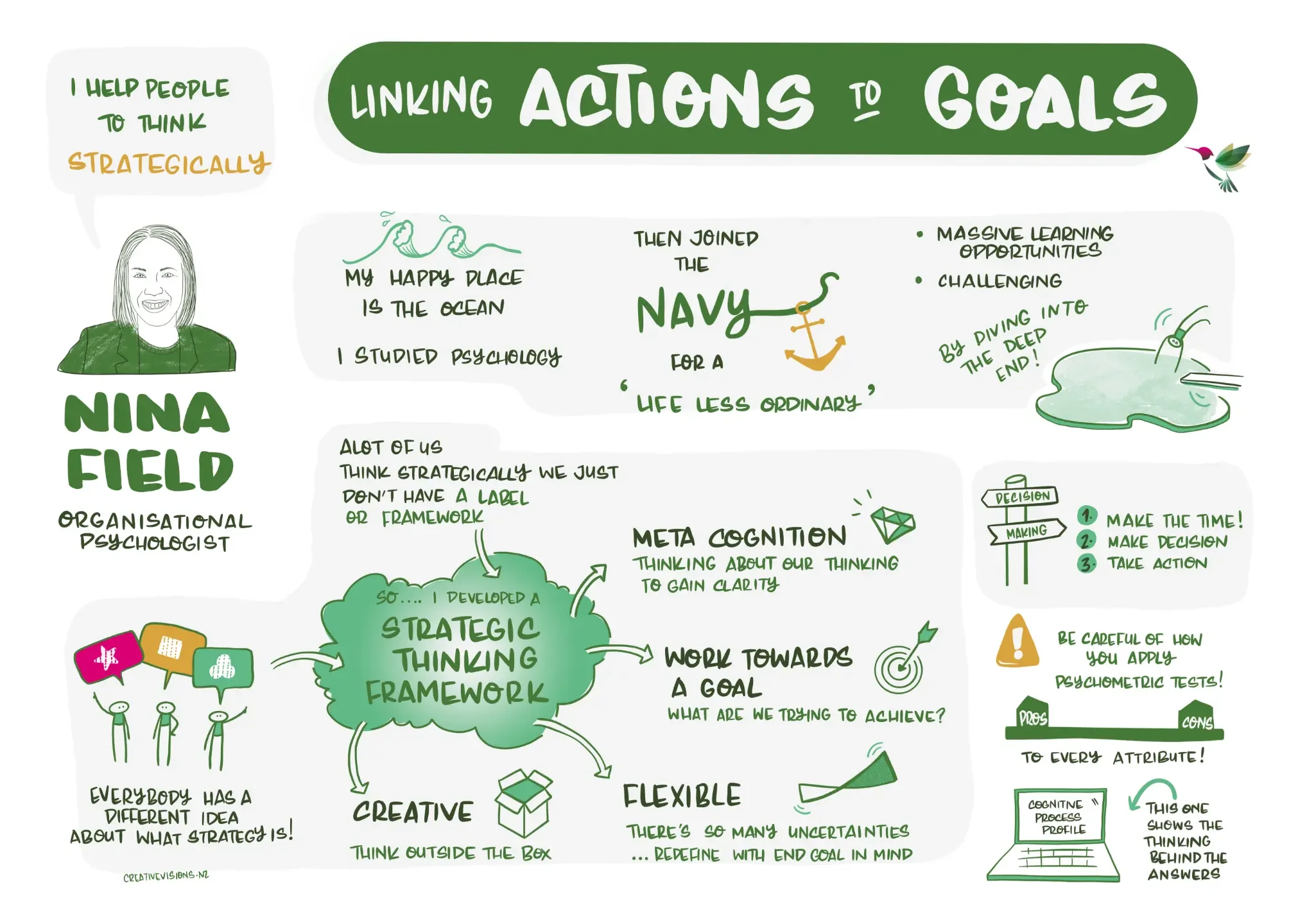
Nina: Kia ora, Jules so nice to be here with you today, thank you very much for having me along. Oh, gosh, my happy place. First of all, I think it's definitely gotta be something to do with the ocean. I like to be on the ocean, I don't do that as much in busy Mum/family life days but certainly if I can't be on the ocean, then walking alongside it.
So, just to introduce myself, I am a business psychologist, or another term that's often used is industrial organisational psychologist. Really, I just say to people, I don't have a couch, I don't do clinical psychology, I don't do mental health as such. I take my hat off to people who do that kind of thing because I decided very early in my study years, that that wasn't my thing – listening to people's problems all day. I think the people who do that are very special people.
Business psychology or industrial psychology, organisational psychology, whatever you wanna call it, is really just about people at work, which I guess makes us a really good fit because it's very similar to your podcast title.
The biggest chunk of my career was in the Navy, as a Navy psychologist, had a lot of amazing experiences there. Did a few things beforehand, and since then I've been focusing in on strategic thinking and that's been my journey for the last six or seven years now. And I've got a programme, an eight-week programme, that I offer and I'm just getting ready, the next phase is to introduce a couple more offerings and things.
Yeah, I get really excited about the idea of helping people to think strategically in a world that just doesn't set us up for it very easily, it's not something that comes naturally to us as humans and it's not something that our world facilitates happening very easily. There's a lot more to that but I guess we'll get into all that.
Jules: Yeah, I've got lots and lots of questions, as you can imagine. My first question is, did you work in the Navy because you like being on the sea?
Nina: Great question! Yeah, I suppose I did in a way. I can clearly remember the marketing campaign that was running at the time when I applied, and it talked about a life less ordinary. So, if the person who came up with that is out there, well done, because it really stuck and that is really what I was after.
At the time, I'd finished my degree and I had qualified in a few psychometric assessment tools and I was doing a bit of contracting, report writing, assessment centres, various little things. And I was actually doing a whole heap of sport at the time, on the water – rowing was my big thing and surf rowing at that time, I'd been through flat water and then open water and then I was doing surf rowing. I was competing overseas and raising sponsorship and spending most of my time doing that and not really wanting to get a real job.
I had thought, though, that I'd better get a real job and I saw this advertisement. How much does it relate to the sea? I think I saw the military as an opportunity to do something that would involve a bit of adventure and something different and not being chained to a desk all the time. And challenge, is a big one for me. Then, of course, I had to choose between the three services, Air Force, Army and Navy and it was just a no brainer because of my love for the sea, and I was also in Auckland so there's only one Navy base in Aotearoa so that was it.
Jules: All done! Can you talk to us a little bit about what it's like in the Navy because I think a lot of people maybe imagine, they see films, they might know somebody who's been in one of the forces, but how would you describe it?
Nina: Oh, gosh! Yeah, it is definitely one of those things that has a certain set of ideas associated with it for people who haven't been there and it's definitely different. I think my parents were a little horrified when I first said that I was going to join the Navy and I was 27 at the time; I wasn't exactly a teenager.
Their impression, because of their generation, was really that I was gonna be raped and tattooed on the lower decks, pretty much. It was just not a really positive…and not seen as a great place for a woman and all of that.
I think that was an indication of how that generation or how the Navy or the military has been seen in that past, but it is a very, very different place now. There's been a lot of work done on the culture and the respect that is expected for all people and behaviour standards. Of course, defence will always be a reflection of society, and there will always be those people who don't live up to those expectations but, if you ask me, it's not really any worse than anywhere else. I suppose one difference is that you take a whole bunch of people, a cross section of society and put them in a tin can on the sea and the pressure's on, people are away from their families and things so there's that aspect.
But, on the whole, from a work perspective, from a career perspective, it was the best thing I ever did. It was a huge learning curve, as soon as you have done your basic training, you're in a uniform and you're pretty much expected that you can get chucked in the deep end anywhere and you do get chucked in the deep end everywhere so a massive learning curve.
A huge range of work from a psychology point of view. Probably one of the biggest groups of psychologists working in one place or one organisation in New Zealand, so huge learning opportunities there and networking and a great bunch of friends, really. So, yeah, it's a brilliant place. I could probably go on about that for a long time, but I won't.
Jules: During COVID, I was the Director of Strategy for a time for the Managed Isolation Quarantine Service, in the public service.
Nina: Oh, wow! Really?
Jules: Yeah, I think many people in New Zealand saw footage of Army soldiers outside MIQ facilities. And maybe know less about the fact that they were a lot of people from across all forces who were in, sort of, the back office and the management space, doing a whole lot of work. I guess for me, it was my first experience of working alongside people who came from one of the three forces. And we had a real mixture of people there anyway – private sector, forces, general public sector.
I would say my experience of people from all of the forces is this amazing ability to be dropped into something and just do their absolute best. I think that's a really admirable quality. A lot of discipline but also a lot of humour. But that ability to be faced with a new challenge or a new task and just be very systematic and quietly get on with it, rather than being too dramatic about, "Why have I been given this?" or, "This is new," or, "This is really difficult." It's just like, "Right, let's just get on with it," which was amazing to work alongside.
Nina: Yeah, it is definitely a feature, I think, of the training and it's definitely a feature of the culture and the career that people have. That's really what you're training for, you're training to be able to walk into any situation and do what needs to be done to the best of your ability.
Jules: So, you've obviously left the Navy now, now that you're a business owner, entrepreneur, whatever we wanna call ourselves these days. What led you to decide to leave that big institution and go on to the next thing?
Nina: It was a big decision and I think for everybody who leaves, it is always a big decision. The reason it's a big decision is that it is just so good being there, you do have so many opportunities. And the people who stay 20/30/40 years always say that they said they would stay as long as they were having fun and as they were being challenged and enjoying what they were doing. The reality is, you can do a string of jobs for a long time and still have that, and have a huge variety.
But, for me, as a specialist, it is a little different because you do have a narrower area. You can do jobs outside of that area; that's not a problem at all and I did one of those in defence recruiting, it was more of a management role and that's where I really got into the strategy piece.
But I had my first baby and at the time I was the head of Navy psychology and I went back to work two days a week in a job share. That's the other thing about Navy, is that they're very flexible and able to and will, as far as they're able to provide opportunities for flexible working. In that case, it just happened there was someone to share the job with and it worked for her, and it worked for me. I did that for about 10 months but, while I had been on maternity leave, I had started to get interested in this area of strategic thinking. And I had started to think, I've got something to offer here as a psychologist, I've got something unique to add to this area. I felt like maybe I should be pursuing this and work out a way that I can share this and turn it into a business.
I had started to think about it, went back to work, found I couldn't do both and found I had this pull to do something different, so it was probably more of a pull factor than a push factor that had me moving on to the next thing. But it was a really tricky decision, especially, it's the people as well, you have a lot of good friends and I do miss that aspect now, working on my own.
Jules: There's this term, 'solopreneur'. And I think sometimes that's a really good description for how you can feel, that you're on your own, that the battles are yours. There's some pros and cons. Because I run a couple of businesses myself and I love being my own boss, and being able to make the decisions and be as creative as I want to be, without being within that organisational box or whatever those constraints are.
But, on the other hand, when things don't go well or when there's some task to do that you really don't want to do, the only person to do it is you and that can be quite a lonely place, I think. Particularly when you've had that flash of inspiration and passion. And then you realise that it also takes a whole lot of hard work and discipline and all of those things that, of course, it will take, but you're on your own. You haven't got work colleagues to grumble with, other people necessarily alongside you to help where you're weak and they're strong and vice versa.
Nina: Yeah, it's the fun, too, when you've got a good group of people that you work with. I remember the banter in the Navy was just so amazing! Andy Longley, that I think you talked to recently, he was one of my colleagues back then. And you get together at a conference and there's 25 psychs all in one place and it's a lot of fun. But you just have to find other ways, right?
Jules: Absolutely.
Talk to us a little bit about your focus for your programmes. I think there's a quote of yours around strategy, when you boil it all down, is linking actions to goals, I believe something along those lines? How does that play into the ethos of what you do with your clients or on your programmes?
Nina: Coming from a psychology background, one of the things that I got curious about and was interested in when I was in defence recruiting, in that management role, I had to develop a piece of strategy and it was really coming from the point of, "I don't even know what strategy is – I'm a psychologist, where do I start?"
There was a lot of people around defence headquarters at that time, well, at any time, that were very experienced, so I got a lot of help with answering that question. The thing that got me curious about it was that every person I asked, would tell me something different about what strategy is. And I thought, this strategic thinking thing seems to be something that everybody wants to be able to do but no one can tell me what it is. I think I'm drawn to a challenge and so the challenge of being able to tame that in a way that made sense for people was something that really interested me.
And I started to think about, what is it that requires strategic thinking from a person point of view, from a psychology point of view and I started coming up with a few ideas around that and testing them on people, just in discussions or coaching or whatever it might be, and I found very quickly that I needed a framework. So I needed something, so… for example, creativity is one of them, you have to be able to think outside the box or outside your usual way of thinking, there's times where we need to come up with ideas that are very new, very different, we need to change directions or whatever it might be.
But I couldn't talk to someone about that without having a framework for saying, "What actually is this strategic thinking thing that we need to be creative for?" I started to develop, just through my own reading and understanding the subject and, sort of, boiling it down into something digestible, I came up with a strategic thinking process.
Which is what I use to define strategic thinking, too, because strategic thinking is the process of thinking strategically, if that's a bit of a circular thing. What that ended up with, was that if I boiled that process right down, that's where I came to that quote of linking actions to goals. Because ultimately, when we're thinking strategically, we are trying to achieve something, there's something we're trying to achieve, there's some important goal that we are moving towards. And that's why we need to be thinking strategically, because we need to decide what to do, obviously, but none of it makes sense without a goal.
Jules: Okay, yeah that makes sense. It sounds to me what you've done is you have almost used your experience of trying to work out how do you leave the Navy and set up your business as your experiment, if you like, for the offering that you also now have as a programme. I can imagine you using that same thought process to determine how to set up your business, what the goals are, what your values are, in terms of your own business?
Nina: I probably did, but at the time I wouldn't have been that aware of it, because it wasn't until later that I really started to put some words around it and put some things on paper. But now, I certainly do all the time.
Anyone who's been following my blogs or anything, would know that towards the end of last year I got into a very overloaded with work situation. And I had a whole lot of work come at once, both some contracting that I was doing on the side, as well as my own programmes and developing new things and all of that. And I made a commitment for the following year to not do that again.
And my two themes were balance and consolidation and I decided I'd just basically cut everything else away except for my eight-week programme. Decided I'm not focusing on that, I'm gonna get this programme right. I'm gonna bring on some admin support, get the systems in place, get it running smoothly and get better at marketing it I suppose or explaining to other people what it's all about.
And as it turned out, that was an incredibly good decision, but I didn't know it at the time but I was certainly thinking, what are my goals with my life as a whole? What am I trying to achieve? And it's certainly not having this huge pull between personal and work all the time and feeling exhausted and finishing the year just limping, staggering towards the end.
That's just an example of how I was thinking strategically, I had to think what's really important for this coming year? As I said, as it turned out, I ended up with COVID and then long COVID so from late February until now. If I had gotten sick last year or if I hadn't had made those changes, it would've been a lot worse. But that's one of those things you can't see coming and that's the thing about strategic thinking, is there's so many uncertainties and you just don't know.
Jules: That's right. That's absolutely right. It's interesting, isn't it, because I think when you break strategy down and you demystify it, a lot of people do think strategically quite often, whether that's at work or in their personal lives. They just don't label it as such or they don't have a framework or a model. So they don't recognise their thought processes as being quite systemic and thoughtful in terms of, what other strategic goal that I want to achieve and am I being distracted? A lot of people will go, "I really wanna do X, therefore I'm gonna focus on A, B, C," which is kind of a strategic plan, but they don't think of it like that.
The other thing I was gonna reflect on is that one of the things about strategy, I do a lot of strategy work with leaders and organisations, and I think there is this real misunderstanding of the value of strategy. It doesn't give you all the answers, it doesn't create a document or an end point and you don't have to work at it.
As you know, things happen all the time, curve balls happen all the time, events are ever changing. And your strategy has to enable you to flex with those things and redefine what you're gonna do, while still keeping that sense of that end goal. But I think organisations have tended to get caught up in this idea that you do a strategy and that's your strategy for 10 years. And you've written it down and, therefore, the strategic thinking is done, now it's all about the execution.
Nina: Yes, absolutely. I had a bit of an exchange on LinkedIn recently about that actually, and somebody was, "Yeah, but if your strategy isn't … then your strategy wasn't good enough," they're saying, and I'm like, "Yeah, that's fine until something changes." You can spend all the time you like on a strategy and then something changes. Absolutely, I think your first point around people doing strategic thinking and not having a label for it or a framework, that is such a big thing. And that is really what people leave my programme with often, is that confidence that they, "Ah, now I know what I'm supposed to be doing." Of course, they've got the capability of doing it, it was there already, all I've done is given them a tool.
One of the skills that I weave right through the programme is something called metacognition. So thinking about our thinking and the strategic thinking framework is a metacognitive tool because it is the thing that allows you to know what you're thinking about at any one time and, therefore, communicate on the same level as well.
A lot of people just get stuck in their actions loop talking about, "Should we do this?" or, "Should we do that?" Actually, you've gotta be able to shift up, you've gotta know when you're talking about your big picture and that middle piece as well – that jump from the big picture to what are we actually gonna do, is so key. If you're not aware of all those different levels of thinking and that, then it's just all lumped in together and it's so confusing. It really is that clarity of knowing what it is that you are actually thinking about.
Jules: That metacognition concept is so important in so many aspects of life.
Nina: It so is.
Jules: I do a lot of focus on decision making and decision-making practice, and it's not as though there's any right way to make decisions. But I find that what a lot of people don't realise is that they rush into the decision making, when they haven't really realised that they're actually making a decision, if that makes sense. They don't pause for thought to go, "Am I the right person to make this decision? Is this a decision that I can and should be making? How do I want to make this? Do I want to make it on gut instinct? Do I want to gather a whole lot of data and talk to a whole lot of people and get a variety of views or do I want this to be a solo decision?"
They don't consciously think about that practice, they walk straight into the decision. And then they walk straight into, normally inaction, because they think the decision itself is an action. So, you've got two things, where I think if you have that process for framing the fact that you're in a decision-making zone, so how are you gonna do it? Is it the right time? Are you in the right frame of mind? All of those things. And it doesn't need to take more than five or 10 minutes but it's that five or 10 minutes that's so important.
Nina: Yep, you're absolutely bang on. That's exactly what I see all the time, and I think distinguishing between the decision and the action, but I find also the thinking and the decision, if you know what I mean. It's almost like there's another step before that.
I just finished an intake this morning with a group and a couple of them are grappling with, how do I actually even put this time aside to do this thinking? Then, once I'm in that space, once I can get myself in that space – and this is a big deal – then I've got the space to do the thinking and start making the decision and then I can go and do something with it. That's another distinction.
Jules: It's interesting, isn't it?
The challenge of leadership in that space is quite complex, isn't it. Because there's a whole lot of focus on leaders being so many things, being visionary, being strategic, being detail-focused and knowing exactly what's going on, even though they're supposed to be strategic. And staying and being active and proactive yet actually they also need to be enablers and to create the conditions. I guess a lot of the people that come on your programme are leaders already and trying to refine their practice.
How do you advise them in relation to choosing out of all the things that they could be as a leader, what are the things that they should focus on?
Nina: One thing I'm clear with people about is that my programme, it's not a leadership programme but it's a programme for leaders. I've also had people on there who are not leaders, they don't have teams; they are senior subject matter experts or specialists in a certain area that might not have people reporting to them, but they do still have to show leadership in the organisation through their thinking and their contributions.
And so, I guess, it is a very focused programme, it is about strategic thinking. And it's not just about strategic thinking, it's about being a strategic thinker. And we do, of course, you can't isolate things cos everything is connected, so we do place it in this context of leadership often or whatever their role might be. And so we have a lot of discussions that sit on the fringe of what it is to be a strategic thinker and what it is to be a leader, and how do you do that in the context of leadership?
One of those examples is, we talk about articulating strategy, because strategic thinking is no good if it just stays in your head. So, we talk about articulating strategy and how you can get clear on that in your head, in order to communicate it and articulate it. That's not just how do you write a strategy document, that's how do you have day to-day conversations where you're being clear with people, you're leaving space for them to come up with their own solutions.
I just had a great example this morning of a guy who had thought through an issue and then happened to walk in on his direct reports' meeting with his team and heard him explaining the issue. And it was one of those things that was a bit controversial, they weren't quite sure if people were gonna be okay with it. He happened to walk in and hear him explaining it in a really similar way that he had just explained it to this leader. So he'd modelled it and this guy had gone off and used the same approach. As much as it is a strategic thinker development programme, you can't escape the leadership aspect of it. That's just one example.
Jules: So, I know that you obviously have a psychologist background, and I'm sure that you're aware that there's been lots of talk over the last few years about the value of psychometric testing and assessment centres.
What's your take on the value of, I guess, understanding individuals in terms of either assessing them for work opportunities, or for them to understand more about themselves to step into that strategic thinking space or leadership, or any other role?
Nina: It is a big topic at the moment. I am a fan of assessment; I just think it's got its limitations, but it's always had its limitations. I think for development, I have no problem with it at all because I think you're in a context where you're learning, you have an opportunity to have a little bit more objective information on yourself and to explore that.
In a selection setting, it's never been something that as a psychologist, you would rely on a hundred per cent as your only source of information because it's always flawed; it's just the nature of it. It's an approximation. It gives you an approximation of what's really there, and it gives you some clues and maybe some red flags to explore and things like that.
In a selection context, it's a very different question and I think you do have to be very careful about the tools that you use, the quality of those tools, the nature of those tools.
The one that I use in my programme is called the Cognitive Process Profile, I'm not sure if you've come across that one? I'm not sure if anybody else in New Zealand is using it, actually. But it's a South African test provider that does it and it's very different to other assessments. It's a cognitive assessment. We know a lot about personality through assessments and there's a long history of research there. The assessments give you a lot of nuanced different information about personality and separates it out into many factor. Whereas when it comes to cognition, there's not a lot of assessments out there that tell you more than the very basic abstract reasoning, verbal reasoning, mathematical reasoning, or general measures of intelligence and there is a few more things.
This Cognitive Process Profile actually looks at not just the answer you come to but also how you get there, and that's why it's called Cognitive Process. There's lots of reasons why it's a good assessment and a better assessment than many others, in my view. But it's certainly been quite transformative for the people on my programme, because it just gives them that little bit of awareness about some of those thinking processes that they're using.
You know we talked about metacognition; it really is a tool for people to realise, am I a person who jumps quickly to an answer? Am I a person who needs to be very logical and analytical? Does creativity and curiosity come naturally to me or am I someone who prefers to think through things in the same way each time? That's been quite helpful. It's a bit of an and/or question. Sometimes they're good, I think you've gotta be very careful with them, though.
Jules: I'm gonna ask you a question about your own assessment in a minute.
I just wanna reflect, years and years and years ago, however many years, like 20 years ago, I did an assessment for a job. The recruiting leader said to me, that was all fine but there was one conclusion that we were fed by the machine or the assessor or whatever, which was that you follow the rules as long as you agree with the rules, and then when you don't agree with the rules, you don't follow the rules.
At the time I was quite intrigued by this because I thought, I'm quite a law-abiding person, I've never knowingly at that time, gone against organisational rules or whatever it might be, and it didn't stop me getting the job. My reflection on that is, 20-odd years later, that it was completely accurate!
Nina: I was gonna say, it's actually kind of a good thing, right?
Jules: Yeah, that's right! I guess that's my point, is that at the time, it was a red flag for an organisation to just think, did they still want to employ somebody who wasn't gonna hard and fast follow every single rule. But, for me, it was a positive thing and I guess that would be my reflection, is that it's about learning about yourself, or about candidates or your team or what have you, but a lot of strengths can also be weaknesses and weaknesses can also be strengths.
Nina: Yeah, depending on the context.
Jules: That's right, it's about the context.
I guess my question to you is, have you ever been surprised by any of those tests that you've done on yourself or that have been done to you as part of your training or what have you?
Nina: Oh, for myself? Well, I suppose when I did that CPP during my training on it, I was surprised to see that I very much profiled as a strategic thinker. Surprised and unsurprised, I suppose; I'd been really interested in the topic, so it did make a lot of sense, but that sort of did surprise me. Then I've had surprises with other people doing it as well where I've had some quite senior people who are very low on the scoring … I wouldn't say low, but on the operational end. And just learning how they operate and how they get by, and they've still got a lot of value to add, but it can make a real difference to how they operate and them realising that, is pretty interesting as well.
There's so many pros and cons; like any scale on any assessment, there's pros and cons at each end. And I think if you went and had a conversation with my Mum, you'd find out that there's a few … or my husband for that matter, that there's definitely a few cons to being a strategic thinker. I'm not good with details, and I have shocking memory, and I just get really focused and into something and I can forget the rest of the world when I'm in my thinking space.
And process, I can remember trying to learn all the steps in the military, in weapon training and having to break a weapon down into parts and put it back together, and all of the procedures for firing on the range – rote learning is not my thing. Yeah, it's pretty interesting.
Jules: You sound very like me.
I can do detail and I can do process, and, in fact, I've developed a whole lot of operational processes. But I have to know the why, and if there's not a good why, then my brain is always focused on the why rather than the specific detail in front of me.
That's not necessarily, I wouldn't necessarily see it as a weakness, but I think it's one of those things that is really important for me to know, so that when I'm going into a programme or recruiting for my team, I recruit people who are really, really good at that. They're not so good at finding the why. Having those strengths all around in the team of people that you work with is so important. You can't recruit for that or look for that or collaborate for that, if you don't know the areas that maybe you have some blind spots in.
Nina: Absolutely. Then you need that awareness, too, because then you've gotta work with that person and they've gotta work with you. So each has gotta know what you're bringing to the team and that that's valued, even though it's different to the other person. And yeah, absolutely, absolutely.
Jules: I know that you have been on forced rest because of COVID and long COVID. And I don't have long COVID, but I did have a horrendous bout of COVID last year that left me feeling not myself for a while, I have to say.
But I also know that your brain's been ticking over all of that time, so what's next for you?
Nina: That's very perceptive of you. My brain is always ticking over about what's next, it's where my brain lives. I've got this break coming up, this is my last week at work and then I've got a good couple of months – two weeks completely off and then the rest of the time's gonna be just a little bit of work here and there but no delivery work. And I'm not doing intake over that time for the programme. I'm working on firming up a few sales for after that.
I'm starting to get interest from executive teams, so at the moment I've got two potentially on the go. And that's different to what I've done in the past. Previously, it's been mid to senior level leaders. Either I've done some public programmes where it's people from different organisations and I've done some in house programmes but it's people from different parts of the business, not a whole intact team.
There's gonna be a little bit of experimenting with that, just to see how that goes. I'm a hundred per cent confident it's gonna go great. It's just that, I feel like for a team there might be something more that we can add onto that in terms of how does the team work together, because the programme at the moment is very much focused on individuals getting confident in the skill themselves and getting that personal insight. There might be an extra piece, or it might be a slightly remodelled offering, but it will be the same content, just tweaked a little bit. So, there's that.
Then in my head, I've also got a next layer down offering as well, which is the people who are not necessarily in strategic roles, they might be team leaders also or all sorts of individuals as well and people who are having to make decisions on behalf of the organisation but they're not senior leaders. They're probably taking their first step out of the operational tactical space where they're having to suddenly think a little bit broader and be aware that there is a bigger picture and that they do need to connect their work into it.
I've got that forming up in my head, I've potentially got a client who wants to have that designed for themselves so that might be a starting point, and then create something a bit more generic for anybody.
I only have five of these programmes planned for next year. I had six planned for this year and I had to cancel two because of COVID, so I've only scheduled five for next year, and its potential with the conversations I'm gonna be having over the next two to three months, that they are actually already sold.
And so, I'm starting to toy with the idea of maybe bringing on someone else to facilitate some of my programmes. That is a big decision because it's my baby, and I would need it to be someone who I could really trust but I would love to have a thinking partner. There's lots more that I wanna do, to the content and to the programme. I wanna get it on to a platform that's more suited and creates a bit more community engagement within each cohort. Lots, lots coming up.
Jules: Sounds like a lot. I'm glad you've got some time off before you start again.
Nina: Yeah, and look, I'm very used to the fact that I can't keep up with all my ideas. That's normal, so I know that I have these ideas and I don't have any visions of being able to do that within a few months; it happens when it happens, that's what I've had to learn.
Jules: That's sounds very wise, I'd have to say. I wanted to say thank you very much. I know we've been trying to plan this for a little while and COVID has interfered, but we've finally got there. You look like you're feeling great and your brain's obviously back on full speed.
Nina: I wouldn't say full. It can be full for periods of time!
Jules: I wanted to say thank you so much, it's been great, really interesting and I'm sure lots of people will have lots of questions. We will put information about your website and your programme in the show notes so thank you very much.
Nina: Thank you, Jules. Thanks for having me.
Jules: Thank you so much for listening and thanks, as always, to the generosity of our delightful guests. The stories of how others have faced up to their challenges can help give all of us courage to keep going with our own. For more great episodes, blogs, learning packages, go to the JERICA Global website.
Humans at Work Podcast