
Kindness Matters — with Sophie Bretag
Humans at Work Podcast | Episode 17
Host: Jules Harrison-Annear | Guest: Sophie Bretag
Jules: Kia ora, welcome to Humans at Work. I'm Jules, your host. Thanks for joining me and our latest guest and thanks for taking some time in your day to indulge your curiosity about other people and their humanness. If your thirst is unquenched after this, check out jericaglobal.com. Now let's begin.
Hello, everybody. We're here today with Sophie. I'm gonna ask Sophie to introduce herself, tell us where she's sitting right now, what part of the world and where is her happy place.
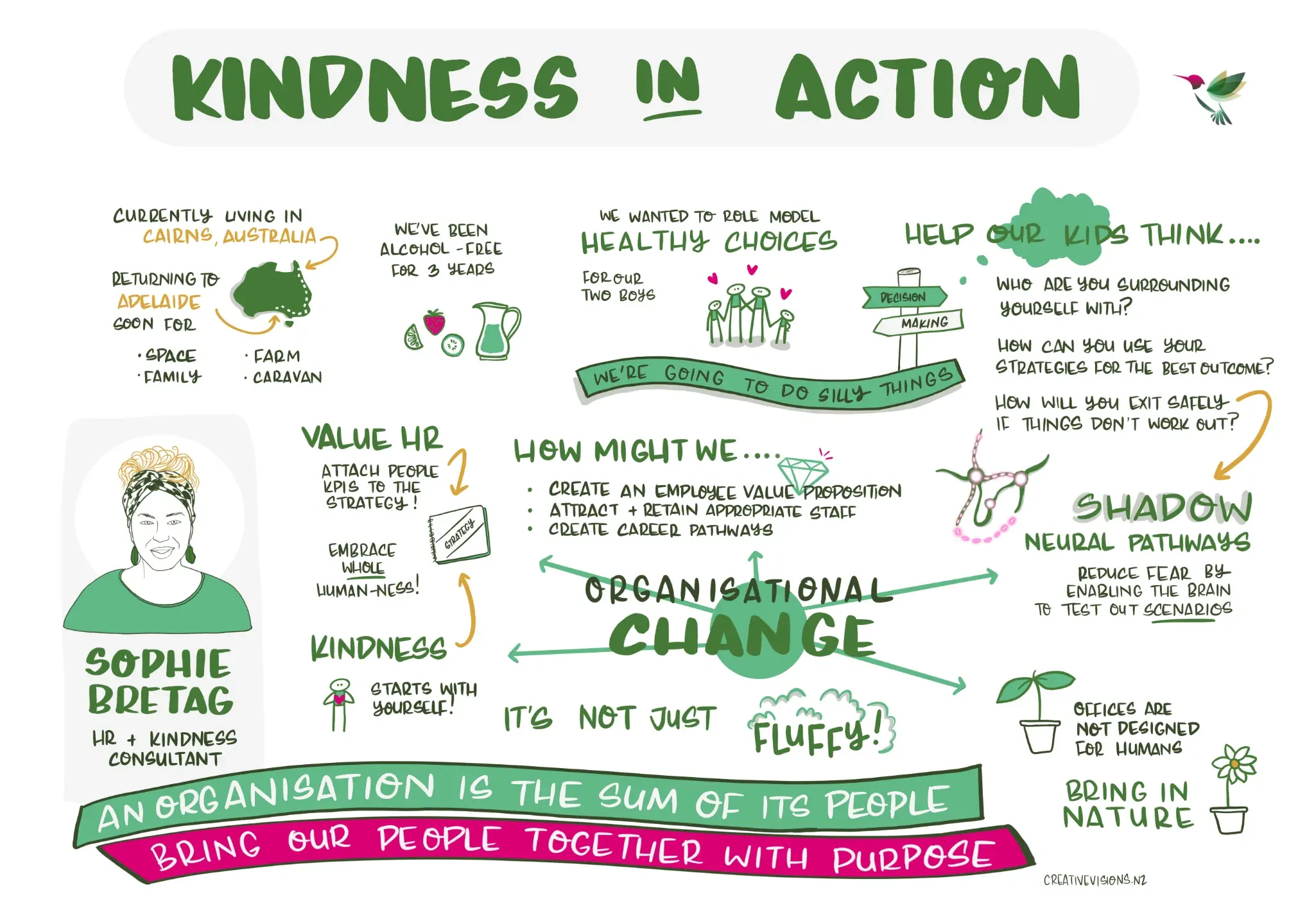
Sophie: Hey, Jules. I'm so glad that we've been able to finally align our schedules after four attempts, I think. Thank you so much for having me today. I'm currently sitting in my home office, which I've made a really restful cocoon for me and my work. Currently living in Cairns but we are actually gonna make the trip back to South Australia, and we're moving back to Adelaide. So that's on the cards for later in the year. We're gonna do three and a half months of caravanning down the east coast; a bit of an adventure. My happy place is in the forest, barefoot, usually with my kids.
Jules: That sounds beautiful but first I have to ask, why Adelaide?
Sophie: I'm from Adelaide. So, I grew up in Adelaide and we've got a family farm in the Adelaide Hills, so we've got 60 acres there. We moved away, wanting to move to Cairns because we were chasing the sun after being with wood fires and freezing cold for most of our lives. We just wanted to try something different, so we thought we'll give far north Queensland a go.
Things have changed a little bit through the years; my Dad has been quite unwell for quite a few years, but we left knowing that he wasn't a hundred per cent at the end of last year. He's got steadily worse throughout the year so he can no longer fly which means that he can't fly up to visit us, like we'd planned. And my Mum wants to move off her farm; she lives there on her own – she's amazing at 75. So, we need more space and we wanna be back to family and friends.
Jules: Weirdly enough, I have a whole lot of family in Adelaide. Sort of strange because I'm originally from the UK, my Mum had two brothers. And both brothers moved to Australia 40 years ago, and they both settled in Adelaide. So I've got an aunt and uncle and four cousins with their families who have all grown up in Adelaide. One now lives in Melbourne with their kids but all the rest live in Adelaide. That's just a really weird coincidence, isn't it!
Sophie: I love that. That means then that you just have to come visit and our kids will have to meet and go run wild on the farm together.
Jules: That sounds perfect. The farm, does it have lots of forests, or is it arable?
Sophie: Sort of. It was grazing land, so Mum bought the land nearly 25 years ago now and it was just vacant grazing land. In that time, she's had cattle on it, she's got horses.
So, my boys have each got — I've got two boys, one's just turned seven and the other one's about to turn 10. And each of them have a pony, so we had to leave them behind when we moved up here which was very sad. They've got a pony each there and I've got one of my old horses there.
Apart from that, she's let it rewild, which has been really lovely. Because we've been watching over the years trees springing up and shrubs springing up, and she's been really quite careful about making sure that any plants she's planted have been native, so that she's attracted native birds and wildlife. It's really beautiful, it's really gorgeous.
Jules: That sounds amazing. And if you drink wine, obviously there's wine growing country around there, right?
Sophie: There is, but we don't drink any anymore. We haven't drunk alcohol for about three years – my husband and I – but we were big drinkers and we used to very much partake in the local wine areas. There's a lovely gin distillery just in Hahndorf as you come in there, and they've got some beautiful gins there. We do the non-alc drinking now.
Jules: What led you to stop drinking, if you don't mind me asking?
Sophie: I don't mind you asking at all. A couple of reasons. We were looking at becoming a healthier couple, and we did No Sugar November. As part of that, we cut out all your chocolate and sugar and the standard things that you would find sugar in. I was a big champagne and sparkling drinker, so I used to love a good glass of bubbles, or more than one. So I thought, well, that's got a really high sugar content – why don't I cut the alcohol out as well? We'd done Dry July, and we've done things along the way where we'd stop drinking for a few weeks at a time and we'd think, it's not really doing anything, so why not just go back to drinking because it's easier.
What we found this time is when we cut out all of the sugar and the alcohol, we felt a lot better. And we got to the end of November, and I know that's heading into the Christmas season, my birthday is the middle of December as well, there's New Year's, and we just kept going. We were substituting and making sure that we had sparkling water in the fridge. We would have fresh lime and strawberries and cucumber and lemons off the farm. We would always have something fresh and lovely to break the habit of reaching into the fridge and grabbing a bottle of white or sparkling. There was that reason and it just organically kept going.
A few years ago, my husband started having quite a few mental health challenges – he's a police officer and he was finding that he was drinking a lot. And often not knowingly, but he would not have an off button so he would keep drinking and keep drinking and then feel really crappy the next day. And then go to work and be stressed and come home and have a few drinks. It was just not a healthy way of living and leading his life.
I certainly have always been a big drinker as well. I used to sell wine, funnily enough, so I used to work for what used to be Fosters and then split up into Fosters and Treasury Wine, so I stayed with the wine part of the business.
I have always loved wine and been a drinker and I just found that I was drinking and then just not feeling very good the next day. And I think I hit 40 and had a big 40th. And then went, I don't have the time, I don't have the energy to feel yuck the next day while my body is taking a lot longer to process something that potentially I don't really need in my life. There's quite a few different reasons.
Jules: It's really interesting how people come to a similar position. I don't really drink either. I was never a big drinker, in fact, until I turned 30, I couldn't stand the taste of alcohol. It didn't stop me drinking when I was at university a lot, but I didn't enjoy it. I drank to get drunk or to do what friends were doing and then I moved to New Zealand and New Zealand does have a good drinking culture.
Sophie: You've got good wine regions.
Jules: I thought, these wines are really nice, so I got into drinking red wine. But I could never keep up with the Kiwis, I have to say.
Then I found that a little bit, perhaps like your husband actually, in that I used to work in Wellington city at that time and I've always done fairly high powered, intense jobs. I'd find myself sitting on the train coming home thinking about a glass of wine. I might only have one glass. But when I found myself thinking about it, I thought, I don't really want to have a dependency, it's just a mental dependency on something. Then I needed to have an operation and I thought, I'll just stop drinking at all a few months before the operation. And then I never started again.
If I'm particularly somewhere warm and there's a nice gin and tonic on offer, I'll have it and I'll enjoy it. But I find that it's one less thing to think about. When you go out to dinner, you don't have to worry about who's drinking, who's driving. You don't have to worry about the next day and that feeling, fog and inertia and what have you.
We don't have to worry about the role modelling for the kids. My partner will have like a no alcohol beer or whatever, or one with alcohol, but he can take it or leave it. I find it's taken off a layer of pressure and organisation and logistics that, we don't need another layer; we've got enough layers. We don't miss it but, equally, if we want a glass of wine at a party, we might have a glass of wine. But it's not a part of our habit, it's not a part of our life.
Sophie: It's about breaking that habit, isn't it?
That's really interesting you bring that up about the kids and role modelling because we were starting to see in our kids, they'd be like, "You're gonna have a glass of wine tonight?" or, "Daddy, have a beer while you're cooking the barbecue."
It really stopped us in our tracks, actually, around what we see, we become. We were role modelling so much other healthy parts of living, that when you see what effect your habits have on your kids and those around you. It's been really interesting to watch them transition because now they have the chat with us, oh I don't think I'll ever drink alcohol. We have the chat, "You can try whatever you want to try, there's no judgement from our part as long as what you're doing is making you happy, and you're with safe people who will take care of you if something goes wrong."
We've been very upfront with our boys to say, "If you want to try alcohol or if you want to try something new, make sure it's with people who will take care of you and that you're safe with. And you're making those strong choices about who you're surrounding yourself with when you do try those things."
I found that really interesting, actually, that you've mentioned that because we are exactly the same – very careful around how we role model particular things to our boys.
Jules: Parenting is a constant adaptation, isn't it, I think as they grow older and they notice things. That's one area that we don't have to worry about. There are other areas like screen use, for example. Terrible role models, and maybe a bit on the healthy eating and sleeping or whatever.
My partner and I joke, but it's not really that funny, is that when we were teenagers, we were in some very unsafe situations. And we're still here by luck, not by any other reason. And luck is cruel.
We don't really want our kids – we've got four between us – we want them to be sensible about risk taking, because they have to take some risks. They'll find themselves in situations where they need to think on their feet, and they need to be clear headed about things. And alcohol is one of those almost sort of invisible risk factors. There's a lot of talk about other risk factors, but actually alcohol is so prevalent.
Sophie: It's so easy to get, too.
You think about the amount of time, and it's funny because my best friend and I were only talking about this the other day – we both said there were times where we're not even sure how we're still alive. Because there were times that you couldn't remember what had happened or you woke up somewhere that you didn't realise you were going.
I think it's really, really good to be having these discussions with our kids because they weren't the discussions that I had with my parents; no fault of them because they grew up in a generation where no seatbelts in cars and drinking and driving was fine.
Jules: Smoking on aeroplanes.
Sophie: I still remember that. I remember because we flew quite a bit because my Dad's English, so we flew to the UK quite a bit when I was younger and I still remember the smoking and my kids are like, "What do you mean people used to smoke on planes?" I'm like, "Right?"
As we grow and develop, hopefully, we can not force our kids not to try things and not to take risks. Because we've always allowed our kids, like I'm sure you have, to make informed choices, but knowing that there's consequences at the end of those choices. I think they're really good conversations to have.
Jules: They are, and they're really difficult as well, and they're constant. My partner has a saying that he says to the kids all the time, "You can do stupid things without being stupid about it."
Sophie: My gosh, I love that.
Jules: He's constantly trying to reinforce the fact that, of course you're gonna do things, of course you're going to try things. But just take a moment.
That's one of the things that I talk about a lot when I'm helping people with decision-making and conscious decision-making is – you can be risky, you can be risk tolerant and courageous and all of those things – but take a moment and just think, be really clear about the fact that you're making a conscious decision and what's your exit strategy?
We say that all the time. I think as women, if maybe our kind of generation, you know I grew up watching the street when I was walking down it.
Sophie: Same. I still do.
Jules: Yeah, that's right. So it's like you apply that thinking into – you're gonna go and do things because you're exploring and you're learning the world and how will you ever know until you've experienced some of that – but just take a little pause and think about consciously, I'm gonna do this and what's my exit strategy.
Sophie: I love that. I love that so much.
It's interesting you bring up the point of watching the street because I don't think that's changed. And I don't think it matters what gender you are. We always talk to our kids about keeping themselves safe, who they're surrounding themselves with, and the same – we don't say exit strategies – but we do definitely talk about who you surround yourself with to be able to make the best decisions and to have the best possible outcomes in whatever you're deciding to do.
Jules: I think for certainly for the teenagers that we have, the street has become the cyber world. The emotional and mental toll can be almost worse for some from the cyber world than a physical toll. But, of course, the physical world is still there. They're really street smart now about cyberbullying and phishing scams and what's real and what's not and who's behind Facebook and all of those ethics stuff.
But that doesn't really translate sometimes into what it's like in the world. You can tell people, you can tell a story, you can tell lots of stories but actually part of the world is going and experiencing those things. So, knowing some of your safety mechanisms and your techniques, that's just as valid.
Going into a big meeting, you have to have a few things like that as well. How am I going to get out of this situation if it turns to custard?
Sophie: That's so true. It's almost a matter of, how do you pull together all of your strategies for creating the best outcome possible and if that outcome doesn't materialise, what's your strategy for either turning it around or exiting in a safe and appropriate manner?
Jules: It's active strategy rather than I've got a plan, it's all gonna work out fine and you stick with that even when the world's crumbling all around you. It's that ability to see what's really happening and make adaptive choices all of the time. I think almost everybody needs to hone, in terms of their skill sets, but certainly kids and teenagers, they're trying to do it all the time. They work really hard at it but it's not easy.
Sophie: I think it's also not easy for kids either, because look at my nearly 10-year-old and he's been making some really not strong choices lately around his behaviour, just at home; at school he's amazing. Really having those discussions with him around what is the purpose behind saying this, doing this, behaving in this particular manner? A lot of the time he goes, "I don't know, I just do it." I think from a developmental perspective, it's really hard to make strong choices when you're developmentally not able and don't have the capacity to understand the consequences.
I think it's a topic that is super important because in the online world, as you know, we're online so much of the time now so we've had to have those discussions around, is the person who they say they are? We don't let our kids go on to any group online gaming or anything like that. Because, firstly, I think they're too young but, secondly, I don't think they have the capacity to be able to make those decisions and know that chatting to somebody, they understand it on the surface but don't deeply understand what the consequences could be yet.
Jules: That's a topic close to my own parenting heart at the moment with a nine-year-old boy who sometimes makes good choices and other times just does not.
Sophie: What is that? My husband and I have just gone, what is nine? He's nine and a half but we're like, what is this? He's hit nine and all of a sudden, he's regressed to a two-year-old!
Jules: I think it's all part of the natural ebb and flow. And it's so difficult for them.
It puts me to mind with this concept of shadow neural pathways. When you're working with organisations and people on change, a lot of what you face is fear. Because they cannot visualise what the future will look like. So in that vacuum, the assumption is that the future will be negative. It's a scary place, I'm not going to like it, I'm not gonna feel valued. And part of that is because they might not have experienced a change like that or a good change – the one that's actually made a difference and finished well.
If you can do scenarios with people, what happens in the brain is that the brain creates sort of 'sketched out' neural pathways, if you like. They're not full neural pathways because those people haven't actually experienced it; they're shadow neural pathways which enable their brains to practice what that journey might look like.
It's such a valuable tool in a whole range of different situations to be able to say, okay, let's look at what are the possible ways this might go? How might this look? What might this feel like? With children, your ability to do scenarios is still really limited because they don't know what they don't know. So the consequences conversation can be quite difficult because it's only what they've experienced, and they find that scenario concept quite difficult to grasp.
But in more professional settings, it's such a useful tool to demystify and put a bit more control back in the hands of people who are gonna go through some sort of process or experience or change. Because they can start to colour it in themselves and be part of that, rather than having that fearful distance myself reaction.
Sophie: Change can be scary; it doesn't matter what age you are. I really like the way that you do that. Do you do that through actual scenarios that have happened or scenarios that could happen and then you work your way through what the outcomes could look like so that they have a capacity to understand what could happen from a positive psychology perspective? Or do you look at some of the negatives and how you could potentially work through those challenges or both?
Jules: Both. Both.
For example, with executive teams, they tend to be – I hate to stereotype but just from my experience – very focused on current problems and some sort of solution to those current problems. The default is to go to a tried and tested process that will magically make all of those problems disappear. And they've gotta make decisions and be visionary and hold the line throughout that process. And it gets really gnarly in organisations, more than they ever thought possible if they haven't done it before.
Being able to talk through, if you do this in this way, these are the kinds of decisions you'll need to make and here are some of the positive or negative options that you might end up with. What you're able to do is to give them a sense of (a) their role in that process but also (b) to help them see just how many trade-offs there will need to be along that path. Nothing is ever a hundred per cent positive. You can't please everybody all of the time.
They have this term here, I don't know if they have it in Australia, about you're either on the bus or you're off the bus.
Sophie: Yeah, totally, or on the train or off the train.
Jules: That's right and it's that if you don't get the vision, if you don't comply with all of our processes, if you don't engage, then you're obviously not right for this organisation.
In some situations, you end up having to get quite hard about that stuff because there's poor behaviour all over the place. But in other situations, you're faced with the consequence of that approach is that you end up with not enough capability and enthusiasm and loyalty and creativity to actually deliver the value and the vision that you want. You might not have lost all of those people who are on the negative side; they're still there most of the time. But your circle of people who are in that zone, who are gonna take you forward and embed all of that vision, has shrunk because of how you've approached that change. It's kind of a lose-lose-lose situation.
It's tough because organisational change like that is full of trade-offs, like timing and cost, and quite often some really hard decisions that have to be implemented.
What I always say to people is you need to understand what's the end of this gonna look like, which is basically the beginning of the hard bit. We'll do a change for you and then you've got the hard bit because you've gotta lead this organisation and this group of people that's left. Your job then starts, that's the really hard target. And that's very difficult for people to understand.
That's where scenarios help – a change process might last a year or six months, and then the embedding of the change lasts five years. So where do you wanna put a lot of your effort is on thinking ahead and making choices that are about the entirety, not just the next six months.
Sophie: It's probably hard coming from an HR perspective because my brain always goes to the people. Often, it's hard for the people within the business to see that long term vision. And being able to partner with a business to help them to implement that change in a productive and more positive manner is a gift I think that consultants like you and I get to do in our work to be able to help support organisations to be, not only good but great. But understanding that along that journey it's not gonna be all rainbows and sunshine.
Jules: No, not at all. I wanted to understand a bit more about your history in HR. Because I have worked in HR, too, although I wouldn't call myself an HR professional. I never do call myself an HR professional; I have people in my team who are. I fell into it because I love the innovation that you can bring from a people perspective to an organisation. It's a different angle, if you like.
One of the things I found about HR is that often there's a whole lot of invisible effort within the HR function that the organisation doesn't see and, therefore, there's a lack of recognition of the value of HR. If you take an HR process, for example, unless it's a very simple one like applying for leave or what have you, most of the organisation will not understand the point of that process.
Sophie: No. So true. I've been in HR now about 15 years and I fell into it as well.
I remember we did a move to the country – rural, so eight hours west of Adelaide with my husband's job, policing. My husband said, "There's a job at the local council," and I'm like, "Okay." I needed work and he said, "It's HR," and I'm like, "What does HR do? Don't they just do contracts and recruit people?" I had no concept – none – and did a bit of research into what is an HR position responsible for? I was just blown away with the amount of responsibility that when you dive into the position itself and it can be as broad or as specialised as you like as well. It's such a huge part of the way the system within a workplace can function or not function.
I got the job, and I did do my research before I went for my interview and loved it. Absolutely loved it. I see a lot of HR people who are not supported, not respected, they are consulted yet probably not listened to. They often don't have a strategic level impact, or a seat at the table at the executive level, and yet are expected to be responsible for all of the people at all of the time. And if they're not behaving appropriately or not productive or not engaged enough or not recruiting the right people, we're not retaining the right people, HR gets blamed for that.
What I've learnt through not only working as an HR professional – I started at the bottom and worked my way right up to senior executive level – really, it's about, firstly, taking responsibility for how you choose to show up in that position and taking care of yourself. A lot of people in human resources burn out, because they are trying to be everything to all the people all the time. And they end up completely over giving and exhausting themselves and not being able to keep the momentum up.
I think there's also a factor there of a lot of organisations not respecting the expertise, and not valuing the expertise of human resources within their business. I think through COVID that changed a lot because everybody just threw their hands in the air and went, oh, my goodness, HR help. And in the process went, oh, my goodness, you actually do all of this, as well as you're trying to keep our people healthy and well?
Certainly, what I saw as I was going into businesses post the lockdowns and all of the really deep part of COVID once we started to emerge – definitely the discussions around mental health and wellbeing, emotional health and wellbeing, workplace happiness, the way that we're leading our people, the way that we're showing up for ourselves, not only for the people in our teams and the clients at the end of the service or the products we're producing – there was a shift.
I'm hoping that is starting to change where HR are being more valued and they're seen as instead of just being an advisor or an officer, an administrative… I think it's shifted from more of the functional systems and processes which all still need to be there obviously for a business to work optimally, but to step into more of a strategic part of the business where, what's the employee value proposition? How do we attract and retain appropriate staff? How do we create beautiful career pathways for people? How do we make sure that while people are here within our business, they're thriving, and they're engaged and they're productive. But also getting to be able to have those discussions at the higher level within the businesses.
I don't think all organisations are doing that by any means, but I do think that there is a shift towards valuing HR more which makes my heart really happy. Because being in HR, I know how much you carry because you're expected to be a confidant and yet you can't confide in many people. You're keeping a lot of information where people offload to you and then just walk away and go, "Thanks so much. I'm glad I offloaded that, now I can go do my stuff," but then you're left with the, "Hang on a sec. You've just divulged this to me, now I need to decide do I do something further with it or do I just keep it to myself and watch and wait?"
I feel that the position is probably not understood as well as it could be, about the mental load and the emotional load, as well as making sure everyone's legislatively compliant. But making sure they're well and they're happy. And then how do you then attach that to the strategy and KPIs and the profit and the bottom line? It's a big job. It's a big job. I love it, though. I just love HR.
Jules: No, it's not weird at all. I think 90% of my consulting team are all HR professionals. And it's not that we don't do people-focused work. I think it's that coming into independent bespoke consulting enables you to do much more of that strategic thinking and that strategic work.
I think what's really interesting for me is that somewhere there's become lost this concept that an organisation is a collection of people. And it's a collection of human beings who happen to work in the same loose structure. And what happens is, you box those people in through processes or naming or functions. Then what's happened with the shift from leadership in the leadership space, is that the responsibility for your little box within the big box of humans has become diffuse. So, it's become the leader's responsibility to care for their little box of humans and make sure that they know the naming conventions and where they fit within this box. And HR has become the process keepers, the legislation keepers, the ambulance at the bottom of the cliff. And I'm not saying that leaders aren't accountable for the health and wellbeing and the team dynamics of their team, but there's so many things that aren't accurate about that picture.
Number one being, an organisation is only the sum of its people. And because of all of that, what happens is there's not enough time and effort put into thinking about the purpose of that organisation. Do we really understand it? Are we refreshing it? Are we clear about the value that we provide? And then helping that loose conglomeration of people come together around that same vision.
Then it becomes HR's problem that people aren't in keeping with the organisational culture that we're supposed to have, or we're not doing our best job for customers; we're letting standards slip, or we're not finding the right people with the right attitude. And then it comes into a change process because we need to change some of the people that we've got.
It's become this tangled web, and this focus on processes and procedures and guardrails. And somewhere within that, the consideration of people, humans, choosing to work together and what's the why – and what's HR's role in helping form the why, check that the why is understood, revalidate the why, make sure that pay and conditions and roles are meaningful in relation to the why. That has become something that's done as part of strategy, and then straight through the leaders. And HR you're just supposed to come along behind and put a whole lot of things in place to make sure that that is happening, which is so boring for HR professionals.
Sophie: Totally, because we're people people.
Jules: Absolutely. If you think about products, product teams will spend a lot of time these days doing customer focus groups and human-centred design processes, user experience testing. They'll train their frontline people on everything to do with how to make sure that the customers buy this product. Then they'll do follow-up email surveys when you've bought the product. So, you do all of this work around your product, but you do almost none of that around your people.
Sophie: I know, it's mind boggling and I've said so many times to so many people, leading people is not rocket science. It's not. You just need to understand that they're humans at the end of the day and they will be driven by different things. But how do you bring them together for the common purpose of achieving what you wanna achieve in business together?
Jules: Done. Solved.
Sophie: Look at us solving the problems of the world!
Jules: Absolutely.
So, talk to us about kindness, then.
Sophie: My favourite topic! For me, kindness, particularly in workplaces, is something that is often missing and I think it dovetails really nicely into the conversation we've already had around people in your business are the biggest asset to your business. So why not treat them with kindness and that they matter and let them know that they're valued, that they're seen and they're heard and that they are more than just a number. I think we've all worked in a business where we are just a number, or we feel like we're just a number.
My first job was at Baker's Delight when I was younger but that was a great job, by the way. I used to love it.
My first real job was working in a call centre on an internet tech support line. Goodness knows why I thought that was gonna be something that suits me but, anyway, and it was shift work. Honestly, I have never worked in such a regimented, less human way than when I worked in that call centre.
I feel that that really showed me what it's like to not matter, but to be expected to achieve particular outcomes, to adhere to particular guidelines, to show up more like a robot and just be expected to just do the job. What I felt when I finally left that job was this huge sense of relief that I could actually work in a position where, and I vowed that I would never work in a business where I was just a number again.
When I look back, kindness within workplaces has developed and grown in my heart. And I know that's why I have such a particular passion for working with particularly care giving industries so people who are taking care of people, particularly vulnerable people, so aged care. I moved into aged care and was in aged care in HR for seven and a half years. And that was probably one of the most fulfilling yet exhausting roles of my whole life.
But I still have such passion for aged care and retirement living and first responders and health care, because without kindness to self and without kindness within those workplaces for those humans, those humans won't survive. That sounds really drastic, but it's absolutely true, because the more that you give out and the less that you are taking care of yourself or the less that you feel taken care of within your workplace, the less you can give the people at the end of that service. And the more likely you are to not stay because you will get tired, you will get jaded, you will get frustrated, you will feel like you're giving and you're getting nothing back.
Kindness has this big cumulative effect and beautiful way of not only supporting the people within the business, but the return on investment is huge. You've got people who are feeling more engaged, they're gonna be more productive, they're gonna have less sick leave, they're less likely to have return to work claims because they'll feel safer, they'll feel like they're trusted, they're empowered, and they'll feel healthier. And that the job that they wanna do and that they are doing is respected and that they're cared about. It's a really deep seated knowing of I've not been in workplaces that are kind before and I wanna change workplaces for other people.
Jules: Which is amazing. Who doesn't wanna work in a workplace where you feel that kindness and that warmth.
What does kindness look like? When you are called into an organisation or a group of leaders and they say, "I'm a kind person. What are you saying, I'm not kind." How do you approach that to get them to understand what it looks and feels like to deliver as well as experience?
Sophie: A lot of the work I do is workshopping to start with and we workshop what does kindness look like? What does it feel like? What does it sound like? Just in general, not in the workplace to start with. It's often quite interesting because people will be like, "Kindness is smiling at someone or buying them a coffee or taking the time to chat to someone or doing something that's outside your comfort zone and you can help them."
Yes, it is, but where we start, once we've workshopped what does kindness look like to you and what would a kind workplace look like and what would an unkind workplace look like/feel like/sound like, we work through that. Then it's how do we implement that?
For me, kindness, when I speak about it, it very much starts with self-kindness. I think that if we are connected to who we are, we are living and leading in alignment with who we are and our values, so values are super important. When we know what we will and won't do and why we will and won't do those things. And then we have the opportunity to hear from the other people within our team around what matters to them, what drives them from a values perspective, why might they respond in a particular way? Why might they do or not do something?
It's this almost 'aha moment' of, if I know who I am and I'm aligned in what I'm doing and I'm not doing and I know that the people in my team are doing exactly the same, and then we can then work towards – what is the common purpose? What is the why of the business? Why are we all showing up at this workplace? What's driving us from a work perspective?
When people can get really clear on personally what it means to them and then how that might look within the workplace as well as encompassing everybody around them, how it might look to them. Kindness can look different to different people as well. Kindness for me is very specific around boundary setting; by setting clear and not rigid but I'm very strict with my boundaries around my time, my emotional energy, my energy levels, my mental bandwidth around what I will and won't take on and what I will and won't keep. That, to me, is being very, very kind because if people know what is expected of them – you can even set the boundaries around in a workplace around, "As a leader, I expect A, B, C and D; within that we'll work together but these are my non-negotiables." Then people feel safe so then it leads into more trust, they feel more empowered once they're very clear on what is expected but also then they know, in this situation, I might respond to this request in this way and then the leader can understand how that person may respond.
For me, kindness is there's so many different layers; it's not just a smile. It can start with a smile; it can start with a connection to the person. But it's very much on how do we lead in a consistent and clear manner so that people know what to expect every time they show up in your presence. People know when they meet me face to face, I'm exactly the same as I appear online. I speak exactly the same way, I am very clear about my values, I'm very clear with what I will and won't do and I'm also very generous with my time with people and holding space for people. Kindness for me, when I talk about being valued or people feeling valued; when I'm listened to and when space is held for me and I'm supported and I feel like I can trust the person I'm speaking to, that's kindness to me.
These are the kinds of themes and topics that I talk through in workshops with businesses and with groups because I feel like a lot of the time we go in and we're told, "This is your job description, this is your team, here's your computer, here's your tour of the office, here's your emergency exit." But if you're emotionally not connected to the team or to your job, how can you possibly expect to be as engaged or productive as you are needing to be to receive and create the best outcomes for the business and for yourself and stay well in the process.
Jules: It's interesting, isn't it, because when you go for a traditional interview, often you're asked what would you do in the first six months in this role? Particularly in a leadership role they ask a lot about what would be your hundred-day priorities to get sorted in this role?
What I find when talking to leaders, particularly leaders who are struggling, is that if I ask the question, what are you in this organisation to do? The answer that I quite often get is, "My job is X, my function is X or I'm a leader of this function," or what have you. My own personal journey of moving to run my own businesses was partly driven by wanting to be able to say really clearly any time I'm asked, "I'm here to do this and these are the reasons why and this is why I work in this way."
It doesn't matter which client I'm with, which of the businesses I'm fronting at that moment, it is the clear sense of purpose and the why. And that then drives the passion and the clear expectations, the ability to say no – which you cannot do with any confidence unless you set those clear boundaries or clear expectations. You can't even have a trade-off conversation with people or yourself if you haven't set your clear expectations, set your service levels – how many hours are you actually gonna work? Are you available on a Friday afternoon? All of that kind of stuff. If you don't know that for yourself, then when people make outrageous demands on your time…
Sophie: Nobody would do that. What are you talking about Jules? Nobody would expect you to be on at midnight on a Saturday night. What?!
Jules: You don't have any way of either saying no or having a trade-off conversation to say, "Here's the reasons why I won't do that, but I will do this," because you haven't actually taken that time.
I absolutely agree with what you say about the induction. You induct people into, particularly a leadership role, and often leaders have come up through the ranks, so they know what to do to do the jobs of the people that they're leading. But they don't know how to necessarily be a leader in a strategic way or a cross functional leader where you've got some areas that they're not confident in the technical part of what that looks like.
We don't, as a rule, have an induction process that talks about, "Here's the purpose of the organisation and here's the values, take some time and think about in the one, two, five, however many years you think you're gonna be here, what is your contribution to that going to be?"
We don't personalise it, in fact, we depersonalise it. We say, "This organisation has these three key values, and this is our mission statement. You need to know all of those by rote." It's meaningless.
Sophie: That's such an English thing, isn't it? My Dad speaks fluent Latin.
Jules: I know. I don't know it, I can't read it; all I could do is just regurgitate it back.
I can know a mission statement of an organisation and have no concept whatsoever about how I'm gonna measure my own contribution, my own success. And therefore, you lose confidence, because you're expecting external validation of your contribution against something which is a 50-year strategic goal that is meaningless to anybody in the organisation.
I really get that point. It seems to me like a lot of organisations are looking for a different way of getting in and breaking some of those habits. And kindness seems to be one of those ones where nobody can disagree with it, everybody wants some.
Sophie: But they can. It's really interesting because people go, no kindness – that's just fluffy, who needs that? Yeah, we all need to be kind, whatever, it's not a strategic objective.
You know what? If people were kinder within business and they understood kindness the way that I understand it and the way that I embody that in the work that I do, they would be absolutely so amazed. Because it has a physical return on investment, and I think that's what people don't understand.
When you start talking about what were traditionally known as the soft skills – so your empathy and your compassion and your kindness and your love – and I'm loving seeing all these discussions being had a lot more on LinkedIn, particularly because I'm looking at business leaders and thought leaders who are starting to have these discussions around, businesses can no longer afford to not take this seriously. And take their human part of their business seriously because you're not gonna attract the best talent. You're certainly not gonna retain your best talent.
It was really interesting, there was a Forbes article released in July around the top – I think it was about 1700 people interviewed or surveyed – and kindness and mental health together were seen as two of the top reasons why somebody would apply for a job and stay at a job, and I thought, hallelujah.
Jules: The word is out there!
Sophie: We're talking about it! Because at a core level, we all know, we all wanna feel like we matter. So the more that we can do that within a workplace for people and the more that we can create a culture that embraces whole humanness – look at me on my soapbox now. The more that we can do that and bring that into the workplace, the more we're going to have happier, healthy, thriving staff who are gonna want to work harder for you. It's just a no brainer for me.
Jules: I completely agree. I guess, I would take that into the realm of planetary kindness. There's a lot of focus still on organisations and leadership and products and what have you and it seems as though we're 20 years behind where we need to be in relation to partnering with nature and the environment.
Sophie: I love your environmental quotes. I'm like, she's my human!
Jules: I've gotten to that point where I'm gonna shout it every time I can, and be subtle when I can. It just seems crazy that we know that mental health, emotional wellbeing, physical wellbeing are all exponentially increased if you have nature, if you are doing good, if there is biodiversity, if you can hear the birds…
Sophie: Touch the grass. You can touch a tree.
Jules: You can feel the gale force winds if you live in Wellington, on your face! It makes you remember that you're alive.
Sophie: And human.
Jules: Absolutely.
Sophie: We've forgotten that we're human. It's really interesting. I love this.
Offices are not designed for humans. I'm gonna say it on the record – if you can't open a window in your office, who would design that? I get so tired when I go into an office that has no windows that I can open and that has no natural light. I've been in offices where there's been barely any natural light so it's the fluoros above. If you want your people to thrive, bring the nature in or let them get out.
Jules: Or why not design an office environment that is a bit of both? It just seems crazy. These glass fronted behemoth buildings that show you the beauty of nature but don't allow you to touch it or to experience it.
Sophie: Or breathe it.
Jules: Years and years ago I lived in Manchester, and I led an organisation that supported asylum seekers and refugees, so it was really, really intense. The local council found a little office for our team to be situated in, which was safe. Because at that time in the UK and quite like now, I suspect, it was dangerous to be working in support for asylum seekers and refugees because of all the bigotry and hatred. This office that they found for us had three sets of bars on the windows and four locks on the door. So I used to get there at 7 o'clock in the morning in the dark and you couldn't really see out because they couldn't clean the windows because of all the security bars, and you couldn't go out walking because it was in an unsafe part of the city.
Sophie: Sounds awesome!
Jules: Yeah, super awesome. Then I'd leave in the dark. So I would be a robot. I was a robot. Luckily we were working for a cause that we were all passionate about – social impact and other people in those kind of social impact organisations are exactly the people who don't get kindness from external, the newspapers or people walking down the street or whatever it is – and they're driven by this innate kindness to do good and what have you. And that drives them for a long time until quite often they burn out.
I can remember it turning into spring and being able to come home seeing a little bit of daylight.
Sophie: It's really sad.
Jules: It's so depressing, now that I think about it.
I am this huge believer in this partnership with the natural world. And apart from anything in 20/30 years, as you'll know from my posts, we may not have a kind of world that's safe. So if we don't start now in thinking, we can be kind, we can work in a different way, we can have flexible working policies, we can have organisational procedures and buildings and energy usage that doesn't take away from the environment but, in fact, regenerates. We can situate that organisation within a local community where it's seen as a valuable part of the community.
We can do all of those things so why don't we do them now, and then we can innovate from there to help with some of these bigger crises that are absolutely just around the corner, if not here already. That's my soap box.
Sophie: I love a good soapbox, as you know, so bring it on, I'd say.
I always bring in nature wherever I am. You can see I've got a plant behind me. I've got another plant on my desk. I've got all my windows open as well. Wherever I am, I have to have a plant on my desk or multiple. I have to have the window open, if I can, and if I don't, I feel like I'm withering and dying.
I know that I'm not alone because I watch people in an office. They'll come in, they'll sit at their desk, they might not move very much, and we all have that happen because we get engrossed in what we're doing or someone who's sitting at a reception desk or someone who's sitting somewhere that can't move. Why not create spaces around people who aren't able to actually physically leave their space? Why not bring that into being closer to them?
All my workshops I include nature connection. Absolutely. I actually do women's connection circles as well so we always have a forest bathing part of our women's circles. And even when I've done keynote speaking, I've brought in nature, parts of nature to incorporate into my presentation and it really surprises people. But the way that it invigorates them, and they get interested and they get really curious and the energy lifts. And it doesn't take much. It really doesn't take much to just bring those little bits and pieces in to energise people.
Jules: Hopefully they're not cutting any trees down!
Sophie: I hope not. I really hope not, otherwise I'm gonna tell them off! It really doesn't take much to bring a bit of the outside in to energise people.
Jules: What's next for Sophie and Metta Leaders and kindness circles and connection circles and all of that stuff?
Sophie: I'm actually taking a little bit of a break from travelling. We're going to travel for three and a half months. So we leave Cairns and we're travelling back down the east coast of Australia with our boys. We're taking our boys out of school so we're gonna give them the school of life for term 4.
What I'm doing in that time, I've got a conference presentation that I'm doing on mental health and kind leadership in September on the Gold Coast so I'm super excited about that. It's at the Workplace Mental Health Symposium. And I've got another couple of workshops which I already had booked in which I'll be doing as well.
But apart from that, I am just gonna focus on doing some ad hoc work around speaking, and then we'll launch into 2024 with a lot more of our women's connection circles. I'm gonna have a retreat in the middle of the year. It'll be an eco-retreat so we're actually gonna make it very connected to the natural world and it very limited, it's all off grid, so I'm very excited about that one. Really getting us settled on the farm and getting our kids settled back into nature and life back there.
In regards to the kindness part of my work, I've got a few articles which are actually due to be released over the next couple of months so I'm really excited about that. I'll be sharing them on LinkedIn and my social media once they're released and I'm able to share that, as a couple of them are national.
Really, for me, it's just a matter of, I'm just gonna be immersing myself in nature for the rest of the year but also really stepping back and doing a lot more writing. I wanna focus a lot more on my why and my purpose and why I'm doing what I'm doing and what I wanna put out into the world from 2024. It's almost like a wintering for me at the moment and I'm just gonna marinate in the step back and the turn inward for a few months, I think.
Jules: It sounds amazing.
I have this concept of daydreaming and how important it is for your brain to daydream about things. The beauty of being on a trip where you might have some lines in the sand of where you have to be somewhere at a certain time, but generally you can go wherever you want to go. It's a little bit like what your brain does when you are daydreaming. It takes you down some roads that you might not normally think you're gonna go, and you end up in really interesting destinations. I would say rather than marinating, which it sounds like you're a piece of meat…
Sophie: I'm gonna roll around in it! Immerse myself!
Jules: I would say you're having an immersive daydreaming marathon and amazing things will come out, I have no doubt.
Sophie: Thank you. I really love that way of thinking about it because, for me, creativity is one of my top five values. And I feel that often, when we are in the doing, the constant doing and the constant planning and we've gotta have this done by this time and that. And I know that I'm in a very, very fortunate position that we're able to do this, but we have actually manufactured our life to be able to do this this way as well. But being able to create spaciousness, will then create expansiveness. And I feel that there's gonna be some really exciting creative projects that drop in over the next six months, and I'm really excited to see where that might lead the kindness revolution into its next evolution.
Jules: Listen, I know it took us about four attempts to get to this call. I also know that we had a big conversation before we even started recording this podcast! And I will definitely take you up on your offer of coming to the farm in Adelaide with the twins.
Sophie: You are welcome.
Jules: Thank you so much. You are a real inspiration to a lot of people. And certainly, I follow everything that you do and I love to see your smiling nature-based videos. They always put me in a good mood so thank you so much for your time and sharing your story. I really appreciate it.
Sophie: It's been lovely. And everything always happens exactly when it's meant to happen, so I feel that we might have taken four attempts to get here but we got here and it was absolutely beautiful chatting to you. Thank you for sharing so openly your journey and your story as well. It's why I love jumping on these kinds of conversations – you get that human to-human connection, and we get to share some more beauty and joy in the world, so thank you so much.
Jules: You're welcome. Thank you.
Thank you so much for listening and thanks, as always, to the generosity of our delightful guests. The stories of how others have faced up to their challenges can help give all of us courage to keep going with our own. For more great episodes, blogs, learning packages, go to the JERICA Global website.
Humans at Work Podcast