
Postscript Moment: ForgottenStories Matter More Than Ever — with Enver Samuel
Humans at Work Podcast | Episode 18
Host: Jules Harrison-Annear | Guest: Enver Samuel
Jules: Kia ora, welcome to Humans at Work. I'm Jules, your host. Thanks for joining me and our latest guest and thanks for taking some time in your day to indulge your curiosity about other people and their humanness. If your thirst is unquenched after this, check out jericaglobal.com. Now let's begin.
Hello, everybody. We're here today for a follow up conversation with Enver Samuel as part of our postscript moment. Enver, you look as if you're in exactly the same place you were last time we talked – your office in your home, am I right?
Enver: You are a hundred per cent correct and I think even the weather's similar – bright, sunny day in Johannesburg.
Jules: That sounds really, really good. Last time we talked, you were about to head off to Singapore for your first marathon in Singapore so tell us a little bit about that. Was it as hot as we thought it might be?
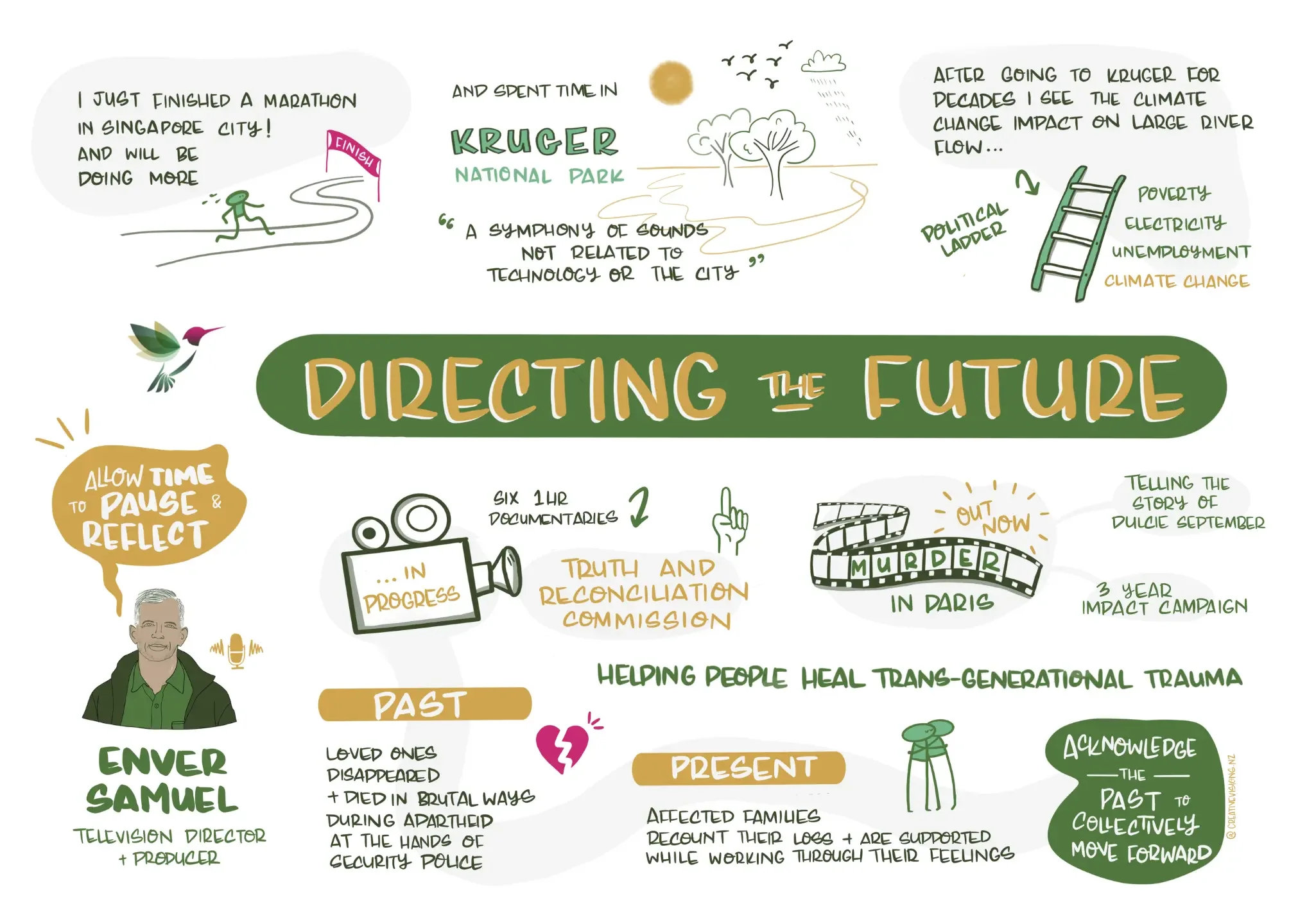
Enver: It was extremely hot, and I think it was a great leveller, because it's the first time I've done a marathon that started so early. I think we started around about 5am or was it 4am? It was some ridiculous time. Obviously, to try to escape the heat! But it was an enjoyable experience to run through the city of Singapore at that time, with all the neon lights. But it started to rain and it seemed to make the humidity level go up another notch, and the first 21km was a breeze and the second 21km was like something grabbed me by the shoulders and said, "Hang on, you didn't actually factor in this humidity!" And the second half was really, really a slog because I did not expect that type of heat and humidity. But I did finish, and I was very chuffed!
Jules: Is that on your list to do again or once done, that's it forever?
Enver: I think for me, at this stage it's like once done and then what is the next one, and in which place can I visit that will be another experience to be there, but to do a different type of marathon.
Jules: There must be an annual calendar of all these big marathons, so what's next in your sights?
Enver: There definitely is a calendar. We have game in South Africa, the Big Five and they talk about the Big Five and those are, for example, New York Marathon, Boston Marathon, the Berlin Marathon and one or two others. I think I'll try the London Marathon.
I mean, I deliberately chose Singapore because I didn't wanna start off with the Big Five. On the map I have the Victoria Falls Marathon, I'd like to do the Great Wall of China Marathon. So for some reason I wanna do those type of ones before I look at the Big Five. And Sydney marathon, too, I'd love to do the Sydney Marathon.
Jules: I think you definitely should because I can definitely come and watch you and cheer you on in Sydney! A little bit more difficult to get to any of those other places, although I'm game, obviously. But Sydney, definitely.
Talking of the Big Five, we were talking off camera that you've just been to a game park for a holiday. Tell us a little bit about that experience.
Enver: There's some points during your work that you really feel that it's starting to consume you and take over your life. We're fortunate here in South Africa that when moments like that come, you can choose to go to destinations that allow you to pause and reflect. And there's no better place, in my opinion, to go to but to what we call the Kruger National Park.
Kruger National Park, I think they say is the size of Texas, the way it's so big – from the north to the south is almost shy of 400 kilometres. In the Kruger National Park, if you do the journey which we did, we started in the north and we went down right to the south, you see the change of the geography, of the landscape. The north is more if you're a bird lover and as you progress further down south, then you start encountering all the animals – the big five.
We chose to do it in the camping sites so it seemed to make it even extra special because you're much closer – literally in the camping sites, then there's a fence and then the other side is the wildlife. And you can choose to do that, which seems to bring nature much closer.
There's nothing better than listening to those sounds and it's not just the roar of the lion, but just those sounds of silence and nature which takes over and the light, the beautiful sunsets and sunrises. It gives you time to pause and reflect and almost start anew when you get back to your normal busy life.
Jules: I love that. I remember, I've been to Kruger and other game parks and it's never silent, is it, actually. But it's a different kind of noise. There's a hum and there's different animals talking to each other, and the insects and the heat; you can, kind of, hear the heat as the sun goes down. It's really, really peaceful, it's a different kind of music, isn't it, that takes you out of your everyday life?
Enver: Yes, definitely, it's a symphony of sounds, but a symphony of sounds that are not related to technology and what we experience in the city. I guess it's going back to where we originate from because that's how it began. There's something so special about it, to see it all there because, literally, if you're looking at a scene or a landscape, it's unchanged and you can say this is how it would've looked 500 years ago, 200 years ago, this is how it looked, and this is how it still looks.
Jules: Did you find – there's a lot of talk about climate change and biodiversity loss and what have you, and obviously Kruger has been around for a long time, and they spend a lot of time and money and effort to protect the plants, the landscape, the animals. Were there any signs of any impact or changes from climate change?
Enver: I think you can see that definitely, if you've had the luck or the privilege to have been going to the park for a number of years. And because my parents are into that, we've gone to the Kruger Park from a young age, we're spanning decades. So I can see that there are some things that are very, very different.
I think one of the biggest things is the flow of the rivers, there are many spots where you say, "But where's the river?" because it's just a little pond or there's no water at all. Some of them are seasonal rivers but even though the huge ones and the big ones, they don't seem to be flowing like they used to; you could see that these were big, major rivers. For me, I think that's, when you talk about climate change, the biggest thing that was noticeable.
Jules: Is that high on the agenda politically and socially in South Africa? The impact that Africa, as a continent, is feeling in terms of particularly global north, they talk about global north and the pollution and what have you. Is that something high on the list of priorities?
Enver: I would say, I think unfortunately not. There obviously is talk and discussion about it, you see it, but you don't see it as a centre stage issue. I think in South Africa and on the continent, unfortunately, there's so many other things that are taking the centre stage that climate change and issues like that seem to be further down the ladder. When we're talking about things like poverty and unemployment and our newest bug bear, the electricity problem, I think climate change, unfortunately, is relegated to the back room, but there is awareness of it, definitely.
Jules: That's a common situation. I think almost every country is in a similar situation where there are immediate pressing concerns that seem to take a lot of the effort and the investment from the environment and other environmental issues. I was wondering how that was being balanced in places like South Africa, where the effect of poverty and unemployment and debt, are so all consuming.
It's sad to hear that it's the common story, really, that there's just no room, there's no head space to think about the longer term because the more immediate urgent things get more news coverage, they get more political coverage.
Enver: Yeah.
Jules: Last time we spoke, you were starting to launch your latest documentary, Murder in Paris and I see from following you since then, that you've been to a number of different countries for showings, I don't know what they call it, premieres, I guess?
Enver: Yeah.
Jules: Tell us a little bit about how that's gone.
Enver: In March, we had a screening in Paris and Amsterdam and quite a few local screenings, in fact, tomorrow I have a screening at the French Embassy for the new Ambassador.
It's been going very well and it's a combination of us trying to follow up on the broadcast because it was broadcast a while ago, but we didn't want that to be the be all and end all; we wanted to continue with its outreach programme or impact campaign. And I think we're doing that quite successfully.
Because next week, I think it's on the 29th of August, we have Dulcie September and her family receiving a huge award here in South Africa, directly related to the impact that the documentary's made because the people that are giving the award found out about Dulcie September through the documentary and its impact campaign.
Through the documentary and impact campaign, we've made her name very present in today's environment because her name was virtually forgotten. It's rewarding to know that something that you made, has resonance even after it had its main goal, which was to be broadcast. I call it it's still living; it still has presence.
Jules: That's amazing. That must make you very proud.
Enver: Yes, and it makes me want to continue along this avenue. I think we did talk a little bit about that on the next project which was the six one-hour documentaries on the South African TRC – Truth and Reconciliation Commission. I've finished the first two and I've shot the next two which we're editing from next week.
We've had test screenings with the first two with the families, together with the Foundation for Human Rights who have facilitated those screenings. The content of these documentaries where the families basically let me into their life of grief because their brother, their sister, their son or daughter or their parent was killed in the most brutal fashion during apartheid by the Security Police. And they talk about that incident of their disappearance, of their torture, literally like it happened last night.
I felt it was very important for them not to just watch this on the national broadcast, I called them and said, "By the way, watch on the 1st of June, for example, at 8 pm."
I felt that they had to come and view and take it in but view under very controlled circumstances. So the Foundation for Human Rights got a counsellor, very experienced counsellor, Bishop Paul Verryn, to mediate the viewing or facilitate the viewing so they were counselled prior to the viewing, during the viewing and after the viewing. So, a particularly poignant moment to see how the families watched, and how they cried, and how they, most importantly, how they felt at the end. That this was a little bit of a tribute to their loved one but also, at the same time, is making South Africans aware of the sacrifices that these people made for this country as it exists today.
Jules: Wow. That must be extremely emotional for you as well. We talked last time we met about your, not fascination, but your empathy and your wanting to understand what sits behind. And what strikes me about those stories is that during that time, there was very little information. It was before the internet, it was before mobile phones. A lot of those things happened where there was state controlled information and there was whispers. But people would disappear and you wouldn't know anything about them. Yes, they may have found out more information and through the Truth and Reconciliation process, they would have got some answers but it's not out there for the world. So those voices were silenced, which was part of the regime's strategy, right? We see that all around the world, even now.
What I was thinking when you were talking is that, for those families, it's finally an end to the silence about what happened to them, what happened to their loved ones and you're giving them that voice and that platform to kill that silence, which is incredible.
Enver: Exactly. A big focus of the series is transgenerational trauma and the majority of the stories have been told through the child, the child's eyes. The child, in some instances, were as young as three months old when their father or mother was killed; some were five years old and so they actually have memory. It varies.
But what it allows them to do is look back into the past but, more importantly, so they don't become just historical stories through the child's eyes or the brother or sister. They become almost living testimonies of the past, the present, because it's how that affected their lives in the past and how it's affecting their lives today, and how is it gonna affect their lives in the future.
Most importantly, did my father or mother die in vain, to a certain extent? When you look at some of the social economic and political trials and tribulations we're facing today because it's the same ANC-led Government that these heroes and heroines died for.
For me, I don't think when they were fighting for freedom, if you look around and see some of the things that are happening in South Africa, I don't think that they would foresee that this is what we fought for. They're particularly important and powerful stories because they're not just about the past, they become very present through the eyes of the child.
Jules: There's that lost opportunity, isn't there, also? People will put up with amazing things if they feel optimistic that it's worth it. Then there's the disappointment when you reflect and you think, well, I'm not sure this is what I dreamed of when I put that effort and that sacrifice in or when my parents or my family members sacrificed so much.
There's also a lot of lessons there for the future, aren't there really, because the value of storytelling is that you can ignore the context or when things… were actually a lot of the messages from the stories, a lot of the experiences would be either the same now or they will be the same in the future, unless something fundamentally changes. So how do we learn the lessons of what's been done in the past, what people have experienced and that utter disappointment, in order to get something better in the future.
Enver: One of the positive spinoffs that I saw, besides the families appreciating that this was giving a voice to their loved one, giving them an opportunity to … there's generally a move of people saying, "Let's look to the present and the future now, because the past is the past." For these families you get a window into, you can't move forward if you haven't addressed the issues of their trauma that they're living with in the present, so in order for them to move forward, they need to address that trauma and it hasn't been addressed. To a certain extent, these documentaries have given them or become like a vehicle for them to address those issues.
We had a mother and a son talking about the death of the father or the husband at a level that they haven't done in three decades. You'd think that they would've done it but they said, "No, decades just went by and we'd never actually addressed it, never talked about it because we just didn't want to go there."
Through some of these documentaries, we actually gave them that cathartic experience of talking about it and talking about it in depth, which they said was like a weight off their shoulders. That's when you feel, okay, I'm doing something that is worth carrying on with because it has such a strong impact.
Jules: It's a very important topic in New Zealand with the colonial history. One of the things that causes a lot of people a lot of difficulty is that recognition that you have to understand and acknowledge the past and the trauma, the intergenerational trauma that is still continuing and has affected peoples' futures as much as their past and their present before you can collectively move forward.
I think it's very much a common drive to put the past in a box and look to the future, but you can only put the past in a box if you haven't had that trauma. Or it only stays in that box for so long and then it comes out in different ways.
That is a very significant topic for New Zealand society, as I know it is in a lot of other countries where there was colonisation. The general today, the present, is built on colonisation and everything that came after that. And somehow there has to be a reckoning, a reconciliation and acknowledgement of that in order to collectively move forward. Or else you stay in those lines where you have that divide, because you've never managed to bridge that divide by that recognition and that discussion and that acknowledgement.
Enver: Yes. I think it's incredibly short sighted of people not to factor in those elements and issues, because all those issues of colonialism have lasting impact that is even felt today. I remember my first time coming to Australia to do my degree in Perth, 1990, I think it was June, and seeing the legacies of that up to 1990 in terms of when I interacted with the Aboriginal community or saw issues around that in the national press and television, and being absolutely shocked that that was the circumstances of their plight.
Then I started to read about it and learn more about it through works of people like John Pilger, I think it was, and then discovered things like extermination policy and then the thing about taking the children and bringing them up in the churches or mission stations. That's why I think to a certain extent, in 1990, I was still seeing the legacy of all that trauma and abuse right there, live in a western first world nation. The same thing would be applicable to New Zealand. And then for people to just not consider that past is really narrow minded because it has an influence even today.
I've just finished a book called The Kaiser's Holocaust, which is about Germany's takeover of Namibia, which was then called Southwest Africa. What they did there with the local Herero tribes was all a precursor to the things that were gonna happen to the Jews in the Second World War – they practiced it in South West Africa. Again, policy of extermination of the local indigenous tribes and concentration camps. So, you cannot pretend those things didn't happen and you cannot pretend that those things don't have an influence on what happened a hundred years later, and how living with that legacy of that trauma can still have an impact in today's world.
Jules: Definitely. I can see that if those are the topics that you've been delving into, why you needed a complete break. I used to work with asylum seekers and refugees when I lived in the UK, and I used to hear the stories and do what I could to help mitigate some of the impacts. But you take it home with you. You can't hear peoples' stories of amazing fortitude and suffering every day, day in day out, and have to delve into that to understand a bit more about it, whether that's for you for your film making or in my situation was to find information so that we could get the help that they needed. You can't just close your mind off to those things.
I used to find that I had a long commute home in the car, and I would try and go through all of those things in my mind and go over those stories so that by the time I got home, they were just echoes in my mind, rather than front and centre.
You do need to have a complete break, I think, to let some of those things go; they never go completely. I still remember individuals and stories from 25 years ago, but your brain does need a break to be able to let those things sift away, if you like.
Enver: Yes. Definitely, because obviously you can never put yourself in the footprints of, say for example, the family that had their mother or father killed brutally, because it didn't happen to you. But through their pain and their anguish you start to feel, whether it's indirectly, you do. And I don't think you'd be human if you didn't start to feel that pain and that anguish and that trauma indirectly. Because you get so close to it as a documentary film maker. You get so close to it because of these in depth, long discussions with the family, that it does filter down to you and percolate or permeate within your being.
Then there's all these other things because you're also starting to research it so you're starting to read about it. For example, I'm looking at the footage of exhumations, of skulls with bullet holes in the top of the skull and things like that, photos and evidence and forensic evidence.
So, no matter how gung-ho you try to appear, it would affect you and I'm lucky that I could pause and then say, "Okay, let's go to the bush to recharge."
Jules: Apart from going to the bush and running marathons, what are your strategies for staying positive and optimistic and driven. Because you have to be driven to take on the next challenge and do the next episode and what have you. What are some of the techniques that you use?
Enver: For example, this year, I've seen how the Murder in Paris documentary of Dulcie September, what a big impact it's had, even after one would say, "Okay, you've done your job, it's been broadcast, it's shown all over the world – move on." But I haven't moved on because the impact campaign is still running, next year will be the third year.
I want to continue because I feel that these stories that I'm telling are very important for South Africans and particularly the South Africans that came in after 1994, after our first elections and who we call the born-frees. I think the more they know about the past, the better they can actually understand our history better.
This year I turned down three of my normal jobs – I told you I turned down a Netflix reality show, two on BBC Prime, so three reality shows I turned down. Because I think I'm convinced that this is the way I wanna go. And even though it might have that subconscious impact that I'm not fully addressing, because you can't always go to the bush to escape, but I think if I wanna outweigh, it's all in terms of the balance of doing good for me and having impact is outweighing maybe the negative impact it could be having on me as a human.
I seem to control it by doing these things of doing the marathons and doing the cycling and mountain biking and running. For now, that is my way of coping. I think at some point I would like to, because I'm reading a book now about the trauma of the brain and how the brain reacts to trauma – very fascinating. It's something you can't escape, it's something that is very present and it's not to be taken lightly.
Jules: That's fascinating. I'm reflecting that I have been on a somewhat similar personal journey since we last met; completely different topic and I don't produce TV shows so completely different!
Where I had always cared about the environment and about biodiversity but in the last year, I have come to the realisation that I have to focus on it much more in my professional and personal life to try and have an impact. But in getting to that realisation, I've had to really look into it all. When you look into the state of the planet, things don't look great; it's very depressing, actually, in terms of where we are and how fast things might go in the wrong direction.
That personal impact has been almost like grief the last six to eight months. And I have what I call the climate change blues where I've had days where I've felt like that weight of knowing, the weight of knowledge of something, is almost like a kind of trauma. But the way to counteract that is to do something about it. The counter to the weight and the enormity, is actually to have an impact and to do impact campaigns and to try and reorient what you're doing.
Your choice is not to do three of your other normal shows, in order to focus more time and attention on the things that are gonna have the biggest impact for good, is a conscious choice. And you do it knowing that you won't have that relief that you get from doing that other kind of work. That's very, very similar to the journey that I've been on.
Really fascinating, because we've texted a couple of times but we haven't really talked about it.
I think the way the brain seems to work at night, is that it takes all of the memories and experiences of the day, and it's like a sponge and if you have a good sleep, it wrings out the sponge, so it becomes dry, it becomes lighter. And then the next day you can listen and hear and see and experience other things and it'll do the same thing every night if you have sleep.
I think it's the same thing with rest, as in taking a break, going and doing something different, going for a run or whatever; it's your brain's opportunity to just get rid of some of the weight of those memories, of those experiences, of that knowledge, to free up a little bit more time and space for absorption again. So that you can analyse and cogitate and do what you need to do.
I do not run marathons, as you well know, but I have been consciously taking breaks every day, part of my technique, to do a short walk in the local area or to go for a swim or even just to lie on the couch. And do that conscious 'not thinking' so that my brain has the opportunity to let go of some of the weight of that knowledge. We have completely different techniques and we're in completely different businesses, but very similar thought processes and conscious decision making.
Enver: Exactly, yes.
Jules: What's next? You've got your next couple of episodes that you need to film and get sorted. Have you got your next project in mind or are you gonna take a little break?
Enver: Karen, my partner said, "I hope the next project you undertake is gonna be a little lighter!" I think I'm gonna disappoint her on that one.
Jules: There'll be another one that just piques your interest and that you cannot resist.
Enver: Yes.
Jules: Well listen, I think, you know we value the work that you're doing. I know that I think what you're doing in terms of giving a voice to those stories is absolutely incredible.
Always great to chat; next time we'll do a longer one because I'm sure we have lots to talk about, rather than just a PS moment. I wanna say thank you again for dropping in and having another podcast conversation with us. Thanks very much, Enver.
Enver: Thank you for giving me the opportunity, and thank you for doing the work that you're doing because I think it's really, really useful in terms of awareness, it plays a very important part. Good on you for doing it.
Jules: Thank you.
Thank you so much for listening and thanks, as always, to the generosity of our delightful guests. The stories of how others have faced up to their challenges can help give all of us courage to keep going with our own. For more great episodes, blogs, learning packages, go to the JERICA Global website.
Humans at Work Podcast