
Systematising the Wellbeing of Future Generations — with Sophie Howe
Humans at Work Podcast | Episode 19
Host: Jules Harrison-Annear | Guest: Sophie Howe
Jules: Kia ora, welcome to Humans at Work. I'm Jules, your host. Thanks for joining me and our latest guest and thanks for taking some time in your day to indulge your curiosity about other people and their humanness. If your thirst is unquenched after this, check out jericaglobal.com. Now let's begin.
Kia ora, everybody. Today I'm talking with Sophie Howe. Rather than introduce Sophie, I'm gonna ask her to introduce herself and tell us where she is in the world right now. Sophie.
Sophie: Kia ora, everyone. I'm Sophie Howe and I was the first Future Generations Commissioner for Wales, the first Future Generations Commissioner in the world! And now I'm helping other countries and progressive organisations to think about intergenerational fairness and how they go about their business.
Jules: And you're in Wales, I believe?
Sophie: I am, I'm in Cardiff, I'm in our capital which is right in the middle of rugby season here, so that is consuming the whole nation at the moment. And it's raining, which it often is in Cardiff.
Jules: I actually have ancestry from Wales. My grandfather on my dad's side was Welsh. He was part of the march to Parliament back in the last century, when times were really tough. He ended up boarding in a place in Essex, coastal Essex after that, where he met my grandmother and ended up staying/living in Essex for the rest of his life. But he was always a very proud Welshman, really good at singing, loved singing, loved his rugby. I think I was a disappointment because I've never been a rugby fan, unfortunately, and my singing voice isn't great. A quarter Welsh didn't really flow through.
Sophie: They say you can take the boy out of Wales but you can't take Wales out of the boy, so it sounds like that was true for your Grandad.
Jules: Yeah, definitely. I often wonder what he would've made of Gavin and Stacey – the TV show. Because of course I recognised both parts of my family and original culture, but I'm not sure that he would've found it quite as funny as I did.
Sophie: You can't not find Gavin and Stacey funny, it's absolutely brilliant, and quite accurate, I think.
Jules: I think so, incredibly accurate, including the little nuances that you'd only really pick up if you'd lived in those places or you'd had family who did those same things. Like the wallpaper in Gwen's house was very reminiscent of my childhood. Incredibly good how they got all the little touches down just right.
Sophie: Here's a claim to fame, the sofa in Pam and Mick's house was my Mum's old sofa.
Jules: What?! No. Hang on.
Sophie: Yeah.
Jules: What? How did that happen?
Sophie: She sold it and then she… I don't quite know how it happened, but it ended up there. She used to work in television so when we first saw it, we were like, "Oh, my God, your old sofa's in Pam and Mick's house!" And then she did some sort of tracing and worked it back so, yes, there we go.
Jules: Wow. Oh, my gosh, that is so cool. I'm sorry but that is really cool because that sofa was the site of amazing scenes, wasn't it.
Sophie: Yeah. Yeah.
Jules: So, tell me a little bit about your family. You live in Cardiff, and I know you've got many, many children because we just talked about them off camera. Tell me who makes up your family.
Sophie: I live in Cardiff with my husband, Kerry and we have five children. We've got four boys and a little girl, she's the last one so she is very well looked after by her older brothers. My eldest is 24 and my youngest is nine.
I often think about that actually, in terms of my own personal experiences, in terms of the way that public policy in Wales has developed. I compare the experience of being a Mum and the experience of my 24-year-old through school and so on, to the experiences of my nine-year-old and there's a lot of positive differences. I think some negative, as is always the case, but definitely a lot of positive differences.
I think it's really important to try and take some of those personal experiences with you, I think those are the things that drive a lot of leaders. Although, also important to recognise that they're your experiences and therefore you don't know what you don't know, and you need to bring in a diverse range of perspectives if you're gonna do a really good job.
Jules: Definitely. I have teenage step-kids and nine-year-old twins myself and even between the 18-year-old and the nine-year-olds, you can see that things are different. Some of those differences are for the better, I think, in the sense that, when the teenagers were younger, things like social media and what was gonna be constructive and positive for people, and when was the right time for kids to have access to social media – I think we didn't know that much then and now we know a lot more. So planning ahead of the nine-year-olds when they're older, we feel a little bit more seasoned.
We often have conversations with the kids about how difficult it is to predict what life will be like. In New Zealand there's a push from the current Government to stop the use of mobile phones in high schools – in secondary schools – for teenagers and, of course, the teenagers are aghast at this policy.
When we talked to them about the fact that we successfully went through school and had friendships and did things and had parties or whatever and mobile phones weren't even a thing, it makes you feel old. But it just shows you that a lot of things do change in a very fast time period. There are some things you can kind of predict ahead and other things will just come out of left field, and you have to adapt to those things as they come.
Sophie: Yeah, I think you're totally right. I think just that one example speaks a lot to perhaps how much we don't really think about preparing us for the future.
On social media regulation and those sorts of things and some of the quite damaging things that it's doing to our kids, we're still nowhere near getting on top of that and yet we have known that for five or ten years probably. Or even if we didn't know for definite, we probably should've been putting in place a sort of precautionary approach to it.
I think that's part of the problem with the way Governments govern – not just in Wales or New Zealand – but all over the world, they only deal with things when it becomes a problem rather than anticipating what might be coming down the track. Then when it does become a problem and it becomes a complex problem, often they're trying to find a really over-simplified solution.
I can see why banning mobile phones in schools is attractive, I can see why you might jump to that but, actually, what we should be doing is really investing in regulation in terms of social media and upskilling parents, teachers and particularly young people themselves on how to navigate it. Because they might not be able to use it in school but then they're going home or they're out with their friends and they're using it all the time, so it's not going anywhere. So instead of having this weird ban during school, I think we should be looking at how do we help people to have a healthier relationship with something like that.
Jules: It's a really good point and I think it's a common one, particularly with Governments.
We're seeing the same thing with AI. AI is already out there, it's been coming for a long time but, actually, there's always this surprise at how fast it becomes a reality. I know that there's a lot of work looking at guidance and regulation and what have you, but the fact is, it's already out there, it's already integrated into a lot of apps, people are using it, organisations and companies are using it, copyrighters are using it, it's there, it's in the environment.
Yet, when you look at Government that I have been involved in, they're still trying to work out whether or not they should be participating in it. But that decision, that question was five or ten years ago – that's when that should've been a discussion. Because now they're left behind because everybody else is already on that track.
The opportunity to create positively the conditions where it will be a constructive, helpful tool have sort of been left behind; we've lost some of those opportunities and now it's rush, rush, rush. A lot of risk management and risk mitigation when, actually, the time for thinking about that was a few years ago.
You short-change your own processes, you short-change your ability to engage with your communities, to think about the possibilities, where it'll work, where it won't work, how do you wanna shape that. Because you don't get onto those things until they've become a reality.
Sophie: I think you're absolutely spot on there. And what happens is that the private sector and the developers are developing, and by and large because of our economic model, they're developing for profit, aren't they? They wanna be the first to do this thing and to capitalise on these tech advancements. The public sector and Governments are very slow to catch up with that, either to regulate or to keep it in check with the public interest in mind or to actually capitalise on it themselves for public good.
I can remember talking to a Google executive who said, "I could have my developers sit in a room for probably two or three hours and develop you an algorithm around tracking, on the basis of their interaction online, who's likely to develop diabetes in the future, for example." And what then happens is that's usually done to target selling stuff for those people because they're more likely to buy when, actually, you turn that on its head and if government were using that effectively, you could target them for public health interventions, couldn't you?
I think you're absolutely right in terms of often there's this jet ski, if you like, of private sector and this slow steamboat of public sector trying to catch up with it, and I think there are quite a number of problems that emerge as a result of that.
Jules: Wales, perhaps surprising to parts of the world, is one of the first in terms of this concept of future generations, and policy making and investment decisions that don't just think about today and today's communities and today's Government agenda but thinking about the future. Can you talk to us a little bit about the Wellbeing of Future Generations Act and how it came to be?
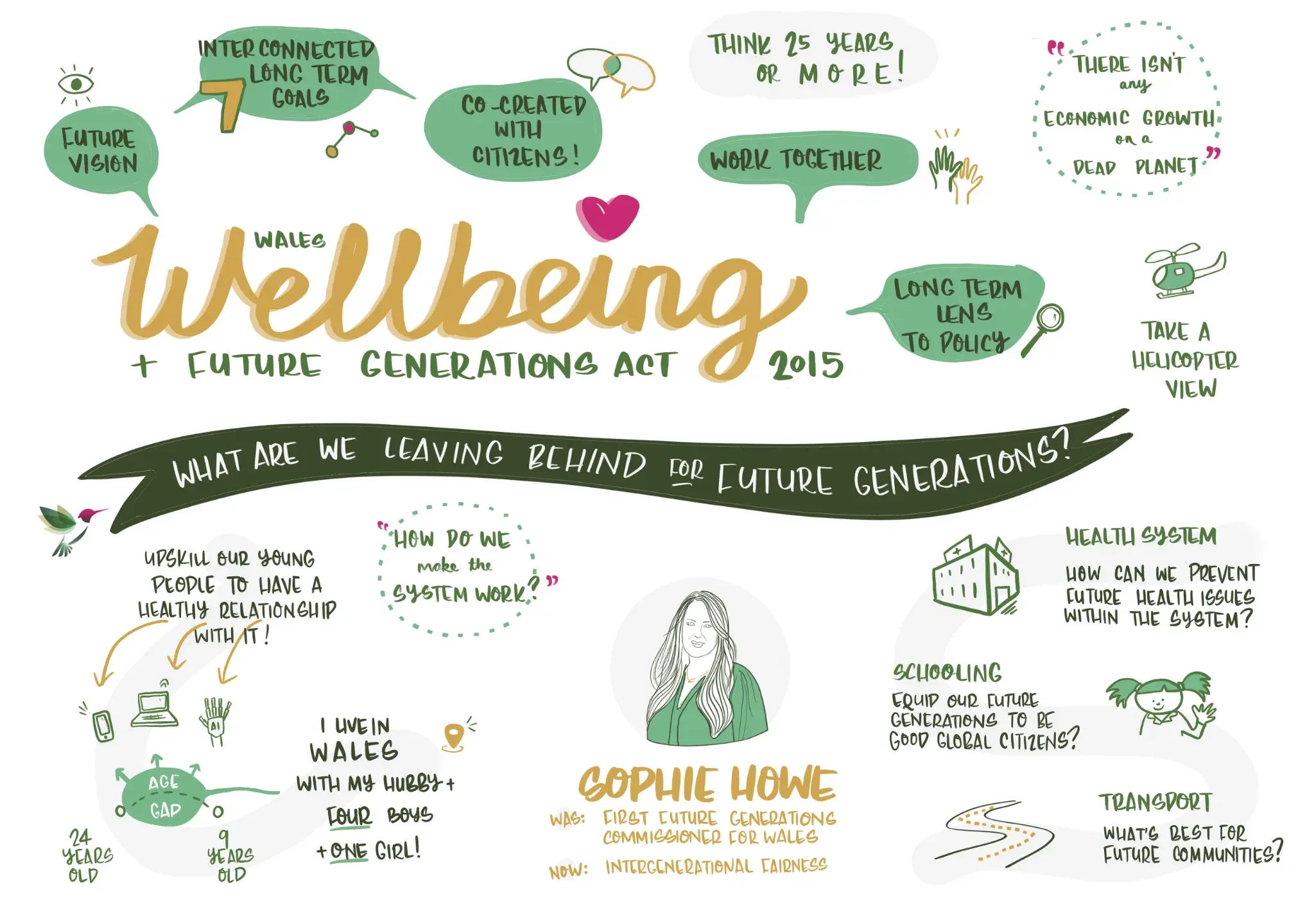
Sophie: The Wellbeing of Future Generations Act was passed by the Senedd, which is the name for the Welsh Parliament, in 2015, and it does a number of things.
First of all, it sets out in law an overarching principle that when we're taking decisions, we must seek to meet today's needs without compromising the ability of future generations to meet their own needs. So that's an important principle.
It then sets out seven long term wellbeing goals. A few interesting things about that:
First, they're long term so they don't change from one parliamentary term or one electoral cycle to the next. Second, they're wellbeing goals – so this is broader than needs, this is beyond GDP – this is the stuff that is the fabric of social policy that supports people's wellbeing. Third, and really importantly, they were co-created with citizens.
As this legislation was conceived, the Government thought we should do something like this. If I'm honest, the Government didn't really know exactly what it should be; the concept is a strong one but how do you legislate it and make it a reality?
They actually held a national conversation with the citizens of Wales. It was called "The Wales We Want" and it posed the question: "What's the Wales you want to leave behind to your children, your grandchildren or future generations to come?" It was the citizens themselves who came up with this vision, and that vision is set out in the seven wellbeing goals.
The final thing that's really interesting about them is that they're all interconnected. We've got a goal, for example, of 'a prosperous Wales' which talks about a productive, innovative, low carbon society, which uses resources efficiently and proportionally and acts on climate change. You can see there we're moving our definition of prosperity beyond economic growth being the be-all and end-all of everything and towards prosperity or growth that has to be within planetary boundaries.
Then, for example, we've got the goal of 'a healthier Wales' which is around creating the conditions where people's physical and mental health and wellbeing thrive. That's really interesting because if you link that with the definition of prosperity, we're not gonna have good health if we're living on a planet that can't survive.
What it's really trying to say is that all of those seven goals – for cohesive communities, for a more equal Wales, for a Wales with a vibrant culture and thriving Welsh language – they all intersect and link together. And they try to get beyond different departments of Government doing things in silos, and recognising where all of those things come together.
Two other main things that the legislation does: it sets out five ways of working.
How do we need to act in Government if we are to meet that principle? We need to apply a long-term lens to our policy; don't just do things by only considering what the implications would be in the short term. We need to aim to prevent problems from occurring or from getting worse – what are those preventive interventions we can put in place? Integration – recognising the connections and working together right from Government down to all layers of public services, and increasingly so with the private sector and the voluntary sector. And we need to involve citizens in that process because citizens are often their own experts – they know the sorts of things that would work in their communities.
Then finally, it establishes a Future Generations Commissioner – so that was my job for seven years. My job, well it was a pretty cool job description, if not a little overwhelming; it was to be the guardian of the interests of the future generations of Wales.
I think when I was an 11-year-old, I didn't ever think I'd have a job description like that! Essentially, it was to hold the Government and all of the other public institutions covered by the legislation to account on how they were applying that legislation, and also to advise them and support them on the things that they could be doing better.
Jules: I've got so many questions about that; I'll try and be systematic about it so that I don't miss any.
I suppose the first one I was gonna ask is, the legislation and that vision that the legislation delivers on, is a really mature vision. I guess I wanted to ask about the citizens conversation and how difficult was that? Was there a lot of informing people and educating people about some of the problems and the systemic approaches that have caused those problems to exist going forward?
How much of it was educating people? How many trade-offs were made between people who really think about economic prosperity as being the thing that will drive wellbeing for everybody versus people who think more about holistic approaches? Were there any big rows? Were there any trade-offs? What happened in those conversations to get to that point?
Sophie: Of course, there were differing views and differing emphasis, but I think there's something quite unique about Wales in that we've always been a country which is left of centre; there's always been a Labour Government in Wales, for example, since 1999 when the first Welsh parliament was elected.
Wales has a very strong sense of community, that goes back generations and generations. And I think, increasingly, we've had this interest in our place in the world, particularly from an environmental perspective. Wales is tiny, it's just over 3 million people but our history in terms of coal mining – the first million-pound cheque for coal was signed in Wales – so we have that… some of us perhaps look at a debt to repay to the rest of the world.
I think that, linked with some of the things which are really important to people in Wales, which is our landscapes, our heritage, those sorts of things and how some of that was being damaged as a result of our actions, those were the things that really were driving a lot of the conversations. There wasn't a huge "it's economy or it's environment" divide; I think there was this maturity in the conversation in realising that actually they're really intertwined because there isn't any economic growth on a dead planet, so we need to be looking at things in that way.
In terms of some of the practicalities and how things might've been different… we held this national conversation in 2012/2013 so over a decade ago. If we were running it again now, we would be doing it differently; we would be much more astute in terms of applying a futures lens to things, using better foresight techniques, and you would have probably a much better digital engagement and participatory governance approaches.
The other thing is that the legislation was only proposed to apply to the public sector, and that's because of the devolved competency of the Welsh Government they couldn't apply this legislation to the private sector. Whilst the private sector did engage, they weren't fully engaged with it. If this had meant putting some really stringent duties or regulations on the private sector, then maybe the conversation might've been different.
But the investing in public transport argument has won the day and that hasn't always been popular with the private sector. I was actually listening just last night, on a Welsh political show, to the director of the Confederation of British Industry, which is the umbrella group representing the private sector in Wales, and he actually said, "I think we've accepted that reaching net zero means we need to take some different decisions on transport."
What starts to happen is you set a direction, co-created by citizens. There's that thing about a grief curve, isn't there? People are initially in shock, then they're outraged or really upset, and then there's a kind of acceptance. I think we have gone, in some circumstances, through that and in other circumstances we're still going through that grief curve.
I think the interesting thing as well about the legislation in Wales is that what people really like is that it sets this long-term vision. Even the private sector will say, "Well actually, we know where the country's going." Even if there's a change of First Minister or change of Government or whatever it might be at the next election, we still have these seven long term goals, so we know that's the direction of travel. That's pretty useful to all sectors, actually.
Jules: In terms of future generations, how far ahead does the Government and does this thinking tend to look?
The reason I ask that is, personally and professionally, we take a seven generations approach, which is borrowed from indigenous Canadian people. But when we're working with organisations, for example, in my consulting practice, seven generations seems far too long. People find it really difficult to think that far ahead; they find it a lot easier to think in terms of 10, 20, 30 years, in terms of those kinds of chunks, if you like.
How does that play out in Wales in terms of this future generations and who are they?
Sophie: Our starting point is it should be at least a generation, so about a 25-year time span, because I agree with you that the further out you go, the more obscure it gets or the more difficult it is to pin down.
I think, however, the concept of saying, "What am I leaving behind to the next generation and five, six, seven generations to come?" – particularly when we're thinking about things as fundamental as the foundations of our planet, our environment, nature, biodiversity and so on – I think that is a frame that we should be looking at, that kind of seventh generation thinking.
In terms of the real practicalities of, "I'm a local authority or a local council and I need to set a plan," we're looking 25 years into the future, which is still incredibly difficult for the public sector. If you think about it, you still have annual budgets and you still have elections every five years and you still have all of these things we're still trying to navigate – but that's the premise: 25 years.
Jules: It's an interesting one, isn't it? Because when you think about big investment decisions, often they are quite long term. You think about return on investment, it's easy to see it in things like infrastructure because it takes a long time to get the consents and then it takes a long time to build or develop the roads or get the buses or whatever it is. And then it takes a long time to recoup or to see the full impact of that. In infrastructure investing, people are quite used to thinking fairly long term.
But in other public sector settings, often the resources are so stretched that people on the ground or the people making the decisions are just trying to get through the next months or balance this year's budget or what have you.
I think there's been this real dissonance in terms of the kinds of thinking that people are empowered to do in those different kinds of public sector environments, but also the conditions that enable them to do that. Things like annual budgets and quarterly treasury forecasting and all of that sort of stuff, make it quite difficult to have those, often contentious, conversations about actually doing this because it's for future generations, as opposed to doing it to get us out of this hole right now.
Sophie: Yeah. There are still those tensions in Wales. Just because we've got this piece of legislation, it doesn't mean that suddenly we've changed the public sector habits of a lifetime and all of the regulation and the performance metrics and the budgeting processes and so on that have been going on forever.
But there are particular mechanisms in the Future Generations Act which help to guide us away from that. For example, in each local authority area there is the establishment of something called a Public Services Board. That's bringing together all of the key public services plus the voluntary sector, the private sector and sometimes further education and so on, in each of that area. And they have a statutory duty to set a long-term wellbeing plan collectively. This is where joining the dots is really important.
For example, the sorts of things that are happening as a result of that – we've got a health service, which I think like many health services across the world, is under massive strain. Because we've got an aging population, we've got all of the long term health conditions that we haven't dealt with because of our poor diets and air pollution and a whole range of other things. The health service is really struggling to cope with that and they're just on this constant hamster wheel of trying to treat, treat, treat, medical interventions for more and more people with this increasing demand.
Actually, a public health intervention in terms of how we view it in Wales: one of our Public Service Boards seconded a public health consultant into the council to lead on the development of the transportation strategy. Because when you start applying a public health lens to what is initially set out as a transport problem – we've got a problem with congestion and we need to reach net zero – what he is able to start doing is saying, "Well actually, maybe we need to be looking at where are those areas with the highest levels of air pollution, the lowest levels of life expectancy? How can we use active travel, increase in walking and cycling to get people active and exercising because that's good for their health? How can that also bring down air pollution in these areas? How can we invest in these areas to help to improve public health whilst also having those positive effects on the transport problem that we started with?"
It's those sorts of integrated long-term solutions that are really, really important.
And there's the challenge, isn't it, that we're trying to shift to preventive spend, whilst demand for all of the problems that have occurred because our predecessors didn't do any long-term preventative thinking, we're having to deal with those problems now. I think this is an incremental approach to doing things differently – it's not a big bang.
There have been some big bangs in Wales like we're not building roads anymore, for example, but in many cases it's that incremental approach which helps you to frame, okay where am I going and how do I need to think about this problem differently and with other partners who can help?
Jules: I do wanna come back to the roads thing, but I just wanted to look at that a little bit more in terms of applying that thinking into things like the education system and what the younger generations are being taught and how they're being taught. So that by the time they get to being in those jobs or whatever, it's quite natural to think in that preventative way. Is that happening as well?
Sophie: Yeah, one of the things that the Future Generations Act has helped to deliver is an entirely new school curriculum for Wales and it's built around our seven long term wellbeing goals and the whole Act itself. It's quite future focused and it moves away from rote learning, an education system which imparts knowledge on kids, towards the development of the skills that are gonna be relevant for the future.
Four key pillars of our curriculum are:
First, developing creative and enterprising citizens. Why is that? It's because when robots take over the world – I joke a bit – but when robots take over the world what's gonna be really important? Human creativity. The things that make us human.
Second, healthy, active and confident learners – so the physical and mental health of kids in Welsh schools is as important a part of the curriculum as learning maths or English or history or whatever it might be.
Third, my particular favourite – ethical and informed global citizens. Now imagine if all of us had been through a school system which taught us to be ethically informed citizens. I'm 46 – and those of us who are 45 and up who are in that category of leaders at the moment, if you like – what if we'd all been through an education system which taught us to be ethically informed about what our actions were doing, not just on our doorstep but in other parts of the world? Or about the climate, or about how the economic system favours some people and definitely not the majority of people. Might we have a completely different perspective? I think that's our aspiration in Wales – that we equip our young people not just to be global consumers and to go on and get high paid jobs in the future, but we equip them to be global citizens as well.
Jules: It certainly would've created a whole lot less angst, I suspect, for our generation. I'm 47 so join me in the mid to late forties. Certainly, a lot of people that I talk to, and my own experience, you're working away, and all of a sudden you start to realise that the environment and biodiversity are seriously at risk. It was always there but it really wasn't part of the narrative; it wasn't part of everyday work conversations; it wasn't part of my degree, for example.
You have to learn about that later and it really does force you to rethink your whole ethical framework, your internal one as well as your external one. And a lot of people find that incredibly distressing because it's like the life that you lived before was a lie or, even worse, you have that real sense of guilt about future generations because you've got this missed opportunity, that the rest of your life was a missed opportunity to stop pushing all of these problems further down the line.
I think a lot of people really struggle with that and some people find that, actually, the grief is too much. There's quite a lot of work now in helping people psychologically work through that sense of grief and guilt and helplessness to get to the other side which is, well okay, regardless of what's been done before, I can act now to be part of the solutions and part of the new world.
But certainly, a few years ago there was no sense of that. People just hit a brick wall quite often and were flabbergasted by all of that stuff. I find it really interesting that we're now nine years after that legislation and that citizens conversation which, on the one hand, seems quite short but actually it's quite a long time since Wales were grappling with that same conversation and those same kinds of things. And I guess you must find that other countries are at different stages in terms of getting to that point, and they look to Wales for lessons and guidance and a bit of national help, in terms of getting over that hump and thinking those things through without being paralysed in terms of where to go with that.
Sophie: Yeah, absolutely. I think sometimes when you describe it – it came into force on the 1st of April 2016 – and if suddenly overnight every aspect of the legislation had to be implemented to the letter, it would be completely paralysing for the public sector.
As Commissioner, that was something that I really grappled with. We've got this new and aspirational legislation, and the eyes of the world are on Wales and the United Nations came to Wales and said, "What Wales is doing today, the world will do tomorrow." No pressure! So, we need to make it work, we need to make it do something, but we also need to not absolutely terrify the bejesus out of people. And you have to start where people and organisations are at. It's been an iterative approach.
And I think I have always described it as the biggest cultural change programme Wales has ever seen, because if I was a commissioner that came in and was finger wagging at people and saying, "You haven't met this specific statutory duty correctly," everyone would be tied up in knots.
What we did find that was really impactful was that we sought to find these people that I call the "frustrated champions". These are people who are out there in every sector and there's thousands of them in the public sector:
It might be the family doctor who's seeing one generation to the next of the same family having the same preventable health condition. It might be the social worker who's seeing one generation to the next of families going into the state care system because we've never broken that cycle. It might be the highways engineer who built a road 20 years ago to deal with the problem of congestion and, lo and behold, that road is now full again, and we still don't have any different alternatives for people to travel.
These people who are in the system, who are frustrated by the system, can see that there's a better way of doing it, but the system has stopped them doing that. I think that's the real power of this legislation because it gives those frustrated champions permission to challenge the system. It gives them a legal mandate – and this is often the legal officers or the finance officers or those sorts of people who run our public services – if that's the thing that floats your boat, here's a piece of law that says you've gotta think about that. You've also got the power of the mean and nasty Commissioner who's gonna come and potentially tell you off if they're not gonna do it. Or is gonna be your biggest cheerleader if you are going to get with the programme and showcase and highlight the things that you're doing.
And I've spent a lot of my time calling out the madness of short-term thinking, so asking those questions, holding the mirror up saying, "Why are we doing it like that and how have you applied the Future Generations Act?" A lot of the time, as well, doing things like introducing civil servants in one department to civil servants in another department to say, "You're building 20,000 affordable housing over there and, in this department, you're doing a new skills plan. Maybe your skills plan should include the skills to build 20,000 low carbon homes, because over there we've got a commitment to being net zero in housing."
A lot of it was taking that helicopter view, a long-term helicopter view and joining the dots.
Jules: I was gonna ask about the transport question. I mean, this is such a common thing that countries all around the world are dealing with. How do people get around and do EVs negate the need for public transport or not?
And I think one of the interesting things now is that, certainly in New Zealand and in other countries, there's this question about infrastructure investment in things like roads when climate change means that they will last a lot less, that the need for maintenance will be much higher than it used to be. It used to be that you might say 'this road will last for X number of years with a little bit of maintenance every couple of years' but now with the amount of rain and storms and soil erosion and a whole lot of other things, that return on that investment is getting shorter all of the time.
You see it a lot also in places like Fiji, where donor agencies have come and they've built infrastructure as part of their donating towards the country's growth and economic development. What you see is that the effects of climate change are felt really, really strongly by small island nations and those things that were supposed to be 'the answer' to some of their issues – they never were really the answer, and they're not lasting very long, because none of them took into account the fact that those nations would be hardest and first hit by a lot of these climate changes.
Talk to us a little bit about the transport decisions that were made in terms of future investment because I think it's a really good example.
Sophie: The starting point is that all decisions that the Government take, whether it's transport or anything else, should seek to maximise the contribution to our seven long term wellbeing goals.
That's quite a different construct because usually we say, "Right, well this road is full, or this road is no longer fit for purpose. What's the answer? We need another road." There's hardly really any other consideration. If you applied a futures lens, we would say, "Okay, well we do have these challenges in terms of reaching net zero but it's okay because we're gonna move to EV by 2035 and so on."
Now, if your sole mission was to deal with net zero and build a road infrastructure that could cope, actually, putting all your eggs in an EV basket is probably quite sensible. But if your mission, as it is in Wales as set out in law, is not just to decarbonise and enable people to travel, but it's also to improve the health of the nation; to create the conditions which maximise physical and mental health; to build cohesive communities; to develop a more equal Wales – then, actually, putting all of your eggs in an EV basket is not the answer at all. Because what we know is that we'll all be sitting in congestion in our electric vehicles rather than our petrol ones, still getting fatter and not talking or interacting with our communities or our neighbours.
If you're from a poorer background, the chances are you're much less likely to own a petrol car and you definitely won't be able to afford an electric vehicle. So actually, if we're trying to address inequity, a much better investment is in public transport.
That's where, when you start to apply this holistic wellbeing lens to a problem, you often come up with a different set of solutions. That's essentially what we've done in Wales – we've applied that principle starting with one big test case of Government plans to build a motorway using the entire of their borrowing capacity to deal with the problem of congestion, which I intervened in. I essentially held a mirror up to them and said, "Explain to me how you've applied the Future Generations Act to this decision," which they really struggled to do.
There was a big public inquiry and a very public spat and debate and so on between myself and the Government and various different sectors. But, to cut a long story short, the Government changed their mind and cancelled the road and set up a commission to look at what were the alternatives that would best deliver against those seven long term wellbeing goals.
Then I intervened further to say, "Okay, I want you to show me how you've considered this for all of your infrastructure spending on roads, how have you applied the Future Generations Act?" There was a bit of a gulp at that point, I think – they were like, "God, we haven't really done that and now she's asking us to show her how we've applied our own law. This is awkward."
Again, they did a big review following a lot of pressure and some brave decisions by the Welsh Transport Minister. And 55 pre-approved road building schemes were considered, and I think 49 or maybe 50 of them have been cancelled completely, because they don't stack up when you apply the future generations and wellbeing lens to them. What is happening with the money that we would've been spending on building roads – that investment is going into public transport instead because you get better wellbeing bang for your buck.
Now, that all sounds sensible and quite good. However, it's obviously not without its controversy. Because if you're trying to get to work and you're stuck in your car in traffic all the time because this road is congested, you're not very happy. And, still, although we're shifting the spend into public transport, there is a long lag between when you take that policy decision and when you actually have new trains and bus routes and so on.
There's this period in the middle, and we're in it now in Wales, where we're having to hold our nerve; where we're saying we've taken a long term decision, there is likely to be some short term pain – i.e. you're not gonna get a new road by next year or the year after, and you probably won't get new public transport until three or four years down the line. So it's gonna be a bit miserable now, but in the long term, we can't just keep doing the same things that we've always done – build more roads and then we fill them, and then we build more roads and then we fill them, and then build more roads, and every time the emissions are going up and poor people are still disadvantaged because they don't use the roads because they don't own cars.
None of it's easy and it still takes a lot of bravery, but I think what applying that holistic lens does is it forces you to take a different perspective and consider things across the board, often then with those different results.
Jules: You said earlier that when you were 11 you could never have projected forward that Future Generations Commissioner would be your job, and how could you have; most of us at 11 want to be a nurse or a firefighter or a superhero. When you were given that job with the no pressure job description – basically, sort everything for the next lot of generations and don't mess anything up, Sophie, catch all of those things! I would imagine that there was a moment where you thought, oh, shit, and then had to put your big girl pants on…
Sophie: Several!
Jules: …your superhero outfit underneath your clothes and what have you.
So, I guess my question is how did you, and how do you, because you're still involved in this work, personally balance having to have that system view all of the time, and needing to know enough about a lot of things to be able to have those conversations and hold those mirrors up? How did you get to that point? Obviously, it didn't happen overnight, unless you really are a superhero.
How did you get to the point where you had that courage and enough of that knowledge and enough of those skills to be able to be part of those conversations, and take that power and responsibility and really use it for that greater holistic good?
Sophie: In some parts I go back to my childhood. I grew up in an area of Cardiff which was always featured in the top 10 of the Welsh index of multiple deprivation – one of these areas with high levels of unemployment, high levels of teenage pregnancy, low levels of life expectancy and so on. Actually, both my parents worked which was quite unusual for that area and by virtue of the fact that they worked, I actually went to school where my grandparents lived which was in a much more affluent part of Cardiff.
The thing that I really take with me throughout my entire life and career is the difference in the life outcomes of the kids that I played with on the street versus the kids that I played with in school – the level of aspiration, the level of opportunity and accessibility to different experiences and so on.
And so, I suppose everything I've entered into in my career has been about that sense of social justice. Why is it that by virtue of the fact of the place that you're born, your life should be determined? And, I suppose, increasingly as I entered into this world, why is it that by virtue of when you're born, your life should be disadvantaged or not?
Early in my career I was elected as a local councillor at the age of 21 because I really wanted to make a difference and I wanted to advocate for that community that I grew up in. I suppose that early grounding in local politics led to understanding how the system worked. I fairly quickly found that the system is mad, the system is completely not joined up, the system often doesn't do the things that are blindingly obvious that it should do to solve the problem. It just puts all these sticking plasters on it and does stuff for the benefit of the system almost, or what's easiest for the system rather than what's gonna be actually right for people and communities.
The thing that's really driven me throughout all of my career is: how do we make the system work for people and the issues that are affecting them?
I've worked in various aspects of public sector. When I was 11, I wanted to be a Police detective. I did a stint as the Deputy Police Commissioner in one of our biggest Police forces and it wasn't quite the guns and the breaking down doors that I thought I might be doing when I was 11; it was actually far more interesting than that. It was about saying, "Hang on, we're dealing with 35,000 incidents of domestic abuse every year in my Police force alone, of those, there are 6,000 victims which means that people are victims multiple times so whatever it is that we're doing is not working, is it? Victims are reporting to the Police and it's happening again and again so what is it that we need to be doing to transform that?"
And actually, the answer was not necessarily what the Police needed to do; it was about earlier intervention, it was about getting upfront of, into the education system and challenging what the concept of a healthy relationship was. The reason I'm giving that example is it's about thinking about things in that system way. My thing is always asking why. Why does that happen? Okay, so why is that? And why is that? Until you keep going back until you get to the root cause of the problem, and that's essentially where you need to get to in terms of what a public policy response and what a leadership response should be addressing.
That's the stuff that I'm passionate about. I am not an expert in climate science or the ins and outs of the healthcare system, but I am an expert, I think, in systems thinking and working out where the connections are. And exposing that to people and saying, here's where the connections are, how are we gonna bring you all together, to help either avoid those connections working against each other or more positively, maximise the benefit of making magic happen.
Jules: Once you've had a job like Future Generations Commissioner – that's a pretty cool job title – where do you go from there in terms of the work that you're doing now or the work that you will do in the future?
Sophie: Well, it's a very good question because I thought it was the coolest job in the world and I absolutely loved doing it. It was a seven-year term, so the term came to an end last year. The thing that really drives me is quite early on in my term as the First Commissioner I knew that Wales had developed something really special here. Now I'm not saying there's a one size fits all and what is relevant in a Welsh context might need to be applied differently elsewhere. But I certainly think that we developed a template that others could tweak and adapt.
I also recognise that Wales is a tiny nation – even if we do the best job in the world implementing this, we're not gonna have that impact – and so many things that affect Wales are determined elsewhere.
My mission fairly early on was not just to make this work in Wales but to deliver a message about how we could be doing things differently to other parts of the world. I've been working quite closely with lots of colleagues in the UN system, for example, and something that was really exciting a couple of years ago was the UN Secretary General António Guterres, after a lot of influencing and persuading and some brilliant work within the system, committed to having a declaration for Future Generations which will be passed, we hope, at a UN Summit of the Future in September of this year.
What does a Future Generations Commissioner for Wales do after she's stopped being Future Generations Commissioner? She tries to get Future Generations Commissioners – it was quite lonely, I didn't really have any friends, that's the main thing – she tries to get some other friends in other parts of the world. That's essentially what I'm working on now through a range of different routes, through some work with the UN and with the School of International Futures, and with the Wellbeing Economy Alliance where I'm a global ambassador. And by doing things like this to say, I've never come across anyone who, when I describe what we're trying to do in Wales, has said, "That's a really shit idea." Actually, what they tend to say is, "Bloody hell, why doesn't every country have that?" And that's the mission now.
Jules: Yeah definitely. I'm a hundred per cent behind you on that. Absolutely.
I guess, conscious of time and bedtimes for kids and all of that sort of stuff, one last question: for people who see how that works and want to be one of those champions within the systems and the countries that they work in, what are some of the things that they should try and build or practice or refine in terms of their ability to do that influencing and connect those dots?
Sophie: It obviously depends at what level you're operating. A big ask that we're putting out there to those public policy officials and those who have influence is to be making contact with your Ministries of Foreign Affairs now, who will be part of negotiating this UN declaration on Future Generations. There's a relatively small window of time. There's certainly something in saying that this is something that we believe in and something that our Foreign Affairs officials should be supporting at a UN level.
I also think that there's something around using your influence no matter where you are, to be asking some of those questions around, okay so how might this play out in the long term? Do I need to be making connections somewhere? Is the root cause or the solution for the problem that I'm trying to deal with or prevent actually somewhere else?
We have the legislative infrastructure in Wales but there's nothing to stop different organisations coming together to do some joint long-term planning. There's absolutely nothing to stop that. Even if you don't have the law forcing you to do it, it's an inherently sensible idea and you will be delivering better for the citizens.
I think that equally applies in terms of the private sector. Whether the private sector like it or not, they're gonna have to reach net zero, there is this big debate going on at the moment in terms of wealth and equality and so on. It's worth thinking about those things holistically and where you can come together with others to look at some long-term solutions.
Jules: Amazing. I think it's been a very inspiring conversation. I feel like we could've delved into a whole lot of topics there, and particularly ethics and equity and social justice – maybe a conversation for another time. Maybe when I'm in Wales or when you're back in New Zealand. That would be amazing.
For now, I just wanted to say thank you so much for your time. I know it's later on in the evening after a long day, I really appreciate it and really appreciate you sharing some of those learnings and inspiring the audience. Because I'm sure everybody will have the same reaction – why can't we have this where we live?
Thank you very much, Sophie.
Sophie: You're welcome.
Jules: Thank you so much for listening and thanks, as always, to the generosity of our delightful guests. The stories of how others have faced up to their challenges can help give all of us courage to keep going with our own. For more great episodes, blogs, go to the JERICA Global website.
Humans at Work Podcast