
Creating Resilient Future — with Melissa Clark-Reynolds
Humans at Work Podcast | Episode 20
Host: Jules Harrison-Annear | Guest: Melissa Clark-Reynolds
Jules: Kia ora, welcome to Humans at Work. I'm Jules, your host. Thanks for joining me and our latest guest and thanks for taking some time in your day to indulge your curiosity about other people and their humanness. If your thirst is unquenched after this, check out jericaglobal.com. Now let's begin.
Today I'm talking with Melissa Clark-Reynolds. Rather than introducing Melissa, I'm gonna ask her to introduce herself and tell us what her favourite food is to eat. Melissa.
Melissa: Favourite food would probably have to be chocolate!
A bit about my background: I have an eclectic background. I studied both anthropology and environmental management and epidemiology. I always think I'm a pattern recognition person – the anthropology gave me a really deep interest in patterns of human behaviour, how do we behave in groups, culture, what is that, can you make cultures, how do you hold cultures together? Those sorts of questions.
And then the other side, I'm really interested in both the impact of the changes that we're making to our environment and also patterns of disease. It's given me a real love of maths patterns – I'm really interested in looking at numbers and seeing what patterns they sing to me.
The two have come together really well; in my portfolio career I've spent a lot of time in tech, I founded some technology companies, I was CEO of some others and more recently, since 2016, I've had a foresight practice which means I work as a futurist. All of that pattern recognition stuff comes together really well as I think about the future of work or I think about the future of food or the future of agriculture.
One of my real concerns is that with climate change, chocolate may not be around forever. Chocolate and coffee are both looking like endangered species – bit of a worry.
Jules: Now that is a real worry. Not the coffee for me, I'm a tea drinker but I would have a similar problem if tea was looking difficult and chocolate, absolutely.
I find myself sometimes wracked with guilt because one of the things I really love to eat are dark chocolate covered almonds! And you've got almonds that suck up so much water and you've got all the issues with cocoa plantations and equity in terms of where the farms tend to be and all that sort of stuff, and you're putting in a little bite and thinking, this is delicious but I'm wracked with guilt about this whole process.
Melissa: I think we have to have small pleasures and we can find our way through. Lindt make the most amazing chocolate, but I won't buy it because their stance around child labour is so much 'we'll get round to it'. You can draw lines, you can find companies that do a fantastic job of it and in the scheme of things, even one small bag of almonds a week, you're not gonna make that much difference.
Jules: No, that's true, it's the system, really, that we're trying to change not whether or not I have a couple of almonds. We've had a similar debate in the family because we have two girls who love Nutella or Nutella type products but, of course, Nutella uses palm oil so we've had a sort of outright ban for a year or so. But every time we go to a shop, and they've got similar products, we're reading the ingredients to see what's there and we finally found one that doesn't use palm oil which is great.
The debate with the kids has been by far the best bit of that – of them understanding, first, that there are some choices that you can make and, second, that those choices come with consequences. Similar kind of issues, it's great to be able to have those debates, but it is a bit sad when they can't have something that they really love.
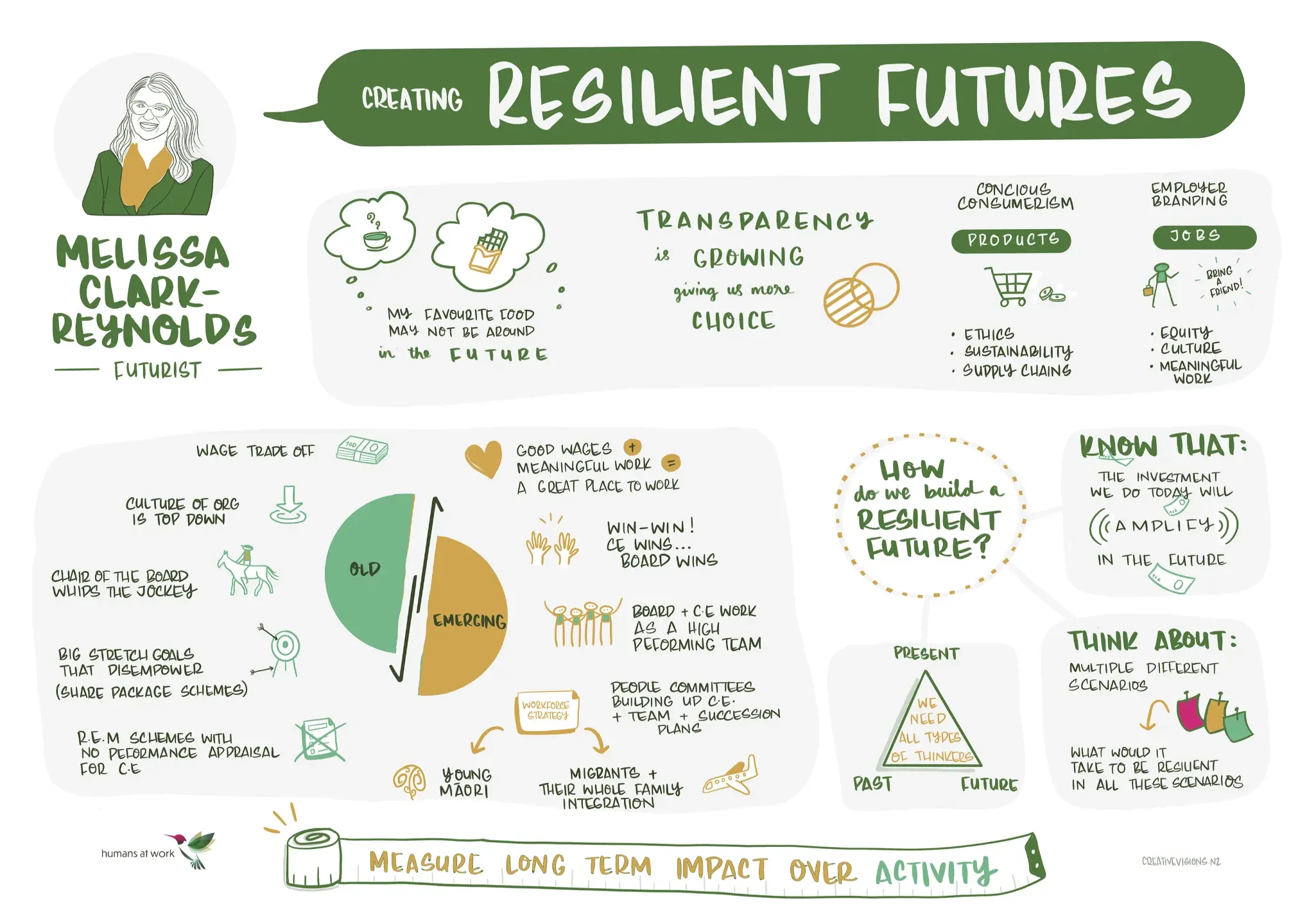
Melissa: It's great though, because it feels to me like we're in this era where transparency is really opening up – it's one of the big themes I see as a futurist, whether it's conscious consumerism or whether it's employer branding. And we're seeing an ability to be able to dig into brands that we like to find out, would I give my hard earned money to them? If I'm giving my money to them I'm basically voting for their practices.
And the other way, labour is so scarce at the moment, and I've been sitting here today working on quite a big project looking at migration and where does the labour force of the future come from? Workers now have a lot more choice about who they work for, probably than any other time in history.
My ability to look up an ESG index on an employer and decide whether I would be willing to give them my time – if I'm only here eight hours a day, am I willing to spend that eight hours working on their agenda? If not, who is an employer who gives me a great place to work, where I can feel really proud to tell my family and my friends that I work there?
This transparency theme is one that I've really seen grow in the last 10 years and I feel like we're not even at the peak of it yet, it's still building. Do you see that?
Jules: Absolutely and it's interesting because with my consulting company, we've built now a website page that talks about, not just our carbon cost of doing business – and going through the whole accreditation process in relation to that which is a huge process for small businesses – but also what does that translate into in terms of our ethical framework as an organisation and how do we make sure that all of the team are aligned with that, but also all of the work and all of the advice that we give is also aligned with that. You don't just want it to be for you and your company, you also want it to be for your clients, your partners, everyone within the ecosystem.
From an employer's perspective, organisations tend to think they're an island, people come to the island and they stay for as long as you want them to stay and you either boot them off or they leave.
Of course, no organisation is an island, particularly these days with the interconnectedness of how even public sector systems are all connected, private sector companies are all connected, supply chains, global or what have you.
Your reputation and your ability to talk the talk and walk the talk is becoming more and more important for your workers and your partners and people that you would want to partner with in the future. I don't think that every organisation has really got their head around that they're part of an ecosystem, not an island that's untouchable.
Melissa: Totally and I was sitting here thinking – I'm on the Board of an organisation that's got a name similar to another organisation. When I joined it people told me, "They're a terrible employer," and I go, "No, that's not us, that's this other company."
Even so, it's really made me, as a director, dig in deep into the business and understand. Everywhere I've gone as a director I'm curious about pay equity, not just by gender but by ethnicity and age and then gendered roles in the organisation – what is it to be trans and work here? How does that work? How do we accept that?
Coming back to the ecosystem thing, in an era where it's really hard to get employees, word of mouth referral has never been more important. Putting out the word to your staff to say, "Have you got any friends or family that might like to come and work here?" tells you something.
I know a lot of places do their employee promotion scores – they've got the net promoter scores for customers – but do they think about whether staff would recommend working here to their friends?
I see a number of companies, including the one I'm just talking about now, where their main recruitment strategy is 'bring a friend'. And that has been incredibly effective for building strong teams, for building deep networks into the community, for building outreach into the next generation of those families to come and work in the company, too.
We have to think more carefully about it – it's not just an exchange for money. I know there still are some employers who see it that way. It's almost like, I'm paying you, you come in, you do your thing, you're on the island for eight hours and you go home, and I'm expecting you to come in five or six days a week, give me everything while you're here, and I'm only paying minimum wage.
I'm still seeing a few of those who think that's the exchange whereas, what I would say is that more and more and more employees are looking for an exchange that is about self-actualisation, that is about contribution. And I don't see why you should have to trade off wages for a good place to work – but that sometimes is the case. You think, I'll stick it out here a bit longer because they're really nice, they may not pay so well. But it shouldn't have to be that trade off. It should be both: we pay in the top quartile and it's a great place to work and you get to work on meaningful work. When we see that, those companies tend to have really great productivity, great creativity and obviously stickiness of staff.
Jules: I'm interested in your experience as a director, because I know you do a lot in the governance space and that's one of your key areas. You seem to spend a lot of time advising Boards and you've been a member of such a good variety of different Boards in different sectors.
What I'm interested in is whether you've seen a shift in the responsibility that the Board has to shape and role model that kind of ethos. If I think about it from any employee's perspective, it used to be that pay conditions and who your leader was gonna be were the most important things. And now it's shifted to, am I feeling like my time is well spent and is this an organisation that, holistically, I'm proud to say I work there?
If that's been the shift for employees then I would imagine that Boards and directors, as well as CEs and other leaders, have had to think much more carefully about their role and the role of decision making in creating that sense of ethos and holistic reputation.
Melissa: One of the big shifts I've seen during my career – and part of it, I believe, is generational – is that the generation before me, and it's not true of all of them, had a feeling that becoming a company director was a reward for a career well played. You made your way through the ranks, you got into the C suite, you maybe made CEO but maybe you were a CFO or a chief marketing officer or something, and then when you retired you went on to Boards to sprinkle your wisdom across these younger people.
I feel like that generation and that thinking around Boards is on its way out quite markedly. I saw it disappearing maybe 10 or 20 years ago but there's not that much of it left.
With that came, what's the right word, an idea almost that culture in the organisation was CEO down, in a hierarchical language, and you measured the CE. If I think about my last CE role where I had a Board, I had a whole lot of KPIs including the employee promotion scores and employee engagement scores and they were in my bonus as well as financial performance and a bunch of other things, and so they got measured.
They didn't really, in my experience, get measured in order to try and make the place better; it was a way of measuring me. What I found fascinating was starting to want to have conversations with that Board about their behaviour – and that was quite difficult particularly, I'm talking here 15 years ago, where that hierarchy between the chair and the CE was very strong. The chair was there to manage my performance.
I remember when I did the weeklong company directors' course for the IOD 20 years ago, we were told to ask every Board meeting, "Is the CE performing and if they're not, who's gonna fire them and who's gonna start recruiting the next one?" It was very much adversarial almost – it was like your CEO is a jockey, and it really bothered me. There wasn't a sense of the Board packing around the CEO so that the company won.
A couple of things, for me as a Board member: I believe that the way that the Board wins is to have a CE win. If I can have the CE win, what does it take for the Board to get up and under the CE and have them be really successful? Whereas the jockey metaphor is almost like the jockey whips the horse, we whip the jockey and somehow it's all gonna be fabulous.
The second one for me is that not enough Boards talk about the values of the organisation and how they epitomise them. They hold the senior team to the fire in terms of culture, but they rarely hold themselves to the same account. We might agree four or five values, then we measure the CE on those but we may not relate with each other the same way. For me, the Board is also fundamental to the culture.
The way the Board interacts with each other, the way the Board interacts with the senior team – that is the signal that the senior team get about what the culture really is in the organisation, as opposed to what might be written up.
I've got one last thing while I'm on a roll. I have a commitment that every Board I join will turn into a high-performance team. That language was anathema to some of my chairs early on in my governance career. I remember I was on a public sector Board, I said this to the chair and he just gave me this withering look like I was a complete moron. And explained to me very slowly that this was more like cricket, where people popped up for their specialist role and you didn't all go out there on the field together. His whole big metaphor was: you're there as the IT person, your job is to talk about IT, your job is not to talk about X, Y and Z.
I made sure that, for the rest of my governance career, I've avoided those kinds of chairs and I really believe that good teamwork makes a Board better. But it still feels like new theory, in a way, about Board dynamics, which is such a shame.
Jules: I'm just having flashbacks to being a tier two leader in an organisation that had a Board, where the Board chair really wanted to be the chief executive and used a command-and-control approach with the rest of the Board members.
What you want from the Board, where you've got a whole range of different perspectives, is input and some testing of that strategy from your diverse audience. They're in the tent, they know enough but they've got that degree of separation so they should be the ones that give you amazing advice and help shape and empower that strategy. But how that Board was run was very much, everyone looked to the chair, the chair made a pronouncement at the end of a presentation that was either, "Yes, I support this," or, "No, I don't." Then, to use the cricket analogy, you went off to sit in the clubhouse until it was next time that you were asked to come out.
The CEO in that situation was completely disempowered, disenfranchised, trying not to be a mouthpiece but, in fact, was.
Melissa: I was thinking as you were talking, Linda Yaccarino and Elon Musk. Linda Yaccarino is an incredible executive but she's taken a CE role at Twitter, X, where she's got Elon Musk as her chair who just says whatever he wants to say and says it in public. I just think the job is untenable, I don't know why she stays. But I'm thinking that's an extreme version of that, if people want an example that's in the public domain. He clearly hired someone amazing and he's running roughshod over her and basically command and controlling her – it just seems like such a waste of effort.
Jules: You see it in other tiers within leadership within organisations as well, where you've got the CE who used to be head of ops maybe and has now got a deputy head of ops, but they insist on being the one who knows best because they've done that. That ability to step away and let others move into their own space and do things differently is a maturity step, but often it doesn't flow through.
I was gonna ask, off the back of that shift of expectations and behaviours, has there been a corresponding shift in what success is for companies and for organisations? It's a really interesting one when I think about the intersect of your governance approach and your futurism because success today, my performance metrics for this year might be X, Y, Z and I can tick them all off. But if I'm not making strategic decisions that enable us to be a sustainable organisation that builds the brand and adapts with the time and is environmentally friendly in the longer term, then my success measures for today should actually be crossed off because they're a failure.
I was interested in has there yet been that catch up in some of those success measures or are we still on that learning curve?
Melissa: We're still on the learning curve, but I'm really curious about how we might incentivise people to do the right thing for the long term. I think about the packages that I've had where it is very much this year's result. And maybe I have a number of exec packages that include share options, but then they can be as disempowering as they are empowering. The last time I had share options the Board actually wouldn't let me execute the strategy that would've doubled the share price. Instead, when we put up strategies that really were growth strategies, really were innovation strategies, the Board lost its nerve. And eventually I left because I realised that this big chunk of my incentive package, really based on a three-to-five-year performance, I actually had no control over.
As a CE, if I can't invest for that medium term then what you get – and you see it – there's a lot of results this year from people in the ag sector where I spend a lot of time; they had record years two years ago and they've had record losses the next year. I don't think the Boards were really stopping and thinking, great, we've had this boomer year, what happens next?
They often think that it's a linear growth thing and they go, "Great, we've had a boomer year so next year will be boomer, too." You see changes in the CE roles in some of these organisations and, again, part of it is that we set up these incentive schemes with the BHAGs, the big goals and stretch targets, but we don't always think about could these big stretch goals be disempowering as well as empowering.
Two, we struggle with the long-term incentive packages and often as a Board we don't allow the senior team to do what they said they were gonna do in order to achieve the outcomes, because they have a higher risk profile.
The third one is I'd really like to see more packages for both Boards and CEs that perhaps you can't cash the shares in for 10 or 15 years. Most Boards and CEs don't like packages like that because it's outside their span of control. I might only be a director for three or six years, so I want to be able to cash my shares in in that period. What I think those share package schemes do is they incentivise what I call stunts – they incentivise me to hit the numbers you told me to hit at any cost.
One of the other changes I'm seeing is that I join Boards and they have REM Committees, and I just wanna eye roll because it feels so nineties. These REM Committees meet once, maybe twice, a year and what they do is they set the CE's REM, and if they meet a second time of year, they do the CE performance appraisal. I don't know how many Boards I've joined now, it would be well over 20, where the CE has never had a performance appraisal. And the reason they've never had one is the chair had a bad experience getting a performance appraisal in 1979 or something and they've hated them ever since.
These poor CEs are usually begging for a performance appraisal, they want feedback, and the chairs tell me, "I give them feedback every month. Every month we meet after the Board meeting, I tell them what was good and what was bad," but that's not really what you're looking for. Even when we do continuous coaching with our employees, we still make time to sit down and go, "What do you want to achieve this year? How are we gonna know if you're achieving it? Is it the right thing? Is that alignment with strategy?" I see a lot of Boards who don't do that with their CEs.
I like to get on the REM committee, I like to change it to a People Committee or a People and Performance or People, Performance and Culture Committee, to meet four, five, or six times a year. And to really help the CE to build the team they want to build, to think about the culture of the Board, to think about the succession plans for the Board, to think about the needs that the organisation has longer term – are we building succession plan in for the CE and so on – and really use it as a strong people committee of the Board. That's again one of the changes that's occurred.
There's an old one I remember – I remember explaining to my staff that I felt like a human shield between my Board and my team and I didn't want my senior team to come to Board meetings because they were just gonna get torn apart. That seemed just a complete waste of time and undermining to the culture I was building as a CE.
That's always in my mind when I'm on these People or People and Culture Committees of the Board. How do we work with the people lead and the CE to ensure that all of these relationships are at the highest level and that we've got succession at both the governance and at the senior team level? And that's a big shift from the old REM Committees.
Jules: Don't even get me started on those old fashioned HR structures that are like safe little caves for people who've been around for a while and understand what they're for and they're quite process driven; they're not human driven. And they're not able to flex with the context, and a lot of people find that quite safe because the context can be scary.
The fact that what they have available may not meet the needs of the context is scary, so rather than trying to think that through, they avoid thinking about that. You see it in the number of organisations that don't have a workforce strategy. They might have a recruitment plan, or they might have a values strategy but, actually, in terms of, if organisations are groups of people, who do we wanna be? How do we make sure that we have a culture that enables us to be successful, whatever success looks like for us, and what are all the things that we need to put in place?
Workforce strategies seem to become quite scary things. I find that really interesting because once you have a workforce strategy, a whole lot of things become much easier in terms of decisions and what have you, so it sounds very similar.
Melissa: It's great and there's a few things that come to mind. One of them is we see pendulum swings – it's one of the nice things about getting older – in lots of workforce training approaches. If I think about someone like a Google or a Facebook, they put all of their training up on Coursera and on MOOCs, these big online course platforms, you know what you have to do, which certifications you have to have before you can join. People do all the certifications and then they apply for the job. That's one way of doing it.
There are others that say, "We want to retain the people we've got," so every person will have a personal learning plan. Both kinds of employers exist in the market right now.
With my futurist hat on, I can't help but look at the numbers. Pākehā New Zealanders' median age is 54. Well the future workforce is not there! And I get that some of those people may choose to work for 20 more years but they're not gonna be working full time probably in 20 years' time.
A reliance on the existing workforce – one, it's not working today and, two, it's definitely going to stop working fairly soon. Alternatively, if we look at the Māori population in New Zealand, the median age is under 20. For me, if I'm really thinking about where am I gonna build a long term workforce from, I want to be thinking, how do I make this a bicultural workplace? How do I make this a place where Māori want to come to work? How do I make this a place where Māori will say to their whānaunga, "Man this is great here, you should come work here, too." I don't see enough employers thinking about that even in just a straight-out self-interested way.
The other thing that we've got in New Zealand is we've just had 200,000 new migrants, we've had a 20,000 increase in unemployment – which is nothing. We have the highest employed population in the OECD so there are no people wandering around looking for jobs in New Zealand. Literally, anyone who wants a job's got one. And currently our plan in New Zealand seems to be, don't worry, we'll just import them, and the problem isn't productivity or anything else, the problem's just that we haven't had enough migrants.
Which is amazing to me because so few employers have got a really good plan on how they're gonna integrate migrants into their workforce. What is it like to be a Filipino meatworker in Feilding or what is it like to be an Indian dairy worker in Central Otago? We need to be having some really great conversations about how we think about their whole families integrating in.
On top of that we have labour policies in New Zealand that I don't think most of us know how difficult they are. You've probably all seen cases of dairy workers who've been here 10 years on annual visas and get kicked out with their kids who've been at school here and they're part of the local church. We have this revolving thing where migrant workers come, they're attached to a single employer; if that employer goes broke – which has been happening a whole lot lately in the construction sector – they may have been here for years, they've been paying taxes for years, but they're not allowed to apply for jobs with another employer because their visa only allows them to work with that one employer that brought them over.
We've got some real structural issues here about thinking about how do we make it a great place for migrants to work? How do we incorporate migrants into our communities, and how do they get a path to residency so that we're not just, almost like the old HR thing, where the contract is we give you money, you give us labour? It feels like that's the deal we're doing with our migrant workers. Instead of saying, "Come here, be a whole person, bring your whole family, think about what it would be like to build a life here" – you're contributing taxes, your kids should be able to go to school, you should be able to get health care.
I just think we're not having enough of a conversation about that, we're still treating migrant labour like it's human resources, like something you can just buy and sell. Rather than thinking, actually, New Zealanders aren't breeding, so if we do want to continue to grow as a country in terms of the workforce here, our only strategy is inwards migration – so how are we gonna make that work?
Jules: My sense is there's been this separation between "the economy" as if it's a thing that stands alone, and life. Where you really see it is in the experience of migrants because they come, they're fettered, if you like, because they're good for the economy, but in terms of everyday life, there's no attention paid – as if there's a separation between those two things.
Melissa: Yeah, I like that.
Jules: New Zealand does have an issue with slave labour and really dodgy practices that are the rotten end of that continuum.
I have a big problem with 'the' economy anyway because 'the economy' is a created structure. And as we've already talked about, the economy is changing and will continue to need to change. Your Signals webinars are always talking about how this concept of production, circular economy and consumption, it's changing all the time, it's fluctuating all of the time.
What nations are struggling with, some more than others, is that concept that we can't rely on the economy as a standalone to be the answer to all of the issues that we have today, but also all of the issues that we know are coming down the track in the future.
To go back to the conversation about incentives for the future – if we invest a whole lot in infrastructure now, we use the money that we have that could be used later for other things versus, we invest a lot now in preventative things that mean that we won't have some of those problems later. I think we're in a state of flux in terms of some of those foundational ways of thinking, particularly in western or global north thinking, where they're starting to crumble a little bit. You see some countries and companies going, "Great, this is our real opportunity to become industry leaders or market leaders or the best place to work because we do all of these things, not just focus on one thing," and others who just don't understand why there's even the conversation yet. It's really interesting to see the two ends of the spectrum.
Melissa: I wanna come back again, as a futurist, to this idea about how we think about the long term. The infrastructure one is really interesting to me.
Investment in education is an investment in the long-term future of the country. It takes a while for it to flow through. I'm lucky I've got two children who are different generations. My son went through school in New Zealand pre-NCEA, it was all very child centred, he was encouraged to play a lot, he didn't do any exams or tests or assessments until he got to Year 11 and it was a really big deal. I remember it being terribly anxiety-creating because they had no experience of those. But his confidence that came from school was very rounded – music and art and dance as well as maths and languages and history and geography and everything.
My daughter went through school as National Standards came in and you think about the anxiety that goes with that. She's been tested every few months since she was preschool, actually. That also means they were really teaching to the test.
The child centred education systems, to me, are much more resilient for the future because we're at an age where my ability to access knowledge has never been better. Yes, I could ask ChatGPT and I'll need to know whether it's true or not, but the 'whether it's true or not' is the important thing, not that I know more than it. Yet what we're doing is we have an education system at the moment in New Zealand that is all about the knowledge, not about the thinking.
We know for the long term we need to be able to build critical thinking and that means teaching them critical thinking ideas, teaching creative writing, allowing for free play, allowing kids to go and mess about in puddles and find bugs and follow what's interesting to them, enquiry-based learning. We know that. At the same time, that's an investment today that will pay off for the country in the future.
Public health is the same. Vaccination rates for our children, nutrition for young children, dental care, exercise – they're all things that we pay for today, but they pay us back in 30, 40, 50, a hundred years.
With the infrastructure one, what I find fascinating is the debate we're having now isn't that we'll pay for it today; it's that we'll borrow today and our children and their grandchildren will pay for the infrastructure we're using today. When we think about whether we invest in rail, whether we invest in roads, even the big discussion New Zealand's having about how to pay for water – we're not talking about paying cash for any of those problems, we're talking about how do we get access to loans that future generations can pay for the water problems we have today.
That's what I find fascinating about this futures thinking – the prevention we do today and the investment we do today in things like health and education amplify in the future. The investments that we do in infrastructure, in some ways they allow for growth but what they can also do is hamstring our future into paying for stranded assets. We love roads in New Zealand – I can imagine we're gonna borrow money in the next five years to build a whole lot more roads. Whether that's the right thing from a climate resilience point of view or the right thing from reducing fossil fuel use, I don't really get it. I can see that we're not having those really long-term discussions.
Again, I think it comes back to the fact that we're easier with short term incentives, we're easier at measuring activity than impact. I see us measure things like did the road get built? Yes/No. Rather than asking, is this child gonna have a fantastic life in 20 years' time? We know that women who are educated reduce their birth rates, they have better birth outcomes, they're more likely to survive a birth, their baby is more likely to survive to adulthood. There's a whole lot of those things but I don't feel like we're measuring the really long-term impacts – we're measuring did we do things, we measure activities and inputs.
A lot to unpack in there but it's my deep concern that we don't think enough about future generations. I think a lot of Māori organisations do this very well – they think about what's the impact on their mokopuna and on their mokopuna's mokopuna, so grandchildren and grandchildren's grandchildren. But generally, we're not having those debates enough.
Jules: It's a really interesting one. We have adopted the seven generations principle both personally and in my companies, and that is a mind bender when you try and project forward. Obviously, we just don't do it as well, we're not practiced at doing that, compared to the indigenous people of Canada where it's just something that they do in their communities.
One of the things is, when we're working with organisations, that just seems like a stretch too far. Working back from that we say, "What about if we thought in 10, 20, 30 years rather than in one year or in the next election cycle?" Particularly when you're working with public sector, they're driven around the big election cycles, which are just not long enough for some of those big trade off discussions.
One of my other guests for this series is Sophie Howe who used to be the Future Commissioner in Wales. I asked the same question of Sophie about, when you say future, how long in the future is Wales trying to think? Her response was, "People have a big problem with this really, really long term, but what we've done is we've said at least one generation," which for them is 25 years. They've had amazing debates publicly about infrastructure investment on that exact same topic – how do we justify to the next generation, 25 years, that we spent all of this money on this road that, by that stage, will either be degraded because of global warming or be fully congested if we haven't done any of the other systemic changes?
That has been quite a good length of time for them in terms of being able to picture it. I find that question about how long ahead can people really think really interesting. I'm interested in your futurist work – is the question of how long ahead people need to think one of the things you find people grapple with the most? Or are there other things that people find more challenging?
Melissa: There's a couple of things in there. One of the first books I read about strategy was actually a Japanese book and a lot of Japanese companies have 150 or 200-year strategies and have been doing that for the last couple of hundred years. There are some cultures that value that more than others and if we look in New Zealand, a number of tribal authorities and corporations like Wakatu have done these very long term strategies.
What I find interesting when you analyse those from multiple cultures is they're not trying to predict the future; what they're trying to do is to build a resilient future that future generations will have the most choice over. What would it take to restore the land? What would it take to preserve forest? What would it take to ensure that we were building life expectancy and quality of life generation after generation after generation? They're almost better at principles – what are the principles that make the future resilient and successful? That's thought number one.
Thought number two is not everyone should be a futurist. I know that sounds like a funny thing to say but the more I work with organisations, and particularly I've found this working with a number of organisations in Te Ao Māori, I've been working with a piece of theory around our preferences for the present, the past and the future, and I believe they're all really important.
I do an exercise often in a room with people when I'm working with them, and I've got a series of questions that I ask about where they prefer to be and we move them around this triangle, physically. We end up generally with about a third, a third, a third of the room.
A third of the room is much happier in the past. In Te Ao Māori, they're the holders of tikanga – they hold protocol, they hold process, they may be the holders of the language, they may be the language teachers, they hold the ancestry – whakapapa as we call it here, they hold the sense of genealogy. If you think about your own families, there's probably someone in the family who's more interested in genealogy or where did the family come from, or, "You've got a nose like aunty Doris," or whatever it is. They are also often the people who care for the dead. Those holders of the past are really important because they're almost the foundation stone. They've got a whole lot of pluses, but they can also be stuck. You want them – they're fantastic, they give you a sense of identity, they are really good at risk management and risk mitigation – but they can hold you back.
Then you've got the people in the present and I think about them in Te Ao Māori as ringa wera – the red fingers, the people who are actually doing the work. They're often the accounting team, the payroll team, the product execution team, customer service – there's a whole lot of people in an organisation who are just making the present happen over and over and over again. They don't really need to know the whole history of it, and they don't necessarily have that much interest in what's gonna happen in 500 years' time. But they're gonna solve today's problems and they're gonna sort them out and they're gonna make sure everybody gets paid.
Then you have this group that I have nicknamed the wekas. They're like these sticky beaks, running around poking their nose into things, haring all over the place, a little exhausting, and they're the ones who are going, "But why? But why? But why? But what if we tried this?" They can be a little random.
I see that organisations that handle all of these time elements well are better than any of them alone. Because the future people, they can get a bit up themselves and they can be a bit like, "You're stuck," or, "You're so busy you don't have time to think about the future," and they can undermine the people who are in the present who are actually making sure they get paid. Yet, if they don't have people who execute, then they're just dreamers. It's all very well to sit around and talk about what the future's gonna be like but if you can't build it, so what.
Most people out in the future can't build it. There are books and books and books about the strategy execution paradox. We should be thinking about it as three moments in time, not just two moments in time. I've been thinking about this one a lot.
Jules: I actually love that, and as you were talking, I was thinking about my own team in my consulting team. Possibly the most valuable member of my team, and I count myself in that team, is my virtual assistant. Because actually what she does is she manages the present, over and over and over and over again. The administration, the accounting, the GST returns, the file management – all of that stuff. Before I had her, I was trying to be the strategist, to have the vision, I was trying to tell the story of where we came from, and I was trying to do the day-to-day. And it's really exhausting because you have to put yourself in those different time zones and locus of focus, if you like.
I was just thinking as you were talking that that's also a makeup of a really strong team as well, where you have people who say, "Remember we tried that in this organisation and here are all the things that went well and here are all the things that didn't," and they're the holders of the past. It's having that equity in terms of voice and being able to listen and debate all those things, that gives you a really good quality product.
I also remember a little anecdote from a CE years and years and years ago who said to me, "First week of the CE job, big strategic CE role. The first thing that happened is that the staff payroll went down. The first thing I did as the CE was make sure that we could pay people. Because it's all very well being this big CE of this thousands and thousands strong organisation – all of that grinds to a halt if the payroll isn't working." It's the great leveller!
Melissa: It's true. Yeah.
Jules: It's stuck with me, that was about 15 or 16 years ago and I remember thinking, it's a really good induction in terms of coming into an organisation: what's the thing that's gonna make or break your reputation within the organisation in your first week? Not how good you are at speeches and what have you, but actually did you help make sure that this problem was resolved, the thing that affects every single person in the organisation? Yes, you did, great – okay, you've started to build that little bit of trust from all of the employees.
Melissa: I'm so with you. If the present isn't handled, you don't buy the right to play with the future. I think that's a really interesting thing.
Jules: I just wanted to ask you one other question which is, once you've been a futurist for a long period of time, what does the future hold for you?
Melissa: Couple of things. I have this saying that the present is messy and contradictory, and the future will be, too. I feel like one of the things I've become much more relaxed about is that there are multiple futures out there. And when people ask me about 'the' future of payroll or 'the' future of healthcare or something, now I wanna say, hang on a minute, it's really different in different circumstances – the digital divide is different in different places in New Zealand, do they have internet coverage or not.
The present is already really messy. What I've learnt is that the future will be really messy, too, and that there won't be a single answer to everything. Coming back to foresight then, I think good organisations should really do the work of imagining multiple futures, and there's some really well-designed scenario methodologies out there for working out which kinds of futures you might want to think about.
Let's say you end up with four different futures for how you think the world might be – that's really, really useful for strategising. What would it be in a world where people thought it was disgusting to kill animals for food? What would it be in a world where meat was seen as a treat? What would it be in a world where everybody ate meat all the time? What would it be in a world where meat was entirely grown in precision fermentation vats?
Instead, what we tend to do is we then pick the one of those four that suits our strategy and we just have this hubris that we think we can go out and make the future we want. Again, it feels very pre-digital, post-industrial revolution, hundred-year-old thinking. It didn't work then – those companies have all gone broke that had that approach.
For me, it's how do we be resilient in the face of any of those futures? What would that take? That's probably where, for me as a futurist, I'm really curious. How do we grow these scenarios and grow companies' ability to be resilient no matter how the future turns out, rather than believing somehow they're all powerful and they just have to tough it out and smash through. That approach just isn't working.
Jules: No, I completely agree, and I have a real-life example and experience of using that kind of methodology when I was director of strategy for MIQ. We had a Futures Team within the Strategy Team and they worked us through an exercise of looking at those different scenarios. When COVID was still really playing out and providing a whole lot of different surprises, they developed these scenarios, one of which was a wild card – that was part of their methodology. Fascinating process to go through just thinking about all the different elements and how little you know about what's gonna happen tomorrow, let alone in a year from now.
It really gives you a sense of humility when you do those kind of exercises. The upshot of that process was there wasn't any one that we could pick and from a strategy perspective, what we needed to do was develop an agile approach to acting on the basis of looking at trends across all four scenarios and using the scenarios to then inform back to what the strategy would be.
That kind of practice is the sort of thing that seemed to be mandated much more so during things like COVID, but they've got so many lessons to teach us going forward as well.
Apart from anything, I firmly believe that things like COVID can erupt again. Everything that I've read in terms of the likelihood of those kinds of things happening has said that they will happen; it's not a question of when or what and will it be a global pandemic or will it be more localised. It doesn't really matter, the point is it will.
Back to your point around resilience, knowing that it will, let's stop spending too much time trying to be exact about which kind of thing it will be and how much it will impact and when. And actually think about how do we build resilience so that if and when it happens, we're much better placed than we were last time, when we were really on the back foot. How do we do that and learn those lessons and think forward is just super, super valuable and actually I find it fascinating as well, really interesting.
Melissa: It is. We knew a pandemic was coming and we know there's gonna be some more. We saw countries like the US disestablish their pandemic committees.
One of the other things about these scenarios is that often what happens is that they turn out to be sequential – we didn't realise that. If we even look back at New Zealand, we did the lockdowns, we had very strong public support for that, we reduced deaths from all causes including cancer and suicide and car deaths and everything. And then at some point, the public decided that they had a different value system and the freedom versus longevity of life took over.
That again is where these different scenarios are useful; not because you necessarily think, this is the one, but you think, what are the other options that might happen? If this one happens, what's the next chess move?
If we think about this idea of the pendulum swing that I talked about earlier, we had this very strong pendulum swing that said, "Great, I trust the Government, I want to keep Grandma safe." Then we had a strong pendulum swing the other way. But they're completely predictable if you stop and do this work. Then there'll be a swing back the other way at some point.
We see it with vaccines – there's a big measles outbreak again globally at the moment, and that's part of that pendulum swing for vaccines and against vaccines. We saw what happened when New Zealand exported measles to Samoa and lots of people died.
These pendulum swings are also very useful to think about. The rise of feminism, we had lots of young, amazing women leaders around the world get elected, and then you have all these right wing men get elected. It's that thing, not to think about that as being discontinuous but to think about them being part of exactly the same pendulum swing, and that swing will continue to happen.
That makes it a lot easier to predict the future in a way – even though I said I'm not entirely in the prediction business – but you can predict that things will become more liberal and more conservative; that they will become more racist and more multicultural. These swings just continue and they're part of how human beings seem to work en masse.
Jules: We have met before so we have talked about a lot of these things before as well, we can talk again! Before I go, I just wanna say thank you so much, I know it's a public holiday for us in New Zealand so I do appreciate you giving up your time, but it's also meant a little bit of peace and quiet for us to have this amazing conversation so thank you very much.
Melissa: Thank you, what a great podcast. This whole, what is it, to make work more human? It's just such an important topic so I'm delighted that you do it.
Thank you so much for listening and thanks, as always, to the generosity of our delightful guests. The stories of how others have faced up to their challenges can help give all of us courage to keep going with our own. For more great episodes, blogs, learning packages, go to the JERICA Global website.
Humans at Work Podcast