
Unleashing the Potential of Direct Solidarity — with Emanuele Santi
Humans at Work Podcast | Episode 21
Host: Jules Harrison-Annear | Guest: Emanuele Santi
Jules: Kia ora, welcome to Humans at Work. I'm Jules, your host. Thanks for joining me and our latest guest and thanks for taking some time in your day to indulge your curiosity about other people and their humanness. If your thirst is unquenched after this, check out jericaglobal.com. Now let's begin.
Hi everybody, today I'm talking with Emanuele Santi. As normal practice, I'm not gonna introduce him, I'm gonna ask him to introduce himself. Over to you.
Emanuele: Thank you. Thank you, Jules, for having me on this podcast, very exciting for me to travel from Luxembourg all the way to New Zealand via your podcast.
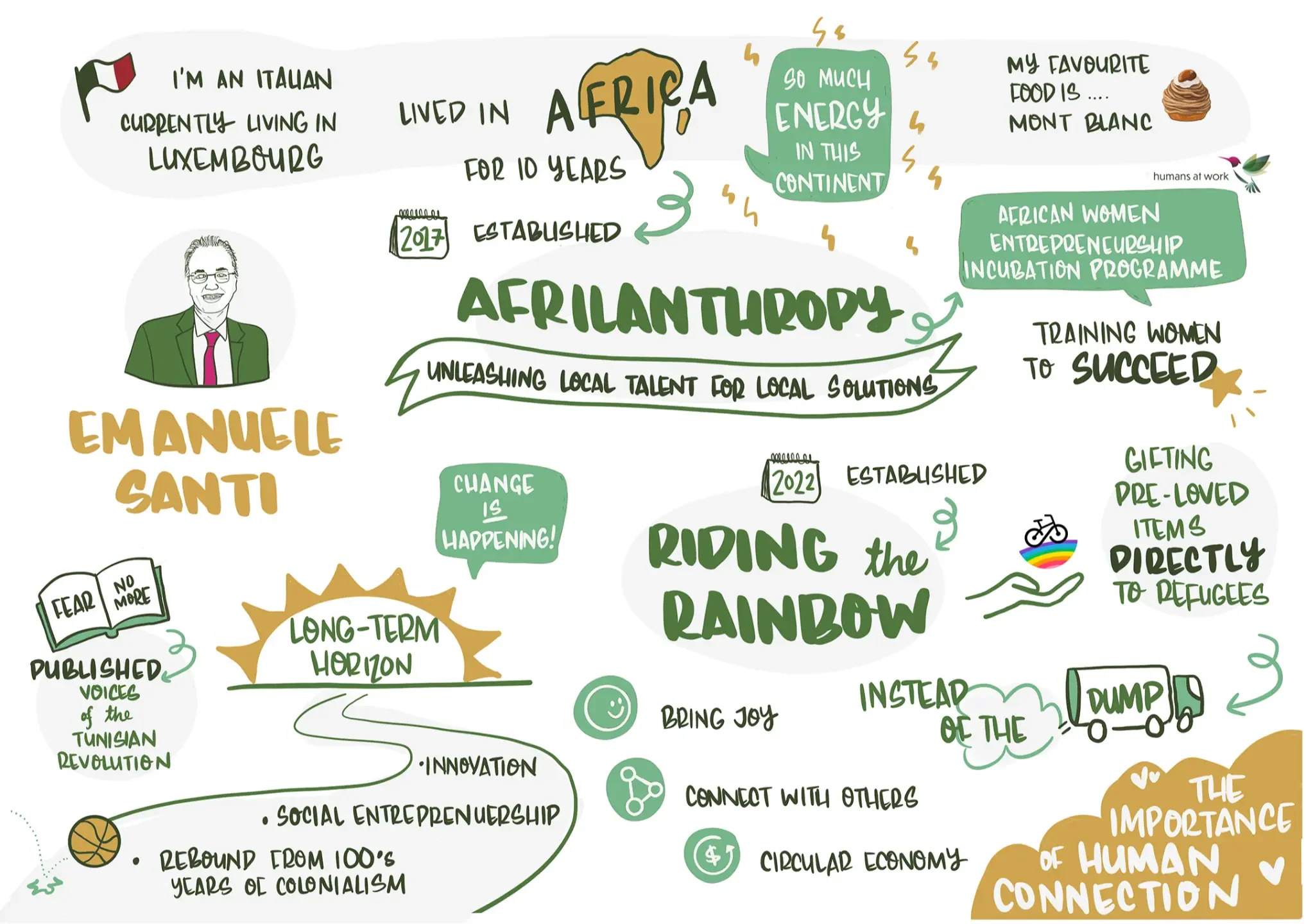
I'm Italian and I live in small, tiny Luxembourg – I don't know how many of you know where it is, small little country sandwiched between Germany, France and Belgium. I'm originally from Italy and I spent more than a decade in Africa, and now I run a charity here called Afrilanthropy which launched a very interesting project here with an impact locally. I'm here to talk about this. Locally and worldwide – that's why we are having this conversation.
Jules: Tell me a little bit about your family. Is your family also Italian?
Emanuele: Yeah, two kids 17 and 15, one was born in Washington DC, the other one was born in Tunisia, so we have been travelling quite a bit. We spent a whole career in development, I used to work for the World Bank then the African Development Bank and I used to manage an impact fund here in Luxembourg until the big thing happened that we're probably gonna talk about a bit later. That's something that really changed my life for good.
Jules: Being Italian, I would imagine that food is very important, can you tell me what's your favourite food?
Emanuele: My favourite food is something that my grandma used to make, it's called Mont Blanc, which is like a white mountain – a mountain between Italy and France. It's made by meringue, which is like a glazed, whitish pastry that is made of a very lot of sugar. On top of that there is a chestnut cream and on top of that cream there is whipped cream. It's horrible for your diet but it's so good and my grandma used to do it so every time I eat it, I think of her. Unfortunately, she passed away – fortunately for my diet, I guess, but unlucky that I don't have her around – but it always reminds me of her and the great food.
Jules: Tell me a little bit about how you ended up living in Africa.
Emanuele: I've had a strong passion for Africa since my upbringing. I had a great uncle, the brother of my grandpa, who was a missionary in Uganda and he passed away – actually, was murdered in Uganda while he was serving during one of the darkest times of Uganda's history under the Amin dictatorship. He served that country; he created a school, a vocational training school that still holds today. I was always inspired by the story of the great uncle and always heard about Africa.
When I started studying in university, I wanted to do something Africa-related, didn't know exactly what but I had that African imprinting. My older brother had also an Africa experience early on, he is still in Africa, he lives in Mozambique. I just had the drive to do something about the continent and so eventually I joined the World Bank. I studied political science, and I studied economics and I really wanted to go there, work on economic development and eventually I started my career at the World Bank and then I moved to Africa. I felt how beautiful that continent is and how addictive that continent can be.
In France they have this expression, they call it Mal d'Afrique, which is a kind of a disease which hasn't been clinically defined by the WHO but I think it should. That once you are in Africa once, it gets into your veins and you always wanna go back. I got so passionate about the continent that it carries on and I still miss it and it's now like my new home.
One of my sons was born in Africa, we had a wonderful 10 years, they had their upbringing there. Then my wife at some point got a job in Europe, and my wife and I have been following each other for quite a while, and it was my turn to follow and that's how I landed in tiny Luxembourg – very unexotic, very uneventful in many ways – but that's how I'm here.
Jules: I love that. You know I grew up in Africa.
Emanuele: You did, I didn't know….
Jules: Yeah.
Emanuele: Whereabouts?
Jules: My parents were teachers, and they first went to Zambia, and they taught in a little rural school in the middle of nowhere. So that's where, from when I was six months old, I lived the amazing life in rural Zambia, absolutely loved it. We've got photos of me playing with all of the local kids and it was life, but it was an amazing life.
We moved to Malawi and in Malawi we lived on a teacher training college, and they taught teachers. And then we moved to South Africa, and this is during apartheid, and in South Africa they taught black African teachers how to teach so that they could go into the townships and run schools because, at that point, there was no education. If you lived in a township, you didn't have any education. They worked for an NGO that taught teachers and provided equipment and learning programmes for teachers. I lived there until I was 11 and in my deep down, I still have that sense of the African earth under my feet and the smells and the sounds.
Emanuele: You have the Mal d'Afrique? You feel the Mal d'Afrique?
Jules: I have the Mal d'Afrique absolutely. There's something that's very sensorial about it. Conceptually, it's very difficult to describe but you feel that sense of what it is like to be in Africa, you feel it through your senses. I don't think you have that in any of the other countries that I've been in, which I've loved, but it's just not that same sensorial thing that's deep down that I think you have if you've ever lived in Africa.
Emanuele: Absolutely. Sometimes with events – you've been through the apartheid, I had a chance to be in Tunisia during the Arab Spring and I saw how powerful that whole movement started, we're talking about 13 years ago now and things were so intense. The way the Arab Spring started in Tunisia; many people think about Africa just as sub-Saharan Africa, but also North Africa can be as engaging as sub-Saharan Africa.
I was there during the Arab Spring, and that was such an amazing experience, to see how people took destiny in their hands. I actually ended up writing a book – I might've mentioned it to you – I wrote a book about the Tunisian revolution, it's in English, it's available on Amazon, and after all these years, it's still very inspiring. It's called Fear No More, it's been authored by me and my wife, we wrote it together, it was an interesting journey. We documented the heroes of the Tunisian revolution and how they took destiny in their hands, and they just jumped off and they took the risk of fighting the dictator and they were able to topple him.
And then when I went to Cote d'Ivoire it was also very exciting, an adrenaline-filled environment – it was post conflict and was fully recovering. There's so much energy in that continent.
One of the things I like is, it's like if there was a generator of human energy, Africa would be powering the whole world. That's one of the things that got me excited about Africa and that's why one of the things that led me to start my NGO when I left Africa to move to Luxembourg and was looking for new ideas and ways to reinvent myself.
That's why I created Afrilanthropy as an NGO that harnesses that power of people and energy of particularly social entrepreneurs who really make a difference in people's lives. That's still my connection to the continent and I take immense pride in trying to also help, in a community sense, many social entrepreneurs doing fantastic work.
Jules: I'd like to learn a bit more about Afrilanthropy because it's really interesting, this concept of philanthropy. I think it's going through a change where it's becoming more mainstream and closer to return on social investment ideas. You've been running your NGO for a while now, how do you see that change coming through and where do you think it might go because there's lots of potential in that space, right?
Emanuele: I think there's a lot of consensus now that charity should move into something more sustainable. We're moving finally, after decades, from providing the fish to teaching people how to fish or even, more importantly, enabling local fishermen to fish in their own way. That is what Afrilanthropy is all about – it's about unleashing the local talents and local solutions and not necessarily imposing solutions from the west or the north or wherever. It's really about discovering and unleashing the local talents, the local solutions, and just helping them.
We have, over the time, since we were established in 2017, come across some amazing social entrepreneurs who do have solutions to African problems. They don't need the usual white dude who lands there and says, "I have a solution for you. I come from Harvard." Who cares?
We are trying to push for a shift in the way development aid and impact investing is going, which is still very post-colonial in many ways. You still see the white dude landing in Africa and saying, "I'm gonna be identifying the best entities to support, using my own parameters."
The way Afrilanthropy works is that a network of mostly Africa-based advisors – a number of volunteers, co-funders, helpers, African and non-African but they are there on the ground – they identify the most promising social entrepreneurs, they know them, they see them, they vouch for them. And then we pitch their solution without necessarily altering that solution. Providing some limited advice, but really helping them build Africa home-grown solutions to solve African home-grown problems.
It is not an easy ride, it's actually very challenging, especially for a small charity to challenge the mainstream, top-down "I'm coming with my own solution" kind of thing. That's why there's been a lot of sweat and tears, but we have a passionate team that is pushing to change the world. We're not a World Bank, we are not an African Development Bank or other big institutions – I know the scale, I've been there. But we see a lot of very small but tangible impacts on the ground with the entrepreneurs we are helping.
Now we're running a programme that we just launched around Women's Day – that was an interesting coincidence – of training women entrepreneurs in Africa. We do an incubation programme entirely run by women, so it's women for women, women trainers a hundred per cent, for women entrepreneurs. We're working in partnership with Cartier Women's Initiative, which is a big international programme supporting women entrepreneurs, and they chose us and we're proud of that. Because of our knowledge, because of our reach on the ground, and our innovative capacity to really train women in a different way.
It's somewhat surprising that our proposal is considered innovative – it speaks a lot to how far we still have to go on gender issues. I've worked a lot on business entrepreneurship, even when working on entrepreneurship at the World Bank and African Development Bank, and I saw so clearly that some cultural contexts required very different approaches for women and men. If you wanna run a women's entrepreneurship programme successfully, you have to pay attention to this.
A lot of women are prevented by their husbands from going to a training programme run by women; you don't wanna challenge that directly. Of course, you need to be culturally aware of that and be able to adapt, and that's our approach. We adapt ourselves to the local cultural context, because ultimately, we want those women entrepreneurs – even those who are prevented by their husbands from taking a traditional path – to be able to succeed.
We're very proud of what we've been doing for the past few years and for the programmes we're implementing, and we're looking for new partners. Maybe through this podcast, some of your listeners may be interested in reaching out and seeing how they can do things differently.
Jules: It sounds amazing. I'm reflecting on my own journey – I'm a co-founder of a startup and it's a social impact for-profit, mixed completely. What I found really interesting is that all of the advice and all of the systems around setting up that business and reaching for investors tries to put our concept into the business-as-usual system. And the point of our concept, as will be the same with most of your entrepreneurs, is that our concept is gonna succeed because it's not part of the system, it's not like the current system.
In order to move on to the next stage, I think a lot of impact entrepreneurs find that they're asked to make a whole lot of compromises in order to fit in with the investment system or the metrics that go alongside traditional investment. And those actually dilute the impact of the solution.
It's not even worth trying to go into that system because by the time you've done that, and you have compromised your idea so much, your idea has lost its value. What I've seen in the last two years or so is that more and more organisations are trying to bridge that gap. They're trying to educate investors that, actually, they're the ones that need to move because you're diluting this innovation and these solutions by forcing everybody to go into systems that are already broken. Those are the systems that have produced the challenges that people then have to come up with solutions for.
I guess I wonder, on that basis, if you and your team spend more time educating the investors and the philanthropists than you do actually supporting the entrepreneurs, who know what they need to do and they've got the idea, right?
Emanuele: I think that's exactly our niche, that's our sweet spot. Indeed, as you said, the most challenging thing is to switch the mentality of the investors and the philanthropists, because they like to see things their own way and they like to push investment criteria that do not make sense.
When I came to Luxembourg, I founded this NGO but then I started advising on impact investment and I managed an impact fund. One of the things I struggled with also within the asset management company that I was working with is, you need to shift the mentality, shift the thinking around really getting a better understanding of the reality on the ground. Also from a risk perspective, a lot of funds, particularly if they are impact funds, are sometimes as risk averse as many commercial banks.
The way you look at risk in an Africa and developing countries context, whether it's in Asia or Latin America, is different. Those entrepreneurs have way more capacity to handle risk than the capacity or reflex to risk that investors are used to, which is very different. Sometimes I use the analogy – and sorry, it may sound a little bit off – of the way Italians drive. Italians are crazy drivers. If you as a New Zealander arrive in Italy and rent a car, you will go insane. Because Italians are crazy drivers and they go through very intense traffic jams, sneaking in and out, they have a high capacity for managing a possible accident. I feel much safer around Italian drivers because I know that they have the reflex to handle a possible accident, compared to the United States where people are just used to almost falling asleep on six-lane highways and if there is an unforeseen event, they're gonna go bananas.
In many ways African entrepreneurs are the Italian drivers – they run through a lot of obstacles to do business, they have great resilience that they developed since childhood. The way you look at risk in the African context is totally different. I agree with you, this is really the narrative and educational part – I actually think it's on both sides.
At the end of the day, for small NGOs like us it is very challenging to do that big education, so sometimes we piggyback on those that are more enlightened and want to do things differently. But that's our journey and that's the biggest challenge. The biggest challenge today is not to find African talent – you can find it very easily and there are a lot of people with proven track records. The biggest thing is the change in the mentality of those that look at risk in a different way, that look at challenge in a different way, who wanna see solutions that resonate to them but may not resonate to the locals. That's the change that we wanna bring into the whole impact space and the philanthropic space.
Jules: Do you find that people are more open now to thinking longer term?
Emanuele: Absolutely.
Jules: A lot of these problems, they're not gonna be solved – you're not gonna see any return on any social investment or impact investment for quite a long time, and then it might not be the return that you expect. Because you can't predict, if you're trying to do something innovative that hasn't been done before, what the metrics are and how you can measure progress and impact – it could be anything. You could be way off base but that doesn't mean that idea or that solution is wrong; it just means that you weren't able to forecast accurately what the potential impact might be until you actually start to do it.
There's this longer-term horizon that impact investors and philanthropists are needing to get their head around, and it's quite a difficult challenge because a lot of the challenges that these solutions are trying to fix have been around for a long time and they're urgent. There's a whole lot of urgent challenges out there that you want to have some immediate relief from, but that's not how it works, I think.
Emanuele: Absolutely. Even if you look at the west – look at Facebook, who would have ever thought that Mark Zuckerberg would have been able to create Facebook? Sometimes people in the west or the north or the east, whatever your geography is, forget that some of the greatest innovations come almost by chance or from a brilliant mind that is proving something that is not able to be projected on a spreadsheet. A spreadsheet mentality is entirely misleading.
As you said, it's changing. People are looking for new solutions, people are now sick and tired of the usual charitable stuff that is not sustainable – as soon as the money dries out the impact stops. Or even from an impact side, people are starting looking at a different way. If you look at M-Pesa, everyone in Africa knows about M-Pesa, which is a digital platform launched in Kenya. It was a $10,000 grant from the DFID for some random guy who had this brilliant idea. And now it's a big digital platform and all the money is going through M-Pesa in Kenya and many parts of East Africa and it's growing and becoming a model.
I think that people are realising. They are not realising at the right pace – as you said, there are a lot of challenges out there and people want to solve their problems in a generation, they don't wanna spend another hundred years.
What is also beautiful is the changing narrative. Again, it is not changing at the pace that we would like to see, but it is changing. All the narrative about Africa being starving children, HIV and AIDS – it's finally fading away. There's this new narrative about Africa rising, that is actually getting people to also think things differently.
Because if Africa is now a hotspot of innovation, maybe we should look at Africa in a different way than the usual charitable approach. You can do charitable stuff, and we did it during COVID-19. We felt that we had to leverage our network to do charitable activities because people simply were starving – street vendors were getting out of jobs because of lockdown. We know how important the informal economy is in Africa, but we created a voucher system in Mozambique whereby, with local grocery stores and cash-and-carries, they were giving us discounted vouchers which we were distributing to vulnerable people. So it was still charity but a very smart charity involving also the private sector.
Those are the kinds of modalities that make sense, that are more sustainable, they are more viable than pumping money, doing three or four months of needs assessment study and then going there and shipping in another guy.
COVID was a great opportunity for innovation in many ways. I agree with you, people have the problem now, they don't wanna wait until the big waves are coming. That's why we want to be in that sweet spot – our focus is entrepreneurship because we see it as a big talent that needs to be unleashed. The solutions need to come from the continent, they cannot come from other places, and we like to be in that spot.
Jules: I'm really fascinated. I'm gonna ask you maybe quite a difficult question here. I know you used to have a job title of economist, so I'm interested in, if you could go back to your younger self when you were training to be an economist and you were doing economist type work, based on what you know now about economies, informal economies and other kinds of economies, what would you say to your younger self?
Emanuele: Wow, I'm not prepared for that. I think I would shift people from the macro perspective of looking at the Government doing most of it. I was mostly in macro economics, I was raised in macro economics. I would encourage relooking at what the private sector can do for your economy, because that's where, I feel, in the developing country context, there is often a vacuum of a strong public sector.
Let's face it, most African countries have been colonised for 500 years, and the colonisers destroyed any form of local governance, most of them, with some different nuances. Post-colonial Africa was a mix of copy and paste of rotten ideas imported from the west. It's still taking some time for governments to move past this trauma and get a governance system that makes sense for the continent – not just a blind copy and paste of what they inherited from the former colonies.
The private sector is still carrying on; most of the economy is run by the private sector. Whether it's a local doctor who turns his practice into a local private clinic in rural villages, compensating for the absence and inefficiency of the public sector – the real economy is driven by private individuals. What I would tell a young economist is: look at the private sector, look at the micro. Not to say forget the macro, but look at microeconomic elements. Look at the ways that you can actually make a difference by creating those enabling environments for the private sector to flourish.
Of course, macro is important, public debt is important, a lot of countries are struggling with that, there's a lot of bad spending. Good public spending, good governance is absolutely essential. There's that trauma that, I think, many countries are still overcoming – it's a big political influence, the post-colonial legacy of Europe, which is still very much present, the new forms of neo-colonialism that are happening.
But ultimately healthcare, education, water, electricity is provided mostly by the private sector, by lone individuals that hook up to the grid or create a new micro grid and provide electricity in townships. A lot of that is happening. The question and the challenge I will ask policymakers of new economies is, how can you affect that person who is making a difference in his community? That's what keeps us very excited and awake at night.
Jules: It's particularly true that story in the food production space, isn't it? Food production is built on small and medium sized private enterprises and the fact that massive multinational companies have tried to monopolise food production is a failure of governments.
It's not saying that they are entirely able to deliver without all of those little, small entrepreneurs and small businesses, because they aren't. They're entirely reliant on them but they've convinced the world that they run everything and that they are the ones that need to be supported.
It's one of the great magical tricks that has been pulled off in the world – that there are a few big global food production companies and governments need to pander to them because without them, food will not be produced. And it's absolute rubbish. It's something that they have designed and that they publicise and spend a whole lot of money on. But actually if you took them away, food would still be produced and at arguably better quality, cheaper, more accessible, more available.
I think it's a really good example where, as economists and particularly public sector economists, if you looked beneath the covers what you would see is, if you were supporting the small businesses at a local level, you would have a much more equitable and sustainable food system. Much more food security for countries.
Emanuele: I'll tell you a story about one of our favourite entrepreneurs we've been following from the very beginning, one of our first partners. Her name is Affiong, she's from Nigeria, she manages a company called ReelFruit. I met her at a conference, and she had a little stand, and her big thing was she was worried about mango. You see a few mangoes coming to, I'm sure, everywhere, but that's a small fraction of the mango that is produced. Mango is very highly perishable; a lot of it simply rots on the way. What she had in mind was to give high value to mangoes – to dry mangoes and create nutritious dried mango snacks. That was a simple idea and she wanted to do it in a very environmentally and socially minded way. She employed a lot of women, a lot of vulnerable women, and she created a women-led company and now she's exporting dry mangoes across the world. She started with a little kiosk and the little things, and she's selling this dried mango fruit, which also has nutritional value, to the Nigerian market, which is a big market.
I totally see your point, and I agree with you. You don't need big agro-producing companies; you need to unleash the talents of the Affiongs of this world and let them use their drive and passion and social conscience. Because many of the local entrepreneurs, they know what it feels like to be affected, they feel the pressure of even their family members and things that are struggling, so they are naturally the most socially minded people who want to see the impact on their community. There are so many distortions in the food market and I think governments should really be sitting back and seeing how they can support people like Affiong.
I could speak for hours about food production, but I think that applies to also other sectors – that applies to energy too.
If you look at getting energy on grid to the local areas, it's absolutely very challenging and costly. There are a lot of off-grid solutions, there are people creating micro dams, there are people creating solar, there's a window of opportunities for people to self-generate energy; it doesn't have to be the State providing energy to everyone. But the State, of course, needs to be an enabler, the State needs to help. You cannot expect those big States to do everything, because again those are countries that have been traumatised by 500 years of colonialism where they've been deprived of resources, there's been a deliberate attempt to diminish even the intellectual capacities of leaders, there have been massacres. Colonialism is such a stain on our conscience and it's still lasting. I'm not saying there isn't a new generation of policymakers that are actually making a difference in many countries, but I see the biggest level of energy in the private sector.
Jules: Yeah, absolutely. It's interesting because you say that, but now we want to talk about Riding the Rainbow, which is nothing to do with the private sector. It's actually to do with humans linking up with humans, right?
Emanuele: Yeah, and that was a very spontaneous initiative. At the end of the day, we work a lot in Africa. Our team of volunteers are across the globe, we're all very excited but we also want to have a local impact where we live. The story started in 2022 – the war in Ukraine started pushing a lot of families and kids across Europe and many other places, so I felt I wanna do something. With my family, we started thinking what can we do, we wanted to host a refugee, we wanted to do something, we were emotionally touched by this – there were loads of families coming in, kids the same age as our kids.
We live in a small apartment – I'm actually squatting in my son's room today. And we had a couple of bikes, outgrown bikes, that were sitting in the garage, I said, "Why don't we start giving those bikes away?"
We did a Facebook post. Many people in Europe started reacting and I think the war in Ukraine opened up a lot of hearts and minds to the refugee crisis as never before. A lot of Europeans felt much more connected – shamefully in some ways, because there was not a similar emotional connection with the Syrian refugee and other crises before.
It was also a massive scale – the numbers, the volume of even children and families coming, it was so big.
We, in our own way, said let's do something, let's give away these bikes. Incidentally, those bikes were yellow and blue. These kids came and the joy in the eyes of this couple of kids that came with their mum to pick up the bikes after responding to a simple Facebook page was so big – it struck our minds and I said, "You know what, I'm gonna offer my garage as a collection and distribution point for bikes for refugees."
I mean bikes in Luxembourg – for those that don't know, it's a super flat country, bikes take you everywhere and it's very small so you can nearly even go to the border with Belgium if you have good stamina. The bikes were also a way for our kids to connect to the local community and be free. We started this and we distributed – guess how many? Three hundred bikes.
Three hundred happy children coming out of my garage. Then we had other volunteers join our forces from Afrilanthropy and other places – they heard about this and they said, "I wanna do this," and so we had five garages throughout the country of people doing exactly what I did. Just appealing to friends and everyone, "Just bring me your bike and I'll distribute it."
Then something happened. People were coming ready to dump the bikes – because we're so used to dumping things. I dunno about New Zealand but here in Europe we just dump stuff to the churches, stuff to the recycling centres, to the local charity organisations, and we quickly dump and we go back to our bubble as quickly as we can. Also, the fact of being in close contact with someone in need actually scares us.
What happened is we had those people who were coming ready to dump the bike to me and rush away, and sometimes they incidentally met the refugees. And meeting with the refugees was also then pushing them to do extraordinary things – just often times very simple, like giving advice, offering words of empathy, but even offering advice about… even jobs were offered. Because people found that big immediate emotional connection, they felt that they were empowered to do more.
Let's face it, I dunno about New Zealand, but there are a lot of our refugees who live like phantoms, like ghosts in our communities. They have this opportunity for people to discover that there are people from a totally different country and culture and, "Wow, I can help those guys." That created a little click, and I said, if I have the chance to create a vehicle that allows everyone on the planet – from Luxembourg to New Zealand to the United States, everywhere – to create that same emotional connection that happened in the garage, I'm changing the world.
I was an investment banker, I was doing the Afrilanthropy as a bit of a sidekick, we were doing it with friends, and it wasn't really full scale. And then I said, "That's my chance to change the world."
So I dropped everything else, and I said, "That's my chance." I actually got COVID, which was a blessing for me – not for my brain cells because I still sometimes feel some brain fog. But I had the chance to really focus and conceptualise this whole idea of the app. During that one COVID week, locked in my room, I shipped that proposal to a couple of local foundations to ask them to give us money and, crazy enough, I got the money.
Some of the Ukrainian friends who were coming to my garage and bringing people – I asked them, "Do you know any developers that can develop this idea?" We got some Ukrainian developers, who were working under the most challenging circumstances, with blackouts every once in a while, doing phone calls and things, but they were very passionate about doing this. They developed this app and in a few months the app was live and I'm so proud.
Now the app is being used by thousands of people – it's not a few hundred but thousands of people who are actually sharing items and sharing connections and meeting up. It works very simply like an Airbnb – you post your stuff, for example, making available a bike, a scooter, sports equipment, a toy. It's expanding; the categories are changing all the time because of user feedback. Those objects are creating those emotional connections and they're creating journeys of integration, and you are discovering new cultures that you're helping.
A lot of the refugees here, particularly in Luxembourg where the app is used quite intensively, is being something that has a lot of value and is creating a new culture of direct solidarity. People are getting out of their bubble and seeing how beautiful it is to connect. Also with my kids – I have two boys, 17 and now 15. There's one anecdote that I always like to share. My son, who was 14 at the time, came back home and said, "Daddy," just out of the blue, "I bumped into some Syrian refugees today. They were carrying heavy luggage and they seemed to be lost. I just went to them and said, 'Are you looking for the refugee camp?'" And yes, they were looking for the refugee camp and he took them there.
How many 14-year-old kids on this planet would be able to identify a refugee, know where a refugee camp is, and have the empathy and compassion to take the risk and go in there and say, "I can help you."
Of course, it sounds like I'm bragging about my son, and I am in some way. But because he used the app, the app has allowed him to have the reflex to identify someone who could be a refugee, someone in need. And then he knew where the refugee camp was – which are often times in your neighbourhood and you may not even know. He had also physically brought items with me there. That has given him a mental opening, and if we're able to create this mental opening at scale, we're gonna change the world just with this simple app, and that's what is driving me.
I left everything and said, "It's my chance to really dedicate myself to Afrilanthropy and make it work," and locally, making this app work – but also expanding it to other places. And that's why this podcast is actually our launch of the app in New Zealand.
Jules: Amazing, I get chills, as well as tears, when you talk about that, and I know we've talked before. I used to work with asylum seekers and refugees when I lived in the UK. One of things that happens, I think, is that people assume that asylum seekers and refugees are very different to them, because you don't want to think about having to leave your home – not just your house but your home, your home country, your home community. That idea is so scary that you don't wanna have anything in common with people who have had to leave their home. What happens is people unconsciously create these barriers of assuming that those people are very different – they're other, they're aliens, they're not even immigrants, they're less than that.
I've had many debates over the years about people who assume that asylum seekers and refugees are all there to take from the State and not give anything back – all of this prejudice that really comes from this sense of fear and risk.
Anything that breaks that down is incredibly powerful. And I think really powerful going forward, because the number of people in communities who will be at risk from climate change is gonna dramatically increase the number of climate refugees. We see that coming, it's already happening now, but you see it coming. And I think for people who are looking at what's happening and curious about what climate change will bring, they're seeing that that risk of themselves being in that position is gonna be much higher than it might have been in the last 50 years.
The next 50 years brings unknowable risk from that perspective. So anything that enables people to see beyond the label that's been put on someone, and to create that empathy and that connection and breaks down that fear, also enables people to be more realistic about the risks that they're facing. In the climate arena, a lot of people don't wanna face those risks so they're not doing anything about it, they're not part of the change because it's too scary. If you can bring the fear down, then you allow people to use the part of their brain that enables them to think logically, to make risk-based decisions, to think about jumping into a different kind of work because they wanna be part of the solution rather than cleave to the security of the past.
I think we need more and more things like that, that enable people to see that other people are just human. And that's really what drives my podcast from the very beginning. I don't agree with labelling, and I don't agree with saying those people, those communities, that nation, they're so different from us. I think that is the wrong thing that we should be doing. We need to get everybody together in that common space of humanity and empathy because that's the only way we're actually going to be able to create safety and security going forward. I'm a really big supporter of both the concept but also the idea, the implementation.
The other thing I was gonna say is, it's a really good example of circular economy where rather than dumping stuff – and you're absolutely right, everywhere that I've lived, dumping is exactly what happens. You don't wanna see reflected that you're a consumer, so a way of breaking that consumer/recycler dynamic down and saying, well actually, this is about the circular economy and any goods that you give are just going to be recycled and reused by people, and that is part of your stance on consumption. Anything that you buy, there should be a method for you to pass it on to somebody else to use or reuse. It ticks so many boxes, I'm not surprised that it's been an amazing success.
Emanuele: What a joy also of that recycling. I'll give you another anecdote. There was this kid who came to look for football cleats when we started moving the app. Someone came and was looking for football cleats and my older son gave a pair away. Of course, when a family comes to your place looking for football cleats, what is their next need? Maybe the kid needs a football club. And who is best at finding someone a football club than a father or a kid who's playing football – because if you have football cleats to give away, they must come from somewhere. Next week, the kid was playing with my son in the same football club. And what a joy it was for me to see these outgrown football cleats having a new life and being the connector between the two, and what a joy it was for my own son to see the power of that circular economy at work.
Why waste your energy dropping something to a warehouse, which may even create more carbon footprint – you've driven kilometres to get to the warehouse and you don't even know if that thing is gonna be used. Eventually it's gonna be shipped to some developing country where it's gonna distort the local market and eventually go to waste. That's what a lot of our clothes are ending up doing. What about the joy of a direct connection that could create even a friendship between young people?
That is the most exciting part and I think you are totally right – people are afraid, people are scared, people have been so much brainwashed by this negative narrative against refugees, labelling foreigners, and we have some unconscious bias these days we don't even know where it comes from. Tools like this allow you to open up in a mild, gentle way. I'm not asking anyone to commit to going for dinner with people; I'm asking people to have a handshake, but I'm sure and I can guarantee that a handshake will transform into something more like friendship. Even if it's a word of empathy, a word of compassion, it can have a huge value.
If you go on a website, there's a lot at www.ridingtherainbow.com – you can see a lot of videos of stories and how even some refugees felt about this initiative. You can see how powerful the human connection you were talking about can be, because invariably we are humans, we want to do well, we are inherently social animals. But in many ways we have been so brainwashed by this negative narrative that sets us apart, that wants us to be far away from each other, wants us to be afraid, wants us to be controlled, and we self-inhibit ourselves from these meetings.
Anything that breaks down those barriers, even in a gentle way, could be enough. You can post something and wait, and if you're scared of someone contacting you because they have a strange name, you don't have to donate, you don't have to meet that person. If you're scared of meeting in front of your house, you can just post the item in front of your church. We have community guidelines suggesting people not to donate from their house because these are vulnerable people – we don't want to have predatory behaviours, so we want people to donate in very well-lit, neutral places. People need to be comfortable. We monitor the chats, we make sure that the chat is safe, we work with refugee support organisations.
In New Zealand we've launched this collaboration with a Youth Refugee Council which is excited to work with us, and they're going to also be helping us quite a lot to identify the refugees. That's the kind of dynamic that we want to create. The app is also for refugee support organisations – they have an organisational profile they can create, and the idea is also to create more of a community around helping. We also have a points system so the more people donate, the more points they accumulate, and people can create little competitions between schools, between companies.
But also, more importantly, we want to evolve this from simply a secondhand exchange to really being a one-stop shop where refugees can find relevant organisations and what they do, but also on the same side volunteers and people who wanna do things can find all the information where they can do things, events and so on. That's really our vision.
Our dream is also to evolve this and create a chatbot. We'd love to pilot it in some countries – we're still trying to look for a donor, so people interested in supporting the first chatbot for refugees, please reach out. It's as simple as this – it's not that complicated, but this technology hasn't yet been used for those things. Imagine you come from Papua New Guinea, you land in New Zealand and all that information is somewhere on the web. About how to find things, where to contact organisations and where to do things. Imagine you have an app that not only gives that immediate response to your material needs but actually powers the app with a chatbot.
We look forward to having discussions with the Youth Refugee Council and with local authorities to see if it's something we can pilot in New Zealand, because New Zealand is a perfect place where this can also start.
We're also having discussions here in Luxembourg. The app is already used in 15 countries and we're looking for people that, even people listening to the podcast, if they get very excited about this and say, "I wanna help you" – this is the way we're growing. We have a huge network of volunteers, we have ambassadors ranging from kids… the other day someone contacted me from Paris and said, "I love your project, I wanna speak about your project in my school, can I do it?" Of course. Now they're creating a little hotspot in Paris – a young group of kids from a classroom that are going to promote the app. That's the kind of same dynamic that we want to create.
As you said, Jules, people are naturally human and they're social and they want to help, so what we want to do is really unleash the potential of humans to really connect and help. It's a bit of what we do in Africa – it's unleashing the potential, the entrepreneurial potential to actually drive solutions, and what we're giving is this tool that even any random individual can be a solution to local problems.
Jules: Amazing. As we were talking, I was thinking maybe you and I can collaborate on a series of blog articles around some of the topics that we've talked about, because I think there's so much depth and you can't cover it all in a podcast. Maybe that's something that we can work on together as well, because I think there's so much that we can do to connect these things up and make it easy for people to see how they can step in to be part of those solutions.
Absolutely fascinating conversation, we covered a lot of topics in a very short space of time. And I know it's been a lot of planning to get to this point, so I do wanna say thank you so much, really, really fascinating. I'm sure everybody will be very interested to connect in. We'll put all of the links up on the show notes and on the website so that people can find you easily. Thank you so much for your time.
Emanuele: Thank you, Jules, and thanks for your podcast which I love and that you're really giving voice to a lot of game changers. I'm actually very honoured to be here and I actually enjoy the conversations, I look forward to working with you more. And thanks for all of you that have been listening all the way to here and are still listening. You guys rock and I hope that we have given you some inspiration and I hope you can join our journey of compassion and support to make a better world.
Jules: Thank you so much for listening and thanks, as always, to the generosity of our delightful guests. The stories of how others have faced up to their challenges can help give all of us courage to keep going with our own. For more great episodes, blogs, go to the JERICA Global website.
Humans at Work Podcast