
Leading with Love — with Kent Frazier
Humans at Work Podcast | Episode 22
Host: Jules Harrison-Annear | Guest: Kent Frazier
Jules: Kia ora, welcome to Humans at Work. I'm Jules, your host. Thanks for joining me and our latest guest and thanks for taking some time in your day to indulge your curiosity about other people and their humanness. If your thirst is unquenched after this, check out jericaglobal.com. Now let's begin.
Kia ora everybody, I'm here today with Kent Frazier. As per usual, I'm gonna ask Kent to introduce himself and today I'm gonna ask him to tell us where in the world he is. Kent.
Kent: Hi, Jules. Thanks for having me today. I'm in the United States of America, in the state of Colorado, in the city of Denver.
Jules: Do you know, we've talked many times, and I never knew that that's where you were. I knew you were in the States, but I just didn't have this sense of the geography. Colorado, lots of mountains, am I right?
Kent: Yeah, the Rocky Mountains. The way I hold this is, I come from the east coast of the United States, Philadelphia area, I spent 30-ish years there. I spent 20 some odd years on the west coast of the United States, two different vibes and influences. Colorado is a high point, literally, it's a mile above sea level so this is my integration point.
Jules: How did you end up there? Did you just put a pin in the map and say, "Oh, I'll go there," or did you follow a job? Did you follow love? How did you end up in the middle?
Kent: Yes, all of that. I was working with someone at the time who had just moved his family from Los Angeles, which is where my family was prior to coming here to Colorado. So, there was that. I had a sense that I didn't want to be in California for another extended period of time, I'd been up and down the coast and this felt getting closer to my family that are still back on the east coast, without going all the way back. Just get closer, close enough.
Jules: But not so close that you have to see them all the time?
Kent: Exactly. Really, truly though, I feel deeply in my lived experiences what it was like growing up in the northeast, New York/Philadelphia has a certain vibe for anyone in the United States that knows this stuff. West coast of United States has a certain vibe, and Colorado has a certain vibe, too, that really does feel to me like an integration of those respective influences.
This is what my work is as well, whether we think about eastern cultures, western cultures, masculine, feminine, however we wanna think about light, shadow. How do we honour the full spectrum of who we are and who we wanna become? That's where I am these days.
Jules: Seasonally, you have extremes, don't you, in Colorado? You have snow and you also have a summer?
Kent: We do. It's actually one of the sunniest cities in the country, we get 300+ days of sun a year. It's not uncommon for it to be cold and snowy in the morning and be warm and sunny in the afternoon, not needing jackets so we get a full…
Jules: I feel like that suits your personality as well.
Kent: Bipolar kinda, is that what you're trying to say, in a nice way?
Jules: No, no, no. I was thinking about that concept of polarities that we've talked about so often, how you can be more than one thing at once. That idea of, you wake up and it's snowy and then it's warm enough to sit outside in the afternoon.
It's that sense of things change every hour, every day, things are constantly shifting and there's this systemic aspect to that, which I think is something quite deep in terms of your ethos, is that nothing stays the same, you're never just one thing. So, I was reflecting on that, that that would suit your personality as well as how you work and what you tend to think about.
Kent: Beautiful reflection. Gosh, I so enjoy our conversations and how we're getting to know each other, I appreciate your reflection there.
I said bipolar somewhat jokingly and I don't mean to make light of that condition. I have friends that suffer quite a bit from that condition and that was something that I was curious about, as you're accurately naming in my way of being. I can tend towards mania in some instances, and I can tend towards depression in some instances, and so this was a deep curiosity of mine for some time in a real clinical sense. Might I be on that, at the effect of that condition in some way, shape or form.
That also gave rise to the naming of my work, this idea of what does it mean to become more fully human as we explore the edges of our personality and our 'shoulds' and 'ought tos' and what's happening and how the environment shapes who we wanna become. Really, I appreciate your reflection, thank you.
Jules: It's really interesting because from a personal perspective, I have always been on that seesaw – I dunno what you might call it in the States, teeter-totter, that kid's toy, which I actually despise now as an adult. But as a kid I can remember lots of hours of bouncing up and down with friends.
In terms of my personality, I would say that I swing up and down between introvert and extrovert. I'm fairly extroverted in a work sense, professionally, but I get home and the last thing I wanna do is to talk to anybody, apart from my family, obviously. People coming to the door, I'm just like nah, I've actually exhausted my extrovert personality at work; now I'm in my introvert, I need to refresh and be quiet. It's one of those things that has always had that question for me in my mind about which one am I? As I got older, I realised that I'm both and that's fine.
So many things in life are put upon us as being, you have to choose which camp you're in. It goes through sexuality, gender, do you work in the public sector or the private sector? Are you from this nation or that nation? I've lived in different countries and so I would say I'm a citizen of many countries, I don't necessarily belong to one.
I think it's only as you get a little bit older and you've experienced that kind of challenge of feeling like you're not in one, you're in both, or you're on the edge of both and you flip in and out, that you realise that nothing is as simple as that and you shouldn't let yourself be put into a box or a single group.
That's the way darkness lies, actually, where you feel like you should belong, but you don't belong. You should feel part of this community but for some reason you feel slightly other or slightly alien. And you think that's about you as opposed to thinking that, actually, everybody's feeling like that, because nobody is just one thing.
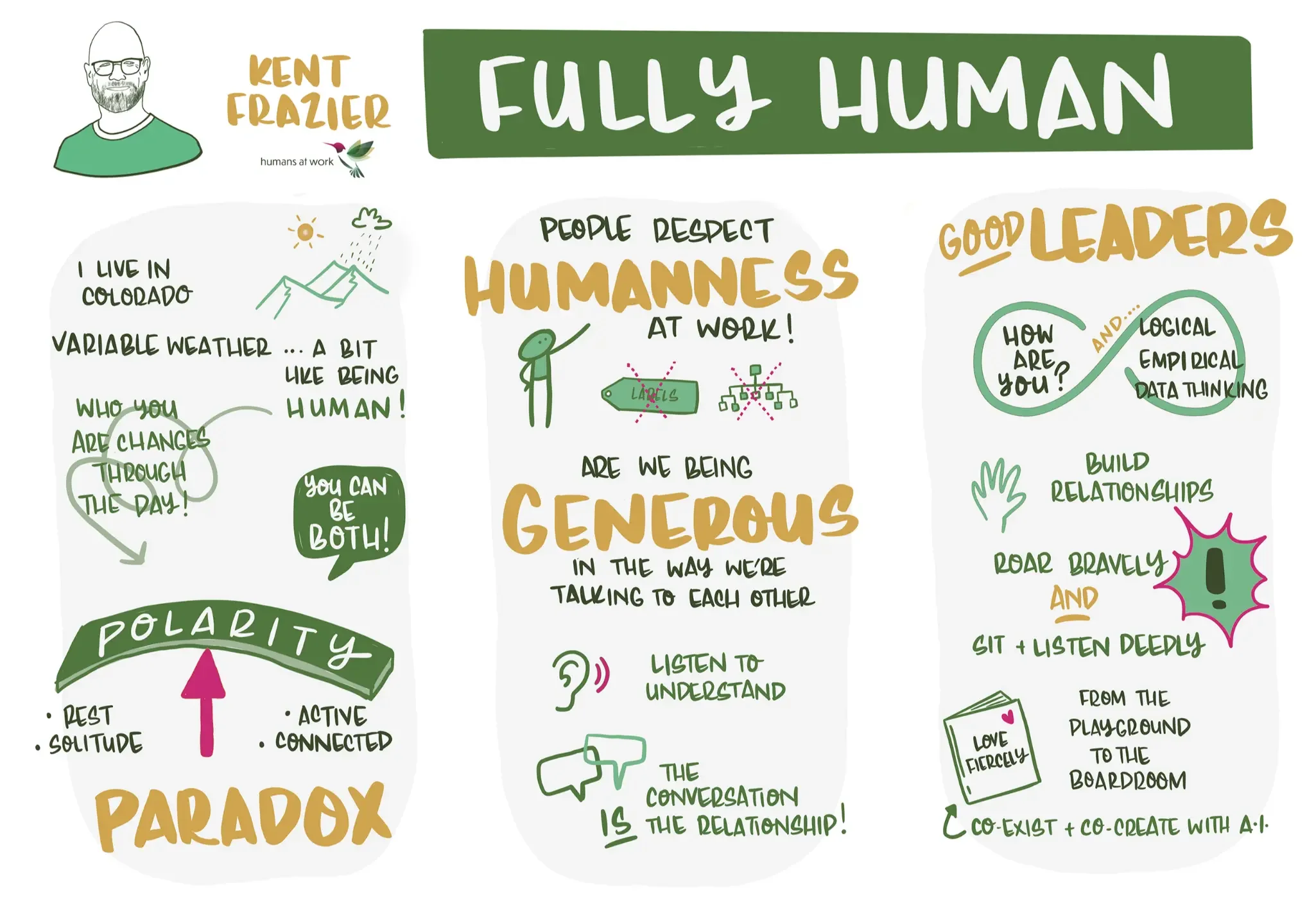
Kent: Beautiful. So much to pull on in what you just offered. One of the notes I heard you just play that's resonating in my listening is this need for both belonging or intimacy, connectedness, and solitude. So many times – pick whatever the polarity is – I need to be active or I need to rest, this is one that we play with as it's not super charged.
It's like if you're always active, too much active can lead to burnout, overwhelm, exhaustion, all those things. Too much rest can lead to complacency, laziness and sloth and all those kinds of things. We need to be active, and we need rest, so how do we integrate both of these?
This is partially why we named our company Paradox Edge a dozen years ago or so, is as we grow and as we become more wise, we become hopefully more able to hold paradox… and the edginess that's inherent in two partial truths that seemingly contradict one another and are also complementary, as much as they are competing.
So, how can we learn to honour and hold the edginess of paradox as we become more fully human, understanding our need to belong and connect with people at times, and understanding I need to be quiet and be in solitude sometimes. How can I hold both of those, without feeling the either/or, good/bad, right/wrong, ping/pong that many folks experience, self-included.
Jules: In terms of your work, I know you do a lot of coaching, individual as well as group sessions, and I would imagine that that getting comfortable with being at that edge is a key thing that people really seek support and advice on. How do you get to that point where you understand that the edge is okay and also, that you feel comfortable and confident in that edge? Personally, as well as professionally, but I suspect that a lot of people identify the edge as being a place of discomfort in a professional sense, much more readily than they do at a personal level. How do you approach that?
Kent: Delicately. I love the distinction or the edge that you're bringing us to in the conversation, even.
As you and I have both done interviews before, we've both interviewed and been interviewed yet, if we're allowing ourselves to be fully alive and I'm not here on some pre-programmed script that I'm saying and neither are you, there can become a certain quality of the conversation that's very distinct, almost as if anything's possible. From the well planned, carefully curated, here's what Kent's gonna be on his script and autopilot saying blah, blah, blah. Here's what Jules is on her script, autopilot saying blah and it's not even, really, a conversation.
When we bring folks to that edge of, okay, what does it feel like for you to be off script? Whether it's the script that one was given from their Mum and Dad, or family or culture of origin – we explore these all the time. Who am I supposed to be to be fill-in-the-blank enough in the eyes of my parents? Then we start to self-author things that are in opposition to what our family or culture of origin might deem as right or comfortable. That's edgy.
And that's a big developmental shift when people move from what Keegan Riley speaks to as the socialised mind – the one that's been conditioned, this is who I'm supposed to be and what I'm supposed to say – to the self-authoring mind, where I'm like, oh, I don't know what I might say next.
Jules: I absolutely love that. And when I think about the Humans at Work concept, the first line on the homepage of the Humans at Work website, which I wrote all the content for myself is, "being you is enough." Take out the word, take out the label, take out the social box that you've been put in, that's "am I good enough?" Am I thin enough? Am I successful enough? Do I earn enough?
Take out the word before and say, how do I get to feel that I am enough, whatever I am? That's really, really important because who you are changes all of the time. In a day, you're a parent, you're an individual, you're a colleague, you're a friend, you're a leader, you're all of these things in every kind of day. But if you're constantly thinking, oh, I'm not good enough in that, I need to be more decisive, I need to be more patient, I need, I need, I need. You're never actually in the moment, you're never open to somebody else saying, "I really appreciate the fact that you're just here and you're just you." You don't listen to that; in your mind you have this thing which is, but I'd be better if…
You see it a lot as a parent I think, you notice it much more when you see your kids growing up and questioning, are they enough? Am I sporty enough? My daughter said to me the other day, "The kids in my class say I'm not sporty, how can I be more sporty?" I thought, what's the definition of sporty? I said, "You play sports so to me you're sporty but that doesn't define who you are. You are kind and you are empathetic, and you are super, super funny and you're really creative and you play sports. But none of those other things that I would label you as, because you don't need a label."
I think for kids or for teenagers, we're very comfortable with talking about that, but then when we become adults we think we should have all of that sorted! And then what you find – and you must find this a lot with people that you work with – is that, once people are comfortable with you, all of those things come out in different kinds of ways. Not everybody has angst, some people are like, I wanna be something different, it's not that I'm not happy with who I am but actually I'd like to make more of a positive impact, or I'd like to become a better leader, or I think I could do better in my decision making and I think these things hold me back.
You realise that nobody has it sorted and there's comfort in that. I'm just like everybody else, nobody has their shit together, we're all just trying to make it all work and be successful and be happy and have good lives.
Kent: Amen to that. Amen to all of that. These labels, whatever they are – sporty or CEO, whatever the label is, or the persona is, that we get so attached to – I found such pain and discomfort and relief when those things get torn away from me. Again and again, I was like, wow, I got so attached to that particular expression of my work. I identify a lot in my work persona, my sense of self, my sense of enoughness, so when that work expression ends and I'm no longer the head of this, or the head of that, or this or that, it's as if I die. It's like, oh, gosh, I have to reinvent who I am again because I'm not that expression anymore.
As we were speaking before we started recording about what's happening to many, many people around the world today when they're being asked to leave their organisation because of financial tensions. "Oh, I can't work here anymore? How am I gonna take care of myself and my family? Who am I if I'm not the CFO? Who am I if I'm not the project manager of X, Y, Z thing. Cos that's who I identify with as the person that takes care of me at home and my people at home." That can put people into quite an existential twist, as you were saying, right?
Jules: Yeah, definitely. When I started my own business, people used to say, you introduce yourself to people and they say, "What do you do?" I thought, oh, gosh, I used to have job titles but what do I use to define myself? Business owner, that sounds a bit boring. Entrepreneur sounds kind of glamourous but you know…
Kent: That sounds sporty.
Jules: That sounds quite sporty, doesn't it? Consultant sounds terrible, so how do I define myself if I don't have a job title?
It's really interesting because in my org design work that I do as a consultant, and I have done for many, many years, what we try and do is to make job titles less about what you do and more about your capability that you bring to any situation. That involves a whole lot of role design, a whole lot of design of how organisations work and how work is distributed and how work gets done…so it's not just role titles.
But for people going through a change process, the role title is the thing that they often have the most difficulty with, in terms of coping, and that's because of this association. You're telling me that I'm doing the same kind of work but instead of being called an X, I'm gonna be called Y, but that's not how I see myself.
That's the tip of the iceberg in terms of people change. I know you've worked in human resources or people fields for a long time, you must've seen this, it's one of those things where you have to be able to explain the whole picture, so that the title becomes less important. If you haven't got the whole picture, people are not convinced, because it's so firmly entrenched in terms of their identity and their feeling of value. The organisation values me because I am 'a' data scientist, because I am 'a' people leader. Not because of the behaviours that I display, or the innovation that I bring, or how flexible I am in terms of moving from one project to another. Those things that, actually, organisations really value from a workforce, those things are not encapsulated necessarily in traditional job titling.
Kent: I have spent, and my teams have spent, colleagues, so much time in just the naming. We become so attached to that naming, and it doesn't point to all the values and characteristics and attributes of what actually goes into that naming.
Wouldn't it be nice if we could recognise ourselves and one another if we're like, "Hey Jules, I don't care what name you have but you're so creative and collaborative and I love your strategic flare for things. I love how you also always focus on what result are we gonna be driving towards." Now, those are things that, hey we need someone who can help us get this over the finish line, "Who's got a good results focus? We're done with the critical thinking, we don't need someone to come in and play the critical thinking instrument, we've done that – now it's time for us to make a decision and get it over the line so who's best to play that instrument right now?"
Versus it always has to be the head person or whatever naming convention we follow. So a lot of the work and language we bring forward in organisations is helping people understand, what are my unique human characteristics that make Jules magic, and Kent magic? How can I notice those, put language to those and get organised around those things because that's where I'm gonna add the most value? If we can forget about the title and all the permissions and all that crap that goes with hierarchical power-over structures, and get more into the what-makes-beautiful-music conversation, I think people would have a much different experience and there'd be different outcomes.
Jules: I completely agree. I'm interested, have you worked in organisations where that has worked?
Kent: Yeah, for sure. This was a lot of our work that we did with Amazon Web Services during COVID. They were in hypergrowth because the whole world was working remotely, so we needed to put everything on servers and we're doing everything remotely. As they're hiring folks, how do you build trust? How do you build a sense of psychological safety? I have no idea who you are in another part of the world, what companies you've worked for, who you like, what you value. And we're doing hard things together as the world is under all kinds of weird stress.
How can we actually introduce a language in a way of sorting through the inevitable tensions that are gonna arise, without diminishing ourselves and each other, yet inviting our best selves forward so that we can actually get to create what we wanna create?
This was rhythms of practice for three years, we were in this, and it was very much getting into the conversation below the labels and the hierarchies – I would just say the approved language that we usually use in organisational life. We introduced more human quality language that helped us understand how to make decisions about, who's gonna put their attention on what, when and why.
I've never had this conversation before, I'm not on autopilot here, does this make sense as I'm describing it?
Jules: Yeah. I was just thinking about two thoughts. One is that there's often this stereotype that, if you talk about that kind of concept of breaking down how an organisation works or how a project gets done into more human characteristics, that you get this stereotypical reaction about this just being all a bit woo woo. This is all the soft stuff, this isn't gonna get this project done and what have you.
I battle with that all the time because I focus particularly on the link between operating model and org design. And a lot of people have already got a view in their mind of those two concepts and it's driven by a very materialistic, very factory, industrial revolution kind of concept, which is long gone but it's still there, it's still taught, it's everywhere.
All the rules, the lines and the boxes and how that makes everything happen and, of course, everybody knows that that is not how organisations work. They work on the basis of relationships and conversations and production of work. But you never produce a piece of work and then never have a conversation about it. That just doesn't happen.
I was reflecting on that, and I was having a memory of a conversation I had with a group of senior leaders in an organisation going through a really difficult time because they'd been given budget reduction targets and they're nervous about that. They're redesigning how they're gonna do work and how many people they need in order to get that work done, and they're gonna have these hard conversations with people saying there will be job losses. It's a really tense time for leaders in that situation, but because of HR sensitivities and legal sensitivities, they can't talk about that until a certain point because that's how things work in those kind of change processes. They said to me, "What advice have you got?"
I took a pause, because in my mature years I'm trying to take a pause before I speak or give advice, rather than rushing straight in. And I thought, I'm just gonna go for it, I know the answer here, but they won't like it because it's not the usual answer. But I'm just gonna go for it anyway.
So, I said, "I think the concept that you need to bring to this is generosity and that makes you vulnerable because you have to put stuff out in the world with no certainty of what you're gonna get back and how you're gonna get that back. Within the limitations of who you can talk to and how much you can talk about it, you have to be willing to go out and have those conversations and say to people, 'There's this unknown happening, I'm gonna do everything I can, here's my story that I'm gonna bring to that, here's who I am. I don't have all the answers.' And to just give generously of your story and your vulnerability and just hold that space and see what you get back. You may get vitriol and tears and arguments and aggression or nothing."
You might just get nothing back. That's almost worse, to be honest, when you put yourself out there, you actually get nothing. In a situation like that, if you don't do that, then nothing's coming your way ever, you're not moving on, you're in a static place and it's a very tense place where you're holding, you're waiting, you're anticipating, it's like the 'sword of Damocles'. If you wanna get away from that feeling, then putting yourself out there is an opportunity to move the dial a little bit and to set your intention – I know you use that term – by showing that generosity and that vulnerability.
As you were talking, I was thinking that is a story where that's not the normal conversation, it's not the normal language within a corporate organisation at a time of restructure, but it is the one that brings back that human identity into a process or into a situation and context. In the end, people respect humanness; not everybody because there are some not very nice people in the world, but generally within an organisation or a community or a team, there will be a level of respect for, in the end, that other person is a human just like me. You have to be willing to take the chance that they're not gonna respect you, because you have to show that respect first.
Kent: You played so many beautiful notes in your riff there. There's some I wanna highlight and play with some more. You spoke about relationships and conversations, and there's a couple of threads that were coming up for me as I was listening to you. And one comes from a Harvard Business Review article that was written in the late nineties or early two thousands by Ram Charan who put forth the idea that dialogue is the foundational unit of organisational work. Let's hold that as one nugget.
The other nugget that came up was from Susan Scott's work, Crucial Conversations, where she says, "The conversation is the relationship." If the conversation is the relationship, and dialogue is the most fundamental unit of work in organisations, the way we talk to each other – are we being generous in the way we're speaking to one another? Or what is the tone and texture of the conversation because that's what the relationship is? Is it transactional? Is it power over? Is it manipulative? Is it cooperative? Is it creative?
This is where, when we're working with organisations, you asked for examples like, okay, listen to how you're talking about whatever the situation is. How would you all name the tone and texture of your conversation? Is it blamey? Is it whiney? Is it complaining? Is it fixing – what is it? Then they're like, oh, okay.
How might you re-imagine and re-construct the conversation about this thing that really matters, with some generosity or with some care, or with some curiosity? What happens as you all do that? Now we're in an alive conversation where people are tuning into, "We really need whoever on our team has the strongest critical thinking, we need that right now." Then there's gonna be a time when we've had enough of that and we don't need more critical thinking, we need to understand the relational domain now, how is this gonna impact? We need some compassion, and we need some empathy, and we need some curiosity around how what we've critically thought about is gonna land in our customers' world, or our employees' world, or in the environment. Unless and until we're considering all those things, we have partial solutions and that has nothing to do with anyone's title or where they sit in an organisational chart.
Jules: Absolutely. That makes a lot of sense to me. I think one of the things that I see is that people confuse meetings with conversation, so often the thing that's gonna make the difference is not having a meeting, but having a facilitated workshop where you facilitate time to have a conversation. You get a lot of breakthroughs and people say, "We spend a lot of time with this team in meetings," but the meetings are about whatever they're about, saying we've had a meeting. Or, "We had a governance discussion, but we didn't actually grapple with the meat of the decision or the real trade-offs that we were talking about. We went through the agenda, and we ticked off all the papers, so we've had a meeting, we've talked about this a lot."
You've talked about it, but you haven't actually conversed, you haven't discussed it, you haven't got to a point of consensus. It brings to mind a story that Enver Samuel told me on the podcast recording that I did with him about Nelson Mandela as President. And how one of his great traits was being in a big meeting, big discussion group and holding himself very still and silent and listening to everything that was going on, and really taking it in and thinking about it, but not responding until that had been done. Not thinking about responding to the situation while he was listening. He talked about this great ability to really listen and understand what was going on. And then when that discourse had come to an end, then it was his turn to think about, well how do I respond to this because this is a conversation, it's not a defence.
Often if you think about how people work together, they're listening to defend what that person's saying to them about their team or their work or their progress, their pace or whatever as opposed to, what's driving this person to come to me with this problem? Let me really understand their perspective and then that might change my perspective, but I'm showing them respect by listening to what they're saying anyway.
Kent: Listening and allowing space, allowing what you just said to reverb a little bit, without me…
Jules: Yes. I tell this story of when I started doing facilitation and I realised that I would be very uncomfortable as a facilitator. Part of the reason for that is, you introduce new concepts or quite often I might come up with a decision-making model that I want the group that I'm working with to reflect on and to think about because there's something that's not working in their decision-making practice.
You introduce the model, you try make it as engaging as possible, but there comes a point where you have to actually just stop, and hold this space, and wait…and you have this uncomfortable pause. But that is to allow people to collect their thoughts, to marshal their responses, to internalise a little bit about what you're saying and to decide who they're bringing to that conversation. What do they wanna know? Do they wanna know more? Have they got more questions? Do they wanna reflect on it? Do they wanna move into the next steps?
As a facilitator, you just have to stop, and you've got a room full of people staring at you and that's uncomfortable. I think it's very similar to the leadership challenges that a lot of leaders face where they're expected to have the answers all the time but, actually, if they have all the answers all the time, what is everybody else doing in their team?
They have to be comfortable to set out a vision, describe a problem, describe an opportunity, ask a question, and then wait for somebody to step into that space. But that's not often what they're taught to do, they're often taught to be the one with all the answers, as if there were ever any "the answer" to any problem or any opportunity.
Kent: We could go on and on with this. One of the distinctions you made that really landed with me as I was listening to you, is the distinction between a meeting and a conversation. I can put this in an example again, building off your generosity story, as I think people like examples of how this stuff actually impacts versus keeping it in theory.
I was working with someone and there was a performance issue and so, the person's like, "I've got a meeting to discuss this person's performance issue, could I get some coaching on it?" I said, "Sure." I was playing around, and I said, "Do you wanna have a meeting or do you wanna have a conversation?" was the question I asked her. She's like, "Ohhh." Because, we could have a performance management meeting and everyone fills out the form, and we checked all the boxes, as I heard you say, and that would have led to a six month, very well managed and orchestrated set of meetings around this performance management issue.
Instead, I said, "What might happen if you were to actually have a conversation about how it's going, and you process all of your leadership principles, which you all do for your other meeting. What if you were to just take all those leadership principles and run them through the lens of care. And how would you have a conversation with this person about how it's gone, rather than have a performance management meeting?"
She took that coaching, and I got an email a week later, "I don't know who you are, where you came from," this is what she's saying, "but I just had one of the most human, connected conversations that led to a mutually excited outcome that otherwise would've taken us six months of painful HR nonsense and resulted in the same outcome but everyone feeling pissed off. Thank you so much for helping us create a caring conversation about how it's really going and what would we all like to see happen, versus the performance management meeting."
Jules: Yeah. The performance management one is a really interesting one and during COVID with all of the virtual work, there's this real struggle about how do I manage performance, and how do I manage my team if I can't see what they're doing all of the time? It's this big crisis of what does leadership mean?
I think my experience of what good leaders did – confident, competent, caring leaders – is that they had conversations with their people about how they were feeling. "How are you feeling about working from home all the time? How are you feeling about homeschooling your kids? How are you feeling about the fact that you're having to do all of this asynchronous work, because people are prioritising going to the doctor or going to the supermarket and it's visible for once?" They've always prioritised it in different kinds of ways, but now you… we used to say, "So and so's had to go to the supermarket because there was only one hour that they could do it and otherwise you don't have food," you couldn't get any deliveries or whatever.
People who were able to say, "I know how my people are doing because I talk to them about how they're coping with everything," had much more productivity. Because people generally go to work to do a good job. It's all the other stuff that's really, really difficult.
It's a conversation I had with a guy called Andy Longley, who uses sports and performance coaching and brings that into the leadership arena. We talked about how things would be different if, say, after attending a meeting or doing a presentation, you said to your member of staff who'd done that presentation, "How do you feel about how that went?" rather than either, "How do you think that went?" which is a very brain, what-am-I-being-measured-on-here kind of response, or going straight in with some feedback.
"How did you feel that went?" Most people have a sense of, "I struggled to get recognition for the point I was trying to make," or, "I felt like I was underprepared," or, "I felt like we rushed too quickly into this solution, and I really would've valued more exploration."
They're performance managing themselves by talking about how they felt, and then you're able to respond in a coaching kind of way – like, "Actually, you might feel it went quickly, but from our perspective it's a very successful outcome that they didn't spend ages on this bit of detail because that proves that you've got some trust there. Valid to have that feeling but don't spend too much time worrying about it." You're able to performance manage and coach in the moment by allowing that person to describe their emotional state and what they've picked up on, cos people are really conscious of a lot of interpersonal things and that can tell them a lot about their own performance.
Kent: You're touching on a taboo, or once upon a time taboo topic – there's no place for feelings at work. Again, born from the mechanistic, industrialisation of things, where we literally denounce the subjective half of reality, in deference to just logical, rational, empirical data, which is true and partial.
I think COVID, as you're speaking to this, what helped differentiate successful leaders and teams in that more asynchronous way of having to get work done, were those that were able to, willing to, be vulnerable, empathise, connect with people and understand how they are actually feeling and coping and navigating. I agree wholeheartedly, and we saw that writ large across all of our work as well.
Now feelings and that sentiment is allowed in the workplace and now we have another challenge that I hear coming up in conversations is, people are confusing not being comfortable with not being safe. It's like, "So and so's creating a hostile working environment cos I don't feel safe." "Do you not feel safe or are you just not comfortable getting feedback about the quality of your performance as a beginner? I appreciate you might be uncomfortable getting some corrective input on how it went, and I appreciate that you feel uncomfortable, but you're perfectly safe."
Jules: This is coming back to this concept of being comfortable with being uncomfortable at that edge of things. It's something that you often see in leadership teams that are not a team. Because they never get to that point of feeling uncomfortable, or they don't want to make anyone else feel uncomfortable so they don't want to hold them to account, they don't want to give them feedback, they don't wanna have a big discussion or big argument, for the sake of using that word, because they don't wanna make other people feel uncomfortable.
The issue with that is, if you never reflect back the reality of how a colleague is acting, or how their function is delivering, then you're never improving, you're never able to have a conversation about, well where's the root cause of that issue? Is it that business group or, actually, is it that there are things that we could do something about, or it's further down the chain?
You're never able to have those really good conversations about how to get better, how to improve, how to make things more valid, more valuable, how to make a better experience for your customers or your people, because you never actually surface the fact that things aren't great.
You find quite often where I get asked to come in and support a Leadership Team "to be better" – the Leadership Team has no idea that they're not great, because nobody's ever said to them, "You're not a great Leadership Team. You don't make clear, transparent, right paced decisions. You flip flop from one thing to another. You agree in a meeting and then you litigate that issue later." They don't have that feedback, so the first time that they get the sense of things aren't being amazing is when somebody like you or me pops up. So we're the ones then who bring in that sense of, there are things that could be more effective but that means you have to be really uncomfortable, and you have to feel comfortable with being uncomfortable.
But actually, if you build relationships with people, you should be able to have… I like to use 'candid' because I think a lot of people go quite aggressive or confrontational and that's not my style at all, I don't like it. I don't like being a recipient of that, so I certainly don't like to be the person delivering it. But if you can have an open, candid, generous conversation where you're able to say, "What I see from my perspective is these things. You guys aren't talking to each other, you're talking past each other." Or "This person's zoned out, you lost them 5 minutes ago and you've not noticed, so is that okay or is that something that you wanna do something about? How do you bring that person back in?" For the person zoning out, "Why are you zoning out? Is it that you've just gone, no, this is criticism – I'm just gonna close, the shutters are down, I'm out. What's happening there?"
That is about understanding who's in the room, reading body language, all of those things that are subconscious, and then being able to say, "When you said that thing about my team, I felt really defensive, and I wish you'd have said it in a different kind of way. I wish you'd have talked about it before. But now that you've said it, I wanna get through the defensiveness and I wanna say, 'How do we work together to make this better?'"
That's when you start to see really effective leadership teams, and they start to role model that for their teams because, above all else, leaders are very visible, their behaviour sets the tone. You have issues within functions, what's the leadership style of the leaders in this group? What are they role modelling? What are they teaching? How are they exemplifying what people should be moving towards, rather than being a really big part of the issue?
Kent: Much of what you're speaking to, I'm reminded of again Keegan's work, Linda Lahey and Robert Keegan, in their deliberately developmental organisations, where they speak to… most executives and most leaders are doing a job that no one is asking them to do – that's "to look good". The question is, am I more worried about looking good or how fast I'm learning?
If we have a deliberately developmental organisation and hold ourselves as a learning organisation, we can give each other that kind of candid – I love how you used that word, candid – constructive, caring conversation about how it's going, what's working, what's not working because we're all just learning. There's not that diminishing, judgy thing and we can get rid of that very human, very natural want and need to look good, to be liked, to be right, to belong. We've gotta relax all that stuff, because we can't learn when we're all trying to be liked, and be right, and know everything.
Jules: I'm reminded of, and I can't remember the exact wording, apologies, but in the book – which we must talk about – there's one of the concepts which I thought really was so interesting in terms of leadership, was about… as a dragon, needing to roar loudly and with passion and yet, on the other side, to speak softly and to be open and listen.
I think quite often, because people are under pressure and they're doing things they don't feel comfortable with or confident in, they go to one or the other, because it's such hard work just to be one, that the concept of being both can be exhausting for people if they're really, really busy, if they're new leaders or what have you.
That's one of the things that really resonated when I first read the book, was that you can take those concepts, and you can apply them into a professional setting just as easily as you can apply it to the world of children. So tell us the story of the book.
Kent: Love Fiercely is the title, inspired in part by the year of the wood dragon which we're in, as you and I discussed previously. What I've been playing with here is how do we lead with love through all the different seasons of our life? From the playground, as I'm trying to teach my kids how to stand up for themselves and to use the one dragon parent that you were pointing to, how can I roar bravely, showing I'm confident and I've got agency on the playground, in my classroom and how can I also know when to be quiet and sit and listen with empathy, and just be present and let other people roar when it's their turn to roar.
Again, it's edgy, holding that paradox and in much of my work over the last couple of decades, people would invariably say something like, "I wish I would've learned this when I was a kid." And I'm trying to find a way to translate what Daddy does to my nine and seven-year-old. On New Year's Day, this idea, I can use a metaphor of the wood dragon about integrating eastern/western, ying/yang, light and dark…paradox. Hopefully, my intention is, that this can become a tool for us to hold intergenerational, multi-perspective conversations about, what's happening? How's it going? Not having meetings about this but really having candid, caring conversations about all of our respective dragon parts.
We all have superpower, magical things that are uniquely ours that it's incumbent upon us to bring powerfully into the world, and we all have our shadowy, lurky parts that we need to manage and deal with. I appreciate you bringing our attention here, it's just two months old, this is one of the first conversations I'm having beyond my kids' first grade and third grade classes.
To your point, it's applicable in the playground, in a first or third grade setting, as it is in a boardroom, where the highest paid person in the room or the boss doesn't always have to roar to show that they're right. Can they actually, as you were pointing out beautifully with Mandela earlier, just sit and listen deeply to all the varying perspectives and wants and needs from all the different parts of the whole? Those are capacities and competencies that we work to develop as children, all the way until the end. From the playground to the infinite, it doesn't end, we're always becoming more able to hold more paradox, to hold more nuance, subtlety, and it's edgy. It is the book trying to bring some playful meanings to that.
Jules: Tell me about the creative process because I love the book, and when you first showed it to me, I thought, oh, gosh, it's so complex and yet it's so simple and there's magic in that. Some of that is just how you've got these beautiful illustrations that are full of colour and movement, and very few words, and the words are all really carefully chosen. How did you actually get to that point?
Kent: I'm also a song writer, poet, so the book is a little poem. I wanted it to be short. That constriction, or restriction, promotes what do I really wanna say? How can I say what I really wanna say in as few words as possible, that a kid could understand, and it would also resonate with an elder? I was in my song writing/poetry mode with the words, and I really just saw it, it was like a flash. I just saw the image of, oh I could have these duelling dragons, if you will, that seemingly are opposites, but really are completing this holistic thing.
Then AI – I can't draw this stuff, so I'm trying to work with the forces that are upon us, AI's not going away, as far as I can tell, so I'm not resisting it, I'm not saying it's bad or stupid; I was like, okay, how can I maybe use this as a tool to help me express what I'm trying to express to my kids? I used Dall-E and ChatGPT, and just continued to exercise my prompt writing until it gave me an image that I was like, yeah, that's what I'm trying to convey with these few words.
Jules: It's really fun, isn't it, that something that's about humanness – that AI will never, at least in our lifetime, be able to replicate – something about humanity and that complexity that makes up humanness, supported and enabled in terms of AI, to deliver the graphics. There's something cute and cheeky, I think, about, this is all about being human and de-mechanising those conversations and our views about ourselves, but I'm gonna make use of the digital tools available to me, because why wouldn't you?
That is very much a metaphor for modern work going forward, I think. The future of work is you cannot fight against technologies, it's how you use them ethically and sensibly, where it makes sense, and how you then protect and really enhance that human aspect. Because, if you assume that technology can deliver what humans can, you're missing the point. You're missing a whole lot of warmth and innovation and resilience and all of those other things. If you say everything's just about the humans, and technology doesn't play a part, then you're also missing the point. Because if you have technologies that can make things cleaner, greener, faster, that don't exploit human potential where you don't need to, then why wouldn't you do that? It's the integration of those things in a sensible designed way that's gonna revolutionise workforces.
Kent: That's my sense and, again, I hold it as paradox. Again, it's back to the naming of our company, it's like paradox…edgy to hold, that being fully human, we also leverage technology. And we're not adopting an either/or way of being. We're not saying technology's gonna solve everything, and letting robots run stuff and not paying attention to human, and we're not saying don't let AI and technology do stuff. We need to hold both of these. How do we co-exist? How are we gonna co-create? How do we bring nature into them?
These three powerful – and the book speaks to this as well – I look at the most powerful streams shaping our future: humanity, technology and nature. How are we understanding the interplay among these three powerful currents, streams if you will, energies, that are moving us forward into some future?
Hopefully it has humanity still part of it. Nature will be here, mother nature will always win, is my perspective. I'm always gonna bow to mother nature and her mystery and wisdom that's way beyond my feeble mind to try to figure out what's happening. That's inherent in this book, too – the mystery of that.
Jules: Absolutely.
Kent: We're largely disconnected from that mystery of mother nature, knowing way more about how it's gonna go than our politicians or technology leaders or whoever's running the world.
Jules: Absolutely. I am a big believer in using nature and natural ecosystems to bring a bit more humanity – strangely, but we are of nature – bringing a bit more humanity into how organisations work or how communities work.
I was gonna say, one of the really fascinating things about the book, and the concept of the dragon in the illustrations that have the dragons in the forests and the wood, is that it's very, very centred on nature and trying to incorporate those things. The thing that really struck me about this concept of paradoxes is that we have become so used to binary – we're either on one side of the table or we're on the other, we're on the opposite side rather than we're both on the same side of the table, we've just got different perspectives on how to solve the problem. We're on one side of the war or the other side. We're on the side of fossil fuels or we're on the side of green energy.
Transition and success for humanity and nature is not going to be solved by warring factions on either side of an artificially created binary world; life is not like that. That kind of concept that is encapsulated in the book, which is, you have to have both and those two things work really effectively together, which is exactly what happens in natural ecosystems.
You have keystone species, you have the recyclers, you have the predators, you have the prey – if you take out one of those, the whole thing collapses. It's exactly the same, in terms of the concepts in the book, but also in terms of some of these huge crises that we're facing, that you can't approach them with one solution or with one mindset. That's not gonna solve the problem.
Kent: That's right. And so, the intention of this book is to really… it's almost as if we're dreaming this into reality in this conversation, because it's about to be born, so I don't know what it's gonna be. How can I possibly know what this book's gonna do, much like I don't know what my kids are gonna do the moment they're born? One of the intentions of it is to invite people into this dream space… how might we imagine a different future that we wanna live into that's not so binary, that's not so either/or, that's not fuelled by war and power over, and everyone has to be and look and do this thing.
I hope this will become an instrument of transformation in that way and we need the dream, it's hard to dream when one's at war. The last couple of months that this has been in my awareness, has very much been a dream space for me to help cope with – we were talking about this before we started recording – all the stuff that is dying and decaying and falling apart, as it should and needs to.
The systems of modernity need to be hospiced, how do we do it? It's our job as leaders to not crap on that, we need to honour what got us here. This is very much alive in our individual team or organisational work. You've gotta honour and bless everything that got us here. And we have to then be able to say and if this isn't gonna get us there, so we need to stop doing certain stuff. And we actually need to dream into and look over the edge to where none of us have any competency, capacity or capability, because none of us have ever been here before.
How are we gonna lock arms with trust and love and care and move into this unknown, unshaped, unformed future and start putting some shape and form to it, born from love? Not fear, power over, scarcity, all that kind of stuff. That's what I'm hoping, this book becomes an instrument in that way to bring forward those kinds of caring conversations.
Jules: You're launching in May, I think?
Kent: I think so, yeah. I'm hoping it's gonna be ready, I'm awaiting the final proof hard copy today, from a new partner. The previous partner that I thought was gonna support the manufacturing and distributing of this had some quality challenges, I'll just say, and the product wasn't up to my expectation. Provided that the copy I get today from my new partner is up to my quality standards, it will be ready to go. And then it will take another eight weeks or so for it to be in all the platforms globally.
Jules: Then we'll see what it grows into, right? It's quite exciting, isn't it?
Kent: We'll see, yeah. How limiting it would be for me to say, "Here's what it is and here's exactly how it's gonna go." Then when it doesn't go that way, I'm gonna be all upset and quit. Versus me holding it like a child – okay, I have no idea, the reception that you and others are sharing is beautiful. I don't wanna try to control this thing, I wanna steward it with other people, likeminded, spirited, kindhearted folks that also have talents and skills and perspectives.
This is what I love about our relationship – we met in this community called Good Ripple, I see you as a human being doing good things in the world, as I fancy myself. And what might we wanna co-create in this way? As these little islands of coherence trying to create good ripples in the world. So, shout out to Carlos Terol.
Jules: Yes, definitely. Carlos, who put us together – amazing. It's coming back to that concept that I talked about earlier about generosity and you putting stuff out there, this is a really great example. You've put your creative thought and effort and passion and love into something, and then you put it out to the world, and why shouldn't you?
I'm reminded of somebody that I know through LinkedIn who posted about being told two years ago that he was unemployable in the country that he was in, in the field that he was in. He took that and he thought, okay, I'm gonna start my own business, I'm gonna come up with my own concept. And two years later he's starting to see some real success. Along the way people have said to him, "You're too ambitious. You should tone down your dreams."
He was reflecting on how difficult it is to keep going with your generosity and your dreams and your ambitions when everyone around you is saying, "Don't do that, that's scary. What are the risks? What might happen?" The courage to stick with it, and to go out into the world and to see what happens is a real exercise in generosity and vulnerability. I'm behind you all the way on this, so you're not alone on this because I love the concept, I love the wood dragon, we've got some ideas about how we might help that concept grow up and grow into the world and I'm sure lots of other people will.
Kent: Thank you. One of the things I'm reminded of now is when we were speaking about this last month, you were like, "I was just having a conversation in my kitchen," was it with your husband? "about the wood dragon and now you wrote a book about it?" We're tuned into that same idea. I just so appreciate your generosity of listening, your generosity of collaboration as we're getting to know each other here. I'm deeply grateful for who you are, and how you've extended your generosity to me as we've gotten to know each other, so thank you so much.
Jules: It's definitely reciprocal! We've run out of time because, as you and I know, we can talk for hours about all manner of topics. I wanted to say, we really appreciate your time, your stories, telling us about your life and showing us a little bit about what goes on in your head, your creative imagination and we look forward to seeing the finished article of the book. Thank you very much.
Kent: Thank you, Jules. Thank you.
Thank you so much for listening and thanks, as always, to the generosity of our delightful guests. The stories of how others have faced up to their challenges can help give all of us courage to keep going with our own. For more great episodes, blogs, go to the JERICA Global website.
Humans at Work Podcast