
Adopting and Adapting for Impact — with Craig Pattison
Humans at Work Podcast | Episode 23
Host: Jules Harrison-Annear | Guest: Craig Pattison
Jules: Kia ora, welcome to Humans at Work. I'm Jules, your host. Thanks for joining me and our latest guest and thanks for taking some time in your day to indulge your curiosity about other people and their humanness. If your thirst is unquenched after this, check out jericaglobal.com. Now let's begin.
Today I'm talking to Craig Pattison. I'm gonna get Craig to introduce himself and tell us who makes up his family. Craig.
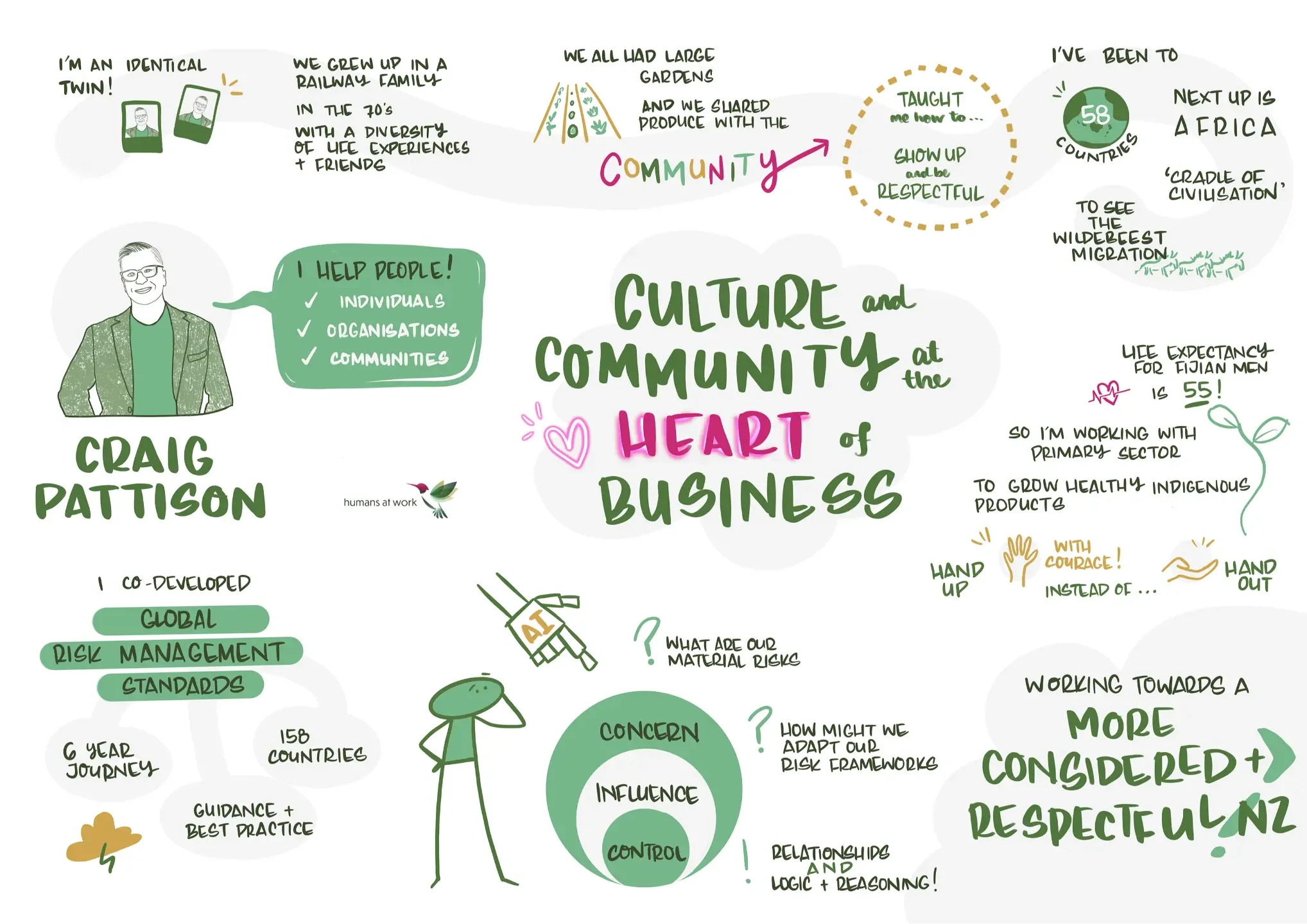
Craig: Good morning. Who makes up my family? First of all, let's start with myself. I would call myself a person that is dedicated and passionate to helping others. Throughout my life, it started very early on and has continued to be a constant and rewarding thing for most of my life. That's individuals, businesses, organisations and the community at large.
In my family, I have an identical twin brother which makes us fiercely competitive which is great for keeping us honest but also for keeping us focused on our goals, our families and our communities. I also have an older brother who lives in Australia and made a decision, as some New Zealanders have done, to go out to Australia in the early nineties and has lived out there for the rest of his time and occasionally comes back to New Zealand.
Jules: I didn't know that you had an identical twin brother and now I've got to ask, how identical is identical? Do you look so similar but you couldn't pretend to be him, or do you actually look super identical?
Craig: No, we're super identical. So much so that when my twin brother, Brent had his children I used to babysit, which was perfectly reasonable when they were little because they thought that Dad was always home. Then there came a moment when they realised, in their own little world, that somehow, I wasn't quite Dad and one night when I was babysitting, I had to call my brother home from a dinner because the children just wouldn't settle. That's how identical we are.
Jules: Wow okay, I'll have to ask for a photo of the two of you side by side because I'm very curious about this…
Craig, what would you say was the biggest memory that you have kept since your childhood? What is the defining memory from your childhood, would you say? Is there a single one or is it a film reel, if you like?
Craig: That is a very good question, perhaps, as I reflect, maybe a collage. I grew up in Cannon's Creek in Porirua and, at the time that I was growing up, there was the Ford Motor Company up on the hill in Porirua. And to fulfil the production line, New Zealand was using a lot of Pacific Island peoples to help with the labour force. But I grew up at a time where the Police were doing dawn raids, and so in my neighbourhood they were coming around and rounding people up and throwing them into vans and taking them off to places and relocating them. And it was a very tumultuous time in New Zealand's history, one that was overlooked in many instances and gone back and acknowledged the difficult times on both sides of that conversation and the respectful thing to do. So I grew up in the backdrop of that.
That, I think in my formative years, probably put, or distilled within me, not realising at the time, a great sense of fairness and equity in life. But also a great sense of empathy to be on both sides of the conversation and listen with real intent cos it wasn't really a win or loss; it was more how do we fulfil the obligations of our need to be productive in New Zealand, respecting the labour force that we could get from the Pacific Islands and actually integrate them into a broader New Zealand story. That was in the early seventies.
And then talking about the collage, I reflect that I had the most unbelievably magical childhood. We were a railway family, and my grandparents played an absolutely, unbelievably dedicated role in raising all three of us. We would spend large amounts of time out at Paekākāriki and Raumati, swimming and walking and mussel hunting and all of those wonderful things that children get to do.
Just like many, as railway families, every single railway family in the community had large gardens that they would all collectively produce vegetables, tomatoes, marrow, pumpkin, beans etc and share amongst the community free. That's just how railway families worked. It was an amazing childhood. That also taught me a great sense of obligation to the community – show up, turn up and be respectful.
Jules: I know that you do a lot for the community now, can you talk to us a little bit about that?
Craig: Certainly, I'm not one, if somebody was to ask me for help, to say no. That both comes at detriment but also comes as a huge reward. It means the diversity of life experience I've had, and the diversity of friendships is just something that I'd encourage everybody to do. It's one thing to think about being active in the community; it's another just to do it naturally.
As I look at how the world operates, that global community, even now we need even more attention and detail to being respectful, to broadening our perspectives on things and to reaching out and helping people. Rather than having our measure as individual success, have our measure as collective or community success cos then everyone gets to have some value.
Jules: I wanted to ask you where you've lived in the world. Have you always lived in New Zealand, or have you lived in other parts of the world?
Craig: My work and passion has allowed me just the most unbelievably, tremendously wonderful life to date. I've travelled to over 58 countries; I've lived and worked in seven, and what an experience! New Zealanders have within them maybe a naivety and a tenacity which encourages them to step into conversations, and rather than talking, show by doing and as a result of doing, we build trust and with that trust comes an invitation to take projects forward and often that's offshore. But also had the opportunity to do that onshore as well.
Having lived and worked in those countries, what you pick up is a whole lot about what it takes to participate in a wide culture that includes business but business isn't at the heart of it; the culture and the community is at the heart of business. And I think that's been a tremendous life lesson and a privilege to have been overseas and bring that back into New Zealand, and help organisations embed that within their own culture, values, customs and practices.
Jules: Out of those 58 countries, what would you say was your favourite?
Craig: Gosh, I thought you might ask that! At the detriment of offending the other 57! It's very difficult cos they're all experiential; some were around friendship, some were around scenery, some were around the organisations. But certainly really liked Asia and spent nearly six years there, and really liked Europe and spent a couple of years there as well. A little bit of time in the States, but certainly western Europe and western Asia. It's really hard to say – really, really loved Avignon in France; really, really liked Vietnam; Hong Kong; really, really liked my time in London, for all different reasons so it's really hard to choose one out of those 58.
Jules: Where is gonna be 59? If you could only visit one other country in the world, what would it be?
Craig: The only continent I haven't been on is Africa and there's plans to do that this year. It's been a lifelong dream of mine to watch the wildebeest migration and this year, God willing, and the finances and flexibility, I'd really like to take that opportunity and go out and see nature unfold that's been happening for thousands of years. At the back end of that, at this stage, is a week just observing gorillas.
Jules: I will tell you that although I haven't seen wildebeest migrating, I have spent quite a lot of time in Africa as a child, and in my early twenties I visited a few times. I think going into the, they call it the wilderness in Africa, and in other places you would call it countryside, but to go to the rural areas in a number of different countries in Africa is actually like nothing else.
It's one of those continents that has an amazing diversity in its landscapes – towering mountains and amazing waterfalls and then very flat and very hot. One of the memories that make up my collage of my childhood, is the sounds of a hot African savannah, which is primarily insects and the sun and the wind on the grass. You do sometimes hear hippos or lions roaring or what have you, but it's that everyday sound, if you like, is one of those key memories that make up my childhood collage.
I hope for your sake that you get there because I don't think it really matters what you do or what you see but being able to just sit and absorb a continent that has been around for so long. And, regardless of science or religion or whatever your beliefs are, there is something about Africa being the nexus of life that you feel, you touch, you feel it on your skin, you smell it. It's absolutely an incredible experience and I think you would really, really, really soak it up.
Craig: Gosh, what a wonderful… for me, I see Africa as the cradle of civilisation. So I wanna go deeper into just immersing myself in what that feels like and what are the new, as you said, sounds and sights and experiences and then fold that into being a broader me and a better me as a result of doing that. Part of it is obviously just to have the holiday experience but, actually, for me it's much deeper than that, it's a real connection to, as I said, what I consider to be the cradle of civilisation; there's a curiosity in me, I just can't wait to go and see what that's like.
Jules: The other thing I'd say about African cultures is that a lot of people who've never been to Africa have a view of what it will be like and what the people are like. That comes from TV and film and documentaries and all of those different things that people have engaged with or people that you've known. I would say that many of the people that I met when I lived in, and I lived in three different African countries, many of the people that I met share similar traits. I would describe those traits as incredibly generous in time and listening and enthusiasm; very gentle and open and welcoming; absolutely hilarious, an incredible sense of humour, and very much a can do attitude.
One of the really exciting things that is happening in a lot of those countries in Africa is that people are starting small businesses or startups that have the potential to be really large, significant, impactful businesses. And they're starting them where they are, in the way that they want to do them, in a way that suits the country that they're in and the community that they're focusing on. Lots of female solopreneurs and entrepreneurs really starting to make their mark both in Africa but also in the global stage, which is incredibly exciting for Africans and also really helpful in trying to disrupt some of those stereotypes that have existed for so long.
I can imagine, knowing what I know about you and your interest in different business models and working with entrepreneurs, you will see so much of that activity that is proliferating primarily in the urban areas, but it's led by Africans and a lot of African women, which is just so good to see.
Craig: It mirrors, in many ways, the way that I've sought to live my life. In the mid-2000s I stepped into the primary sector having traditionally come out of banking and finance and corporates for much of my working career and technology, which has taken me all over the world.
Reading an article about life expectancy in Fiji, I saw that life expectancy in Fiji was 55 and now slightly older. I suddenly went, gosh, that means substantively my life would've finished by now if I was in Fiji, within that cohort. It got me thinking about why was the life expectancy so short and what could we do productively to change that?
I was working for an organisation that brought in and placed agricultural machinery on farms throughout New Zealand. I started a dialogue with opening up an agricultural academy in Fiji and other islands and getting people back to their cultural roots which is chieftain based and growing vanilla and taro and other crops that were culturally appropriate. The whole nub of the idea was to take the secondary agricultural fleet in New Zealand, literally put it on containers, send it over where appropriate to help support culturally appropriate and nutritious foods using traditional methods. One, that would be an ability to go back and right the wrongs of health and indigenous beliefs and values and customs but also as part of our hand up rather than hand out strategy, so I started that dialogue.
As I reflect on the conversation we've had thus far in this wonderful little podcast, I think that really is the nub of who I am and what I'm about, which is why I'm genuinely interested in seeing businesses succeed and why I wanna see emerging ideas be given the light of day. And why I want us to put wrappers around people to support them to either step into new business ventures or new organisational community ventures with courage. Some of them will work, some of them won't but it's definitely worth the journey.
In the early eighties I left high school, and I went to Nelson Boys College, having gone to boarding school from age 11. Boarding school is not necessarily the best experience, and for me, it was the most unbelievable fabulous experience that, if anyone ever asked me, I would suggest that they should seriously consider it. It teaches you resilience, it teaches you the value of friendships, it teaches you patience. It teaches you all of those aspects that you really, really need in your life to be greater than who you are and supportive of those as they grow and develop, and I found it fabulous.
In the late eighties, in what I think is Year 13 now – it was University Entrance – I did six subjects for School C and got five and my twin brother Brent got six. And my parents didn't have the financial resources, as railway families, even though they knew education was important, to fund both of us to come back for our final year. I was gonna get prefect status and instead I came back to Wellington and helped my parents make some progress and it failed for them. And I came back out of school and started helping them over the course of a year, extract themselves out of that business and not have any debt and just finish as neutral. That really got me passionate and excited about doing that for organisations, businesses, and entrepreneurs and that's really where my journey into helping out really began.
Jules: I wanted to ask you about risk because you and I met when you were working in a risk team. We've known each other quite a few years now. My question about risk is do you think the nature of risk has changed? We hear a lot about global polycrises and this expanding sense of real global risks. Is that turning the tide in terms of what risk management practice looks and feels like now compared to what it used to be 10/15 years ago?
Craig: Oh, interesting question. This would only be my personal opinion. For the context of those listening to this podcast, in the early 2000s or the mid-2000s I had the privilege of being part of the New Zealand National Standards development of two international standards, one in risk management and one in governance. That journey was a six-year journey for the development of the risk management standard as well as the governance standard. That taught me an awful lot, cos it's approximately 158 countries participating in the co-development of a universal set of standards and guidance and best practice around risk and governance.
As I reflect on the time from when I was doing risk, as you were mentioning, for a large Government entity and to present day, my observation would be I think that our understanding of risk has changed in two aspects. One is traditional risk methods were done quite in a linear and logical way. And, actually, I think over time as the global workforce and the global economy has become effectively a large local economy, it's meant that we've needed to use a far wider frame by which we would consider risk and governance and, in particular, the emergence of technology such as AI, has just made that even more essential.
Certainly, most recently, organisations that I've seen that adopt great risk and governance practices, as well as organisations I advise and work with, is really changing it to, what are your material risks? There's a wonderful piece of academic knowledge around the circle of control, the circle of influence and the circle of concern. And if you apply that method, you get a far greater way of understanding what the values and customs and practices and governance structures of your organisations need to be and how to apply that.
Hence, I often don't talk about operational or strategic risks, but actually talk in the context of material risks, cos they're the ones that are most likely going to require your attention. And I think that New Zealand has a significant competitive advantage, particularly with AI, because we're the only jurisdiction to date that has set AI up under a set of guidelines and frameworks rather than using legislation. Although we have legislation and regulation around its use, it allows us to broaden our understanding of it and work out how we might adopt and adapt our risk and governance frameworks. I would encourage everyone to start looking at those opportunities.
Jules: That's a good segue into the topic of AI because I know you post weekly or biweekly on LinkedIn about a variety of topics including strategy on a page and risk on a page, but increasingly a focus of yours is about AI. Talk to us a little bit about your interest in AI and where you see the organisations going in terms of their use of and management of the opportunities and threats of AI.
Craig: My experience is that New Zealanders, myself included, we're not the best at asking for help, would be my observation. Also, although we're naturally curious, we can in some instances be unbelievably quick to adopt and in other instances, so slow that the opportunities that exist pass us by.
AI is one of those interesting technologies. Google started in 1998, AI's been around for some considerable time. We already talk to Siri and other mechanisms including software to help us make some decisions.
And with AI in particular, first of all, what do I need to understand about it? That's an open question to us all. What don't I know that I need to know or that I think I need to know about AI? How do I understand it? The next is, how do I actually adopt it? What does adoption mean? Does that mean I download something? Does that mean that I trial something? How do I actually physically adopt it? The next is, once I've adopted it, how do I actually adapt it? How do I adapt it for what I'm doing?
If I look at New Zealand businesses, organisations and particularly not-for-profits, NGOs and others, there are a number of routine tasks that are low cost and high value that could be done by embracing emerging technologies but in a safe and structured way. If I look at corporates, just the sheer volume of reporting that's required, such as sustainable development goals via XRB or even other reporting mechanisms – it means that Boards and others have a significant amount of administrative burden that could be bolstered or supported by AI to better arm yourself to make informed decisions.
I'm really passionate about helping New Zealanders to better understand, adopt and apply. With that in mind, I most recently got invited to a wonderful opportunity, which is deputy chair of the AI Governance Working Group under Madeline who is the chief executive for the AI Forum. It's a wonderful entity within New Zealand seeking to provide, for all New Zealanders, some guidance on best practice, tools, protocols as AI evolves. Hence that's where my passion started.
Jules: I was just thinking, I know that you also do a lot of mentoring, coaching for chief executives and other leaders. What do you hear are the kind of questions that leaders are asking about how AI can enhance decision making quality, because that is at the heart of leadership challenges, particularly at the high echelon?
Craig: We've got this burden of making informed decisions, I believe, in our governance structures in New Zealand and we have some regulation and some legislation that makes it really clear that we have to be quite diligent. Certainly, the things that I'm hearing from those that I'm speaking with or those that I'm coaching is, what are the ways that we can use AI to get a better set of questions or a better set of answers to help us respond in a better and more meaningful way? A really, really interesting perspective.
Just this weekend gone, I was looking at the emerging marketplace and there are four emerging segments to the market – one's Arabic, one's Spanish, one is English, and the other is Chinese. Really what is happening globally is the percentage of Arabic, Spanish and Chinese that's embedded within AI trumps English by a significant number, but also culturally and societally they're completely different. Traditional English applies logic and reasoning but certainly Arabic, Spanish and Chinese, predominantly Mandarin although an aspect of Cantonese, is being spoken into AI and the whole philosophy is around relationships. What's the relationship of water to rocks? What's the relationship of rocks to a hill? Those sorts of things, so it's not logic and reasoning.
The reason why this is important for business leaders in New Zealand is, we're seeking to participate in a global economy. Part of that is to right size our organisation by asking a better and more informed set of questions for us collectively to make a more broader and more robust strategy and tactics but also, to get some insights into where we can provide an even greater role in the global economy. I would challenge us all to start thinking about what part of AI can we embrace from a logic and reasoning perspective, and that's not just the relationships of objects; it's also the relationships with people.
Jules: It's a really interesting one, isn't it, because one of the things I think New Zealand as a small country far, far away from almost everywhere else struggles with, is the relationship aspect of not just business but almost anything, really, expanding life experience, for example.
It's one of those ones that we struggle with from a distance perspective as well as how those relationships are built. I know a lot of people are concerned about the carbon cost of travel, for example, and tools and digital technology seems to give the answer to the carbon cost of travel because you can build relationships through digital means. However, for some people and for some kinds of relationships that's not enough. So there's this curious situation that New Zealand finds itself in where New Zealanders, from indigenous Māori all the way through to immigrants, are all about relationships. Geography really limits our ability to build those relationships in a physically close sense so we have to work much harder at building those relationships enabled through technology.
Craig: A perspective perhaps, New Zealand does, to some extent, suffer from the tyranny of distance and we do need to be respectful about our involvement in working towards net zero and carbon etc. Yesterday was Chinese New Year, the year of the dragon and China estimated that 40 billion trips would be taken over Chinese New Year – 40 billion trips. It's hard to even imagine how many trips that actually is, but a significant number as people move around and meet with families and loved ones and stuff, not just in China but globally.
When I look at New Zealand, it's crucial and earlier in the conversation we talked about the absolute privilege I've had of living and working abroad and travelling to a number of countries, and as I reflect on what would be the most important aspect of those seven countries that I've lived and worked in, absolutely the opportunity to build a relationship in person is key. Appreciating that it requires some careful planning and some careful management but there is much merit in doing the occasional thing in person.
Part of New Zealand's story has always been, for those that are either overseas or for those that are travelling overseas, we're almost in every instance warmly received and instantly become friends in the countries, the jurisdictions, the organisations and communities that we choose to live and work in from New Zealand. I think that's an incredibly challenging but also rewarding opportunity for New Zealanders to consider in future. We can definitely improve much of that activity in a digital format, but it is just not quite the same essence without actually physically being, occasionally, in the same room or in the same meal or in the same conversation with the people that we're doing work with.
Jules: Absolutely. I know we're coming to the end of our time, I wanted to just ask about your next projects because you always have a few on the go. What would you say is your biggest next project? Not the 22 you've got on the hook but maybe the one or two that most excite you.
Craig: The next big project is one of social good. As I mentioned earlier in the conversation, I've had a significant change in my perspective over the last couple of years as I've been invited to participate in the primary sector and what a privilege. These are people that are putting their lives and blood, sweat and tears into the land, into their ventures and into their communities every single day. I appreciate that there are other segments of society that do that as well, but these are really special people for me. Part of that is to look at how they can better enable the farming systems and the communities and the vibrancy of those communities, by adopting and adapting technology such as AI but also new farming systems and practices through the global marketplace by learning and discovering techniques, practices and methods that work. That's one of my passions.
The second passion is around providing the social good for our broader community to live, work and play and have the same benefits and advantages that some of us more able-bodied people might have access to or for some of us that may have cash reserves or privileges that they don't. So, broaden that experience to make us a more broader and more considered and more respectful New Zealand. They're my two big social focuses for this year.
Jules: Plus going to Africa.
Craig: Plus fitting in a little bit of going to the cradle of civilisation.
Jules: Thank you so much for your time today. I know that there are lots of things that we can talk about and perhaps when one or more of those projects come to fruition, we can have a little follow up chat.
Craig: That would be wonderful! Thanks ever so much for the opportunity to take some time to really just talk through some wonderful things that have happened in my life, some wonderful insights that I might be able to share with yourself and with others. I really look forward to seeing the stories that you capture in future podcasts, but also the stories that come from this podcast as people discuss that among themselves, their friends, their families and their communities.
Jules: Thank you, Craig.
Craig: Thank you.
Thank you so much for listening and thanks, as always, to the generosity of our delightful guests. The stories of how others have faced up to their challenges can help give all of us courage to keep going with our own. For more great episodes, blogs, learning packages, go to the JERICA Global website.
Humans at Work Podcast