
Trust and Authenticity — with Dave Trausneck
Humans at Work Podcast | Episode 24
Host: Jules Harrison-Annear | Guest: Dave Trausneck
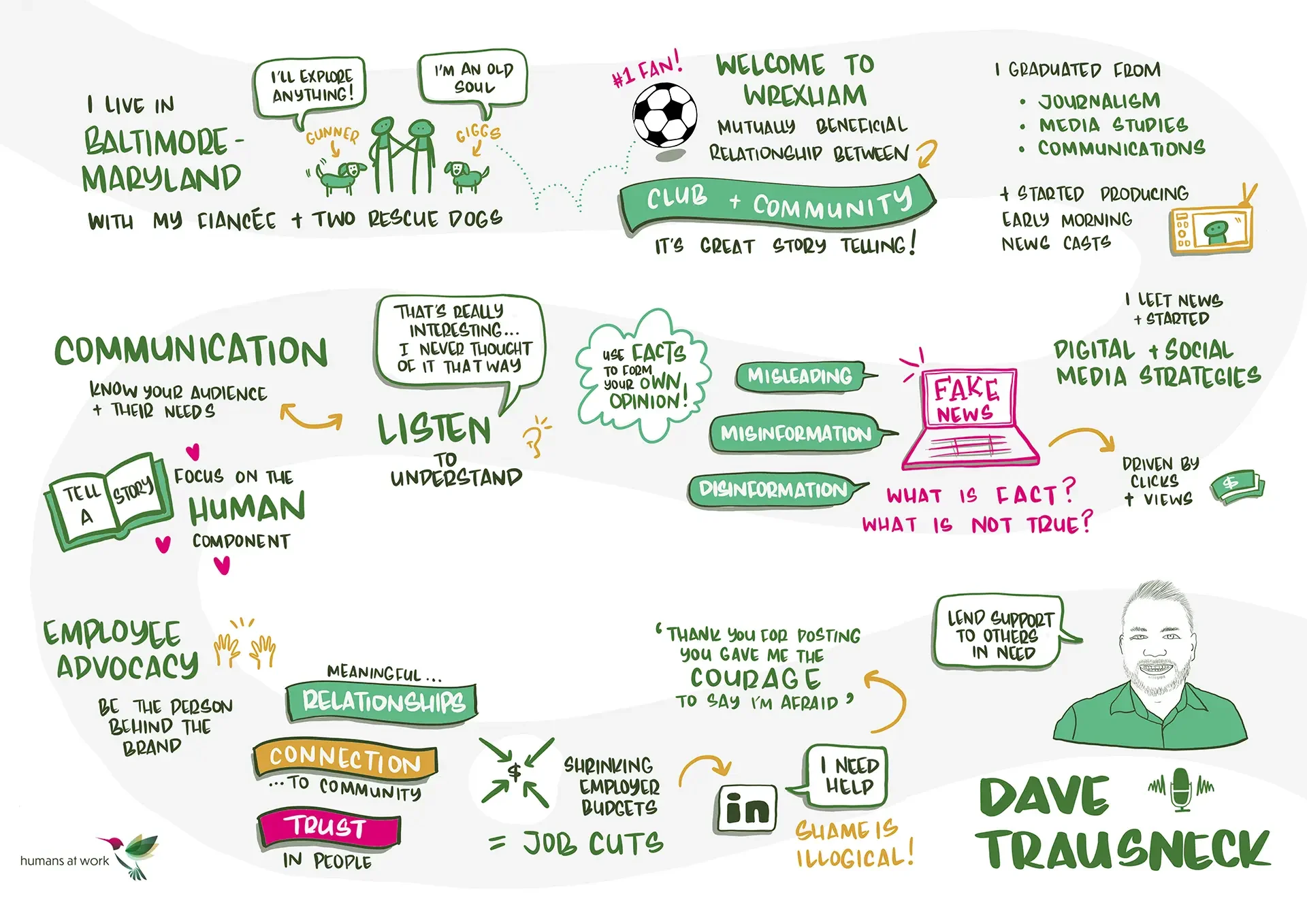
Jules: Kia ora, welcome to Humans at Work. I'm Jules, your host. Thanks for joining me and our latest guest and thanks for taking some time in your day to indulge your curiosity about other people and their humanness. If your thirst is unquenched after this, check out jericaglobal.com. Now let's begin.
Kia ora everybody, today I'm here with Dave. As usual I'm going to ask Dave to introduce himself and because I know he has pets I'm going to ask him a little bit about his pets, what their names are, what kind of dogs or cats they are and what's the favourite thing that he loves about having pets. Dave.
Dave: Hi Jules, it's a pleasure to be here with you today and with everybody. My name is Dave Trausneck. My fiancée and I, we live in Baltimore, Maryland. So, if you're not familiar with the area, it's just north of Washington, DC.
We have two wonderful black and white rescue dogs. One is six years old. His name is Giggs. He's a lab pit mix. And if you hear the name Giggs and you followed football or soccer, as we call it in the US, yes, he is named after Ryan Giggs, the retired Manchester United player. Then we have a one-year-old black and white rescue dog named Gunnar. And Gunnar is named after Baltimore Orioles player Gunnar Henderson. Gunnar's one years old and like many dogs, the first dog, Giggs, he is just calm, an old soul. He's probably been on this planet for 500, 600 years. Gunnar, this is his first time on Earth. So, everything is new and exciting to him, and he is down to explore everything at any time and is ready to go at a moment's notice. But we love both of them, and they bring so much joy to our lives. Just as our own children, they just happen to be dogs.
Jules: Furbabies. Furbabies is the word. Yeah, yeah. So, Ryan Giggs is Welsh originally. I am part Welsh and part English. And I lived in Manchester for five years before I moved to New Zealand where I'm based now. And in Manchester, you either support Manchester United or you support Manchester City. It's really a divide.
So, I'm interested in your interest in Manchester United. I'm guessing that's where it comes from, not from the Welsh national team.
Dave: No, it does not come from the Welsh national team. My interest in Manchester United started in the early 90s with Eric Cantona. And he was the first Manchester United player that I ever, I guess, became aware of. In the early 90s, soccer really wasn't a thing in the United States. And having played it from a very young age, I started playing when I was four years old. I was certainly aware of soccer and football's global appeal. And it was just, I mean, Eric Cantona, a phenomenal player, phenomenal person and character, obviously had his flaws as a player on and off the field.
But it was through that, following Manchester United, probably when I was maybe 10, 11 years old, and Ryan Giggs was a young player at the time and certainly… followed his entire career and just a great player. Certainly, I know he's had his off the field issues and allegations in the past couple of years, but I rescued Giggs before all of that happened. So, I already named him. It's not like I'm going to change his name based off of what happened in the off the field incidents.
Jules: It's so interesting, isn't it, that when you have people like football players or particularly celebrity football players or even celebrities, that they're on a pedestal. And then almost every celebrity that I have ever followed has had something that has turned out not to be the greatest in terms of role modelling or that you'd want to be associated with. Then there's everybody sort of disowns them, but the reality is they're just people. They just happen to be on TV screens or paid an extreme amount of money and we expect them to be 100% perfect. But even if you're 100% perfect today, you might not be tomorrow. Things change, you have stresses in your life or whatever. But it's really interesting how that tends to always happen.
That you have somebody that you think, this person really represents things that I admire and then, you know, ten years later you think, you know I wish I'd known that before but of course everybody has hidden parts to their personality.
Dave: Absolutely. Yeah, whether it's in sport, entertainment, whatever industry, there's so many examples now, and especially as the world's just become smaller and our access to information is so much greater… that we're instantly picking up on what's happening, and people are formulating their opinions in real time.
And that's just something that, whether you support a person, club, organisation, brand, et cetera, or you're a celebrity itself. It's just being mindful of all of that and just being a good person certainly goes a long way.
And I think people now resonate more, even with celebrities who are just more down to earth. They're not flashy. And they kind of go about their business just in a normal way. If there is such a thing as a normal way.
Jules: So, tell me, do you watch Return to Wrexham? The TV show about Ryan Reynolds and Rob McElhenney about the Wrexham football team. Are you a fan?
Dave: Yeah, I mean, that journey is certainly, it's a journey in storytelling that almost anybody can get behind. Whether you're Welsh, whether you're British, you're American, you live around the world. It's just, that's one of the beauties of football or soccer as a whole and the whole promotion relegation system, even though we don't necessarily have it here in the US and other places.
But it's just that, clubs and players and staff and ownership groups, they have the ability to continue to do well and to progress. One thing that I really enjoy about Welcome to Wrexham – it may be Return to Wrexham in different countries – but it's that storytelling approach and how Ryan and Rob, the other leaders of the club and the community, have really joined together because that's really, I think, the beauty of it. It's just this community effort.
And too many times we see, in all different types of sports, ownership groups who are just in it for the financial benefit and don't really have a care about the community, despite what they may say publicly. But you can tell that in the actions of the ownership group, of the club, about putting that community first and making them a focal point and a vested interest in the success of the players in the club going forward. And that's something that really anybody can get behind.
Jules: Yeah, I mean, I'm a big fan, partly because who doesn't like watching football or soccer? I think if you grow up, certainly if you grow up in the UK or huge parts of Latin America, football, and Africa, football is the game.
But the other reason I love watching it is that it really epitomises this concept that we use in our company around ecosystems and where if you have a responsible, caring, keystone species or a kind of catalyst organisation, in this case the football club, that you can really be a part of a thriving social, cultural and economic community if you do it in the right way. And I think that show, as you watch it over the seasons, what you see is the real impact of that.
From the fan's perspective, in terms of individual pride and hope and optimism, but also just in terms of the local town, the economy, how people think about their relationship with the club and vice versa.
It's a fascinating example of, if you are an owner, you're in control of an organisation and you take that exact position that you've described – what is our responsibility to this place, to this community, to the wider ecosystem, and how do we mutually benefit ourselves and other people – you can change the world, right?
I mean, for people living in Wrexham, that has really changed a whole lot of their reality. And it's done it in a fairly short space of time while still continuing to make a profit, because that has to be one of the factors of big business. So, it's a really good example, plus it's fun to watch. I mean, it's engaging, right?
Dave: Yeah, absolutely. I mean, Ryan and Rob, they come from the entertainment background and they, along with their production teams, they know how to tell a great story. And it's wonderful because there's so many storytelling elements that go into each episode, whether it's the growth of the women's team or paying homage to the coal disaster and paying homage to the workers and those elements. They just translate themselves so well to not just Wrexham, but it could be for any club and their growth and development and what that does to the community. So yeah, that was a fantastic point about how just the right mindset can really be a catalyst for change, not just for a club, but for the community as well.
Jules: So, if I watch it from the kind of ecosystem and organisational development perspective, you must also watch it from the how are they telling this story, how are they using social media and the actual documentary itself. It's almost like work and entertainment at the same time, isn't it?
Dave: A little bit. I get it more from the entertainment perspective, but it's yeah from the storytelling aspect of it and the communications aspect of it and the marketing aspect of it. You, just working in those industries, you pick up on different styles, techniques, how they go about telling the story in an episodic format and how they weave narratives throughout the seasons to just carry those threads throughout.
Jules: So, let's focus on your work history because when I was doing some stalking of your career history in preparation for this, the sort of communication and storytelling aspect is really, really strong right from the very beginning in terms of your work in news. So, tell me a little bit about what drove you to take that first job.
Dave: Yeah, ever since I was a kid, I enjoyed news and broadcasting. It's something that fascinated me, just learning about the world, learning about people, hearing other people's perspectives and their stories.
And when I was growing up and went to high school and then was selecting my college or university, I was looking for a place that offered that course of study in terms of communications, journalism, media studies. Went to the College of Charleston in Charleston, South Carolina. Beautiful place.
But I was kind of an oddity. I knew what area I wanted to study when I got to campus. And so, it really helped kind of chart that course for me in terms of what I was going to study. And then I was fortunate to start in local news right there in Charleston, not long after I graduated and worked at the local CBS affiliate in Charleston producing newscasts for the early morning. So, for anybody who isn't aware of what it takes to put on an early morning newscast, it means you're probably there very late the night before putting that newscast together. And so, I was working in the middle of the night for my first job and did that for a little more than a year and worked as a producer there in Charleston.
Then my career moved me to Portland, Oregon on the west coast of the US. Still doing the same thing, producing newscasts. So that pretty much took out the first 10 years of my career in just producing local news stories for affiliates across the country.
The ownership company that owned my station in Oregon, they are one of the largest local ownership groups in the United States. Sinclair Inc. now as they're called. And then I moved to their corporate office to help run social media strategy for all of their news and entertainment properties across the country, because you're looking around the 2013, 2014, how people were getting information, and news had drastically changed over the past few years leading up to that point.
Obviously with Facebook at that time being around for almost 10 years and Twitter, now X, being around for probably six to seven years at that point, people were getting that information in real time.
And I really felt my career pivoted well into that aspect in digital media and social media. So did that for several years and enjoyed it. But after the 2016 presidential election, when it was 2018, I just kind of felt burnt out by news. And if anybody follows the United States political cycle, and we're in the middle of a presidential election process right now, it's just something that was taxing me emotionally.
I was just like, okay, I like what I'm doing as an industry, but I want to get out of news. So, I spent a few years working in social media, digital media, communications for financial services companies, for engineering firms, doing some consulting work for some government agencies and some contracting work. And yeah, just recently, as we were talking right before we started this call, just started as the senior manager of public relations and external communications for a clinical AI healthcare company called Aidoc.
Jules: Wow. I mean, it sounds amazing. I tell you what it sounds to me. It sounds fast paced and intense. A lot of that, particularly the early news focus, because news by its very nature is brand new for people. And so, you need to be there right at the beginning, get it out to people. Otherwise, you kind of lose that sense of value.
And I wonder if, do you find that now news has got a little bit less importance for people as an entity… because what they get is a whole lot of information and it may be new to them but the news, as maybe – I know I'm probably a little bit older than you perhaps – but the news used to be about kind of global or national issues of real import. And now news is kind of quite diffuse. It can be just the latest thing is seen as news. How has that changed from your perspective through the time that you've been involved in it?
Dave: Certainly, as people's attention spans have dwindled more and more over the past few decades, our perception of what is news has drastically shifted. News and information in general has never been more important.
When we're looking at how we inform the decisions that we make in our lives and what we care about. Just using the US as an example, whether it's related to what's happening in our Supreme Court and the cases that they're selecting, what's happening in our local governments, and our state governments, and our federal government?
Having an informed electorate has never been more important and that's one of the things that has always drawn me to news and information is about letting people know facts and what are out there. And certainly, the debate over the last, gosh, eight years or so about what is fact, what is not true, has certainly blurred and really devalued what people see as news.
Because whether you're at a local newspaper or local broadcast station, the resources are less and less. And obviously, just like with any profession, people are being asked to do more and more. So, the quality of information continues to decrease, yet the need for people to be informed is more and more. And so, it creates this massive schism where disinformation and misinformation can easily weave itself into that gap.
And that's, I think, what we've seen, not just in the US but in so many places around the world, how that misinformation and disinformation or maybe misleading information, can be almost weaponised into a point where it affects people's lives. And so, as journalists, we try to stay on that True North in terms of being objective and giving both sides an equal opportunity to present their arguments.
We live in a society now where that's not necessarily the case. People watch the bold sound bite. People respond to the outlandish comment. That's what drives clicks. That's what drives views. And an hour-long conversation or debate on a very thought-provoking topic, that's not going to get the clicks, that's not going to get the views. There's not as much money behind it so you have a lesser and lesser informed electorate and populace out there. So having news and access to news and information that you can base real thought and real opinion on, backed up by very credible sources – that's never been more important.
Jules: Yeah, it's a really interesting one, isn't it? Because trust is a big part of kind of understanding where you're getting your information from and applying some critical thinking, but not to the extent that you doubt the facts. But that's based on trust.
You know, trust has gone down as more and more outlets are able to sort of stand up fast on really very little resources and very little investigative robustness. So, trust has gone down and information and access to information has gone up. And really what's needed in the middle is an increase in critical thinking and applying that critical thinking.
But because of the pace, people almost don't have time, or they feel like they don't have time to apply some critical thinking. They receive, they absorb, they respond, as opposed to receiving, applying some critical thinking, looking at a few different sources to check their understanding and then deciding whether or not they need to absorb or respond or do nothing.
And it's almost kind of, you know, we're missing that bit in the middle. I agree with you. I picked up on your point about the difference between misinformation or disinformation and misleading information, because I think there is perhaps a little bit of slackness in people thinking, well, that's just misinformation.
But actually, there are targeted strategies to deliver misleading information, which is manipulation of the audience. And that's quite different, I think, in terms of its intent and being able to understand what's driving those different things is really, really important. I mean scatter gun, you know, shooting out a whole lot of stuff that could or couldn't be true is very different to, we want to change the course of this election, therefore here is our strategy for getting misleading information out there and manipulating the audience. Those are quite different things in terms of their intent, I believe.
Dave: Absolutely. And when you look at kind of misleading information, nuance and context are so important there. You were just talking about applying critical thinking skills and understanding the context around what was said, instead of just looking at, you know, black and white, this was a statement, these were the words that were said.
You know, I almost think of, like, movie reviews or film reviews. A reviewer could say two separate words. They could have said this movie is incredibly boring or something to that effect. But marketers, they can easily look at everything and they can take two words of a review and put them together and it's just like, well, this person actually said it. Well, actually that's misleading. This is what the person actually said.
Whether it's in politics, whether it's movie reviews, whether it's something else entirely, just being able to formulate your own opinion based on facts is so important. And also, being objective and open to hearing other arguments that may not necessarily change your point of view, but having that willingness to hear other people's perspectives, to have that level of empathy, sometimes sympathy, to the global context as to what's happening.
Jules: Yeah, it's a really important point actually. I remember a story that I heard on a podcast a few years ago about, the person being interviewed was telling the story about their dad. And she was saying, you know, my dad went to a big country – which you may or may not be sitting in right now – and deliberately engaged with a whole lot of people with very, very specific views. You know, at one end of the spectrum in terms of whether they're extreme or very definite views, not extreme. And his approach was to ask them, what did they believe and why.
But the thing that I found really interesting was that his response to whatever they said was "That's really interesting, I've never thought about it that way." So, he didn't get into a debate, where he was on one side, and they were on the other side. What his objective was, was to understand why they thought that. And having gotten them to open up about why they thought that he took it as a gift because it was something that he learnt that day.
He didn't change his views necessarily through that process, but that wasn't his objective – his objective was really to understand, to listen, to understand, which is something that we hear talked about a lot, particularly in big kind of debates. How do you get yourself in a position where you're listening to understand, not to defend or not to change somebody's minds? And I always thought that that was a very poetic way of signalling that you're listening to understand… to say "thank you, I've never thought about it that way". Because often people's different views to you, they don't come from a worse or a better place than you. They just come from a different life.
And so, if you're able to kind of accept that as a gift, that increases your diversity of thinking and your understanding of different perspectives, which is an amazing kind of area of growth for you as an individual.
Dave: Yeah, it's having that mindset that you're continuously learning, and you know, what you know today, it's going to be different than what you know tomorrow, what you know next week, next month, next year, etc. And having that willingness to listen to others. And as you just pointed out, yeah, you might not change your opinion, but I can understand how you got there and that makes sense to me and whether, you know, it's something I haven't thought of before or just having that level of understanding – okay, these are the factors that led them to what they believe is their truth.
Jules: Yeah, absolutely. Now, so now you're working with organisations of different types, you know, in different fields at that kind of strategic level around, okay, well, what is our marketing and communication strategy – presumably with our workforce, with our partners in the supply chain or in the ecosystem that we work with, with our customers?
So, tell us a little bit about the kind of thinking that you bring in terms of that strategic information and communication space.
Dave: Sure, so whether it's in the healthcare industry, which I'm working in right now, or previous industries, whether it's financial services or engineering, et cetera… it's about understanding who your audience or audiences are, what their needs are, and where your brand, organisation, company, et cetera, fills that need or fills what that audience member or customer is looking for.
And we see it so many times on different levels, whether it's brand to consumers, B2C, brand to brand, B2B, or even like brand to government, B2G. It's having that understanding, okay, this is who we are and this is what we're great at. This is how it benefits people, communities, and what is the storytelling behind that that can just help somebody, take somebody that is outside of your organisation, outside of your industry, et cetera. And if you were just at a neighbourhood block party or just at a community event and you ran into a friend and they were just like, hey, what are you working on? In what ways could you just chat with them in terms of, hey, this is something that's going on that's really cool or this is a project that I'm working on.
Certainly, you wouldn't chat with that person about high level industry topics or get into industry jargon, etc. It's just having a conversation with somebody and whether that's at the executive level, whether that's more mid-level or whether that's more junior level employees. In what ways can you just have that conversation with people about something that you find interesting about what it is – whether it's a company, brand or organisation that you work for or even just yourself professionally or personally.
We were talking about access to information a few minutes ago and how it's only increasing, and will continue to increase as platforms emerge and develop. So, it's framing that narrative and also understanding, okay, where is your audience? What platforms are they on? So, when you're looking at social media, is your audience on LinkedIn? Are they on YouTube? Are they on TikTok? Are they on Instagram? Are they still on Facebook? Are they on Snapchat? Where are they and what are their needs?
As social media, digital media, communications, marketing, they've all continuously developed and evolved. It's that increase in data and access to data. And how is this driving human behaviour? What are people engaging with? What are they resonating with? What are they sharing? What are they sending via DMs to their friends or to their family that they find interesting?
A few people are out there searching, just like, oh my gosh, I want the latest blog essay from this company. It's just, how can you cut through that noise to tell a really great story and really focus it on the human component?
Because as we've seen more, especially in the last several years, people are trying to reconnect with one another post pandemic and post COVID. So they're seeking out those individual voices, maybe more so than, hey, I'm seeking out this brand and I want to see what this brand is doing. Oh no, I really like what this person is saying, and they make some really great points. So, I'm going to follow them because I think they have some really great information that can help me in my life.
Jules: Fascinating. I mean, there's so much in that. A couple of things I want to pick up on is, one is, the sense I got from you is that real focus on everybody in the workforce in an organisation actually has an opportunity to tell the story of the organisation. And so how do you ensure that they feel comfortable, mandated, they have information that they might need so that if they're at a barbecue or, you know, they meet an old friend or whatever. They're able to represent, not represent the brand in a sort of strait-laced kind of way, but to give a sort of authentic sort of experiential view on what it's like to work for a company. So, to be the person behind the brand, no matter where they are in the organisation.
And I think that's something that is great to hear because for so long, workforces were seen as sort of an invisible part of an external communication and marketing strategy. As if you step outside the building and you have nothing to do with that organisation. And of course, what we find when we're working with organisations from a cultural perspective is that what the receptionist will say to their friend or what a middle manager will say when they're in a taxi, to the taxi driver or the Uber driver or whatever, is just as important as what you're pumping out centrally in terms of your major channels.
Because people will trust the person in front of them much more than they will trust what looks really slick and fancy and is on a digital channel. So, I'm really interested that that is kind of coming back into or starting to take precedence in terms of that strategising.
Dave: Of course, everybody has the opportunity to influence a decision of somebody else. Over the last probably five to 10 years, the term influencer has its own connotation. People are thinking of specific content creators on specific platforms that have amassed huge audiences.
But that ability to just, as you just said, have that conversation, whether in an Uber, Lyft, cab, taxi, whatever, or just have a casual conversation, those can influence the minds and the opinions of a greater circle. And when it comes to employee advocacy and just chatting about where they work, it's gotta be organic. It can never be forced.
Had a great conversation the other day with someone who was at a very large global organisation and was talking about an example of when they had a post that would be shared with their maybe just their entire US audience, and that person was seeing the same message like 80 to 90 times on a given platform. It's just like, okay, that's not the way to do it.
Like in saying the same thing, it's, you know, personal advocacy, professional advocacy, brand advocacy, it's gotta be organic. And even though the word I'm about to say somewhat gets overused, especially on LinkedIn, but authenticity and just being true to who you are, that certainly is going to have a greater resonance.
Because, to a point we were making earlier even in news, it's about trust – and you were just hitting on this a second ago – people are probably more likely to trust the person's opinion that they're talking to and that one-to-one conversation or interaction more so than they might from a very large brand organisation.
And it's really marrying that, you know, having that employee or personal advocacy within an organisation, that executive advocacy, but then also the brand advocacy as well. And really finding a great harmony between all of those to tell a great story, but tell a story that matters, that really drives the opinion and the narrative of an organisation.
Jules: And of course, in that situation, it's really important for roles like yours, that you're able to see into the organisation as well as out and ensure that there's a real clear line of integrity through all that. Because it's really interesting, I have worked with organisations who have said, well, we really want our people to represent that we're an inclusive organisation. And you say, yes, but your people aren't feeling like they're working for an inclusive organisation. So, you can't expect them to go out there and tell an authentic story to all of their friends that's inauthentic in terms of their lived experience.
So, you know, for positions like the role that you might be in now or other positions that you've held, having the ability to see inside the organisation, to sort of sense check really, that the brand story matches the workforce story, matches the objectives of the board… is just as critical, right, as making sure that the information that you're putting out there is factually accurate and it's hitting the right channels and it's getting to the right audiences.
Dave: Absolutely. And people, when you were just talking about values and making sure that those are aligned, it's also understanding that people respect action more so than probably just words now, because any company, any executive, any person can pose. It's just like, we're committed to X value or Y culture. But okay, I hear you and I see you saying that, but what are you actively doing to back that up?
And I think that's, and we were talking about critical thinking earlier on this conversation, it's about that action and what are people doing? What are brands, organisations, companies, et cetera, actively doing to support what they're saying. And that, whether it's in your internal culture or your business practices, that's what's going to resonate… married, you know, in the storytelling and the advocacy, whether it's customers or people that have benefited from whatever it is that you're doing, that is only going to enhance that trust and build that resiliency.
So when things sometimes go bad, that you've built up so much trust and rapport with your community and your audience that even if something goes awry, because it's going to happen at some point for a brand and organisation. Nobody's perfect! That you've built up so much trust within your community and within your organisation that even a much larger slip-up or mistake isn't going to have as big of an effect.
Jules: Yeah, yeah, and it's really important in that situation that, particularly larger brands or global brands, they're really aware of the place that they're in. Because often they can feel untethered to communities, because their community might be completely digital, but actually everybody lives somewhere, and especially these days when a lot of people work from home, they don't have offices that they naturally congregate in.
It's often harder for organisations to have a sense of the place that they fit within or the places and the communities that they are therefore really reliant on for their workforce, apart from anything else, but also the places that they need to build that trust in.
I find it really fascinating how little attention gets paid by larger organisations to the physical location and the community within which their offices or their homeworkers are based. Because when it comes down to it, it's that person-to-person interaction in a time of, oh there's been a big mistake that we've made and now we need to check in and make sure that we've not lost all of our market hold. We need to make sure that we can build on what little trust we have left.
It comes back down to individuals and individuals live somewhere; they work somewhere. You know, you and I work primarily from our homes, but our homes are not floating around in the ether yet. We're still living in a physical location.
And so, that understanding, particularly for larger organisations who might have, you know, 50, 100 offices or a hundred countries that they're based in. Being able to understand, what are the communities that that means we are reliant on for our physical workforce or our physical location, is so critical in terms of that wider strategy.
Dave: Yeah. And even for my current company, it's a hundred percent remote, which for us here in the US is outstanding. From a quality-of-life standpoint, it certainly provides a great opportunity for me to be around our dogs and my partner, fiancée, we're about to get married here in a couple of weeks. So, it allows me to be increasingly present.
But with that comes that greater responsibility of making sure that you stay connected with your colleagues even in a virtual setting. And that can, it is easier said than done, but it just takes that extra level of experience and willingness to just be there for your colleagues, whether they're your manager, your supervisor, even a direct report, or just a fellow individual contributor. It's just having that connection.
We were speaking about this and how people crave that connection probably a little bit more now that we've emerged from COVID, that they're seeking those opportunities in a way that is meaningful to them. They're more strategic in how they approach those relationships.
Jules: I think, I'm just conscious of time because we can and have talked for a long period of time. And I did just want to ask you a little bit about the post that led to you and I connecting. Because it was a very, I think, difficult post for you to write and to put up. And it certainly got a lot of attention, hopefully in a good way. So just tell me a little bit about your thinking and the process that you went through about putting that post up and what happened afterwards.
Dave: Thankfully that post had a very happy ending and it was with me being offered a full-time position in my current role, which I'm thrilled to be in.
But yes, it was difficult to come to that realisation that it was just like, look, I need help. And as many job seekers at any stage, whether you're at a company currently and you're just really not satisfied with where you're at, or you're basically a full-time job seeker, treating that as a job. I was at a point where I was doing fractional and consulting work and that was going fine for a bit, but employee budgets were shrinking.
And it was just at the point it's like, look, there's a lot of things coming up. And I'm very fortunate that I have a great fiancée and a great partner who is able to shoulder a heavier burden, but at the same time, that's unsustainable. And it's just like, look, I need help.
And it was something that, for me personally, I struggled for a long time asking for help, and it was just like, look I have to get over my own personal bias here and just tell people I need help. Like whatever help, it could be support, if you have positions open in your company I'm happy to take a look, etc. But it was just putting myself out there, being real, that just let people know what I was going through. And the response was something that I never imagined.
I had people from six different continents reaching out. I joke, I don't think anybody from Antarctica responded. I'll have to go back and look, but just as you're in New Zealand, and people in Australia and Southeast Asia and Central Asia and Central and South America and Africa and Europe and across the United States, they just felt a sense of, my gosh, I saw myself in that post or I've been in that position.
And people, whether they're currently employed, or they were basically at a similar point, a lot of them said, "thank you so much for posting what you posted. You gave me inspiration. You gave me courage to post something similar or to not feel afraid to say that I'm afraid."
And again, one of the things I would like to think that emerged post-COVID was that people could ask just for help. Like, I need help, I need support. And as we've emerged from this, people hopefully willing to lend support to others in need. And using that as an opportunity to pay it forward now for other people who are still searching for that full-time opportunity.
Just had some recent life events over in the past couple of weeks. Not to go on a tangent, but the unfortunate passing of my mother in the last few weeks and so I haven't really been able to post more updates about my specific journey and strategies that really worked for me from that post. Because from the time I posted that to LinkedIn to the time I got my full-time job offer it was about a month.
And for job seekers, that's almost like the blink of an eye. Like it usually does not happen that fast… but having already established somewhat of a presence on LinkedIn and being consistent with content there, relevant to my industry, relevant to my peers and colleagues around the world.
I'd already kind of established at least just a very baseline audience. Like I had content there. It's not like I just signed up for a LinkedIn account yesterday and then I'm posting this today. There was a baseline of content there, but no matter where people were, they understood that I was just like, hey, I'm needing some help right now.
And the amount of people who reached out either for, hey, I work at this company, here's a job that kind of fits your background, I'd be happy to refer you or, hey I know this person, I'm going to make this connection with you. That was just something that I'd never really experienced at that level as a job seeker before. And that made all the difference in terms of being able to connect with somebody.
And my role at Aidoc completely came from somebody I'd never met before introducing me to the person who is now basically my boss.
Jules: Amazing, amazing story.
I mean, I think I was one of the people who reached out to you when I read your post. And a couple of things in terms of why it resonated with me. One was that sense of courage, because often I think we think that our lives are much more difficult than other peoples, and you know, that they've got everything sorted and that it must just be us.
It's how we're managing things or our strength or our resilience or our skill set that is the thing that's making the difference and why we're not as successful as other people. But of course, that's not true. I mean, people put up a much shinier version of their life than the actual reality.
And I think the other thing is this sense that, and maybe it's more, I don't know, I don't like looking at generations and tying everything back to generations, but certainly from my personal upbringing and my parents, this sense of… if you can't have a job, if you can't get a job, you should feel ashamed. And that sense of shame is completely illogical. You know, it's like when you're running your own business and you're negotiating a price and you feel embarrassed about that price, why should you feel embarrassed about it? It's a common problem.
And you know, women in particular have real difficulty globally in salary negotiations and price negotiations. I think feeling that sense kind of even deeper of, well, I shouldn't ask for anything. I should just be grateful.
But you know, everybody needs money to live in the world that we happen to live in at the moment. You cannot live without money. You can't pay for food, you can't pay for heating or shelter or for dog food – you have to earn money in order to live.
And so that somehow, we still feel that we should be quiet about the fact that actually that can be incredibly difficult, regardless of your circumstances. And so, I felt that your post was really trying to push against that sense of shame that so many people would feel or have felt or are feeling right now.
And it kind of shone a light on that and said, well, yeah, you could expect me to feel that, but why should I? You know, why shouldn't I just feel frustrated and say, you know, my value isn't being realised and that somewhere out there, there'll be an organisation that really needs me. I just haven't found them yet and they haven't found me. And this is a way of cutting through all of that.
And so those were the couple of things that I really got from your post. I reshared it on my network, partly obviously to help if there was somebody who needed your skills, but also as that real sense of, hey, here's somebody who has been wildly successful in their career and is really articulate and is able to surface all of those things that we all feel in a really succinct, clear way. And I thought it was a great post from that perspective and something that I really wanted to see more of, you know, people standing up for their own value and not being afraid to talk about that.
Dave: Yeah, thank you and obviously for the support that you and so many other people showed after I posted that, and it didn't just end with that post. Obviously, there were follow-up posts in terms of, hey this is what's been happening this week, and these are the people that I've had some really great conversations with. It's, you know, that journey and people who were supporting me on that first post, they were continually supporting that journey and there are so many people, social media, digital media, it's a place that is rightfully maligned in certain ways, but also is a great place for people to receive phenomenal support.
Whether you're a woman, whether you're a man, whether you're gay, straight, lesbian, bisexual, transgender, whatever. Whomever you are as a person, there is an incredible amount of people around the world who just want to see you succeed, way more than anybody else who doesn't want to see you succeed.
And that's something that was just quite humbling, but also quite positive in the response to that post. And that's only something that I can try to implore with other people who may be in a similar position – it's okay to put yourself out there. I had a great conversation with a gentleman who is kind of in a similar position, has a fantastic background, but just really hasn't been able to land a full-time opportunity. And because he doesn't have a current full-time opportunity, he and his wonderful golden retriever, they're staying at like an Extended Stay America because he can't afford to live in an apartment right now. And while he has a roof over his head, it's certainly not an ideal situation.
There's certainly so many people out there who, yeah, you may just look at them on a platform like LinkedIn or whatever digital platform and think, my gosh, what have they done to succeed or how did they get to that position? They could be struggling even more so than you.
And it's okay, at whatever point you're in in your career, it's okay to ask for help. It's okay to get guidance from people. It's okay to put yourself out there and be like, you know what? You may think that I have it all figured out, but I don't, and I need your help. And again, people who are just great people around the world, they're gonna resonate with that. They're going to want to help you or put you in touch with others who may be in a better position to help get you where you need to go.
Jules: Amazing, and so you know you've got a job now you can pay for the wedding! It's important as somebody who has experienced a wedding this year, I can tell you that it's a rush, and it's expensive, but it is an amazing opportunity to pause and celebrate the people that you have in your life and the dogs. Hopefully they're going to be part of the wedding because that would be really cute. I'd love to see a photo.
Dave: Yes. Yeah, one of the reasons why we picked the wedding venue that we did, was because we only had one dog at the time when we got engaged and, both dogs are going to be a part of our ceremony, whether it's outside, like it's scheduled, or if it happens to be inclement weather that day and we have to move it inside, they can also be a part of it.
Jules: Amazing. Well, I hope you will share a picture, and in return I will share a picture of my dogs with their little outfits on that they wore at our wedding so you can see just how miserable they looked.
Dave: Hahaha.
Jules: But we loved having them there. Hey, thank you so much for being a guest and taking the time. We really appreciate it. Good luck with the wedding and good luck with the new job. So exciting to hear that, you know, something that happened a couple of months ago has led to a shift in what you're able to do and levels of optimism and things like that. So, thank you so much.
Dave: Thank you, Jules. It was a pleasure being on and yes, looking forward to everything that's coming up in the next few weeks and months.
Thank you so much for listening and thanks, as always, to the generosity of our delightful guests. The stories of how others have faced up to their challenges can help give all of us courage to keep going with our own. For more great episodes, blogs, learning packages, go to the JERICA Global website.
Humans at Work Podcast