
Leading with Better — with Jasper Steinhausen
Humans at Work Podcast | Episode 25
Host: Jules Harrison-Annear | Guest: Jasper Steinhausen
Jules: Kia ora, welcome to Humans at Work, I'm Jules, your host. Thanks for joining me and our latest guest. And thanks for taking some time in your day to indulge your curiosity about other people and their humanness. If your thirst is unquenched after this, check out jericaglobal.com. Now let's begin!
Kia ora everybody, welcome to another episode of the Humans at Work podcast. Today I'm here with Jasper. Jasper, I'm gonna ask you to please introduce yourself, tell us a little bit about where you are and who makes up your family.
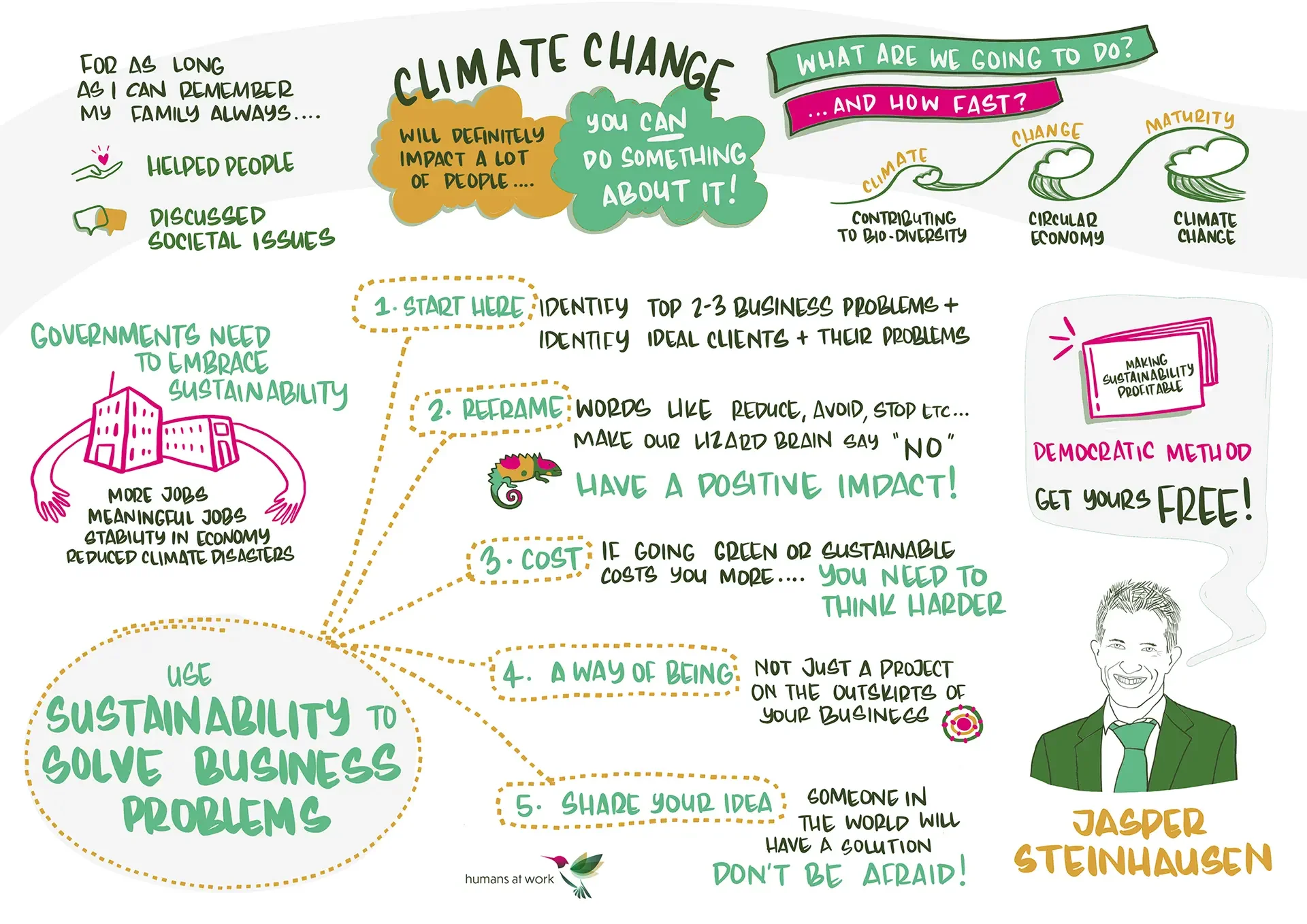
Jasper: Yeah, well, Jules, first of all, thank you so much for having me. I've been looking forward to this conversation. But a bit about myself, I think, as far back as I can remember, there were two things that stand out in my family and in my upbringing. And one was that we always helped people. So, if a car broke down, we came to help fix that somehow or towed it home or whatever, people were moving, whatever, we were always sort of out helping people and vice versa for us if we had something.
And the other thing is that there was always an ongoing discussion about societal issues. How could we make the world better for the many. These have been two solid elements that's been part of my life for as long back as I basically can remember.
And then when I was in gymnasium, I had a bit of a, I guess, kind of a special moment or turning point that became defining. There's basically a line from there to this conversation that you and I are having today, because we had geography and our teacher Tom there was talking about climate change and how the increasing temperature leads to more melting of the Greenland ice sheet. And that affects the Gulf Stream, which brings up the warm water to Scandinavia and the UK. Ironically, as he said, that if that happens, then global warming would actually lead to a spread of the Arctic climate, which could go all the way down across Scandinavia. And for my young brain, it was kind of like, woah! What, is this the magnitude of the experiment that we're going on? And also, really clear that this would definitely impact the many people, which sort of brought me on to that environmental part of sustainability, which I've been on ever since.
And so, that's kind of where it all started. And I've been working in sustainability ever since. And for many years, believing that, also for university and the study I had there, that governments played a pivotal role in defining the steps that we needed to take to see the kind of changes we needed to take. But that lasted until COP15 in Copenhagen in 2009. And I don't know if anybody remembers that of your listeners, but it's widely recognised as the worst COP in history, which is a bit of an achievement if you look at what they've managed to do or not do on several other occasions. But this was where, what happened in 2015 in Paris was supposed to happen in Copenhagen in 2009.
And I had front row as it was my hometown. And it was like watching a car crash in slow motion. You could just see this is going to go awful wrong, and so everything I'd sort of come to believe in and the role of government and all of that was pretty much torn apart right in front of my eyes. So where do you go from there? But that took me over the next six, 12 months or something to the realisation that it's actually businesses that hold the key.
So, I've been doing that ever since and that's why I have the company Business With Impact. It is to help business leaders figure out how. How do you find your way in a way where it's important that it's good for business as well as good for the world. So how do you actually do that? So, that's what I do now and the great thing is, to also tie it back to your question, is that there is this full alignment for me about what's important for me personally, my personal why, and the company why.
So, I have three kids and one of the things is that often I sort of reflect on is, you know, the reason for doing all of this. And if there's a setback or anything, it's just, back up, I have to succeed in this because I have three kids and the kids of the world as well. But right there next door are three kids and they've got to have, the outlook for their future just has to be significantly better than what we are producing for them right now.
Jules: Yeah, it's really a real personal, deep feeling, isn't it? When you're considering what the next generation and generations after that might have to face. And I had a sort of what I call the climate change blues, like a period of six months or so, a few years ago, where I was really racked with this kind of guilt about the future that my children would face. And when you have that kind of feeling of hopelessness, you go through that period of, there's nothing that can be done, reading all the articles about how terrible it is and the planetary boundaries being overtaken and all of these different things.
Jasper: Yeah.
Jules: And then hopefully what happens when you're in that period of hopelessness is that you realise that you can do something about it. You can be part of a different kind of movement.
Jasper: Hmm. Hmm.
Jules: You can do what you can. You can try your hardest and that, not only might that make a difference, it also helps you talk to your family and your children and say, this is what I did. I haven't solved everything, but you can carry that on. Like here's a legacy for you to carry on with.
Jasper: Yeah.
Jules: So that is a real driving force, right?
Jasper: Yeah. Yeah. Well, I'm a very, very strong optimist. And I force myself to be, but I am, I think, by nature and in everything I do. But it also means that I insist that we can do this. And I think that's also, when you talk about what are we saying here at home to our children, well, they are brought up in a, yeah, it's really serious and we've got to do something about it, but it's also absolutely doable and we are going to succeed in this. It's not a question, because there isn't really an alternative. And the thing is that I think most people just want to have a good life, right?
And a good life requires, well, a lot of things, but there are two key things. And one is that we've got to have a stable ecosystem around us, climate, biodiversity, all of that, have to be stable like we've had for the last 10,000 years, right?
And the other thing is that people want a meaningful job where they believe that they will bring home an income, fairly regular. And the great thing about really honing in on doing well on sustainability and climate change is that when you do that the right way, what you will get is that you will, A, continue to have the stability in the ecosystem around you. So, you don't have droughts and storms and stuff that tear your life apart and everything around you.
Your business will have an extra layer of purpose on top of whatever it is you do, whatever the workplace that you are hired at or your own business or whatever kind of work relation you're in. And it will also be more of a solid and, very often, more successful business. So, it will also increase the odds that you have a stable job condition and continue to get payment in.
So, if we do this right, we generate a lot of successful, strong, meaningful jobs, and we maintain the stability that people need in their lives because otherwise everything's just going to go south, right?
So, I think that's another reason why it's so important to do this, it really factors in on everybody's lives in such a profound way.
Jules: So in the last few years, as you've been working in this field, have you seen a change in terms of the mindset, the starting mindset, I guess, when you're working with companies or businesses or people, leaders, where maybe five, ten years ago, their starting mindset was in a particular place and now it's in a different place? Have you seen any changes?
Jasper: Absolutely, but there's still some way to go. So, the first part to answer your question is that I kind of think of this as a level of maturity, or a maturity staircase, or whatever you want to picture it like. And there are different waves, right? So, climate change is far more mature or further in that journey than circular economy, which again is far, far further ahead than the journey into respecting and caring and feeling we need to do something on biodiversity crisis. So, we have different waves that are coming in and we are past the tipping point on climate where, at least here in Scandinavia where I live – I live in Denmark – but in Scandinavia and Northern Europe and basically all the European Union at least say, it's not a question if we should do something. We should.
It's more a matter of what are we needing to do and how fast, and the discussions, both at a political and business leadership level, is more a matter of how fast and what to do. Whereas if you go back a couple of years, there was still a lot of people kind of like, well, do we have to now? So, it started from do we have to, to okay, we have to, but we don't have to do it now. Somebody has to do something later. To okay, it's actually on us, but what do we need to do? So, there's definitely a change there.
I think the problem is that there are two ways you can work with this. One that's gonna cost you money, and one that's gonna make you money. And the problem is that most businesses, and politicians for that matter, but to stick to the businesses, they have a mindset and approach to sustainability that almost certainly is gonna make it harder for them to make it profitable. But there is another way, right?
There is an approach to this where you tie business far more in, and sustainability, a lot closer together, where you understand that you can use sustainability as the tool to solve a range of the common problems that you have.
It's so common to see that businesses can reduce costs, they can increase customer loyalty, they can attract better people, they can keep them for longer. They will increase productivity, they will increase innovation, they will increase their brand value, they will soon also have huge impact on their ability to attract capital.
So many of the problems that are on any C-suite's plate, basically at any given time of the year, you can use sustainability and circular economy to solve those in a way that also has a positive impact on the world, but most people don't get that. So, because they don't do it, they're afraid of it, they think it has to be more expensive, which becomes a self-fulfilling prophecy. It's a bit of a project and they're afraid of messing with the core business.
So, they'll just be doing small projects on the outskirts of the core business, that it's clear for everybody that it is just projects on the outskirts. You've got great new packaging, but your product still is crap. So, I'm not that impressed. And it gets harder and harder to impress people, right? They see through this.
So, the old way of doing it almost certainly will make this just an increasing cost for your business. And thereby all the time is this, how much money do we feel like we can afford? And if it's in a period of rough financial times, well, then you've got to cut down on it.
Whereas if it's the other one, it becomes part of creating new and better solutions for your clients, which means that if it's hard times, you've got to press more because this is what differentiates you. This is what sets you apart. This is what your clients like. Because it's not just going green, it's creating new and better solutions that better match their problems, better solve their problems, which is what they would prefer. Whether that's keeping the product alive for longer or making it easier to repair or simply just a better fix for the problem they're facing, whatever it is, there are thousands of ways that you can deal with this, but these two types make all the difference in the world.
Jules: I love that. And I also love your description that I read somewhere, maybe it's in your book, I think, about your experience at COP, where you realised that governments would not be the answer and how embarrassing that was, particularly when you work with governments. A lot of what you just described, apart from the making money part, are absolutely the same challenges and opportunities that governments have, and government departments have.
Jasper: Hmm.
Jules: Yet they're sort of nowhere, in my experience anyway, they're not really on that journey yet. What is it about, kind of, the government mentality, I guess, that stops them seeing that all of that rationale that you just talked about, is just as true for them? And even more so because one of the key challenges for governments is reducing funding coming in. So, they need to be able to service their clients, do what they need to do, but with less and less money coming in.
Jasper: Hmm.
Jules: So that sustainability mindset and embedding it in everything that you do should be a core belief of governments, right? But it just somehow seems to be missing.
Jasper: I think it's because people tend to think that everything is chicken. And because if you go down to the supermarket and you take an organic chicken and you take a conventional one and you look at it, the price tag is like four to five times or something like that. And everywhere else you look around you, you will find that the quote-unquote green version of a product is more expensive.
So, it's become so ingrained in our brains that that's what it's like. It's more costly. Sustainability is a problem. And it's not just in government, but it's everywhere. But it's just about everywhere I look around, every article I read, every expert I hear talking about this, every politician – I mean, we're in the two, three, four percent perhaps that I hear talking about this in a different manner.
So everywhere around us, we hear that climate change and sustainability is a problem. It's costly. It's not good for business. It's not well aligned with business. There are branding opportunities, yes, but it's more a matter of who needs to take on what part of the burden. Whereas I like to say that one of the things that I'm really, really deep in my heart glad about and that I take great pride and confidence in knowing, is that this is not the ultimate peak of human achievement.
But when you listen to politicians talking, it seems like this must be the absolute peak because whatever we do, we cannot change anything. When I look at the world and think for crying out loud, we are forced to do something because of the way we've been running the world and climate change and all of that. So how can we not want to use this opportunity to then also do something about the myriads of other problems that we have embedded in our society?
So how can anybody think that it's really important that we don't change stuff? Where I feel like this is a massive opportunity to change some of the many problems that we are tackling. So, I think my analysis of it is that so few people seize this as the opportunity to create new and better. And they're so embedded in this mindset that it's more costly, it's troublesome, it's a problem, it's a burden.
So, if you look up the 'playbook for getting re-elected', it will pretty much say, stay out of stuff that's costly, burdensome, a problem. Nobody wants it. Nobody dares to take it on because their understanding of what this is, is completely off.
They don't see that this is the biggest opportunity they have to create more jobs, to create more meaningful jobs, create more stability in the economy, to create more resilience, to reduce the risk of massive climate disasters. On every parameter, and especially in countries like Denmark, where we are good on some areas and we have a lot of export on this. We stand to become hugely profitable as a country the more we dive in.
But if you don't get that, what you sit and have in front of you is, my voters are not going to like this. It's going to be more costly both to me and to them. It's a burden. It's a problem. How do I want to push a burden? We don't.
So, because they don't get it, they don't see the opportunity, they're not aware of what it can do. They shy away from it. And then, of course, there are some that have that as a political strategy to shy away, just like there are some that have, you know, we run an oil company or whatever. So, that's their position. It is to cater to that part of the population that don't want it or who's afraid of it. So obviously there are voters in that segment as well.
But if we remove those and take the larger, I don't know, 70% in the middle. They should embrace this because it's the biggest opportunity they have to revamp their country.
Jules: And of course, what they're doing, really, is pushing that burden to future generations, which is not where we want to be, as we talked about.
Jasper: No, no, we don't.
Jules: So, when you're working with businesses then, and I know you've got a method, a really easy to understand and really easy to read in terms of your book and your presentations, method of how to take yourself through that process.
Jasper: Mm-hmm. Mm-hmm.
Jules: And one of the key things is the mindset. So, talk to us a little bit about how you might help somebody, a client, think about their mindset and what's holding them back from seeing all of those opportunities.
Jasper: Yes. Well, I already talked a bit about it, but the thing is that, as I said, I have in my book what I call the Fatal Five. So, I've sort of distilled five key problems that I see are standing in the way and then developed the corresponding five to thrive.
And by the way, if you like, I'll be happy to gift a copy to your listeners of the book. So, if that will be relevant for them, we could put that in the show notes and then people can go in and download a copy because we just need as many people as possible to act. So, if anybody feels like what I'm saying here might be relevant, I'll be happy to gift them to your audience.
But yeah, so there are these Fatal Five. And if you look at them, we have touched on this a bit, but the first thing is that, again, they think it's about sustainability. And not about, what it should be is, as I say, starting with business. We already talked about all these different business attributes and values you can gain. But as people don't connect that and don't see it, what they do is they might say, let's do a carbon footprint to make it easier.
Let's just talk about climate, right. Okay, and then you get a carbon footprint and then the norm is, well, then you start from the top. But what if you need to go down to number five first, to say something, before you get to a place where if you do this, it will also contribute to solving some of the major existing business problems that you have. I normally tell people, very early on in a conversation with a business leader, I'll say, what's your three to five biggest problems? Business problems, that is. And if one of them or two is unsustainable, that's fine. But I'm not asking for sustainability, I'm asking for business problems. And who's your ideal client and what's their corresponding three to five.
Okay, let's figure out how we can contribute to solving those because if we could do that, that's when you gain the implementation power, right? So, in my view, it's far better to really push through and massively implement something that will rule out your, say, fifth biggest negative impact, rather than starting a small project that never really gets carried through, or if you get to proof of concept, it never gets implemented at any massive scale. So, I want to go down to where I can find the connection between what's already bothering them. Having a dialogue around their problems and simply helping them see, well if we did this, would you think that would help?
Yeah, that would definitely help on my big problem, which I already have mental capacity, perhaps money and everything ready to invest in. So, that would be great. Could we actually do that? Yeah, we could do that.
So, that's the first one.
The second one is that this agenda is so marinated in guilt, reduce, avoid, stop, don't do, let go. I'm pretty sure all your listeners will recognise it, and you even talked about it before, the blues. It's kind of like everything is just dark around us. It's gloomy and we have to let go of tons of stuff we might even like.
And the more I think, when I got this epiphany a couple of years ago, when I realised that the way we talk about sustainability and climate makes the task at hand so much harder for us. It's just really mind blowing and insane that we keep talking about it like this, because the thing is, what happens to you if you feel like something is about to be taken away from you? What happens, Jules?
Jules: You hold onto it harder…
Jasper: Exactly. Right.
Jules: …and stronger.
Jasper: Right, right. So, the second we talk about, well, we've got to reduce the emissions with X percent, and we've got to reduce our intake of meat. We've got to reduce our number of flights. We've got to reduce our consumption. We've got to give up on a weekend trip to whatever, whatever, whatever, right?
The second you do that, then the reptile brain, which is the brain that's running the show because it's so much faster, it instantly says, no, hold on. And then even in your brain and in my brain that happens, then the rationale is so strong with us.
So once the more mature brain gets up to speed, a few milliseconds later, it will come in and rule it out and say, no, no, no, we're doing this anyway. It makes sense. Just imagine when, for people that actually are convinced that it's a good idea to go that way, will still trigger the mechanism because the other one is hardwired in us. We spent several hundred thousand and millions of years of being good at that. So, you don't change that over a couple of decades. And for everybody who's actually kind of reluctant, what happens is just the brain says, no. And that's the guidance for the newer brain, which just says, okay, apparently the signal is, don't go here. We don't like it.
So rather than talking about minimising and reducing, we've got to reframe to talking about creating a new and better version of whatever it is, right. Because if we do that and we want to aim for creating positive impact, because the second we do that, then it will just pass by and we'll go up to the newer part of the brain where we have imagination because we have to create something. That's something we need to start imagining. What does that something new and better look like? So, it lands in a far better place in our brain where also collaboration and everything is. And so, we definitely need this, right? Imagination, collaboration, innovation, ideas, all of that. That's where we want to go.
So, the task becomes so much easier if you talk about it differently. You can do the same thing, right? So, you could say, okay, we produce computer screens. We want the next one to have 30% less carbon emissions. That's the challenge that you set up to do. Or you could reframe it and say, well, we want to create a new and better version that is 30% more energy efficient.
It's the same task. But one starts with a negative and the other one starts with a create. If you go out and sell it, again, it's the same. And the ultimate goal very often could be zero.
But there's how much energy is there in zero? Zero. Nobody gets up in the morning, no businesspeople get up in the morning and think, if we could just reach zero this year, it would be amazing. Because it's not sustainable from a business point of view.
We've got to move into positive territory. We've got to create positive impact. And we also need that, right? It's not like if we stopped carbon emissions today, we are still on an unpleasant trajectory. We've got to roll back. We talk about, you probably remember, the Brundtland definition of sustainability. Do you remember that?
Jules: Oh my gosh, you're asking me a very tough question. Isn't it something around doing no harm, balancing out so the whole kind of focus is really around, you're heading for a net zero impact in the sense that whatever you're doing, you're somehow offsetting it. Is that what you're talking about?
Jasper: No, you're newer. This is a newer definition. You need to go further back in your brain. This is back to 1987, right? When the Brundtland Commission defined it something like meet the needs of the present without compromising future generations' ability to meet their needs, right?
Jules: Yeah.
Jasper: We talk about that. I'm actually calling for a redefinition or an upgrade of it because words matter, right, so when you say, meet the needs of the present without compromising future generations' ability to meet their needs, it sounds like there's still some room to go.
So, imagine you're the driver of the train. And you know that you need to stop at some point. And obviously the train takes some time to slow down and stop. So, the discussion is really, when do we need to start taking off a bit of the speed and start braking? And how much do we need to brake? Because there is this line somewhere further down the track that we cannot cross because then we will reduce future generations' ability to meet their needs. But come on, we're way past that line in many areas.
You talked about the planetary boundaries and how we have crossed several of them, the majority of them, unfortunately. So, it's not about zero. Zero is just a good step on the way, but we've got to move into positive territory. We've got to start actually reversing down that track to get back to when we crossed the line somewhere years ago. So, it's not about being less bad. It's really about moving into positive territory, having a positive impact. So that's the second one – sorry, the third one is on costs.
We talked a lot about that so I won't dive into that, but it shouldn't necessarily start by saying, of course it's going to be cheaper, or at least the value to cost ratio should be better. And that will increase the innovation challenge here, but then you just got to think harder. If you do a sustainable green, whatever you want to call it, version of your product, and it ends up becoming more expensive, you need to think harder. So that's the third one.
The fourth one is that people think this is a project, right? And they've got to understand that this is a way of doing, it's a way of conducting, developing, running your business. It's a way of being. It's not just a project on the outskirts of your business like we also talked about earlier on.
And then the fifth and final one is that many businesses sort of hold the results and all their work a bit to themselves, to keep the cards fairly close. Afraid of greenwashing, afraid somebody will steal the idea, whatever it is. But you've got to change that into being open and collaborative and sharing.
And this is also where you gain credibility. And it's actually also the fast track because whatever you are struggling with, somebody somewhere on this planet has a solution. But if you don't tell anybody where you are, well, how can they come and help you?
So, if you insist on reinventing the wheel for every step along the way, well then keep it all to yourself. But if you think, perhaps I don't have to invent everything on this planet on my journey here, well, then I would definitely start flagging – hey, over here, this is what I'm working on. You and I having this conversation halfway around the globe. Today's world, it's so easy.
You can get the message out to every corner of the globe. So, if you do that, if you find this is really a tough problem, I have no clue how to deal with this. Well, start flagging it. Tell people where you're heading, what you're struggling with, and how far you've gone and what you're looking for. Somebody will join your team or come with a solution. Just about everything we need is out there.
Jules: When you were talking earlier about the fear factor coming in and overtaking that kind of lizard brain…
Jasper: Hmm.
Jules: I was reminded of two things. One is when you think that you need to eat a bit more healthy, you say you're going to stop having chocolate. The first thing that you want is chocolate, right? So, you know, that is not the way of going about it.
And the second thing is, you can actually see in people's faces, in their eyes, when that kind of fear – I don't want to change – comes over them and they just go to sort of doubling down when it happens.
You know, I've been in presentations or meetings with executives where I've mentioned the topic gently of environmental sustainability or biodiversity protection or ethical supply chains, a whole lot of different things, which to a lot of people mean change that's going to be uncomfortable, expensive, and risky. And you can see it come over their faces where they literally stop listening.
So, that takes me to your point around redefining things, because I think we're still using a lot of definitions and language that kind of come from when this movement was really young and there needed to be labels for things that were different to the current lexicon. But those things have become associated with things that are a lot about loss.
Jasper: Mm-hmm.
Jules: You know, if I think about 'post-growth', a lot of people see post-growth as my life and the things that I like doing are not going to be available to me anymore. And so, they cleave onto those things, and they get really defensive and angry about having a discussion with people who want to talk about post-growth, because it's become associated with less.
And I think that goes doubly for businesses, because anything that's less, unless it's less cost or less tax, who wants to think about it in business?
Jasper: Exactly, right?
Jules: So, I really like the idea that you have running all the way through, which is, it's actually about abundance, but not in an extractive way. If you can free up your lizard response, your fear response, then that gives you this never-ending opportunity to be creative, to be innovative, to find different partners out in the world who can help you, kind of continue and develop and mould your business in different and new and exciting ways. Which is the sort of true definition to me of business sustainability, right? Nobody sets up a business to close it down. They set up a business because they believe in something, they want to have some kind of impact, they want to provide some kind of service or product, and they want to be able to live their lives. That's why we run businesses.
Jasper: Yeah.
Jules: So, if we're able to get to the…
Jasper: And if I may interrupt for a second, because there's one thing there that I just want to build in and that is, remember it's better, not green, that's going to make you beat your competitors. Right? So, it's innovation to, again, create a new and better version like I talked about earlier on, that's then also better for the world, but don't sell it on better for the world. That's another misconception that so many people do, and then they have some sort of environmental improvement, whatever that is, and they go out and say, okay, this is it. Now plastic free or now whatever. But there is, again, and most likely because they've done this the old way, it also means it's going to be more costly, right? So, okay it's 10% more costly, but it's free of, or less carbon, or whatever. But there's a very limited amount of people that are ready to pay for that.
Whereas people would near empty their bank account if you create that better solution to a massive pain they have. So, use sustainability and circular economy to view your product in a different way, your whole product ecosystem in a different way.
And to find that new and better version that better suits and deals with the problem at hand, whether that's one for you and or your client, and then go out and sell that. Now we've made a new and smarter version, oh and by the way, it's actually also better for the world, but it's not the other way around. Don't lead with green, lead with better, and then sprinkle green on top. That's what's going to set your path.
Jules: Yeah, because so often businesses, and industries actually, and governments, they lead with green. And then what happens is the bit that's green is literally the cherry on the top and the whole rest of the cake is not green at all, and people see that straight away.
I mean, I remember a campaign around cleaning up beaches and how this was going to be better for biodiversity and better for the ocean, but in order to clean up the beaches, the people that were doing it were using a diesel tractor. And what they didn't realise is that the line about cleaning up the beaches was completely undermined by the fact that actually they were reliant on diesel for the tools that were doing the work. And it wasn't that they were wrong, it's just that it was obvious to people who were looking for it, that it was just a very thin seam.
Jasper: Hmm.
Jules: Or the start of something, you know, but if it's the start of something, you have to be very careful about what you're saying about it. And I think a lot of tagging around greenwashing is, it can be a little bit too ferocious because actually if companies are starting out on something, and they're not saying that everything is perfect, is that greenwashing or is it actually just about them talking about their journey?
And to come back to your point about, you know, don't hide away. A lot of companies are now starting to hide away anything that they're doing that's different, because they're really scared to be tagged with the greenwash label.
Jasper: Yeah. Yeah.
Jules: And it can be misused, right? It can force people back into their sort of safe space rather than giving them a safe opportunity to talk about, hey, we've started this, we're not perfect, but at least we've started this.
And then other people might say, well, we've started it too. Let's see how we can work together on that to speed up both of our trajectories.
Jasper: Hmm. Yeah, I have a recommendation for how to avoid greenwashing basically, but still be able to talk about it. And that is always to have three things in your communication. It doesn't have to be huge chunks, but you got to sort of make sure that it's in there.
So, first thing is that you've got to be on a mission that's somehow bigger than yourself. So, if your mission vision goes along the lines of, we are the best, the cheapest, the fastest, the whatever-est. But it's all about themselves and their product, perhaps for this target market, but that's it.
But you want to upgrade that to make yourself a force for good – we are here to help solve this and this and this problem. Because if you do that, then you know that it's not just a project. It's actually part of what you're doing. And that gives you some credibility and shows you in it for the long run.
And that also means that it's easier to say, obviously we are not done. If we're battling to help end climate change. Well, obviously we're not done, but this is what we are doing. So, you've got to have that.
And then you've got to have part of your roadmap for how are we progressing? Because it will be greenwashing if it's early days and you're telling a lot, but you don't know where else you're going. Whereas if you have a really clear plan and you can show progress, because that's the last part, that's the actual result, right?
Never talk in broader areas. Never say we are green, we are sustainable, we are anything. More like, we have reduced this and this, or we have created this and this. So be specific on the results, but also make sure that you can see that this is part of a bigger plan, part of the pursuit of a bigger mission.
Because when you have these three things in there all the time, it will give you credibility and it will give people the opportunity to also go in and check, what is that roadmap? What are you looking to do in the coming years? And of course you've got to implement those also in the coming years. But if you've done the right thing and making sure that these are meaningful steps to your business, then your roadmap is filled with stuff that you would really like to do because they're part of solving some of the biggest problems you and your clients have. You're really pushing through to implement it. You get that implementation power.
Whereas if you have a roadmap full of environmental and climate ideas that doesn't really relate to your business, it's just this increasing cost and how much can we afford to spend?
So, it makes all the difference. But if you have these three things done right – and that's basically the method of the book, figuring out how to do this and how to create all the steps for doing this – well then you can go out and communicate around this. But just always, of course, be sure that you keep on the right side of the legislation around this. I don't know what they are in your end of the world, but it will work up here including the upcoming European Union's legislation on this as well.
Jules: So, we've talked about your book and thank you very much for the offer. We will definitely link to it in the show notes.
Jasper: Okay, great.
Jules: I mean, I read it when we first met, maybe a year ago. I can't remember when we met, but you sent me a book and I read it.
Jasper: It was earlier this year, I think…
Jules: Was it earlier this year? You know, time just disappears. It's really…
Jasper: I think so. Yeah, you were going away for the summer, I remember you talked about. So, it must have been springtime somehow. Yeah.
Jules: Yeah, that's right. That's right!
I think a lot of people get frightened when they think about a book around sustainability or even a book about doing business differently, right? A business strategy book.
But, you know, one of the things about your book is, I think it's very easy to grasp the methods. It's very easy to think about, okay how would I do this myself? That's one of the triumphs, I think, from the book – that it's really impactful, but it's not scary. It doesn't frighten people away with too many big concepts or technical language. And I think that is part of the issue is that a lot of people want to do things differently and do things better, but they get frightened by the jargon and what they don't know.
Jasper: Thank you so much for saying that, Jules, because that's really what I wanted to do. So, I'm really, really happy that that's how it came across for you, because I wanted to make it straightforward and simple.
And so many businesspeople, especially those in leadership in the small and medium space, besides having the CEO title, they are also deeply embedded in the operationals. Whereas if you get to a slightly bigger business, you just have the CEO stuff, right? But here, when the shit hits the fan, you just got to dive in and help fix it, right? Because we are 50 people or whatever in this company. So, it's all hands-on deck.
Jules: Yes.
Jasper: And when the biggest client calls and has an issue, well, it ends in your table because you are the one that needs to straighten this out and so on. So, they just have so much more work to do, which is why I figured, well, I've got to make this as simple as at all possible and straightforward and in plain language and translated into business as much as I could. This is what they're used to talking about rather than the tribal language of sustainability. So, I'm really happy that you had this feeling when you read it. So, thank you so much for saying that.
Jules: Yeah, well, you're welcome. I mean, I really enjoyed it. I think the other thing about it is that if you are a small to medium business, what you can do is you can invite everybody in the organisation to read the book and understand the method. It's not an elitist method, if that makes sense. And so often, it's only a small number of people in the organisation who really understand what the strategy process is or whatever…
Jasper: Hmm. Hmm.
Jules: …and then they dive into trying to get some buy-in from some of the people in the organisation. But when you're in a smaller organisation, you can actually invite everybody in to be part of thinking about what are the biggest problems, what are some of the solutions? And that makes it all the more likely that you will have that innovation, because people who are doing the work are often the people who see the opportunities.
And so, it's a very democratic method. That was the other thing I was going to say to you, is that as well as being simple for a CEO or a business owner…
Jasper: Hmm.
Nice. Thank you. Yeah.
Jules: I think you can use it for everybody in your organisation or your community to sort of go, okay, here are five things here that we need to think about. We can all think about them. It's not just one part of the organisation. It's not just the CFO or the CEO who has to think about it.
So, I think there are lots of opportunities for people to take it and use it in a really practical way, throughout everything that they do.
Jasper: Lovely. Thank you. I couldn't ask for a better review because that's what I aim to do.
Jules: I'll write that down.
Jasper: So, thank you so much. I'm really happy that's how you experienced it. So, if anybody wants to dive in, please do. It is created as a do-it-yourself book.
It has the five steps. It has, this is what you need to do. Here's a suggestion to a process. These are the kinds of competencies you need. These are the kinds of questions you could ask. And then I think a thousand times throughout the book I say, if you have a better process yourself that you're used to using, just use that, right? Don't overcomplicate. Use as much as you have or whatever you feel like is good for you. But if you don't know what to do, then you could do it like this, right? And you need this amount of hours, you need this amount of people. So, it's really been trying to make it, because we just need to speed up progress, right?
The green transition needs to happen faster. So, I don't use the sort of traditional consultancy business model where you go out and help, but you basically want to tie the customer to you, so they come back next time they've got to do something. That's the traditional model. But I'm really occupied with making sure that people learn that new skill, that new updated version of running their business, because there are so many businesses in the world that need to change.
So, I can't really stick around, help the same small bunch all the time because I want to have big impact. So, I've got to make sure that everybody is sort of capable of doing stuff on their own. And then I can move on and help somebody else.
That's also why the book is really just, there's everything you need. Then probably some, or I know, some say, well, I would still prefer to have you help us do it and that's fine. I do work with some, but for most, I think it's just a matter of, I think I can do this myself. Great. Just do something, then I'm happy.
Jules: Yeah, just try, try something. So now that you've done the book, which must have been a massive project, what's next on your priority list?
Jasper: Well, that is really, I'm starting some group programs because again, I want to have bigger impact. So, I have two different group programs that I currently have in development. I have wait lists for those so people can sign up if they want to have the details on it. So, one is for CEOs. It's a 30-day transformational program that's really on the mindset that we talked so much about. So really making sure that they can see how could this all work. That's one where I can take through lots of CEOs or C-suite people at the same time from different companies, and they will also be able to use each other as sparring partners and everything. There's going to be a small online community with daily prompts and stuff like that.
And the other one is for the environmental director or whatever they call themselves, but the ones that are in charge of sustainability in the organisation. It's basically an extract of the five-step model in the book, but with a focus on those that need more insight into circular economy and sustainability. So, it's really strengthening that and helping them to see how can I get sustainability on the top of the agenda? How do I get approval for all my ideas? They will walk away with specific ideas to projects that they can go back and pitch with a significant chance that the C-suite will say, this is really interesting. This is far more interesting than what you would usually come and tell us because now, again, this connects to our business.
So, one is for the environmental directors and the other one is for C-suite. And several hundred a year I want to go through. Yeah.
Jules: That sounds amazing. Well, we'll definitely get the information from you to put on the show notes so that people can sign up.
Jasper: Alright, that would be great.
Jules: That would be so cool. We've come to the end of our time. I mean, you and I tried three times to have this conversation because the first conversation we had, which was six months or so ago, was so fun that we decided to do the podcast and it's taken a little bit of time but thank you for persevering. I really enjoyed that.
Jasper: Well, thank you.
Jules: And we will check back in with you and see how the programs have gone. I think that would be amazing to understand the impact of those group programs.
Jasper: Mmm. Yeah, I love that. Yeah.
Jules: So, thank you so much.
Jasper: Thank you, it's been such a pleasure.
Thank you so much for listening and thanks, as always, to the generosity of our delightful guests. The stories of how others have faced up to their challenges can help give all of us courage to keep going with our own. For more great episodes, blogs, learning packages, go to the JERICA Global website.
Humans at Work Podcast