
Stepping Into the Curiosity Gap— with Paul McGregor
Humans at Work Podcast | Episode 26
Host: Jules Harrison-Annear | Guest: Paul McGregor
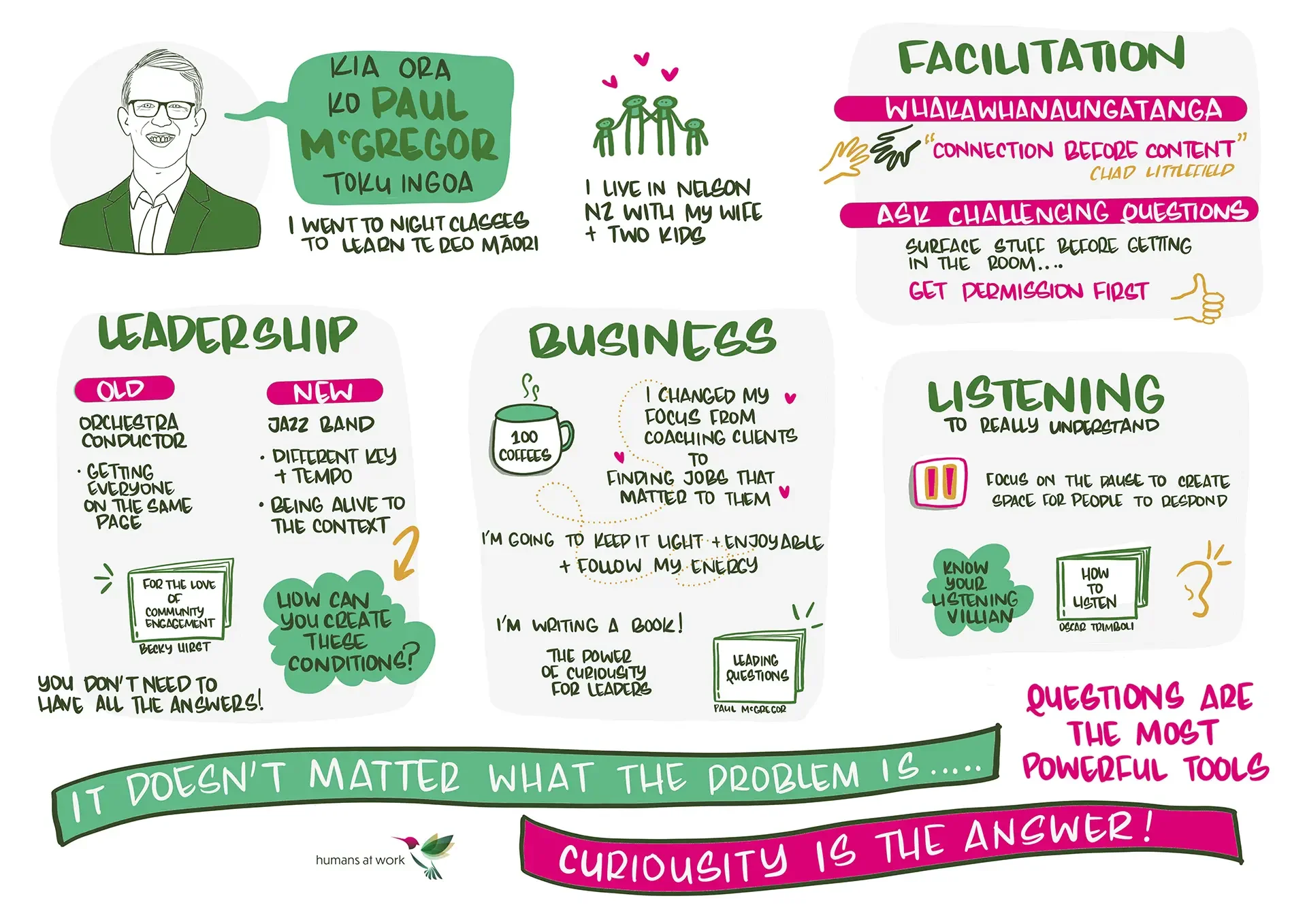
Paul: That's probably my core belief, is that it doesn't really matter what the problem is. Curiosity is the answer.
Jules: Kia ora, welcome to Humans at Work. I'm Jules, your host. Thanks for joining me and our latest guest and thanks for taking some time in your day to indulge your curiosity about other people and their humanness. If your thirst is unquenched after this, check out jericaglobal.com. Now let's begin.
Kia ora everybody! Today I'm here with Paul. As per usual I'm gonna ask Paul to introduce himself, tell us a little bit about who makes up his family and where he is in the world. Paul.
Paul: Kia ora Jules and kia ora koutou to whoever's listening.
Kowai au? Who am I? I tipu au i raro e te maro o te maunga o Aoraki. I kauhoe au i ngā wai o te awa o Waimakariri. No Otautahi ahau. I naina e noho ana ahau ki Whakatū. So yeah, I was born and raised in the beautiful Christchurch and so I mihi to Mount Cook and the Waimakariri River. They are not mine, but they are the mountain and the river of Ngai Tahu, the first people where I grew up. Yeah, and I live in sunny Nelson now. We used to come up here for holidays as kids. And so, I just had this rose-tinted view of Nelson, and I reckon about 80% of that has come true.
So, we moved here about seven years ago, not really intending to stay. And if you can make work work in a region like this, then it's, I just think it's one of the best places to live and raise kids. So yeah, we might have the kids interrupting, who knows. It's school holidays as we're recording this and one of them is about to turn six. So, we've been party planning, and the other one is three. And I'm really lucky because my wife is a primary school teacher. So, school holidays, when lots of people are doing the juggle, I get to keep working, which is pretty lucky for me. And then just tag in and give her a little bit of time and space to be able to plan into the next term. So yeah, that's a bit about me and where I'm from.
Jules: Cool. I mean, I think really interesting for the listeners that aren't from New Zealand to hear your introduction because in New Zealand, particularly working in, I think, guess, public and community sector, it would be quite normal behaviour to do an introduction like that. But in other parts of the world, that would be really unusual.
Paul: Or even in other parts of New Zealand. So, this morning, this mad friend of mine, Greg Burgoyne, he's a LinkedIn lead generation legend. And he got me out for a swim first thing this morning at 6 a.m. There's this thing called Me versus Me, and there's this group of about 20 people, they do it every morning, and Greg sort of convinces me every three or four weeks.
And so, you know, 20 people gathered in this circle and somebody led us in a karakia, which is a Māori blessing. And I knew it and so I said it out loud. And the man next to me is probably 60s, 70s, white skin, gray hair. And he looked at me in such surprise afterwards. He's like, what? This is your first time here, and for some reason he thought it was my first time, and you know that thing already, like he didn't even know what it was called. And so, yeah, it's normal in some settings, but I certainly grew up not learning a single word of Reo. Had to go hunting for that. I don't know if that was what it was like for you, Jules.
Jules: Yeah, yeah, completely. I mean, I've been in New Zealand 19 years and three days now, which seems like a hell of a long time to be honest.
Paul: Wow. Very specific.
Jules: Yeah, very specific. Well, I had my, kind of, landing anniversary at the weekend.
And I can remember the first job that I worked in, which was for a big public sector organisation. I was sent down towards the bottom of the South Island, to Dunedin, to visit with a kind of outreach program for some of our clients as part of the work that I was doing on business development. And as a welcome, they had everybody who was in that place and a client of that place, they came, and they all did their own introduction to who they were. And it was a real cross-section of society. So, some people who were fully confident in doing their introduction, speaking in Te Reo Māori, with the whole process. Others who were on the journey and others who were extremely uncomfortable.
And I have been in the country, I want to say like six months, and this is 19 years ago, right? So, there weren't inductions for employees then in what that might mean or how to navigate your way through that, what the protocols were, let alone teaching you how to do your own introduction. And so I was in Dunedin, in amongst all of these clients, they all did theirs and I was sitting there dreading what was going to happen when it got to my turn, you know, because I had absolutely no idea.
Paul: Yeah.
Jules: It wasn't something that I'd ever experienced before. Luckily for me, there was somebody, one of the clients who wasn't confident in Te Reo and so he did his introduction in English, and he was like two or three people before it got to be my turn.
And I was like, oh finally I understand what they're actually talking about. And so, I was able to cobble together something in English that kept with the form of the introduction. And it wasn't a huge incident, it wasn't a culturally inappropriate interaction.
But it taught me two things. One is that, when you work for organizations that send you out into communities, there is a real responsibility both on your part and the organization to ensure that you understand what are some of the protocols, what are some of the practices, how might you be well armed to navigate those. Not just launching people out there into a client group or what have you with nothing.
And the second thing it taught me is that you don't have to know everything. You don't have to be fluent. What you do have to do is to be respectful, to be engaged, and to try. And if you do that, people will be welcoming, and they'll teach you a few things. And that's been my experience.
I've been to some marae, and I can remember going to a marae once when I was just coming off maternity leave. I still had baby brain. It was freezing cold. I'd worn these big, tall boots and I'd put these bright pink socks on underneath that were really thick and warm, completely forgetting that I was going to take my shoes off. And so, I got there, and I was like, oh! I've got to take my shoes off.
And I was like, there's no way I'm going through this whole process with neon, thick woolly socks on. So, I took them off. I was barefoot, and the women of the Marae who were helping with the welcome and the taking people through, they just had absolute hysterics because they saw exactly what had happened. And they just thought it was really funny and it kind of bridged that gap between us, you know, and they gave me a tour around and at one point they helped me find a slightly warmer spot because my feet were absolutely freezing at the ceremony. But, I think with those things, you just go into them with goodwill and intent and openness, because you're never actually going to be fully confident about what's going to happen.
Paul: And sometimes the goodwill and good intent also isn't enough though, right?
Jules: Yeah, absolutely.
Paul: And you get yelled at. I mean, I've had that. And I know friends have as well. They'll go, oh my kuia was having, you know, having a go at me. So, I think there's different standards for different people. And something a mentor once said to me was, if you're getting yelled at and someone's calling you out, actually that's a mark of respect because they wouldn't do that unless they thought you were worth the energy and time on calling out.
And I really liked that because it, yeah, I just had this experience that was quite intense where I was yelled at and, and that made me realize that actually that was a good thing.
Jules: Yeah, I mean I think there's things along the spectrum, right? I think what puts everybody off, in whatever circumstance, is if people come to the conversation with very fixed views.
Paul: Yeah.
Jules: With the stance that they're not willing to listen, adapt, engage, see things from a different perspective, try to get to a resolution. If you're obviously completely naive, like I was 19 years ago, I didn't feel unsafe in that situation, but I did feel unprepared. You can prepare, but you can't ever be fully certain that you're not gonna face challenges or you're not gonna have to shift your position.
I also think that if people have a robust argument with you or, you know, in your words kind of tell you off, then they kind of got the sense that you're able to take it and that you can engage with them on that level.
You know, and since then, I mean, I went to the States a few years ago to speak at a conference and I spoke some Te Reo as part of my opening and I thought to myself at the time, how far you've come. You know, 19 years ago you didn't even know you needed to think about it. It was about eight, eight, nine years ago, you went to the States to a big international conference, and you used Te Reo in your opening. And I explained why, you know, because it was a US-based audience, and I wanted to really help them understand where we were coming from.
So, you know, everybody's on a journey, everybody's learning, every experience gives you a sense of, oh well, how do I think about what I do next time? How do I think about my presence, my engagement?
Paul: Yeah.
Jules: But you do sound very fluent, so well done, because I know that would have taken work.
Paul: Yeah, I mean, I went to night classes with Te Ata Rangi. They do amazing work. And I remember the first lesson and I went, gee, this is way too slow. I was kind of impatient and that in itself was part of the lesson of, slow down. And then, you know, we had kids in the middle of that. And then I was coming to these lessons, tired and over it. And I was going, oh thank goodness they've been slowly building up the skills. They did an amazing job of getting people talking out loud in the group in front of everyone right from day one, which I think really helped a lot. Yeah, kind of took away some of that fear of stuffing up.
Jules: Yeah, I think that, I was just going to say, a lot of it comes down to fear, isn't it? That, you know, I don't know how to do that and I'm going to, I might make a fool of myself, or I might say something wrong. Therefore, I won't say anything at all. I won't engage at all. And you know, I guess, my thing is if you don't try, you don't know how much you can do and you don't know, you're not opening yourself up to learning. So, you have to try.
It's a little bit the same, isn't it? When you're facilitating a group session. And you're trying to get everybody to engage. And sometimes in my experience, you come to a facilitation process, and you've got one or two people who they've decided from the very beginning that they're not going to engage. And it really does affect the whole group and the whole group experience, particularly when you're the facilitator.
Paul: I kind of love those people, Jules, because they challenge us, right?
Jules: Challenge.
Paul: And I'll walk into a room and actually I had this one workshop a couple of years ago where it was in the bathroom. So, I was in this stall and then these two people walked in. It was for a two-day long workshop and one of them goes, well, this better be a bloody, not be a bloody waste of time. And I don't even know why I'm here.
And then I sort of walked out and said hello to them while we're washing hands. Kind of, really awkward. And then I called it out in the opening session. I didn't point to the specific person, but it gave me these words to use to go, look, some of you might be here thinking, why am I here? What's this all about? So, I love those people thinking of, that's my measure of success. By the end, have I turned you from completely disengaged, to maybe neutral? That's success.
Jules: So, tell me a little bit about your facilitation because it's been one of your key loves hasn't it throughout your career.
Paul: Yeah. And you know, when you were talking about that introductory process that you had down in Dunedin, it sparked in my mind, this memory of a very similar experience where I was working at the time at the Ministry of Justice. I'd studied law and politics. And if I'm honest, I was pretty over it. After not that long of working both in a law firm and in government, in a very hierarchical organization.
And so, I signed up for this youth leadership program thing, didn't really know what it was. It was with this organization called Life Hack. They were only about a year and a half old, and drove out north of Wellington to this place called Otaki and into this beautiful part up the river. And there's these birds chirping and this lovely retreat centre, and we get this really warm welcome.
And it was for this five-day long event. You know, it's quite a long time with these people you've never met before. And so, we go inside and after a bit of a Powhiri, an opening ceremony, it was right, introductions time. And yeah, I remember sitting there going, oh geez, what am I going to say? And the first person they passed to was someone called Alastair Thompson who, he had founded a media company.
He was one of the older people in the group and I was just sitting there going, I haven't got any stories like that. You know, all of the imposter syndrome, I'm not good enough stuff going on in my head. I had no idea what I said in that opening circle, but you know, the heart was beating really fast, and the palms are sweating. And of course, I later found out that everybody else was having that same worry of I'm not good enough going on in their head.
And so that, that five-day event, you know, there were two more of those, was my first real introduction to facilitation. I'd never even heard the word before. And by the end of that three months, I was going, what was that? And how did you do that to us? Because, you know, we're a ragtag group of 30 odd people from completely different backgrounds, working on all sorts of different things. And by the end of it, we felt really close to each other. And I've gone on to start some organizations with some of those people. Some of them are my favourite clients that I've been working with for seven years. And so, there was something special going on and I just, I'd never really experienced it before.
Jules: So now that you're a seasoned facilitator though, can you diagnose what it was? Like, what was it about either the program or the facilitation that, you know, had all the magic ingredients, right? To make the magic potion.
Paul: Yeah. There's so many things. I love the idea from Chad Littlefield. He does amazing YouTube videos, and his motto is connection before content. And they did that amazingly.
They talked a lot about whakawhanaungatanga, the process in te ao Māori of building relationships and understanding who are you, where are you from, what makes you tick before you get into anything else. And so, you know, of that five days, really, you know, a half of it was just getting to know each other.
And so that in itself was really unfamiliar when I'd been in this, you know, law and government policy environment where it's logic. And I think I'd been the week beforehand to this training session on logic models. And so, you know, which is how do you map out what you do in policy intervention A and the flow on effect that that is supposed to have through to the people that you're helping. And so, it was just so stark, those two different worlds of rational, logical thinking and relationships and emotions. Of course, you can't actually separate those, but they felt very different to me at the time. So, you know, that was a huge part of it. Connection before content.
Jules: And so, when you describe your style, and I know a little bit about your style because you and I have talked before and I follow you on LinkedIn, but if I was a client of yours and you were, you know, you were setting expectations, what would you describe in terms of your style of facilitation? What would I get?
Paul: Well, in terms of style, I'd say I'm very curious. And so, I will ask the challenging questions that are going to push your thinking further than you might be comfortable going usually. And so, I have to get that permission from them beforehand, because if I don't, and there's been situations where I haven't made that explicit. And then, you know, they've gone over lunchtime, they've sort of gone, wow, Paul, you're really pushing us. And I'm sort of going, yes, yes, I am. Did I not warn you about that?
And I'm pushing from a place of genuine curiosity and interest, which is quite different to pushing from a place of expectation or requiring something. And that's probably my core belief is that it doesn't really matter what the problem is. Curiosity is the answer.
Jules: And so how does that translate when you are approached by somebody who wants facilitation for a purpose and that purpose is an outcome? And I'm asking because, you know, I'm using this as a learning opportunity for me as well!
You know, often in the facilitation work that I'm approached by, it's we want to get from A to B and we want somebody to help us get there. And often that is at odds with the building of the relationships between the individuals, the surfacing of issues, the getting to transparent, honest, candid conversations. And so, there's two things at play there. You know, the one is, well, how can I possibly get to you to an outcome or an output when what's undiagnosed is a whole lot of other things that are actually your biggest challenge.
And the second is wanting to deliver value for that group of people so that they feel like there's been some kind of progress or outcome for their engagement.
Paul: Jules, I feel like you've answered your own question.
And that's one of the things that I've learned the hard way is to ask the questions right up front. Because yeah, people will come in and they'll say, hey, we want you to facilitate a workshop on this date to achieve this outcome. And in the past, I've gone, great, I'll do it. Fantastic. Let's make it happen. And then you get to the end of the workshop, and they go, oh look, that wasn't that valuable. And I'm sitting there going, I've delivered exactly what you wanted.
So, it's those curious questions right up front. Oh okay, so what's making that feel important to you? Tell me more about the people what's going on and all of that, you know, surfacing of stuff before you get in the room. I've just learned that is so important and especially, I mean, let's just be honest, a lot of people are pretty over it at the moment.
Again, this morning in the cafe after this swim, I heard this guy talking about, well, you've got to survive till 2025. And I'm going, yeah, I get that. It's been a hard couple of years. The stats will say that three out of five people are disengaged from their jobs. They don't really want to be there. Asking those curious questions before you get in the room, I think it's just so important.
Jules: And I know that when we've talked before that, kind of, community engagement has long been something that you've been passionate about. Do you have any different ways of working with communities versus working with organizations, or do you say that you use a similar kind of process, similar kind of style?
Paul: I think it's similar but different, right? So, the first kind of thing you're doing is just trying to understand what's happening in this context. And so that process of showing up with curiosity applies no matter where you are or who you're working with. And that's the point that you kind of stand on.
I love, there's a book by Becky Hurst called For the Love of Community Engagement. And Becky's awesome. She's got breast cancer actually, so right now she's taking time out, but, she's got a wonderful podcast as well with the same name as the book. And, you know, she talks about the process of just spending time with people before you ever think to stand up at the front of the room and lead something.
Like there's actually quite a lot of arrogance to think that I should be the facilitator, that I know enough about this environment, this context. And so, yeah, that applies. It doesn't matter whether it's walking into a corporate organization or walking into the community hall or walking onto a marae. You actually just need to put aside your own expertise for a little while and breathe it in.
Jules: And that translates into different views of leadership as well, right? Because often leaders in organizations or in communities feel that they have a kind of a responsibility, but also an unwritten mandate to be the person at front of the room, to be the leader and others will naturally follow.
And, you know, often when you're working with leaders, they kind of have that sense that they're not really being followed. But they feel like they're doing everything that they should to be the leader, to be the person at the front of the room and they're not really sure where's the disconnect.
Paul: Yeah. I mean, we've got some pretty unhelpful ways of thinking about leadership…that I think start right back in school when, you know, the message we get is there's a right answer and you just need to figure it out and turn to the back of the book and it'll be there. And everything right through our education kind of conditions us to think that having the answer is what's valuable.
And so that flows through into how we think about leadership. Well, yeah, the leader should have the answer and then stand in front of the room and tell people, here's the vision, here's the strategy. I've figured it out. Don't worry, everyone.
And, you know, perhaps it worked in simpler contexts where information was hard to share around, but it's really easy to distribute organization, to distribute information now. And so... Yes, a leader might have the mandate to stand at the front of the room, but that doesn't mean it's effective. And, you know, we just need to look at how disengaged people are in workplaces to know that something needs to change there.
Jules: Yeah, yeah. And a lot of people are incredibly disengaged. On a human level, they might, you know, rate the relationships, but that doesn't necessarily mean that they're engaged with the purpose or the work.
And, you know, I think what's interesting for me is these huge debates about global productivity. You know, one of the things that you know, when you work in an organization is that a lot of effort that delivers, is actually what, in the old parlance showing my age, you might call discretionary effort, discretionary effort. You know, people who come up with ideas or people who find a solution to a problem, even though it's not written in a process, and it's not their responsibility.
That kind of concept of people who will make something work. Because it's the right thing to do as, opposed to because it's written in their job description, or they'll do something at 5:01 even when they can clock off at 5. But that kind of thinking tends to be ignored when you have all of these debates about how to make organizations more productive.
And I particularly have a great antipathy towards productivity means people have to be in the office, because then we can see exactly what they're doing because what you actually see is the sort of non-discretionary effort at play and it's rubbish often, because you cannot describe what an organisation needs in a job description to the degree at which you actually need to make the work deliver properly, right? I mean, I write job descriptions, you do the best that you can but in the end, it relies on the individual assessing the situation, and doing what needs to be done. You can never capture that.
So, you get people into the office and you say, well, now I can check that you're going to be productive. You've immediately turned off the dial in terms of engagement if they didn't want to be there. You've turned the tap off on discretionary effort. And you're stuck with what's written down and what people will do in an office in a static situation.
Paul: Yeah.
Jules: You know, a lot of those things are along that same kind of continuum where we were sort of brought up with a very fixed notion of what something should be. And despite the world having changed 360 degrees about seven times, we're still clinging to those same old ideas.
Paul: Ha ha ha. Yeah, yeah, 100%. I sometimes think of it as the difference between an orchestra conductor and a jazz band leader. And so, we've been taught that leadership is the orchestra conductor. You have the sheet music in front of you and your job is to get everybody on the same page and conduct them and direct them on what to do and when to do it. And I think the world is just changing way too fast for that to still be a viable strategy.
So, we need leaders who are jazz band leaders, where you agree on the key and get the drummer to set the tempo. And then actually it's up to the whole group to kind of be alive and paying attention to each other and having real honest conversations about what's going on. It's those tiny little glances between people when you're playing in a band that, of these little signals that you have to pay attention to. And so, the jazz band leader's job is very different. It's one of hinting and nudging and getting alongside people rather than being out the front demanding that they do things in a certain way.
Jules: And creating the conditions right, with that freedom and that mandate to do what you want to do. So, you know, you might set the tempo, you might set the key, and you might help think about speeding up or slowing down or getting to the end to allow the audience a break and whatever. But, you know, we talk a lot about setting the conditions for positive engagement or for people to be innovative or what have you. And the role of the leader in, sort of giving that permission for people to innovate or for, you know, I'm just trying to think about who plays in a jazz band now so I can keep going with guitar players, bass players, I don't know.
You know, how do you create those conditions within some kind of loose frame that gives people the confidence to know that you've got their back and how far they can go and who they can partner with. All of that is a very different style of leadership and work, than what we might have been brought up with or what we read in still a lot of textbooks or know a lot of things online.
Paul: Yeah. The other thing I'd add though is sometimes you need to be a conductor. So, it's always like that first job is being alive to the context, to what's actually going on here. Cause yeah, sometimes you've got to tell people, right? This is the tough decision, and I had to make it.
So, I think that's the real challenge of leadership, is that there isn't one single way to do things. And what worked last week in that setting might not work this week in this setting. And so that means we have to be, we need to be able to sense a lot more of what's happening around us, which I think sometimes we can just naturally turn off some of the senses that we have. And that's why new people in an organization can be so valuable because their senses are really heightened to what's unusual or what's different.
Jules: So, I mentioned a little while ago about everything changing 360 degrees. So, talk to us a little bit about what's changed for you in the last year or so, because we first met a year or so ago, a year and a half ago maybe, you were doing 100 coffees with people that you'd never met. We had a virtual coffee, do you remember? So, what are you working on now?
Paul: Oh, lovely question. I mean, I might just talk first about that journey over the last year and a half. Because I worked in a business before then, a consulting business, focused on community engagement and, and then jumped out and ran my own thing and gee, it's been a roller coaster. And I see sometimes people on LinkedIn talking about how great it is to be self-employed and the freedom that you get from that.
And I go, yeah, I think there's an illusion of security with permanent employment and there's an illusion of freedom with running your own thing, in that you still have to do the work. And actually, it's often harder to turn your brain off because you're doubly invested in the success. Yeah, you're invested in what's going on for the people that you want to work with, but you're also really, really invested in what it means for yourself and your family.
So yeah, that's been quite a journey and I've kind of taken the approach of I'm going to experiment and I'm going to play, and I want to keep this light and enjoyable, and follow my own energy and follow the energy of the people that I care about, out there in the world doing good stuff. So that's led me to all sorts of things.
I kind of have one side of my business, which is facilitation training, working with leaders to show up in a slightly different way, kind of like what we've been talking about, and then facilitating team off-sites and mc-ing conferences.
But then the third part that, yeah, I'm kind of just playing with at the moment, is helping job seekers, who are totally over it and are feeling like they're never gonna find work that matters for them. And there's a lot of people who have been made redundant in the last year and...
It can really bash people about when you're throwing applications out into the void and hearing nothing back. So, I kind of got into that work just by chance. A couple of the leadership coaching clients that I had lost their jobs two or three weeks into this three or four-month-long coaching program. And I said, well, we can keep working together, but let's change the focus. Let's find you work that matters for you. So, it just kind of started from there.
Jules: It's a really interesting one, isn't it? Because this year in New Zealand, I would say that's been really tough. And similarly in places like the US with, you know, huge, particularly in the tech industry, huge numbers of people losing their jobs and finding that it's really, really tough out there.
But there's a kind of sense of you, shouldn't say that it's tough. You have to put this, you know, this facade on all the time that everything's fine and you know you'll be fine, you'll find another job, you've already found one, you don't need work to validate you, you don't need work to pay your mortgage or to pay food and shelter.
And it's all rubbish, you know, one of the most universal things is that people in our, you know, the way societies currently work, people need to earn money to feed themselves and their families and to provide shelter. But also, a lot of people get a lot of their sense of worth, by their ability to work with others and to deliver something across a whole spectrum. It's a kind of a universal thing.
And so, to feel that you should feel some sense of shame that you're not perfectly able to navigate that and immediately go into another job is just really crazy. It's one of the themes of one of the other podcasts for this season, actually, with a guest who did a post on LinkedIn that I found really inspiring in terms of his ability to articulate that sense of fear. And the courage that it took him to write a post which was about being out of work for a year and, you know, 100 applications and nothing and, you know, it really starting to affect his inner sense of self. I think the reason it was such a powerful post was because it was saying outright what so many people are feeling. And a whole lot of people responded to that.
Paul: Totally normal as well, right? When you're sitting there and you're putting out hundreds of applications and getting nothing but rejections and these AI generated thank you for applying emails, right? And then you start to doubt yourself and you're tailoring your CV and you're spending so much time on it. I mean, people are spending hundreds of hours trying to find their next role. And I think the problem is that we've been told that it's a numbers game. And that you just, you have to just keep putting that work in.
But the way that employers are looking for the right people has just totally changed. And so, I'll put out, I'll respond to the online job ads, just doesn't work anymore because it's too high risk for an employer to bring in somebody that they've never really worked with before. So, they're looking for ways to reduce that risk. And so, I just think the online applications game is completely the wrong game to play and it's not fun for anyone. So, I think we need to create some new sort of norms of actually how we do this whole job-seeking thing, how we find talent.
Jules: Yeah, I mean, it's been one of those things, hasn't it, for a long time where there's been this sort of talk about that whole system is broken and, how is it going to be fixed? But it's sort of an ignored topic. It's kind of ignored within organizations in terms of the function of attraction and sourcing of people that are going to enhance the organisation in terms of not just where it is now but where it's going and all of the processes that go with that. Even to the point that, you know, recruitment teams are often really small, they're seen as sort of transactional teams as opposed to being really the people who should be your expert advisors on hey what's happening from a talent perspective, what are we growing, what are we seeing, what do need. How does our organisation fit in terms of the kind of people that we're able to attract?
But also, just in terms of those processes, I know I don't apply at the moment in my current guise of being a business owner, I don't apply for jobs as such, but procurement processes are very similar. It's a process first and a relationship second. Which is completely the wrong way around. Often you have no transparency about budget, just like you have zero transparency often about salary if you're applying for a job. A lot of it's online. Often it's obscure. What are you actually applying for? Who are the decision makers? What's the assessment process? Are you going to be able to talk to somebody or are they literally just going to look at what you've written down or what's online about you? And how long are you going to be involved in this process?
They're very similar in terms of the dehumanizing aspect. And what's really fascinating is that both of them end up being completely reliant for success on people, and the individuals and the fit between a supplier or an employee and an organization and the organization set of employees. But the human part is only thought of right at the end when you've already made a decision.
Paul: Yeah, yeah, yeah, that's very true. They're very similar. I refuse to do procurement now. I've won a bunch of them, but it's just not a way to set up a relationship at all. I mean, imagine if we did that in our personal relationships. Okay. I'll swipe right. And then can you please fill in this 40-page document before I decide whether we go on a first date together. Let's, no.
And I think the real risk of the processes that we have both in individual hiring and in procuring services and products, is we end up narrowing the pool down substantially. So, for large organizations in procurement, you often then end up ignoring a lot of really talented, small organizations or solo operators… because like me, I just go, no, I'm not doing open procurement. It's not worth my time.
And as you know, the internet has completely distributed and opened up how people can start businesses. It means that actually larger organizations are missing out on some really skilled operators and they're closing themselves off to one of the best parts of the market. One of the most skilled and prized parts of the market.
So yeah, I think it does need a complete rethink. Otherwise, we end up getting, you know, the big four consulting firms who actually end up a lot of the talent is outsourced there. And then that's stripping away the talent that we have in the public sector. So, I just think actually procurement and hiring is one of the most underrated and one of the most important aspects of changing how organizations work. And I think we need to give them more love and attention and yeah, resource.
Jules: Yeah, I agree.
I was just reflecting, I've had a couple of friends who've gone through interview processes for jobs with international companies, they both work, you know, live and work in New Zealand. But increasingly, you know, a lot of big companies that are sort of multinational, international are looking for talent wherever it is. Because remote working is just so doable these days.
And so, I've got a couple of friends who have been sort of, you know, shoulder tapped and asked to apply for jobs with companies based in Europe or Canada or the U.S. And so they've gone through the sort of assessment and interview processes from those companies. And what struck me about both examples, two completely different companies in different kind of industries, is how intensive the interview and assessment process is.
You know, it's a bit like doing an open tender process. Multiple interviews with multiple people in the organisation answering largely the same kinds of questions, but just with a different audience. Assessments, online assessments, as well as the application form, and then a couple of discussions, over a three-month period. And if you think about the individuals involved in that, not only is that huge take up of their time, you know, like your time is just as valuable as anybody else's time. And if you're spending 10 hours over a three-month period on interviews with variety of people in an organization that you're not getting paid for,
Paul: Mm-hmm.
Jules: that's taking you away from other things. That's a massive investment that you're putting in already and it's completely undervalued, right? It's on a promise.
But the other thing is that there's something about what are they testing for? If you have to take somebody through three different interviews with, you know, 10 different people in the organization, what is it that's happening in the organization that means the first person who interviewed you can't be the decision maker?
Is there a lack of trust in there? What is it about that process? Because it's massively intensive and in all of that time for that company, as soon as somebody, another job comes up and they offer it to one of those people going through that process, they're going to take it. They're not going to hang on for a three-month long process where they're not getting paid, and they've got no certainty at the end of it. So, you're kind of shooting yourself in the foot straight away by having those really intensive processes.
Paul: Yep. Couldn't agree more. I saw a lovely post from someone recently who runs a small business, and he paid people to participate in his interview process. So, if he selected them for an interview, he paid them.
Jules: Wow.
Paul: He was recognizing that actually they were adding value by showing up and sharing their thoughts and ideas. And I just thought that was amazing. What a different way of thinking about it and approaching it.
And, yeah, for the person who starts in that small business, like what a start, what a way to know how valued you are right from the off. And then those three or four other people who you've interviewed, they are going to be going and, you know, shouting about that to the rooftops. So, I just always, you know, I look at the existing processes we've got and I go, well, what if we flipped that? What would that be like? What might the benefits of that be? What's the opportunity in us as an organization if we invest in that?
Jules: I mean, that idea is just such a cool idea, isn't it? Because as an interviewer, you often get really good sparks of inspiration from the answers that people give you, even if you don't end up employing them for a variety of reasons. But also, I think there's this sense of what is the relationship between an employee and an organization. We talk in operating model or design space when we're working with organizations about the social contract.
Yes, you have the employment contract and yes, you have the payment system or whatever, but actually an organisation is a group of people who agree to work together for a common outcome, and you see the issue with the social contract not being given enough attention when there's a breakdown. Often that happens in people change processes and you have unions, they're advocating on behalf of employees, but what you see underneath it is that there hasn't been a lot of focus on this social contract.
And I think that starts with how do you recruit and source people? How do you induct them? What's the nature of that relationship? And if it's all, you know, you give and I take, then as an organization, what are you saying to the people around you, both in the organization already, but also potential talent, right?
Whereas if you start from the, hey, we're here to give you something and we're going to benefit from you. And in return for that, we expect you to give the best of your ability to do our purpose, fulfil our purpose and help enhance that. And in return, we will give you supportive environment, great leadership, we'll pay you on time, a market rate, we'll pay you the living wage, not the minimum wage, all of that kind of stuff.
You're setting your organization and your group of people working together up for a different kind of dynamic that will prove much more resilient later on when the inevitable kind of problems start bubbling up.
Paul: Yeah. Hayes recruitment did some interesting research looking at what's the cost of hiring a new person, and their conservative estimate was around about 25% of their salary is what it costs every time you have to rehire.
And, you know, I remember working in a large organization where I went on a, it was like a two-month break, came back and I didn't, I walked in the door and I didn't know if I was still on the right floor, I was like, you're new, you're new, you're new. And that was kind of just normal. And just the cost of that is massive.
So, I think sometimes we forget that. We just kind of think, well, that's normal. Yeah, of course, you know, people move around, especially, you know, like I work a lot with the New Zealand Public Service, turnover rates 15 to 20%. And we just kind of go, yeah, cool. That's how it is. But I don't think it has to be that way.
Jules: So that's your kind of, you know, your, where you're, kind of, venturing into now and starting offering those services. But what's going to be the next thing? You know, what are you starting to, you can feel your kind of curiosity kind of building around something, something new. What's going to be your next thing that you dive into?
Paul: Well, I'm writing a book at the moment, Jules, so that's kind of my stretch project at the moment, getting up at 5.30am, getting the words down on paper while my brain is not taken over by whatever is happening elsewhere in the world. So, I'm loving and hating that process in equal measure.
Jules: And what's the book about or is it going to decide that as it develops?
Paul: Well, I'm about 80% through writing the book. I'm kind of in the editing phase at the moment. The draft title is Leading Questions. And so, it's about the power of curiosity for people who are in leadership roles. And how do you use questions to bring more out of other people, to guide people through change?
And so yeah, it really just started with me going, actually, how do I explain what facilitation is without using the word facilitation at all. Cause I, my draft title for the book originally was Leading With Facilitation. And I got interviewed on, on another podcast and the podcasters sort of went, so, okay, your book title is Leading with Facili…, like she just, she couldn't even say the word. And I sort of went, hmmm, okay. And she's very much not alone in that.
So, you know, the word facilitation comes from facilis, which is a Latin word which means easy. So, it's about bringing a sense of ease to hard things. And questions are one of the most powerful tools for doing that. So yeah, that's kind of where the book sprouted from was my own curiosity of how to ask better questions. And it's gone from there.
Jules: Wow. So, do you have a deadline that you want it to be published by?
Paul: Yeah, yeah, about six months ago. Look, yeah, I'm staying fluid with my deadlines because I want to enjoy the process. And sometimes deadlines can be really helpful to give us a kick up the butt to yes, keep getting up, keep writing, get this next version to the editor. And then sometimes deadlines can just create unnecessary stress.
So, I think it's the same no matter what project that is, right? And so, know, just as with a client project, I might have a negotiation to see if we can push out a deadline because actually it's going to be better for the project. And the same with the book. So originally, I was kind of saying by the end of this year, I'd love to send it out as a Christmas gift. And now I'm sort of going, yeah, you know, it'd be lovely to send out to people to start the year next year. And I'm not really worried to be honest.
Jules: I think that that focus on enjoying the process is by far the best thing. There's this talk often about, it's not the journey, it's the destination. And vice versa.
Paul: Yeah, yeah, No, the other way around. Right, okay.
Jules: It's not destination, it's the journey. Well, depending on who you talk to. Some people say it's not how you get there, it's that you get there in the end. Which to me is like you're saying, well, the journey is important. It can be the worst journey in the history of travel for example but so long as you get to that place that you're going to you're all right. But actually that's not true because you can be completely strung out by the time you get there and you've ruined your holiday or whatever it is. I think it's just about making sure that you're enjoying whatever bit of it you're at so once you've produced it you don't want to have regrets that you didn't spend another three weeks mulling over that part…
Paul: I mean, with a book, it's never actually finished. And so eventually you just have to go, this is good enough. I'm getting it out there. But what I, the other part I've really enjoyed about it is it gives me a lot of confidence in the stuff I know. And so, it allows me to turn up into very challenging or different situations with very little preparation and to know that I've got a toolkit of things that I can pull out of my pocket because I've spent time thinking about them and fleshing them out. That's been one of the surprising benefits for me, which is kind of a selfish benefit. I almost at this stage don't even care if anyone reads it.
Jules: I'm sure lots of people will.
Paul: In fact, is anyone going to? Like, like AI is here. Is anybody ever going to read a long form book ever again? I don't know.
Jules: Interesting though because you know books are, I think books are even more popular than they were sort of five or six years ago. And some of that is because I think there's this movement away from the sound bite. And part of that is just as you've described it that, that you know you might have a surface level of knowledge about something or you might have given it five minutes thought but reading deeply actually gives your brain that real sense of time and space to mull something over that gives you a whole lot more depth and confidence. And so, I've seen, just looking, you know, kind of globally that there's been a real upsurge in people who are valuing books, valuing that depth. And it's an antidote potentially to the LinkedIn post or, you know, the really cool quote.
It's a little bit like podcasting. We were talking about podcasting before we pressed record for this podcast.
Paul: Mm. Yeah.
Jules: There's people who will never listen to a podcast because it's too much time. There's other people who routinely listen. I've got some listeners who "I always listen when I'm in the car, when I'm driving to work, or when I'm walking the dog on a Sunday, which is an hour-long walk. I always listen to a podcast there".
And part of that is it gives you that sense of I'm going to focus on this and that's okay. I'm going to turn off my notifications. I'm going to have a deep dive. It's a bit of an antidote to the super, super fast, busy, busy respond, respond, respond.
Paul: Well, funnily enough at the moment, the book I'm reading is called Focus by I think Marshall Goldsmith. And I was reading it in my daughter's dance class. And it's kind of weird because there's like this whole sort of row of the parents sit and watch their kids dance. And I'm sitting there like I just kind of want to get up and dance with them actually.
But anyway, so I'm sitting there reading this book on focus and sort of the introductory chapters are talking about how we have this crisis of inattention because cell phones and devices are, particularly for young people, training their brains in different ways and making it much harder for them to be able to focus on anything for anything more than minutes at a time. And, you know, he's talking about all the research showing how bad it is to have kids on phones.
And I look up and without a word of a lie, every single kid who is not dancing, like, you know, all the sort of older and younger kids, except for my son, they only what, they were all on their phones. You know, from the ages of like two to five. And I just, it made me sick inside because yeah, I think in 20, 30 years, we're just going to look back at what we're doing to our kids and go, what were we thinking?
So, I know there can be unhelpful mum and dad guilt, and jeez, I certainly feel it when I'm on my phone around my kids or when my kids somehow get onto my phone and start mucking around with something because, yeah, that ability to focus I think is a superpower. And when we can put it to work, that's when we add the most value.
Jules: Yeah, I mean, I completely agree. And I think it's really interesting a tie into your focus on leadership through questions, because one of the things that I have long kind of believed in is this ability to, you know, ask a question and then focus really intently on the answer…
Paul: Yeah.
Jules: … as opposed to asking the question and thinking, I already know the answer to this.
And it's actually really difficult. It's a skill that you have to constantly practice. And I often quote one of my previous podcast guests who worked with Nelson Mandela, and I asked him, what were some of the key leadership traits that you learned from working with somebody like Nelson Mandela? And he said, the top one he learnt from him was the ability that Nelson Mandela had to listen intently, for often hours, at what other people were saying to really understand where they were coming from, what were they trying to get across, not from the perspective of a response, to really just to listen.
And I think if you think about the power of questions, they often lead to other questions which show that you're really engaged, you're really trying to understand, you wanna know more about what that person said. Which is an expression of intent and focus and true listening. So, I actually love that idea that by training yourself as a leader to ask questions, you're actually also at the same time building up your focus muscle and kind of retaining that sense of focus.
Paul: Yeah. What do you find gets in the way of you listening?
Jules: I think there's a couple of things. One is, you know, brains have always got seven different, if not more, tracks happening. If you've got worries about something that's really important and meaningful for you, that's behind the scenes, that may have nothing to do with who you're talking to or the work that you're doing or whatever, you know, you can't help but being drawn back into that thing, you're trying to problem solve that. And you think it's in your subconscious, but actually it's not. It's right there, kind of bubbling away.
And I think the other thing, and I found it through podcasting, I'm interested in whether you have, because you've done more podcasts than me, is the feeling of being on show and not wanting to have that pause where you don't have a response ready or the next question or what have you.
So, for the last two or three years in particular, I've focused on the pause as a power for good, you know, partly because it takes away that sense of performance anxiety, you know. But also because if you create a pause, that creates space for somebody else to be part of the conversation. Whereas if you jump straight in, you know, you're excluding other people from responding.
Paul: One thing I thought of before that I really want to mention for people listening around listening is someone called Oscar Trimboli. He's written a book called How to Listen, and he's got a wonderful quiz on his website, which asks you a bunch of questions and then identifies which are your four listening villains. And it's really nice.
So, you had quite good awareness, Jules, of, well, actually I'm thinking about other stuff. And my listening villain is, I think I already know what you're going to say. And so, I get impatient, and I go, yeah, yeah, yeah, I get it, get it, know. And other people have listening villains of, you know, they just can't help but interrupt, right? And so, knowing your listening villain is really helpful because then it allows you to just tame it a little bit.
Jules: Perfect. Well, we'll put a link to that in the show notes and I will go and do the quiz. I'm really conscious that we've taken up a lot of your time, fascinating conversation, and I hope you did enjoy it. Good luck with your new venture and your book. Can't wait to see it come out.
Paul: Yeah, same here.
Jules: I will read it, and I'll learn from it, I'm sure. So, thank you so much for being on the podcast.
Paul: Wonderful, Jules. It's been a lovely adventure. Thank you.
Jules: Thank you.
Thank you so much for listening and thanks, as always, to the generosity of our delightful guests. The stories of how others have faced up to their challenges can help give all of us courage to keep going with our own. For more great episodes, blogs, learning packages, go to the JERICA Global website.
Humans at Work Podcast