
Breaking Through — with Dr. Tom Cotton
Humans at Work Podcast | Episode 27
Host: Jules Harrison-Annear | Guest: Dr. Tom Cotton
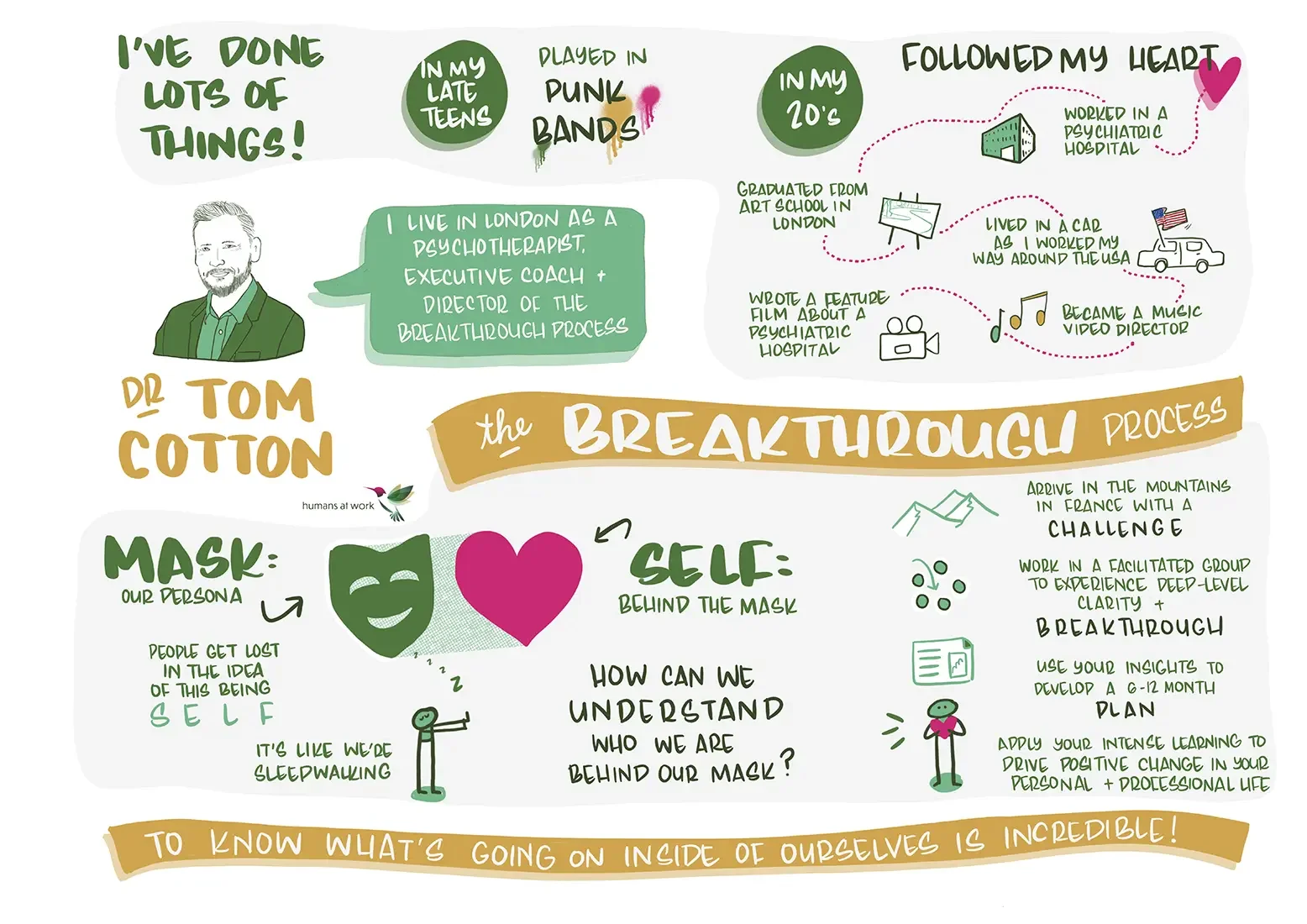
Tom: But at the same time, what tends to happen as humans is the mask, the presentation, we start to get caught up in the idea that the presentation is everything that we are. And that gets very confusing. And so as a psychotherapist and as a leadership coach over the years, I've noticed people get very lost in this idea of, well, what possibly could be more to me than this sort of presentation?
Jules: Kia ora, welcome to Humans at Work, I'm Jules, your host. Thanks for joining me and our latest guest. And thanks for taking some time in your day to indulge your curiosity about other people and their humanness. If your thirst is unquenched after this, check out jericaglobal.com. Now let's begin!
Kia ora everybody. Today I am here with Dr. Tom Cotton. As usual, I'm going to ask Tom to introduce himself, tell us why he's sitting in a boat and where in the world he is. Tom.
Tom: Hi Jules, very nice to be here. I'm not in a boat, I'm in a garden studio in London and it's really blowing a gale outside, it's quite dramatic, but rather lovely to be out in the garden in this weather. So yeah, I'm in Northwest London and so we met, when did we meet? We met in the summer I think.
Jules: Yes we did, yep, in London in a very hot restaurant.
Tom: That's right, yes, that's right, a very hot Japanese restaurant. And so, I guess we first connected over leadership work and sustainability and the kind of exciting developments in entrepreneurship in sustainable business. So, it's an area that we're both really interested in. And I came into that area, I suppose through psychology. So that's sort of the loose umbrella of what I do.
So, I work as a psychotherapist in private practice and work with people one-to-one, sometimes work with couples and families. And then I'm an executive coach. So I work with people in leadership roles. And then I run an organization called the Breakthrough Process and we run a process in a number of different formats, one-day workshops, four-day intensive offsite programs, we have an amazing location in France, and what we do on those programs is we work with mixed groups of people, mostly people in professional roles.
I'm quite often Senior Leadership roles and the programs are a combination of basically all of the things that I do. Wearing all of those hats, so sort of deep dive psychoanalytic psychotherapy, leadership coaching, I work with a wonderful leadership coach called Andy Avaniats.
And in all of those sort of various things that I do, I draw quite heavily on a previous life working as a filmmaker. Actually I started off as a music video director and then I became a feature film writer and I draw very heavily on that kind of past creative experience and incorporate quite a lot of that into our program work but also my one-to-one work.
So, kind of broadly speaking, my niche that I've sort of found, somewhat haphazardly, I think is somewhere between kind of psychology, clinical psychology and leadership. So it's a really interesting place to be.
Jules: And I think the first thing I read of yours after we'd connected was a paper that you'd written about masking, particularly in sort of the professional world. And that really interests me because obviously part of the rationale for Humans at Work as a podcast and one of my later life sort of breakthroughs myself, was around not needing to be somebody else, not needing to mask. And really wanting to support this idea that you can be yourself and still be successful and fulfilled and have amazing jobs and have an amazing impact. And so that's part of the rationale for Humans at Work.
I think I sort of read one of your posts on LinkedIn where you'd been speaking at an event talking about this real problem of masking, particularly for executives and leaderships, where at a certain point in time, the mask becomes too heavy or the dissonance between personal, your personal life and your leadership life is just, is just too much for you to bear.
So, you know, is that one of the things that you focus on in your breakthrough process work and your leadership and psychotherapy work?
Tom: Yeah, so that very much comes into it. That paper that you're referencing is something I wrote with somebody called Adam Rubins, who was the head of European marketing at Disney, at a very young age. And then he went on to become CEO of Waiter Blue, which is an international marketing agency, and he now runs a management consultancy called We Are Ark, I think it's called.
The paper's based on a conversation between the two of us in which Adam is brilliantly open and incisive about his kind of professional journey, which was, pretty early on, by about the time he was sort of 30, he had quite a bad breakdown. And that involved about a year recovering partially in psychiatric hospital. And then he went onto this big role running the International Marketing Agency. And then about another sort of 10 years or so into that, had another breakdown experience.
And Adam came to a few of our leadership forums that we were running during COVID because we couldn't run our programs in France, nobody could travel, so we went online and we didn't attempt to do group work online because it's very difficult to do that. But we ran these really fun leadership forums where a group of leaders who were interested in connecting with similar values and we'd explore a single-word theme every month. And it was great. It was a really, really fun project. And then we'd write the discussion up and what we found.
So, Adam came to a number of those forums and a conversation sort of evolved out of it. We sat down to record the conversation and that became the core of the paper. And so, we've developed a kind of a thesis out of that conversation, is, I mean, none of this is sort of, know, breakthrough kind of scientific thinking or anything like that. But it was really fun kind of working the idea through and seeing where we could get with it.
And out of the research that I did around the subject, I found some things that absolutely fascinated me. So, mask really is another way of looking at Jung's term, Jung, Carl Jung, the analytical psychologist, his way of looking at the idea of persona, which is - we've all got these inner workings which are incredibly complex and most of it's unconscious. We don't know what's going on in there. The words that we're hearing and we're speaking are alluding to all sorts of images and concepts that they're not kind of endogenously in our head, they're conceptual. And so our minds are constantly receiving a baffling array of data. And you can't see all of that inner workings, we can't see it ourselves.
But, the way that we kind of filter all of that is through the notion of Jung's notion of persona, which is we've got to wear something that interacts with the outside world. A mask is another way of looking at a persona. But where my research took me was, I was really fascinated by the kind of the root of the word person in persona. And it actually it has its origin in an ancient Etruscan word called Phersu which means the mask wearer. And so I just became really interested in this idea that rooted at the heart of personhood is mask wearing.
And so how do we navigate this complex reality, which is that we're constantly masked because we need to be, because if you take all of that off and you reveal all the inner workings, it would be complete chaos. But at the same time, what tends to happen as humans is the mask, the presentation, we start to get caught up in the idea that the presentation is everything that we are. And that gets very confusing.
And so, as a psychotherapist and as a leadership coach over the years, I've noticed people get very lost in this idea of, well, what possibly could be more to me than this sort of presentation? And then they don't understand, you know, what's going on in me feels so vastly different from the way that I'm presenting myself.
And so kind of from that notion, we developed this idea, which related very much to Adam's experience, which was, as he put it, the mask that he was wearing, the professional mask, which he kind of eventually came to realize was based sort of quite heavily on his father, which was his idea of a professional man in a kind of a leadership environment, was just so radically different from how he felt inside.
So his kind of leadership presentation was, you know, "I'm serious, I've got authority experience", but how he felt inside was, "I'm absolutely terrified, I'm confused, I've got sort of constant sense of anxiety". And so just sort of building on that idea, we kind of build this thesis, which is, how can we examine our masks? What kind of safe places can we explore what's underneath that? And how can we work with that variance when it kind of starts to shear off so radically that we then start to think, you know, our minds are disintegrating?
And so coming back to your question, sorry, that was a really long-winded response, but on our programs, that's kind of one of the things that we look at is external presentation, whether it's leadership or, you know, whatever our position in life might be that we're trying to focus on. And how does that actually kind of relate to what's going on at depth inside ourselves.
Because when we face a challenge in life, it's not an intellectual challenge. You we normally know the answers to all of our problems like that. You know, we can describe them really quickly. But actually getting it to move and understand what's underpinning it requires going really deep. And so you've got to get in underneath the mask and you've got to do deep level work, is the way that I think of it.
And so our programs, are essentially this very, very intensive, four-day, very safe space, up a mountain, in the middle of nowhere, where we take people on a deep dive journey into who they are and how they operate. And we do that through group work because groups are absolutely kind of fascinating vehicle for surfacing very powerful material. And we use a lot of creative techniques, drawing on my sort of previous life as a filmmaker.
Just, I'll stop waffling on about it, but just to give you a of a really kind of reduced summary of how creativity kind of fits into all of this, is if you get a group of people to sit in a circle and introduce themselves, what all people do, myself included, is you go into a of a CV pitch, you know a one-line summary, your kind of LinkedIn profile or whatever it might be. And we've all said it a thousand times and we're kind of sleepwalking at that point.
But if you get that same group of people and you pose the same question and then you say, draw the response. The first response is everyone says I can't draw, you know, how can I possibly do that? But what happens when you draw a response to something is because most people are bad at drawing and they're really good verbal communicators, because you're not skilled at that medium, in what you communicate something really interesting will come through that's kind of unfiltered and it means that you're already underneath the mask. And it's so uncanny in how powerful it is and how quickly you get there through that vehicle. But also it's fun and it's creative and it's different.
Jules: What would you say is your assessment of success of those programs? So, if one of your potential clients comes to you and says, you know, after my four days in France, what will it mean to me? How would you describe the sort of outcome of that process?
Tom: Hmm, really good points. So the really basic reduced model is we ask people to come up the mountain with a challenge. We'll provide the know-how, the space, the structure for them to experience a breakthrough. And they'll come off the mountain with a plan, for the next one month to five years, depending on the framework that they want to work to.
And then we do one-to-one and group follow-ups to check in with people and see how it's going and to provide support. So that's the sort of, I guess, the basic model of success is, I came with a challenge, I had a breakthrough. In other words, I kind of gained some deep level insight into what is causing this challenge. And based on that breakthrough, I developed a plan that addresses all of the factors that are creating this challenge at the moment, with some tangible next steps, not just kind of ideal next steps based on a kind of an aspiration of what I would like to happen, but based on everything that they've learned on that program. So that's the, sort of, the basics.
But then because what we do is deep, deep level group work, it's often a really intense revelation for the people on the group program that they've had the kind of conversations with other human beings and other people in leadership positions about, you know, this is what you experience too? You know, when you're sitting in a group and you're feeling a kind of a rising sense of anxiety and your throat starts closing up and you know, that kind of thing, that goes on for you as well? because you look so impressive, but actually to know what's going on in you is incredible. And so we dive quite deep into kind of group dynamics and helping people understand what kind of drives group behaviour and organizational behaviour.
So that's the kind of the second point is there's some quite intense learning that when people go back into their organizations and their roles, they bring this incredible insight with them. So that's really exciting.
And then I suppose a sort of a third layer is that people find it, it's difficult to sum it up…when we did a two year follow up on our first programme, there were three comments that I thought were really interesting that attempted to kind of describe the kind of powerful experience that they had. One of them was, somebody said it felt like it was a falling in love experience, working with a group and feeling a really powerful connection with other people. And somebody else said it was a near spiritual experience, and that part of that is, you you're up a mountain, you're hiking up there at dawn, you know, it's incredible. And then somebody else said, it was a little bit like being high on ayahuasca because when you go into that sort of deep level experience you're thinking and feeling things that in the day-to-day you just don't think and feel because you know a lot of the time we're sleepwalking. So a very sort of connected and vital feeling. So that kind of I think sums up the third aspect then what tends to happen is when we catch up with people four months on, four or five months on when we do our group follow-up, it's really interesting how people talk about "I don't know what happened".
One comment sticks in my mind from somebody last year actually, who, she's got a senior position in one of the big tech companies. And she said, I didn't come in looking to change anything with my relationship with my partner, which it could have been better. What I really wanted to work on was leadership stuff and getting more comfortable with my own ego in a leadership position. And I don't know what happened and I don't understand it, but our relationship started getting better and we're communicating much better. And she said, my boss said after about three months, "I don't know what happened to you, but you're suddenly asking much smarter questions, I don't know why", and she said, I don't know why either but I really, kind of, understood what they were saying.
The kind of the longer term effect is also really interesting changes. And I think it's when you go deep and you go deep really quickly, you're working with something very powerful and you kind of get into an area of latent change that we just don't understand. The key thing is obviously if you're to go to that level you have to do it you have to do it safely and that's hugely important.
Jules: I was just thinking about that because I was thinking about my own experience, which I tend to draw on because it's the only one that I really know. When a few years ago, when I had been in a very intensive kind of high, high profile, high-paced leadership role, and I came to the end of a program and I felt really dead inside, you know, sort of that kind of burnt out experience where, you know, who you are, as linked to what you do, feels broken, you know.
Particularly where I think if you're what I would say sort of mid to late mid-career, and you have become defined by what you do, and your success in a professional sense. That if you end up having a break between that connection and your valuing of yourself, you can feel very lost, like you're walking in the wilderness.
And certainly for me, that's how I felt for a while during that process. And it's a very lonely place to be when you're on your own in that, because it does affect all parts of your life, it affected my family life, my life with my friends, my inner dialogue when I was on walks on the beach. Who was I talking to in my mind? All of those things were really significant for me at that time. And what I was thinking about is that, you know, I found my way out of that with hard work and some, you know, flashes of inspiration and deliberately decided at that point that what I did needed to be much more closely aligned to my ethics and my moral compass.
And so that's what led me into entrepreneurship and actually that whole sustainability thing, which you mentioned at the beginning, was that actually having to do that deep work, I realized that it was no longer sustainable for me as an individual to be working on things that weren't aligned to my view of the environment and the future and my concerns about, you know, what was going to happen there.
But that is a very unsafe place to be in if you're on your own. And so I would imagine that having that sort of that group, both the group safety, but also the psychological base behind that, just adds that extra safety net for people who might be used to or, or, know, happy with the idea of leadership support, but actually that deep down emotional or spiritual support is just as important when you're going through those processes.
Tom: Yeah, I agree. And remind me, Jules, what was the role that you were working in that led to that?
Jules: I was a director of an organization-wide change program, so we were redesigning significant parts of a major organization and then taking everybody through a change process. Which resulted in lots of people having their own questions about who am I if my job that I've done for 15, 20 years is now no longer needed.
And so, in that role, what you find is you've got your own weight that you're carrying, but you're also carrying the emotional weight of a whole range of people's reactions to change. And, you know, it was during lockdown, so we were having to do a whole lot of stuff in different ways that we would normally do them, and at a faster pace.
So a whole lot of things that kind of led all to that, but really led to my kind of clarity of thinking that for a lot of people, the job title and the job that they do and the organization they work for is really key to whether they think that they are successful as human beings.
And so that actually, from a personal perspective, what that meant is I ceased to add, to put much value on what I call external success metrics and started to really understand what were my internal success metrics that I was going to use to carry me forward into the sort of the rest of my career and my wider life. That those metrics needed to be things that I truly believed in from an ethical sort of standpoint and an impact standpoint, or else I was going to face that dissonance constantly in my life going forward.
So it was a really significant period of change for me, but I wonder, what I guess what I wonder about for the people who you work with, particularly on these sort of really big, potentially life-changing programs is one of the things that they do is re-imagining what does success look and feel like for me? And how am going to measure the value of my contribution to the world differently? So that I'm not measuring it by those kind of external factors where it's reliant on me carrying that persona or that mask through, but actually instead I find those deeper deeper, more meaningful success metrics that actually go down into what's going on behind the mask.
Tom: Yeah, a good way of putting it. And I think what your question taps into is the fundamental difference between an open group. So people who self-select and go into a group where they're working with other people that they don't know, and a team. So where you're working with a team that has an identity, has a hierarchy that everybody fits into that team in some way and they are invested in that role and identity. And any change to those roles and the dynamic in the team can tap into a huge amount of anxiety.
And when a team goes into a piece of work, they're gonna be invested differently. So it may be that, you know, a tier above in the organization's leadership has said we want to do this work, that piece of change management that you were working on. Some of the people that you were working with would have been very invested in that change process, but maybe some of the other people who weren't going to come out of it so well because in terms of role change, you know, they might have been invested very differently.
And so what's different with an open group is when people self-select, it's because they recognize, I'm at a transition point. And those transition points, I mean, it can be absolutely anything. We've had people who are stepping up in a leadership role. So new level of responsibility. How do I handle that? I've got to kind of drill down on leadership capability and some fundamental stuff that I've got to develop and it's usually around sort of awareness and better communication and that kind of thing. But again, that's a conscious choice. I'm transitioning from one place to another and I'm going to drive this process. But equally, it could be somebody who's transitioning from one organization to another or out of an organization or retiring, or it could be somebody who's looking at a relationship transition.
And so the key thing is I'm recognizing that I'm at a transition point. Something is changing in my life. There's a challenge attached to that and I want to work on that. It's not that my organization says that I need to work on it. Although, of course, that could be a possibility and people do come into the program because it's been recommended by somebody else in the organization. So all of those possibilities, but it's that key sort of contracting point that's the big difference.
And then what people do with that is varied, but yeah, typically it's wanting to kind of get a better understanding of who I am beneath this professional personal relationship identity. So I can start to see more clearly what of the obstacles that are getting in my way, and what's the stuff that I'm not looking at that is actually really powerful opportunity that I just don't, you know, it's literally like a hidden door, I can't see it.
Jules: And so, I mean, I love the idea of you in your kind of, I don't know how old you are, so I'm gonna probably offend you mortally here, but in your eighties or your nineties outfits, directing music videos with punk hair and all that sort of stuff, the kind of thing that I grew up with. And obviously that's where my style was first shaped. So I love the idea of you starting off in that and ending up in, you know, deep, serious, really impactful work.
But I wonder if this idea of storytelling and getting behind the facade is one of the links that has been a common thread through your career in terms of, I mean, when you're doing a music video, you're trying to tell a story, right? You're trying to connect deeply with people. The lyrics or the beat or the visuals somehow draw people in. And they're, in the old, old days, they'd go to a music store and they buy, you know, a single or an album or whatever. These days, it's just, you know, I'll get it free on my, my streaming, my streaming app. But so, so tell me a little bit about storytelling as something that you invest in or that you have utilized throughout your career.
Tom: Good question. Well, to answer your first question, I'm 55. And so I started working as a music video director in my late 20s. But actually, before that, I'd already had probably about 15 different careers before that point anyway. So one of my earliest jobs was working as a scenic artist in the film industry and that was so long ago it was actually on the very first Batman film that came out, at 17 working on that film set which was an incredible experience. And I had thought at that point that I wanted to go into films possibly, but music actually was my first love so I played in a succession of really terrible, noisy punk bands, to your point. And we did a number of tours and played all of the toilets in the north and the south of England. And it was, that was an incredible experience.
But I realized that that wasn't really my metier ultimately, and so I kind of went on a bit of a journey. I was pretty lost actually in my early twenties. And I think I was really sort of following my heart and kind of dominated by, the things that moved me in life. And that was, you know, things like social justice. And I was really sort of influenced by the music that I loved. You know, I guess if you think about it, punk music is very, you know, it's kind of socially aware, politically active music. And all the literature and the films that I loved, that was a new wave of Hollywood. You know, a lot of idealism and kind of radical social thinking. And I was completely lost.
So I went and lived in America for a while, traveling around and working as a kind of an itinerant labourer, it was an incredible experience living in a car for about a year. And I came out of all of this…actually, I forgot to say that before that, I worked in a psychiatric hospital for about a year and a half. And I thought, it really fascinated me. I found it difficult and disturbing, but really powerful. I worked on a locked ward, working with patients who were essentially it was an overflow from one of the secure psychiatric prisons, a place called Rampton, and it was a very intense experience, but such an eye opener.
So I thought at some point I might go into psychiatric nursing or psychiatry, but instead I kind of landed back in film and went to an art school in London called St Martin's. And learned absolutely nothing about filmmaking because they're an art school and they take a very dim view of narrative filmmaking. So I learned nothing about stories or how to tell them, which was a bit frustrating, but it was a great experience and a great group of people and a very inspiring place to be.
And then that's in my second year, I think I got picked up as a music video director, which was, you know, it a real honour actually. And made lots of low budget indie music videos and I thought there was a promising film career ahead of me. But I realised that I wasn't a good kind of mainstream commercials director. I did a little bit of that, but it just wasn't my thing. I'm not good at selling product, I discovered. I knew it before I had the opportunity and messed it up. And really, I was a frustrated storyteller.
And one of the kind of the fun things about music videos is you're trying to create a kind of a world and story to match how music makes you feel. And you look at some of the great music video directors like Michelle Gondry and Spike Jonze. I mean, I'm really sort of speaking from my kind of late 90s perspective. I'm completely out of touch with all the great music video directors now. Jonathan Glazer, who did all of those great Radiohead videos, not all of them, but some of the great ones.
And, you know, it's a real art being able to create a visual world that accompanies a great piece of music. And that really works if you love the music, but if you don't love the music that you're trying to create a world through, it's kind of a bit depressing. I had an epiphany moment in Alexandra Palace at about three o'clock in the morning, and I just realised, I had a crew of about 40 people, and I thought, I don't like what I'm doing, it's a really terrible idea. And I had this moment where the gaffer who's the lighting director said, I've got an idea for the next shot…because I was completely stuck…and I thought that's it. I'm done. I don't know what I'm doing anymore. And that was kind of the beginning of the end, actually.
And then I kind of headed more into feature films. That's where I was always trying to go, and I was very lucky that my first project got picked up by Working Title Films who made all of those great Coen Brothers movies. And then it got stuck in development hell for two years before one of the company founders read it and then said, it's just too weird, we're not gonna make this.
Jules: Aww.
Tom: And it was a sort of semi-autobiographical film about the psychiatric hospital that I'd worked in. I was really interested in this divide between the staff in the hospital who sat on one side of the glass and then the patients on the other. And the conceit of the film was that the staff have much more profound problems than the people they're looking after.
So, I mean, it was a great start in film writing and then I worked on lots of projects after that, and what I started to realise was firstly I'm not sure how natural a filmmaker I am, because it's really hard to tell a nuanced complex interesting story. And my stories always ended up a little bit too sort of convoluted and weird and kind of impressionistic. And I thought it's really difficult to get these projects financed.
But what it did do was, I got more and more, as I tried to become a better writer, I got more and more interested in the psychology of characters and writing and the psychology of change. So what drives change in a story? You know, surprise, surprise, what drives change in a story is what drives change in real life, right? Because we watch stories. Aristotle, the philosopher talked about the process of mimesis. We invest in a story that we're watching and we go on that journey with those characters and we are changed by the change that they go through.
And the more I got into the psychology and the philosophy of story, the more I thought actually where I really want to be spending my time and energy is working with people. And so I came back to it and I did a master's program in psychotherapy and then I did a doctorate program and I got very immersed in research into psychosis. And then ran, my first full-time role in psychotherapy, was running a step-down treatment centre for people experiencing psychosis and drug addiction and forensic clients of people who come out of prison. And it was a very intense and never dull experience.
And we used to like saying that we would have the, all three of the emergency services at our projects at least once a week. The police, normally about two or three times a week. We worked with a very lively bunch of people, so it was never dull. But it was a great sort of starting experience in the world of psychology.
And I suppose sort of back to your point about doing deep work safely, working at that sort of extreme end of the spectrum, I think gave me a really good grounding in working with the depths that we can experience as human beings and how some of it can feel very unsettling. But in working with that, and I suppose with that in myself as well, because that's sort of a key part of the coming to where I've got to professionally, is having to work with difficult stuff within myself…means that you can go there with people and you can experience really quite intense stuff that in most of normal life we shrink away from and we think, I just don't want to go anywhere near that. I know I'm kind of rambling off topic a little bit but I think it's why often we get into such a mess in organizations for example because we build all sorts of defences around going near any kind of tricky, difficult emotion. And I see it so often, it's so hugely unproductive.
So I guess sort of actually coming back to the topic of the breakthrough process and the programs that we run is really sort of creating a structure in which we can say, look, here's all of this unproductive stuff that's getting in the way. How can we break through that in short order in a quick, safe way so we can get to something more productive? So, we can kind of steamroller through all of this stuff that's getting in the way and it's holding you back. How can we do that? So that's essentially what we do, whether that's on an individual basis or working with a group or a team who've got that kind of challenge.
Jules: And so what's the next chapter for Tom, in terms of professional or personal, what's next on your radar in the next year or so?
Tom: Yeah, really interesting question. So we're continuing to offer more of the one day workshops, which are sort of a bit of a kind of a taster experience of how the process works. But it has its own beginning, middle and end. So, people bring a challenge into it and they come out with a plan and some sort of top level insight about what the obstacles are.
More of our four-day programs and we, I think I mentioned the amazing place that we do this in France, which is a privately owned mountain village. And we are going to start running it at a location in Scotland. It's a big kind of stately home, so we've got more space and we can work with more people.
And then more of our entrepreneur programs. So they're one day workshops. But for entrepreneurs who want to get a fresh perspective on life or work challenge and that so it can be a brand refresh or it can be sort of examining a strategy or business plan or it could be a leadership problem or it could be completely sort of personal, you know, I'm burning out, what do I need to do? There's something not quite working, that kind of stuff. Work-life balance, that kind of thing.
And then our Breakthrough for Business initiative, which is really exciting, which is rolling together that intensive breakthrough process with strategic consultancy. So, we're looking at the of the deep level stuff, the top-level stuff. And it's kind of an exciting idea because what we do is we work with the team on a strategic problem, but we take them on a kind of a deep level journey. And in the process, they're working on the strategy, but they're looking at all the underlying things that actually, when you roll out the strategy, they tend to not work because you haven't looked at the of the deeper kind of emotional stuff that is so important to engage with when you actually roll out a strategy. So, we take a team on that deep level journey so they get to look at all of those kind of emotional factors. And where they land at the end is, they've worked on communication so they've sort of cleared a lot of those barriers to communication. And there's a better shared sense of purpose and so therefore uptake is better. And so it's really interesting combining that sort of leadership development with the strategic piece.
So there's all of those things and then we are going to do some more talks and events, which would be great. That was a fun thing that we started doing this year. So, we did an event with TopTier Impact and LSE Generate, their entrepreneur community. And we had a really great panel discussion for people in leadership roles, talking about their experience of some shape or form of burnout or psychological breakdown and how that led to breakthrough. And we had this sort of rather grand vision, which was, let's kind of take that learning and think about how we can apply that to a world that is going through a pretty profound transition point right now. Because it's when you're in that kind of process of something is breaking down that you step out of that kind of sleepwalking mode that you get stuck in, business as usual, this is the way that we do things. All of the assumptions that we carry. And then you've got the opportunity for some really fresh and insightful thinking. So more of those.
Jules: Wow, busy.
Tom: It's quite, yeah, it is quite busy.
Jules: But fun. I think, you know, I find it really interesting that in order to work with people through those processes, you're also working on yourselves all of the time. And I know that's something, you know, when I run some leadership development, targeted leadership development for teams and individuals. And I find it quite fascinating just how hard work it is for the person who's kind of designing and facilitating the leadership development. Cause you're also having to really kind of question and make sure that you're understanding yourself and what you're bringing in terms of biases, or how you can help people through without turning them into clones of yourself and what have you. It's one of those things where actually it's really hard work individually as well as, you know, for the group or the people that you're, you're working with.
So, my last question is really about holidays because I know that you went to the US this year for a holiday. So where is your next place to go for holiday?
Tom: I'm actually going to go to northern Norway for the new year, and if there is not 24-hour cloud cover hopefully we're going to see the northern lights but I've always wanted to go there and never done it before so I'm excited to do that. But I know you asked me where am I about to go, but just coming back to that point about America, there's bits of Northern California that I haven't been to for more than 30 years, which is quite sobering. And it really blew me away being back there. It was quite moving, actually, but it's a really special part of the world. I love it. Do you know that bit, Northern California?
Jules: No, no, I've only been to the US a couple of times and very specifically for conferences actually. And so you end up being, you know, quite limited in what you see and what you experience when you're there. It's one of those places that I've always wanted to go to, but for some reason there's always somewhere else that's first on the list ahead of it.
Tom: Yeah, it's no, you'd love it Jules and when I was there 30 years ago, I was, I got heavily into John Steinbeck and I was reading Steinbeck in Steinbeck country and it was it was weirdly synchronous because I mean, okay, I wasn't from, you know, fleeing the Oklahoma Dust Bowl. Thank God, because that was a kind of the third circle of hell. But I was kind of itinerant and lost and wondering where the hell I was going in life. And, you know, making a fire by the side of the road and cooking food and, you know, really, really basic. And that part of the world is just extraordinary and so reading the Grapes of Wrath and kind of, you know, following the journeys of people who are kind of looking for something better and a way forward. It was really powerful. I've been reading of Mice and Men with my children recently. It's such a great book. God it's such a great book.
Jules: It's good to go back sometimes, isn't it, to the things that are really powerful that maybe you've forgotten and you realize that they're just as powerful today as they were 30 years ago, particularly as we get older, I think. You know, it's actually quite useful to go back and say, well, I might be different and my life might be different, but the meaning's still there.
Tom: Yeah. Yeah. Yeah.
Jules: Well, I know you've got to go and make sure that your kids did actually get into bed as per instruction and expectation. I just wanted to say thank you very much. I mean, when we first connected, I knew that we were going to have a great conversation and we have had a few conversations in between. And I suspect that we will continue as we go through.
Tom: I hope so.
Jules: So thank you very much for your time and your thoughtful description of everything that people are going through. I know we'll put some information up about the breakthrough process and people's ability to connect with you. But on a personal note, I wanted to thank you for your time and great to see you again.
Tom: Well, Jules, lovely to see you and thank you for your time. And really interesting talking and I hope we talk some more because it's been fun and great to see you.
Jules: Thank you so much for listening and thanks, as always, to the generosity of our delightful guests. The stories of how others have faced up to their challenges can help give all of us courage to keep going with our own. For more great episodes, blogs, go to the JERICA Global website.
Humans at Work Podcast